Entertainment
The 10 Most Ambitious Biopics of All Time, Ranked

Honestly, biopics can play things a bit too safe. That’s actually understating things. To push a bit further, the biopic genre might well be the least ambitious and most conventional, at least overall. These are films that focus on one person, or one part of a person’s life, and there’s always an attempt to condense whatever timeframe is focused on down to a manageable two hours or so.
There are countless biopics that play things safe (and some aren’t even that bad while doing so, to be fair), but what’s more interesting are the ones that stand out as riskier and a little bolder. Enter the following ones, which are among the most ambitious biopics of all time, standing out because they’re epic in length/scope, they make some unusual creative choices, they’re visually bold, or maybe even all of the above.
10
‘The Wolf of Wall Street’ (2013)


The Wolf of Wall Street is intentionally chaotic, all to reflect the life of Jordan Belfort, the controversial figure at the film’s center. He doesn’t physically hurt people to the extent that various main characters in Martin Scorsese’s other films do (including some of his non-crime biographical/historical movies, like Raging Bull), but he’s morally questionable – to put it mildly – in other ways.
There are different kinds of harm when it comes to crime, and The Wolf of Wall Street makes this particular strand of white-collar crime look exciting, until it isn’t, but then even after it isn’t, it’s not really punished. Belfort’s benefited from The Wolf of Wall Street, writing the autobiography the film was based on and then getting to cameo in the film itself, so the movie presents itself as something to take into account when looking at Belfort getting away with things. And that it does all that without feeling preachy and while still being enormously entertaining is even more impressive.
9
‘I’m Not There’ (2007)

2024 saw the release of a more conventional Bob Dylan biopic in the form of A Complete Unknown, which does what you’d expect while focusing on the most famous part of Dylan’s career that’s already far from unknown. It’s a safe film, which doesn’t really line up with the always ambitious and sometimes even confounding man himself, which is why 2007’s I’m Not There is kind of the more accurate biopic.
There’s an obvious breaking from reality by having several actors play different versions (or ideas) of Bob Dylan.
It’s more spiritually and thematically accurate, at least, while there’s an obvious breaking from reality by having several actors play different versions (or ideas) of Bob Dylan, reflecting the different personas he’s had throughout his various eras. It’s an approach that would probably also work for David Bowie, if anyone wanted to attempt that. Actually, it could be even more difficult in Bowie’s case (see the documentary Moonage Daydream, which is deliberately fractured and oftentimes overwhelming in its attempts to cover a bit of everything).
8
‘Oppenheimer’ (2023)

If Christopher Nolan continues making movies in the IMAX format, it’s fair to say “Oppenheimer is his longest movie ever,” rather than “Oppenheimer is his longest movie so far.” There’s a three-hour limit to movies made that way, though if technology improves or changes, then that could change things. Hmm. But it’s outside Christopher Nolan’s control, unless he backs away from IMAX, but that feels unlikely after the success of both Oppenheimer and The Odyssey.
All a bit of a tangent there, but the main thing is that Oppenheimer is huge, and it packs a lot into its long runtime, owing to how fast it’s paced and how dense it proves to be. Maybe it’s even a bit much, but the ambition can’t be faulted, with Nolan covering a lot of history, having a ton of characters, and playing around with structure in interesting ways throughout, thanks to the screenplay and editing.
7
‘Amadeus’ (1984)

Amadeus has an emphasis on drama over historical accuracy, with some of it having a basis in history, and other parts being heightened or not really verifiably accurate. It largely takes place in the late 1700s, so that probably makes the approach more forgivable, and then Amadeus also gets away with things because the narrative here – and what it all has to say thematically – proves so compelling.
And then Amadeus stands out from some of the other movies here by having two main characters: Wolfgang Amadeus Mozart and Antonio Salieri, though the latter does recount the events of the narrative from his perspective. It’s about Salieri resenting Mozart, and living in his shadow, all the while having aspirations of being a famed composer but not finding the same success. It’s a loose biopic, if it’s even a biopic at all, but it’s just too impressive and distinct a film to overlook, for present purposes.
6
‘The Irishman’ (2019)

Martin Scorsese was mentioned before, because he directed The Wolf of Wall Street, and he is one of those directors who can make movies about as long as he wants them to be, just from goodwill built up throughout his directing career (see also Christopher Nolan, IMAX time limits aside). The Irishman came out the same decade as The Wolf of Wall Street, and was arguably even more ambitious.
Frank Sheeran is the man at the center of this particular story, with it being about his reflecting on his life of violence (a given if you’re a hitman for the mob) and all the death around him in that time (another given). The ambition here comes from the narrative spanning many years without casting different actors in the roles, and having actors who are getting on in years de-aged. The effects aren’t perfect, but the creative choice is undeniably bold, as is the structure of The Irishman and the phenomenal way it’s edited throughout.
5
‘Better Man’ (2024)

Since the current landscape of music biopics is dominated by fairly bland and/or safe movies like A Complete Unknown and Springsteen: Deliver Me from Nowhere, films like Better Man ought to be celebrated. Specifically, Better Man was regrettably not celebrated at large, since it went above and beyond (or below and beyond?) the majority of box office bombs, since a gross of $22.5 million against a budget of more than $100 million is absolutely disastrous.
That gross does not reflect the quality of the film, though, because Better Man is incredible. If you know nothing about Robbie Williams, that’s okay, because the movie’s about more than just Williams, or maybe it’s accurate to say that it uses the life of Robbie Williams as a springboard to explore surprisingly interesting and intense subject matter. It’s got a lot by way of spectacle, it’s moving at times, and the special effects are flawless. They have to be, because Robbie Williams is depicted as a CGI chimpanzee for the whole movie. Probably should’ve led with that info… that’s the big thing about the movie, and also likely the main reason it cost so much to make.
4
‘Malcolm X’ (1992)

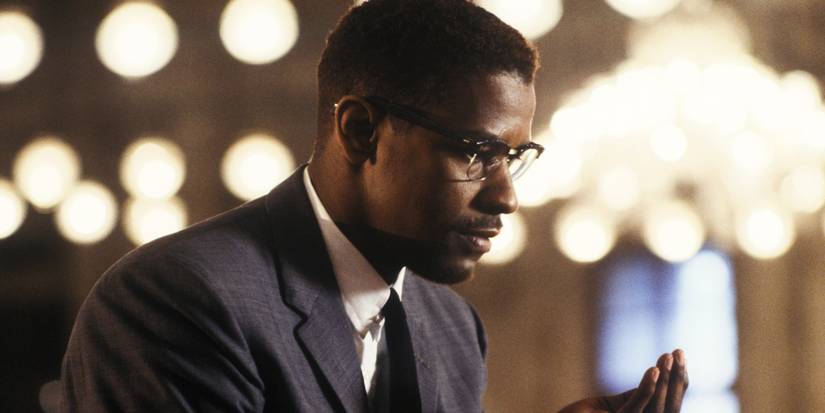
Spike Lee, in general, is a tremendously ambitious filmmaker, and he’s taken various creative swings over the decades, occasionally striking out… but not all that often, considering how prolific he is. And he definitely didn’t strike out with Malcolm X, which is quite comfortably his longest movie, at over three hours, and one of the few biographical movies he’s made, too (BlacKkKlansman is the other major one, though he does have other films that take place in history without necessarily being biopics).
Malcolm X is indeed about the titular man, and it covers his entire life throughout its nearly 3.5-hour-long runtime. Spike Lee infuses the whole thing with many of the stylistic choices found in his non-biographical movies, and so an unconventional portrait of Malcolm X is painted very effectively here, and the film has more than earned its reputation for being one of the best films of its decade.
3
‘Mishima: A Life in Four Chapters’ (1985)

It’s easy to call Mishima: A Life in Four Chapters an arthouse film when so much of it looks like artwork brought to life on the screen, and then part of the film is about art, specifically writing. That’s because the titular Yukio Mishima was partly known for being a writer, and then also known for various other things, including a controversial political activist whose life had a dramatic end in 1970.
You know that’s where Mishima: A Life in Four Chapters is always heading, but the journey there is far from straightforward, since this is a biographical movie that also adapts bits and pieces of Mishima’s writing. It’s like an adaptation, a biopic, and something more abstract all at once, but it’s a difficult film to shake or stop thinking about, once seen, and potentially one of the greatest biopics (or semi-biopics) of all time, too.
2
‘Lawrence of Arabia’ (1962)
One of those classics you can still comfortably recommend to people who might not usually like watching older films, Lawrence of Arabia is bigger and better than the vast majority of biographical movies out there. It’s the gold standard in many ways, although it’s potentially unusual for how little time it covers, because there’s an initial sequence set in 1935, and then the rest of the movie takes place in 1917 through to 1918.
T.E. Lawrence did a lot in that time, though, to put it mildly, so Lawrence of Arabia does feel sufficiently packed with things happening for the entirety of its almost four-hour-long runtime. It’s an effortless watch, and you don’t feel like you’ve spent that much time with it, with Lawrence of Arabia feeling essentially flawless on just about every front.
1
‘Napoleon’ (1927)

Not to be mixed up with the Ridley Scott movie of the same name (even if that one’s admittedly quite ambitious as well), 1927’s Napoleon is wild. Just the fact that it exists is wild. It’s a silent era epic that goes for well over five hours, and it’s only a partial account of Napoleon Bonaparte’s life, since the director, Abel Gance, had planned to make a series of movies that’d ultimately tell the entire life story.
In that sense, Napoleon (1927) had ambition that spanned beyond the film itself. But if you’re only looking at the film that does exist, rather than thinking about what could’ve been, then Napoleon (1927) is still incredibly forward-thinking and adventurous on a technical front, with its camerawork and the famed finale that features a very early cinematic attempt at widescreen. And, again, this film’s more than five hours long. Taking into account all of it being helmed nearly a century ago, it feels difficult to argue that any other biographical film is more ambitious.


Napoleon
- Release Date
-
April 7, 1927
- Runtime
-
330 Minutes
- Director
-
Abel Gance
- Writers
-
Abel Gance
-

Albert Dieudonné
Napoleon Bonaparte
-
Nicolas Roudenko
Napoléon Bonaparte enfante

You must be logged in to post a comment Login