Entertainment
The 25 Best Sci-Fi Movies of the 1990s, Ranked

In the 1990s, the sci-fi genre reached new heights. With the advent of CG-character technology, the tools available for filmmaking increased exponentially. The impossible was now possible, and ideas that were once non-viable in the feature film format were now able to be realized. Of course, technology is only a tool—it can get you so far, but it’s story and character that determine whether a film will stand the test of time. But master filmmakers like James Cameron, Steven Spielberg, Luc Besson, and the Wachowskis seized upon these new opportunities and crafted sci-fi films that would endure for decades.
Of course, the advent of new technology also opened up a wealth of new thematic potential as well. The rise of the digital age gave way to fear of robot uprisings or computers taking over the world, and this resulted in terrific (and terrifying) stories that were relevant to a rapidly changing world. All in all, the ’90s were one of the best decades for sci-fi filmmaking, and in an effort to highlight some of the most memorable films from that period, Collider’s own Haleigh Foutch, Adam Chitwood, and Dave Trumbore have singled out 25 great examples. Behold, the best sci-fi films of the ’90s.
25
‘Screamers’ (1995)


Set against the backdrop of a Cold War on a nuclear war-ravaged planet, Screamers takes a grim and desolate view of the future, focusing on a planet full of soldiers from two sides of the same battle who have been abandoned by their government in the aftermath of war. On the planet Sirius 6B, commanding officer Joe Hendricksson (Peter Weller) sets out to seek peace with his combatants when he learns the truth that Earth has essentially left them for dead on their remote posts. But Sirius 6B is populated by “Screamers,” a form of man-made artificial intelligence weaponry, properly called an Autonomous Mobile Sword (AMS), that evolved beyond what man ever intended. As Hendricksson and his team set out across the wasteland, they face peril at every turn from the various, sometimes deceiving, forms the Screamers have evolved into, and director Christian DuGuary makes fine work of ratcheting up the tension, along with the dramatic stakes, as they make their way towards an uncertain alliance.
The underrated Screamers has some serious sci-fi pedigree, based on a short story by the great Philip K. Dick with a screenplay co-penned by Alien scribe Dan O’Bannon. It never quite lives up to that grand promise, but Screamers is a refreshingly serious-minded spin on what could have easily become a schlocky B-movie that delivers visceral, pulse-pounding thrills every time its titular murder-bots attack. —Haleigh Foutch
24
‘Escape from L.A.’ (1996)

Where Escape from New York was a precisely cut, stylish science fiction classic — politically subversive, serious-minded in its conception, and vibrantly inventive in its imagery — Escape from L.A. seems more purposefully cheeky and cheap. This isn’t to say that the second mission by Snake Pliskin (Kurt Russell) isn’t encoded with John Carpenter’s particular brand of leftist politics, but it’s delivered in a far more bombastic aesthetic, the dark greys and blues of the first film traded in for yellows, oranges, and reds. This is, in a sense, a reflection of the difference between the two cities, but also reflects the mythology of those cities. New York is thought of as a dangerous realm rife with killers, gangs, and violent thieves, whereas Los Angeles is the playground of the blowhards, the covert sadists, the con men, and the self-obsessed.
In a sense, this is a commentary on Carpenter’s arrival in the Hollywood system, far away from his early days as a cult genre filmmaker who had to do some hard-scrapping to get his meager budgets. In Escape from L.A., pitted against a cruel revolutionary who makes himself up like Che Guevara, Pliskin is a man with a name, a celebrity even, brawling and shooting his way out of an island of West Coast maniacs and derelicts, just trying to get a job done. —Chris Cabin
23
‘Stargate’ (1994)


An early work of Roland Emmerich‘s, Stargate is a disaster film that laid the groundwork for the grand-scale sweeping popcorn movies that would come to define his career. The film takes place after the discovery of an extraterrestrial teleportation device that transports matter from Earth to a far-flung alien planet with a distinctly ancient Egyptian flavor. When James Spader‘s Egyptologist Daniel Jackson discovers how it works, he joins Kurt Russell’s military man Jack O’Neill through the portal with a team of soldiers to investigate the planet on the other side. Naturally, once they’re there, everything goes to hell as they come up against the tyrannical sun god Ra (Jaye Davidson).
Emmerich hadn’t yet fully defined his signature style, and it often feels like he’s borrowing moves from familiar playbooks, but the sum of Stargate‘s parts is something that feels wholly his. It can be far-fetched and ridiculous, but part of Emmerich’s greatness is his grandiosity, and the Spader/Russell team-up delivers on its promise of eccentric odd-couple chemistry. It’s a big, boisterous popcorn movie carried by a fantastic leading duo and the emerging outlandish sensibilities of its filmmaker. —Haleigh Foutch
22
‘Tank Girl’ (1995)

Straight up, Tank Girl just isn’t for everybody. It’s cheeky camp to the utmost degree that essentially boils down to a series of strange vignettes and set-pieces that occasionally feel like someone built a film around a string of high-octane music videos. But it’s also fun as hell. A pure product of the MTV generation, the forgotten Tank Girl is like a highly concentrated dose of the alt-rock ’90s, with a pretty jammin’ soundtrack that includes Portishead, Bjork, Hole, Veruca Salt, and Bush.
Based on the comic of the same name by Jamie Hewlett and Alan Martin, Tank Girl stars Lori Petti as the titular smart-mouthed hellion, a flippant, fearless icon of zero-f**ks-given who squares off against the evil Power & Water Corporation in a desert landscape where water has become a commodity so valuable it’s worth killing for. It’s consummately silly, unapologetically so, but it’s made joyfully and without abandon, and if you’re of the right disposition, it’s an absolute delight. —Haleigh Foutch
21
‘The Faculty’ (1998)

Spun from familiar threads of classic sci-fi yarn, The Faculty is a teen movie through and through, but in the hands of director Robert Rodriguez and screenwriter Kevin Williamson, it’s got enough punchy zeal and reverence for the genre it’s playing in to make for a fun, if somewhat silly, pulpy pleasure in its own right. If you’ll allow me to be a bit reductive, The Faculty feels like The Breakfast Club by way of Invasion of the Body Snatchers with a healthy dose of The Thing. The film pits a rag-tag group of teenagers against an alien invasion that turns the infected hosts into a conforming hive mind.
While The Faculty may deal in cliché characters on the surface level — the annoying cheerleader and her quarterback boyfriend, the twerpy smart kid, the slacker genius, the vaguely goth outsider, the too-pure Midwest transplant — it works because they’re all much more interesting than your standard trope fare. The teachers don’t get quite as much of a fair break, but with actors like Robert Patrick, Bebe Neuwirth, and Famke Janssen in the roles, they’re fabulously creepy as they fall one by one to the alien infestation. While teen movies are all too easy to deride, the virulent conformity narrative may have no more natural home than the halls of a high school, and Rodriguez largely steers clear of angst and apathy in favor of a campy, gleeful thrill-ride. —Haleigh Foutch
20
‘Event Horizon’ (1997)
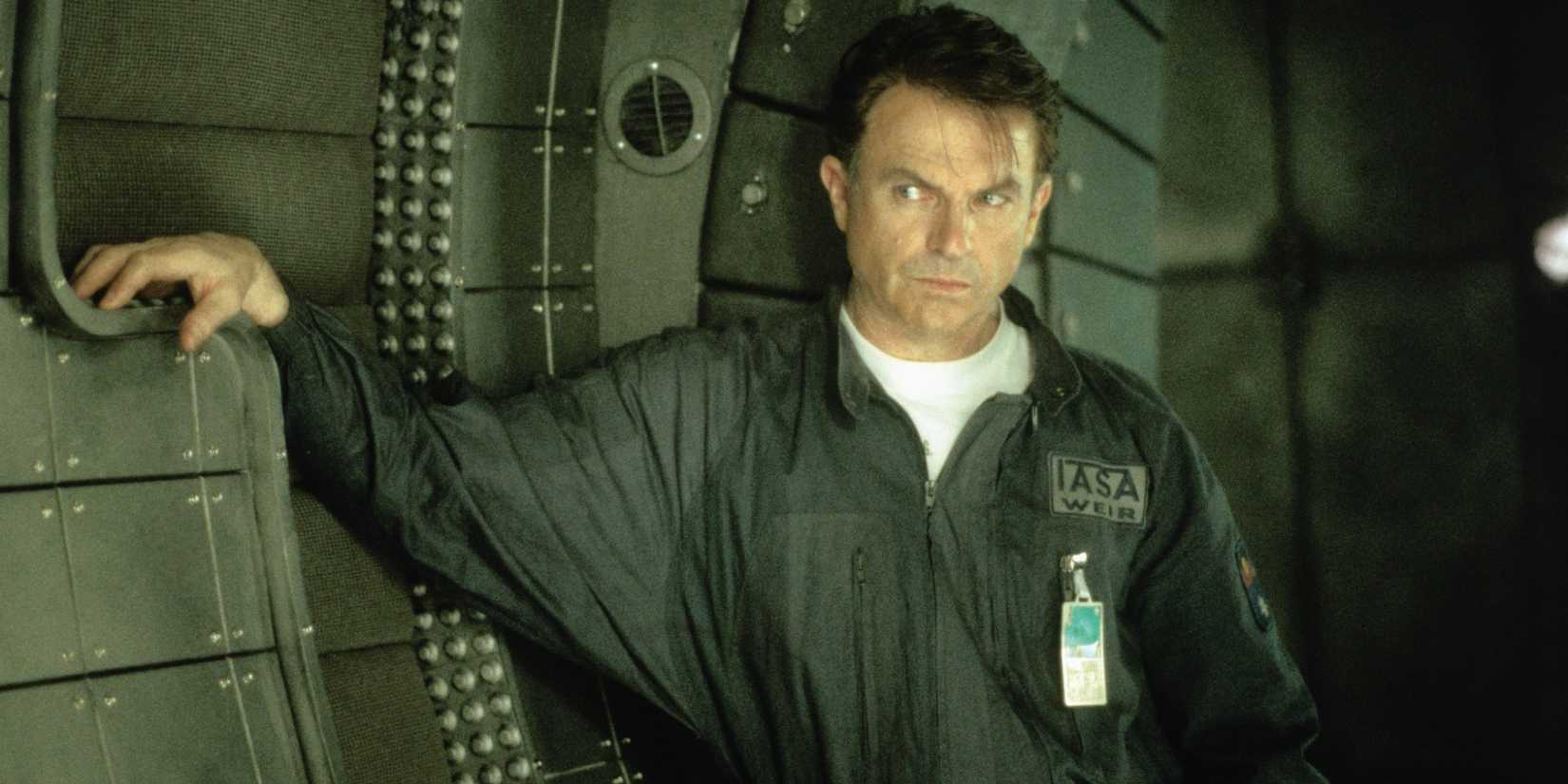
There’s something about Event Horizon that is just downright unsettling and chilling. It’s a complete B-movie, directed by Paul W.S. Anderson of Resident Evil fame, but it also lands on a surprisingly effective tone that somehow wrings out a nightmarish sense of doom amidst the poor character decisions and indulgent flourishes. The story follows Sam Neill as Dr. William Weir, the designer of a groundbreaking space travel vehicle, who journeys into space with a team of military scientists to uncover the cause of a distress beacon. Weir’s great invention was a gravity drive that allows for rapid space travel by creating black holes that close the gap between points in spacetime. But, as always in any good horror sci-fi, that kind of defiance of nature reaps unholy rewards when an evil force consumes the ship, thrusting the rescue crew into the same terror that befell their predecessors.
There’s no doubt that Event Horizon cribs from superior films, and not in a way that feels like homage, but the sense of dread it conjures is a work all its own, punctuated by well-rendered moments of visceral gore and violence, all of it stemming from the natural middle ground where science fiction meets horror. —Haleigh Foutch
19
‘Gremlins 2: The New Batch’ (1990)

Gremlins 2 is a damn delight that may even be better than the original Gremlins, and I will fight anyone who says differently. While the first film was firmly in the horror genre, for the sequel, director Joe Dante wanted to craft a darkly funny satire, and boy did he do just that.
The follow-up takes place in a massive skyscraper in New York City as corporate greed leads to the creation of a hodgepodge of Gremlins (this Key & Peele sketch apparently isn’t too far off). The result is a hilarious, twisted, colorful monster movie with nods to classic films throughout. I get that some may think Gremlins 2 is cheesy or dopey, but Dante was purposefully leaning into the ridiculousness of the conceit, and his willingness to get crazier and crazier as the film rolls on is what makes Gremlins 2 such a joy to behold. —Adam Chitwood
18
‘Mars Attacks!’ (1996)

If Tim Burton is often guilty of style over substance, Mars Attacks! is all style, no substance. The title is literally the plot of the film. Martians show up on Earth. Then they attack. That’s it. That’s the movie. It’s not bad; in fact, it’s pretty fun; it’s just not much. Fortunately, if style’s all you’ve got, Mars Attacks! has got it in spades. A doting spoof and homage to 1950s alien invasion pics, it’s pure B-movie schlock and surprisingly sadistic. As the Martians stage their no-prisoners invasion, Burton relishes finding new ways to dispatch and torment his earthlings, who are played by an impressive cast.
But this movie isn’t about the acting, and most of them end up with not much to do. The political satire is on-the-nose, and the plot… wait, just kidding, there isn’t really a plot, and without a narrative to hold things together, it’s the top-notch production value that ends up being the real star of the film. Spectacle isn’t enough to be great, but in this case, it’s enough to be good enough thanks to how Burton lovingly harkens back to the films that so obviously influenced him as a budding filmmaker. — Haleigh Foutch
17
‘Star Trek VI: The Undiscovered Country’ (1991)

Nicholas Meyer just gets what makes Star Trek tick. The filmmaker behind what’s almost universally considered the greatest Star Trek movie of all time, Star Trek II: The Wrath of Khan, returned to helm another standout installment with Star Trek VI: The Undiscovered Country. The film is essentially a sci-fi murder mystery set against the backdrop of racial tensions and the threat of war that finds Captain Kirk and McCoy wrongfully charged and imprisoned for the murder of the Klingon High Chancellor, while the rest of the Enterprise’s crew rally to rescue them.
It’s a fine send-off for Star Trek‘s original crew, a philosophical and introspective exploration of the series resonant deeper themes that always respects the characters while still delivering the sci-fi spectacle with outstanding effects and clever gadgetry. The Undiscovered Country can feel bloated in parts, but it never overstays its welcome as a well-crafted vehicle for the beloved Enterprise crew and their iconic cast of characters —Haleigh Foutch
16
‘Independence Day’ (1996)

Image via 20th Century Studios
While the sins of the ill-advised sequel may be fresh in our minds, that unfortunate debacle can’t quite dim the shine of Roland Emmerich’s 1996 sci-fi spectacle, Independence Day, which remains a bombastic delight even now. The movie follows three heroes of the alien apocalypse: Will Smith‘s hotshot army pilot Captain Steve Hiller, Jeff Goldblum‘s everyman satellite technician David Levinson, and Bill Pullman‘s Thomas J. Whitmore, president of the United States in the aftermath of a hostile invasion from an unknown alien combatant.
Through the use of miniatures, Emmerich crafted enormous effects set-pieces, sending the world’s iconic landmarks up in flames and billowing plumes of smoke. But unlike a lot of Emmerich’s inferior works, Independence Day delivers characters as entertaining as the explosions, making for a blockbuster disaster adventure that has genuine charm and humor along with its kaboom-ing excess. —Haleigh Foutch
You must be logged in to post a comment Login