Entertainment
The 6 Best International Films of the 2020s So Far, Ranked

One of the easiest ways to waste this decade of movies is to let language decide what gets watched. Seriously. Some of the sharpest romances, ugliest moral questions, strangest mysteries, and most devastating family stories since 2020 have arrived from outside Hollywood, and several of them make the usual awards-season prestige movie feel painfully safe by comparison. Subtitles are doing a lot less work than the filmmakers are.
And these six are miles apart from one another. That range is exactly why international cinema feels so alive right now. And while I don’t plan to jump into this one in the list below, if you’re interested in Bollywood movies, don’t miss Main Vaapas Aunga if it’s available to stream in your region. But let’s get to proper international releases of the 2020s so far, and here are six of them, ranked.
6
‘The Worst Person in the World’ (2021)


Julie (Renate Reinsve) keeps changing her mind about what her life is supposed to look like. Medicine becomes psychology, psychology becomes photography, relationships shift, and adulthood keeps arriving without providing the certainty everybody promised it would. The Worst Person in the World divides that mess into twelve chapters, plus a prologue and epilogue, without pretending Julie’s contradictions can be tidied into a simple coming-of-age lesson.
The famous sequence where Oslo appears to freeze while Julie runs across the city toward Eivind (Herbert Nordrum) captures the movie beautifully. It is romantic, selfish, impulsive, and completely understandable at the same time. Her relationship with older comic-book artist Aksel (Anders Danielsen Lie) carries a different weight because love and compatibility gradually stop meaning the same thing. Joachim Trier lets Julie be funny, frustrating, affectionate, avoidant, and occasionally awful without turning her into a problem the screenplay needs to solve. That honesty is why the movie connects so strongly with anyone who has ever reached adulthood and thought, wait, this is the part where I am supposed to know what I am doing?
5
‘Decision to Leave’ (2022)

Detective Hae-jun (Park Hae-il) investigates the death of a man who fell from a mountain, and the dead man’s widow, Seo-rae (Tang Wei), quickly becomes the person he cannot stop observing. Decision to Leave begins as a murder investigation and gradually becomes something much stranger, where surveillance starts resembling intimacy and professional curiosity becomes nearly impossible to separate from attraction.
Park Chan-wook makes that obsession tactile. Hae-jun watches Seo-rae from across the city and mentally places himself beside her. Translation apps become part of flirtation because language itself keeps creating tiny distances between them. Mountains, fog, wallpaper patterns, photographs, and the sea keep sliding into the mystery without feeling like clues placed there for a clever reveal. Even Hae-jun’s insomnia becomes useful because this is a man already accustomed to living slightly outside ordinary life. The romance is sexy precisely because it is so restrained. Nobody needs to tear their clothes off for the room to feel dangerous.
4
‘I’m Still Here’ (2024)

Before politics crashes through the front door, the Paiva household feels wonderfully alive. Children run in and out, friends visit, music plays, people argue, the beach is nearby, and family photographs keep capturing ordinary happiness. Then Rubens Paiva (Selton Mello) is taken away by agents of Brazil’s military dictatorship, and I’m Still Here stays with the wife and children who are expected to continue living while the state refuses to tell them what happened.
Eunice Paiva (Fernanda Torres) becomes the center without being transformed into some clean inspirational symbol. She has children to protect, questions nobody will answer, money to think about, and the maddening requirement to remain functional while government intimidation keeps invading private life. Walter Salles makes the earlier warmth essential because the loss is measured against all those noisy dinners and casual afternoons that came before it. The family camera becomes especially affecting for that reason. Pictures keep insisting these people had whole lives outside the political violence inflicted on them. That is what makes the film hurt. History arrives in textbooks as dates and regimes. Here, it enters a house and leaves an empty chair.
3
‘Anatomy of a Fall’ (2023)

Samuel (Samuel Theis) is found dead beneath the family’s Alpine home, and suspicion lands on his wife, Sandra Voyter (Sandra Hüller). From there, Anatomy of a Fall does something far more interesting than asking whether she pushed him. Their marriage gets hauled into court, translated into arguments, recordings, resentments, career jealousy, parenting decisions, and fragments that suddenly have to mean something definitive to strangers.
The details are painfully specific. Samuel had been blasting an instrumental version of 50 Cent’s “P.I.M.P.” before his death, and the song later becomes part of the courtroom’s attempt to reconstruct the atmosphere inside the house. A recorded marital argument is dissected as if one ugly conversation can explain years between two people. Their visually impaired son Daniel (Milo Machado-Graner) is forced to process his parents through testimony he was never supposed to hear, while Snoop the dog somehow becomes involved in one of the film’s most tense stretches. The genius of the movie is how quickly curiosity becomes judgment. You start weighing evidence like a juror, then realize how absurdly confident people become when handed incomplete access to somebody else’s marriage.
2
‘The Zone of Interest’ (2023)

Rudolf Höss (Christian Friedel) lives with his wife Hedwig (Sandra Hüller) and their children in a comfortable home with a garden, servants, flowers, a swimming area, and Auschwitz on the other side of the wall. The Zone of Interest understands that showing less can force the viewer to confront more. The family treats the camp as workplace, neighbor, and source of opportunity while screams, gunshots, machinery, and trains continue beyond their domestic routine.
That separation is horrifying because the Höss family is not shown behaving as if they inhabit a horror film. Hedwig is proud of the life they have built. Children play. Clothes are tried on. Plants are discussed. Work promotions create family complications. Meanwhile, the soundtrack keeps telling you what their comfort requires. Jonathan Glazer refuses the relief of allowing atrocity to become spectacle you can look at and then emotionally file away. The garden is beautiful. That is the problem. The wall is right there. They know exactly what is behind it, and breakfast still needs to be served. Few films this decade have made ordinary domestic behavior feel so morally sickening.
1
‘Drive My Car’ (2021)

Yūsuke Kafuku (Hidetoshi Nishijima) is a theater actor and director carrying a complicated grief when he travels to Hiroshima to stage Uncle Vanya. Festival rules require him to use a driver, so the beloved red Saab 900 he normally drives himself is handed over to Misaki Watari (Tōko Miura), a quiet young woman with her own history of loss. Drive My Car runs for almost three hours and somehow makes long drives, cassette recordings, rehearsals, and pauses in conversation feel more gripping than plenty of thrillers.
The theatrical process is fascinating in itself. Kafuku casts performers speaking different languages, including Japanese, Mandarin, Korean Sign Language, and others, then has them repeat Chekhov’s text almost mechanically until meaning begins emerging through rhythm rather than theatrical flourish. Outside rehearsal, Oto’s recorded voice continues reading lines through the Saab’s speakers, meaning Kafuku literally drives around with the voice of his dead wife occupying the empty seat beside him. Misaki gradually becomes the one person who can share that silence without trying to fix him. Ryusuke Hamaguchi never rushes their connection because grief does not operate on screenplay time. When Drive My Car finally opens emotionally, it feels enormous precisely because the film spent so long listening first.

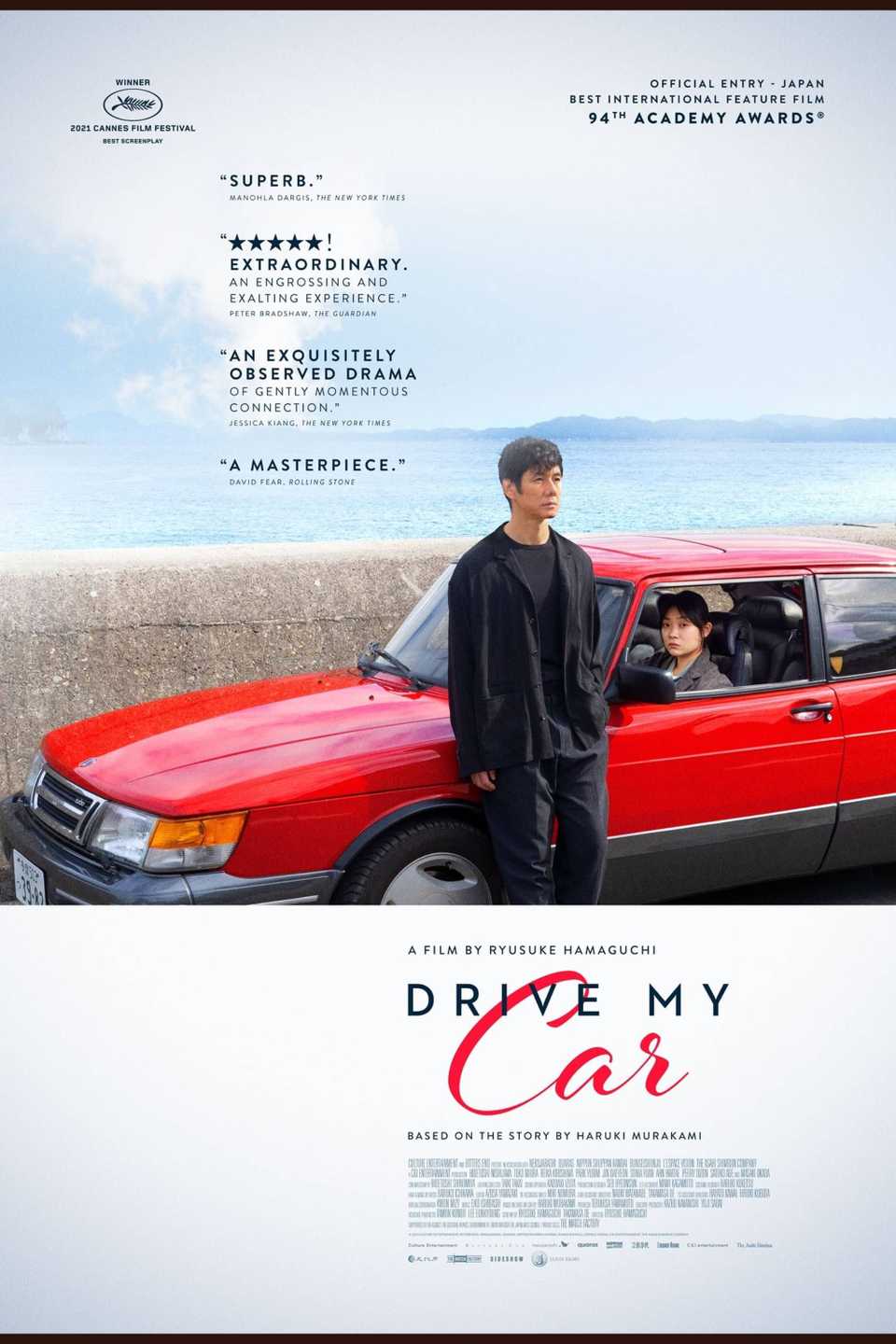
Drive My Car
- Release Date
-
November 24, 2021
- Runtime
-
179 minutes
- Director
-
Ryusuke Hamaguchi
- Writers
-
Takamasa Oe, Ryusuke Hamaguchi


You must be logged in to post a comment Login