Entertainment
The 8 Most Fun Musical Movies of All Time, Ranked

Musical is one of Hollywood’s oldest genres. For a musical to be truly fun, it needs to do more than simply have good songs. The best ones create a sense of freedom where characters can suddenly burst into song and dance through the streets. Whether they are romantic, funny, or completely over-the-top, the best musicals understand that they have to immerse the audience in their world. They invite us to enjoy the music and start moving, but also to get swept up in the emotions.
Here, we put together musicals that bring the most entertaining time. From classic musicals from the 1960s to contemporary 2020s film, these movies are not afraid to go for broke and deliver a jolly good time. They remind us that sometimes the best musical is simply the one that leaves you smiling, humming the soundtrack, and wanting to watch it all over again.
8
‘Om Shanti Om’ (2007)


Om Shanti Om first begins in the 1970s, following Om Prakash Makhija (Shah Rukh Khan), a junior film artist who is killed when he tries to protect the famous leading actress Shanti (Deepika Padukone) from a studio fire that took her life. Om is then reincarnated decades later as a successful Bollywood star. With memories of his past life, he seeks to expose that Shanti’s death was not an accident and confront the killer.
If Hollywood tentpoles tend to have massive action set pieces in them, Bollywood ultra-big productions have elaborate musical numbers and over-the-top, dramatic storytelling. Om Shanti Om has all that, while also paying homage to the country’s long cinema history. The film keeps on escalating, even after the shift in the second half, where the film focuses on Om’s new self. The musical numbers are electrifying and intricate, and they’re inseparable from the plot. Even the final confrontation with the villain is through a song. Shah Rukh Khan’s performance as both the earnest struggling actor and the ridiculous superstar gives the film an enormous amount of comedic energy, while Deepika Padukone’s feature film debut catapults her into superstardom. If you’re new to Indian cinema, this is the perfect gateway to start.
7
‘Funny Girl’ (1968)

.jpg?q=49&fit=crop&w=825&dpr=2)
Funny Girl follows Fanny Brice (Barbra Streisand), a talented young woman from New York who dreams of becoming a performer despite not looking like a typical stage star. Her determination eventually gets her noticed, and she moves from small-time performer to major Broadway celebrity, becoming one of the stars of the Ziegfeld Follies. As she rises, she has to balance her professional success with her personal life.
The obvious reason Funny Girl is so much fun is Barbra Streisand, who originated the role on stage. Her comic timing, singing voice, and charisma are perfect for this film. Songs such as “Don’t Rain on My Parade” and “I’m the Greatest Star” are huge musical showcases, but they are further elevated by Streisand’s personality. The Ziegfeld Follies sequences also give the movie the old-fashioned glamour of classic Broadway. Directed by William Wyler, who did Ben-Hur and Roman Holiday, the film is a major success, with eight Oscar nominations and one win for Streisand.
6
‘In the Heights’ (2021)

Set in Washington Heights, In the Heights centers on Usnavi (Anthony Ramos), a young bodega owner who dreams of returning to the Dominican Republic, while his friend Benny (Corey Hawkins) hopes to build a life with Usnavi’s cousin Nina (Leslie Grace). Usnavi is enamored with Vanessa (Melissa Barrera) who dreams of becoming a fashion designer. As a heat wave hits the neighborhood and the possibility of winning a lottery ticket emerges, the characters have to confront what they actually want from their futures.
Adapted from the Broadway show written by Lin-Manuel Miranda, the film successfully transports the energy of the play to the film. Right from the very beginning, it grabs you with energetic songs and choreography, as well as its characters. Director Jon M. Chu turns rooftops, streets, swimming pools, subway stations, and even walls to create musical numbers that feel magical. The Latin and hip-hop influences also give the soundtrack a much more contemporary energy than many traditional Hollywood musicals. Hamilton alum Anthony Ramos brings charisma and warmth to Usnavi, while the rest of the ensemble that makes the Heights feel like a genuine community. It’s definitely one of the best musical films released in recent memory.
5
‘La La Land’ (2016)

La La Land follows Mia (Emma Stone), an aspiring actress trying to reach her dreams, and Sebastian (Ryan Gosling), a passionate jazz pianist who dreams of opening his own club. They meet and eventually fall in love and begin supporting each other’s ambitions. As Mia’s acting career develops and Sebastian gets opportunities to pursue his musical dreams, however, their relationship becomes complicated by their different paths.
La La Land is so fun because of how it turns ordinary, familiar life into giant musical numbers. The opening highway sequence immediately establishes the film’s joyful sense of movement. Ryan Gosling and Emma Stone also make the movie enjoyable because their chemistry has been battle-tested through numerous other movies, so it just feels cozy to see them on screen. At the same time, the film’s homage to old Hollywood musicals gives it a wonderfully romantic visual style while still creating its own language. The film’s extended musical number at the end is a lovely and heartbreaking sequence that is true to the film’s theme of chasing our dreams. With its 10th anniversary this year, there is no better time to revisit this film.
4
‘The Young Girls of Rochefort’ (1967)

The Young Girls of Rochefort follows twin sisters Delphine (Catherine Deneuve) and Solange (Françoise Dorléac), two talented young women living in the seaside town of Rochefort who are both dreaming of leaving for Paris and finding love. Delphine is a dancer and Solange is a musician, and they are hired as carnival singers. There, they find colorful characters in town, and also what they’re looking for.
Jacques Demy made several legendary musicals in his career, and The Young Girls of Rochefort is one of them. Demy’s colorful and bright style turns Rochefort into a magical place, filled with pastel buildings and brightly colored costumes. The catchy songs paired with elaborate choreography make the film a grand time to watch. Added with Michel Legrand’s score gives the whole film an infectious sense of movement. Deneuve and Dorléac are particularly charming as the sisters, and the combination of French musical romance with a distinctly Hollywood-inspired style makes the film feel both familiar and unusual. This masterpiece of a musical is often overlooked because of Demy’s other masterpiece, The Umbrellas of Cherbourg, but it is still a 10/10 film.
3
‘Singin’ in the Rain’ (1952)

Singin’ in the Rain follows silent-film star Don Lockwood (Gene Kelly), his best friend Cosmo Brown (Donald O’Connor), and aspiring actress Kathy Selden (Debbie Reynolds) as Hollywood makes the transition from silent movies to talking pictures. Don’s latest film becomes a disaster when audiences discover that his co-star has an unbearable voice. With the studio desperate to save its expensive production, Don, Cosmo, and Kathy come up with the idea of transforming the film into a musical.
Singin’ in the Rain remains one of the easiest musicals to simply have a great time watching. The movie is packed with extraordinary dance sequences, genuinely funny comedy, infectious songs, and a level of physical performance that makes almost every scene entertaining. Gene Kelly’s famous rain dance is obviously the centerpiece, but the film has several other spectacular moments. Kelly, O’Connor, and Reynolds have an easy chemistry makes the film effortlessly fun. Its story that chronicles Hollywood’s transition to talkies makes it a must-see for cinephiles as well.
2
‘Mamma Mia!’ (2008)
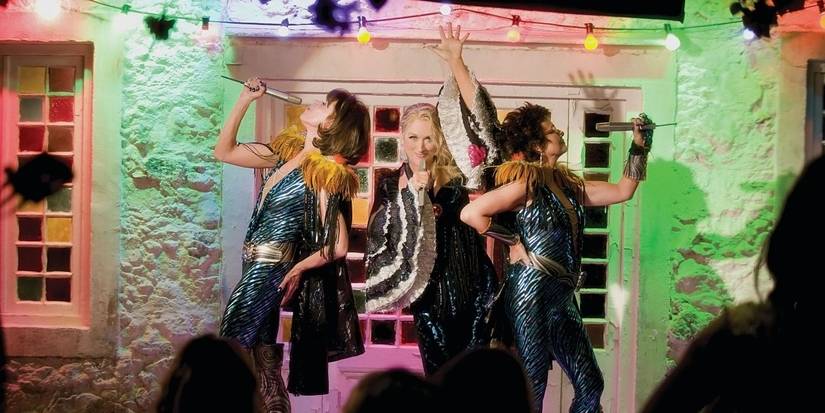
Mamma Mia! follows Sophie (Amanda Seyfried) who is preparing to marry her fiancé and she wants her father to walk her down the aisle. However, she has never met her father and has discovered that three different men could potentially be him. Without telling her mother Donna (Meryl Streep), Sophie invites all three men to the wedding, setting off a chaotic reunion between her mom and the three men.
With the story constructed around the immensely catchy ABBA songbook, Mamma Mia! is simply a joy to watch. From its beautiful Greek setting, comedic moments and colorful ensemble cast, the film invites the audience to sing along. Led by the energetic Amanda Seyfried and Meryl Streep, hit songs like Dancing Queen and Super Trouper become huge communal experiences. The commitment from all the cast, including Pierce Brosnan, Colin Firth and Stellan Skarsgård, only triples the fun. It’s silly and absurd but it is never boring. This enjoyable musical is followed by an equally beloved sequel, Mamma Mia: Here We Go Again.
1
‘The Sound of Music’ (1965)

The Sound of Music follows Maria (Julie Andrews), a spirited young woman who leaves the convent to become the governess of the seven children of Captain Georg von Trapp (Christopher Plummer). The captain’s strict nature makes it difficult for Maria, but still, she brings music and playfulness back into the household, especially for the children.
The Sound of Music is one of the most important and iconic musicals in Hollywood. The songs are instantly memorable, but more importantly, they are woven into the plot in ways that make the film feel constantly energetic and alive. “Do-Re-Mi” turns a musical lesson into a playful family excursion and “My Favorite Things” transforms anxiety into comfort. They are timeless songs that can also function outside of the musical. Julie Andrews gives Maria an infectious warmth makes the movie thoroughly engaging for audiences of all ages. Even with its darker historical material, the film remains remarkably cheerful, colorful, romantic, and funny. It is the gold standard of musicals.


The Sound of Music
- Release Date
-
March 2, 1965
- Runtime
-
174 minutes
- Director
-
Robert Wise
- Writers
-
Ernest Lehman, Howard Lindsay, Russel Crouse
You must be logged in to post a comment Login