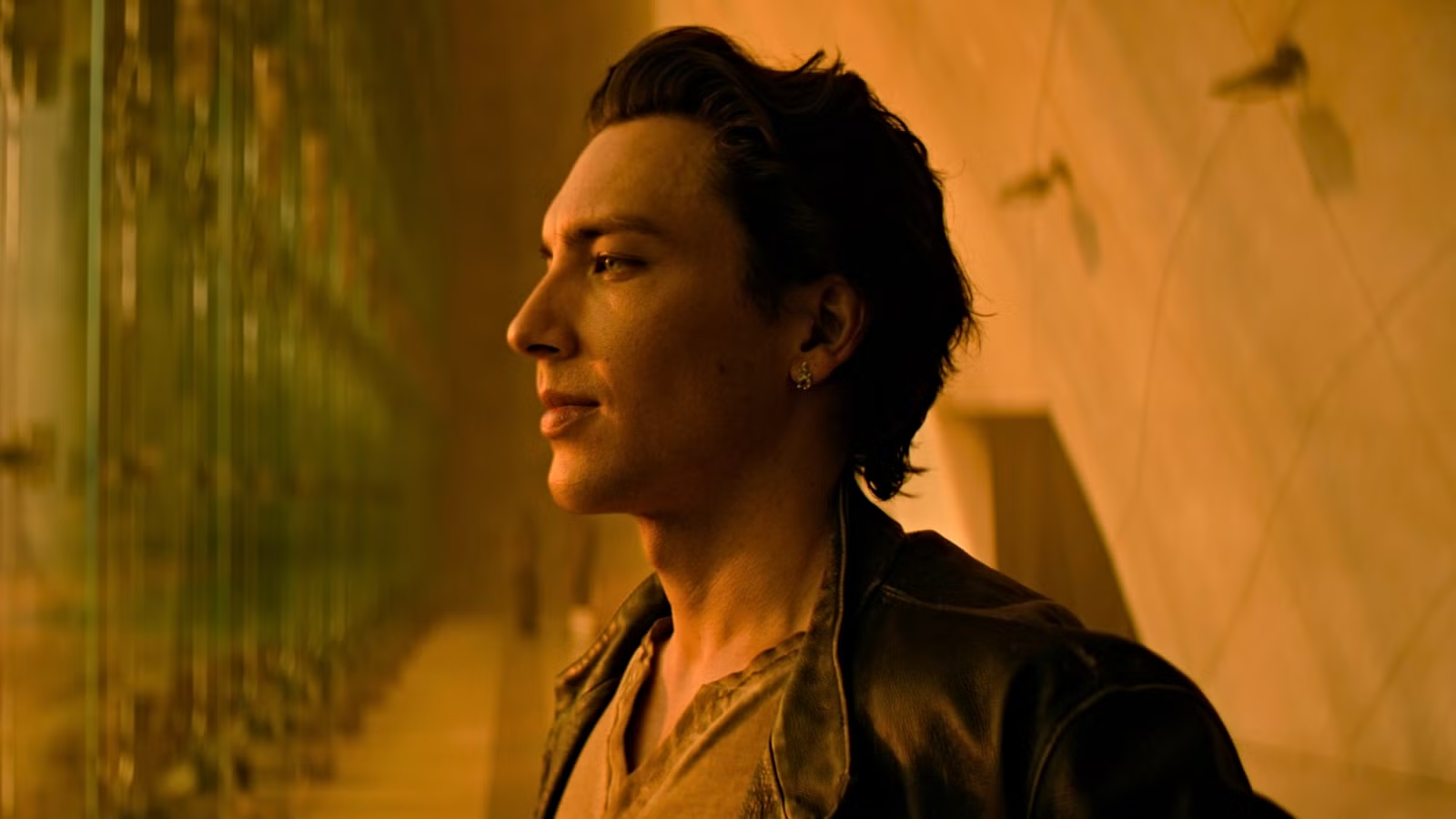
Cody Fern in Foundation Season 3Image via Apple TV
Every streaming platform has plenty of sci-fi shows to offer, but it’s hard to beat Apple TV’s offering of original sci-fi programming. The platform got its start with more light-hearted hits like Ted Lasso, but it’s become more famous for shows like Severance, Invasion, and even Pluribus. Severance has aired two successful seasons to date, while Invasion recently wrapped up with its third and likely final season. Pluribus, which comes from creator Vince Gilligan, took the crown from Severance to become the most-watched Apple TV sci-fi show of all time. Apple did release a sci-fi misfire a few years ago with Constellation, which was one of the few shows to be canned after one season. This came despite praise from legendary author Stephen King.
Many would argue that the most underrated Apple TV sci-fi show is Foundation, which is a complex saga of humans living throughout the galaxy under the rule of the Galactic Empire. The series features big stars like Jared Harris and Lee Pace, and it recently aired its third season last summer. Apple TV renewed Foundation for a fourth season, but it’s still unclear at this time when the show will be released or when it plans to resume production. Although it’s been months since Foundation went off the air, the show is still hanging around in the Apple TV top 10 in several countries around the world. Foundation was written and created for TV by David S. Goyer and Josh Friedman, and it’s based on the series of novels by Isaac Asimov. The show holds scores of 87% from critics and 73% from audiences on Rotten Tomatoes.
This week, X marks the spot. Eight conspiratorial questions to see if you’re a real X-Files fan… or if you’re an alien posing as an agent.
Advertisement
What Else Is Streaming on Apple TV Right Now?
The most popular series on Apple TV is another of its wildly underrated sci-fi ventures, Monarch: Legacy of Monsters. The shows stars father-son duo Wyatt Russell and Kurt Russell as young and old versions of the same character, and it’s directly connected to HBO’s MonsterVerse franchise. To reach the top spot, Monarch had to dethrone Hijack, the thriller show starring Idris Elba that just wrapped up its sophomore season. The most popular movie on Apple TV right now is F1, the Best Picture-nominated blockbuster starring Brad Pitt. It briefly lost the crown to Eternity (Elizabeth Olsen) before gaining it back last week.
Check out all three seasons of Foundation on Apple TV, and stay tuned to Collider for more streaming updates and coverage of Season 4.
Advertisement
Advertisement
Release Date
September 23, 2021
Network
Apple TV+
Advertisement
Showrunner
David S. Goyer
Advertisement
Directors
Alex Graves, Roxann Dawson, Jennifer Phang, Mark Tonderai, Andrew Bernstein
Writers
Advertisement
Jane Espenson, Leigh Dana Jackson, Liz Phang, Eric Carrasco, David Kob, Addie Manis, Marcus Gardley, Lauren Bello, Olivia Purnell
Starfleet Academy is a show that has pretty shamelessly been relying on older Star Trek shows to tell new stories. Accordingly, one of the biggest criticisms of this new spinoff is that it doesn’t have that many ideas of its own. After all, the most memorable episodes of the season serve as fairly shameless sequels to beloved episodes of Deep Space Nine and Voyager.
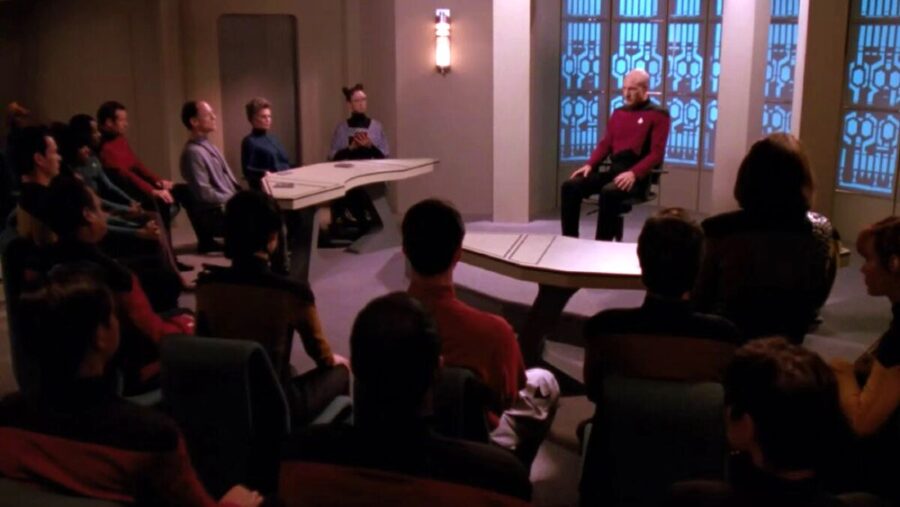
However, the Season 1 finale “Rubincon” finally put a new spin on an old trope. Among other things, this episode extensively relied on a trial, and such courtroom drama was a staple of the Golden Age of the franchise (especially in The Next Generation). However, Starfleet Academy puts its own spin on this ancient trope by using the trial less to explore ethical conundrums and more to explore simmering character conflict.
Star Trek: Law & Order
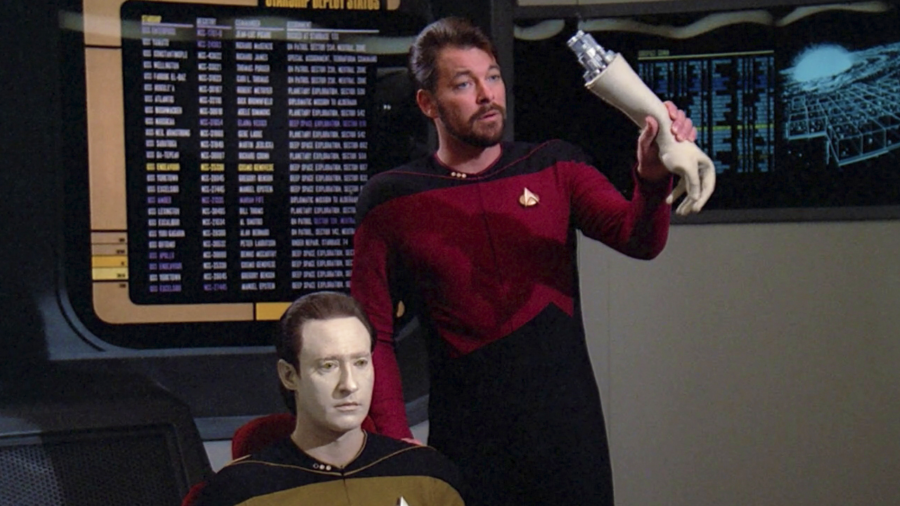
So, when did trial episodes become a staple of Star Trek? There have been some judicious flirtations as early as The Original Series, like when Captain Kirk memorably faced court-martial. Arguably, though, this trope didn’t become something Star Trek was famous for until The Next Generation. This was a show where Data had to fight in court to be seen as a person and not a toaster, and Picard had to give a speech about freedom vs. security to a crazy admiral. Speaking of Picard, he also began TNG and ended TNG the same way: by testifying on humanity’s behalf in front of an omnipotent imp of a judge.
Star Trek: The Next Generation established a core aspect of these trials early on: rather than exploring characters, the courtroom drama was used to explore ideas. In “The Measure of a Man,” the fans at home already believe that Data should be treated like a human, so nobody watching is likely to have their beliefs about this character changed by testimony. Instead, we are here to enjoy the crunchy philosophical question at the heart of the episode: “how do we de define life in the far future?”
The Trial Never Ended, Picard
Similarly, “The Drumhead” is about an overzealous admiral investigating suspected sabotage aboard the Enterprise, eventually investigating Captain Picard himself in her mad urge to root out suspected traitors. As viewers, we are primed to believe Geordi La Forge and Data when they report that the explosion that triggered the investigation was just an accident. What we’re here to see is the episode’s exploration of a question that once vexed Benjamin Franklin: “is better security really worth sacrificing all of our personal liberties?”
This trend continued into other Trek shows: in Voyager, for example, Voyager’s “Death Wish” explores the morality of assisted suicide. However, the Starfleet Academy Season 1 finale “Rubincon” changed the formula up by having supervillain Nus Braka put the Federation itself on trial. His old nemesis, Captain Ake, basically represented the defense, while Anisha Mir (also Ake’s old nemesis) gets to play judge, jury, and executioner.
Advertisement
Putting The Federation On Trial
What made this episode different is that there wasn’t really any underlying philosophical question being explored. Nominally, viewers might briefly consider the validity of Nus Braka’s claims, but “briefly” is the keyword here: no Star Trek fans watching think the franchise’s latest spinoff will suddenly make the Federation the bad guys; instead, the trial is mostly a vector for Nus Braka’s megalomania and an excuse to have actor Paul Giamatti chew all the scenery in the quadrant. Beyond that, though, the courtroom drama is a vessel for something that used to be verboten under Trek creator Gene Roddenberry: juicy, juicy character conflict.
After all, the trial is the only place the show allows Anisha Mir to unload on Captain Ake, accusing the Starfleet officer of unfairly imprisoning her and separating her from her son. Meanwhile, Ake gets to explain how the other woman was an accessory to a pretty brutal murder. Along the way, she gets to dismantle Nus Braka’s sad backstory: he claims the Federation destroyed his home colony, but she proves his father did it through what the Picard show might frame as “sheer f*cking hubris.”
The Girls Are Fighting
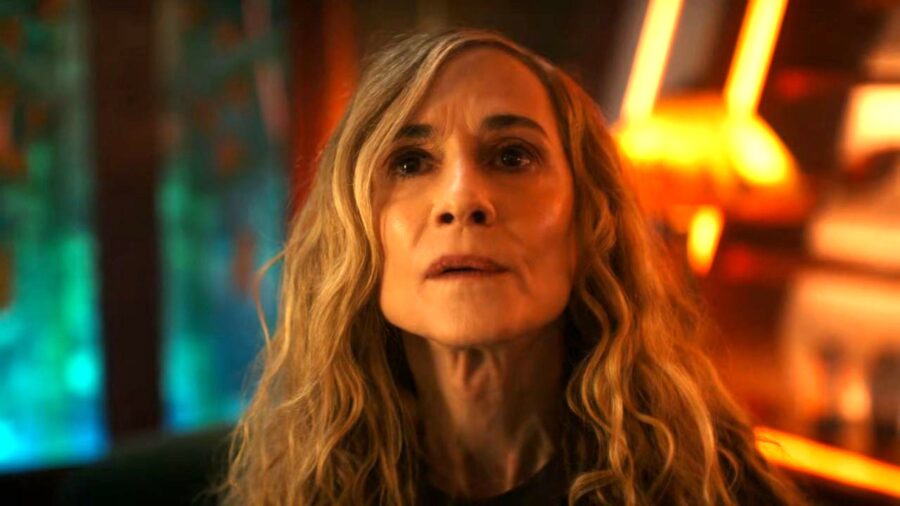
Fortunately, the character conflict is quite juicy: both Holly Hunter and Tatiana Maslany are great actors, and it’s cool seeing them square off against each other onscreen in such a powerful way. Giamatti, arguably the show’s finest actor, gets to serve as a chaos agent, stirring the pot whenever things start to calm down. The result is scene after scene of captivating tension that furthers our understanding of these three characters and their relationship.
That doesn’t make these scenes perfect, of course: in my review of “Rubincon,” I noted how the mock trial is arguably the worst part of the episode. This is true on a storytelling level because Ake is really just buying time before the inevitable Starfleet rescue and equally inevitable happy ending. But everybody watches Star Trek for different reasons, and if you like seeing actors bring out the best in each other (a pretty darn good reason to tune in), it’s tough to beat these courtroom scenes.
If nothing else, Starfleet Academy deserves credit for proving that you can teach an old Targ new tricks: the show might still lean a little too heavily on the Star Trek tropes of yesteryear, but this season finale reveals that the writers are learning to do something new with them. Plus, the worst thing about this episode is three of television’s best actors giving it their all for the better part of an hour. If that’s the worst “Rubincon” had to offer, that’s a surefire sign of a good story!
Intergenerational showbiz comedy Hackshas been a hit for HBO since its premiere in 2021, but all good things must come to an end. That includes the misadventures of veteran comedienne Deborah Vance (Jean Smart) and Ava Daniels (Hannah Einbinder), her initially reluctant joke writer. Collider’s Steve Weintraub caught up with Einbinder at South by Southwest, where her new film, Seekers of Infinite Love, will make its debut.
Einbinder confirms that the series has completed its fifth and final season, as of two weeks ago: “We’ve wrapped.” Although she was initially cagey over whether this will truly be the end, she eventually confirmed that this is indeed the show’s swan song:
“I don’t know? I think so. Look, I… Yes, okay? Yes. I don’t know what I’m supposed to say and not say. One time, I said the wrong thing, and then we took it back. But it was real then, and it’s real now. So yeah, it is the last season, okay? And I bet that’s true and out there. I bet it’s out there because multiple people asked me today, but I don’t know. But I do, and it is! I’m sorry. F***.”
She also teased that the final season will have the same magic that earned the show a devoted audience and an Emmy win for Outstanding Comedy Series.
Advertisement
“It’s the Hacks special, baby. You’re going to laugh. You’re going to cry. There’s going to be wigs, and the girls are there. It’s going to be great.”
The final season of Hacks will premiere later this year.
What Is ‘Seekers of Infinite Love’?
Griffin Gluck, John Reynolds, Hannah Einbinder, and Justin Theroux in Seekers of Infinite LoveImage via SXSW
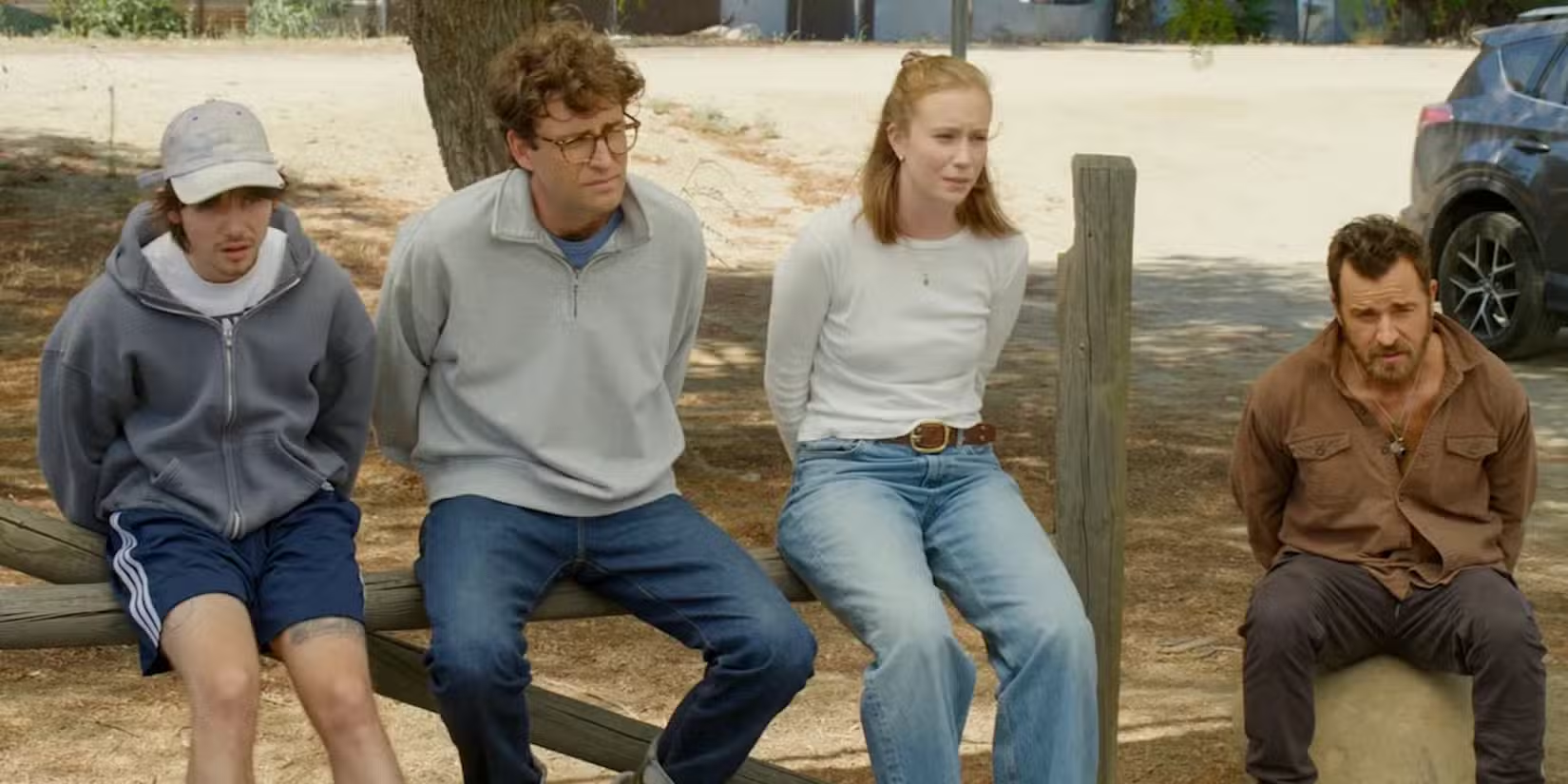
Three mismatched siblings — struggling author Kayla (Einbinder), a lawyer and wannabe folk singer Zach (John Reynolds, Search Party), and Wes (Griffin Gluck, American Vandal), a graphic novelist with addiction issues — go on a road trip to rescue their wayward sister, Scarlett (Justine Lupe, Succession), from a cult, with an alleged cult deprogrammer (Justin Theroux, Muholland Drive) in tow. The film is directed by Victoria Strouse; it is her debut feature, but she has written films like Finding Dory, Let It Snow, and Family Switch. In addition to starring, Einbinder also executive produces the film.
Advertisement
Einbinder is also set to star in Teenage Sex and Death at Camp Miasma, a new horror film from I Saw the TV Glow‘s Jane Schoenbrun. She’ll star as a queer film-maker who teams up with a reclusive actress (Gillian Anderson) to helm a new entry in a long-running slasher franchise.
The fifth and final season of Hacks will premiere on HBO Max in 2026. Stay tuned to Collider for future updates.
Advertisement
Advertisement
Release Date
2021 – 2026-00-00
Network
Advertisement
HBO Max, Max
Showrunner
Lucia Aniello
Advertisement
Directors
Desiree Akhavan
Advertisement
Writers
Pat Regan, Ariel Karlin, Carol Leifer, Joe Mande, Guy Branum, Andrew Law, Samantha Riley
The highest honor that a filmmaker can possibly aspire to is a Best Director Academy Award. Handed out since the very first Oscars in 1929, nominations for this highly coveted award have gone to several of the greatest movie directors the art form has ever had. Much more often than not, a Best Directing nomination comes with at least a few other nods in different categories—including, quite often, Best Picture. Seven noteworthy times in history, however, that wasn’t the case. On these seven occasions, the only Oscar nod a film received was Best Directing.
The reason why this phenomenon is so rare is that it’s almost impossible to conceive a film that the Academy deems worthy of a nomination in what’s arguably the second most prestigious prize of the night, but not in any other category. The directors who have attained such an honor, however, are among the most important filmmakers in history. From David Lynch to Martin Scorsese, they’re directors so strong that the Academy looked at their movies and decided their work was so great that it deserved a Directing nod, even if they didn’t deem the film worthy of any more recognition. They are presented in chronological order.
Advertisement
7
‘The Inn of the Sixth Happiness’ (1958) — Mark Robson
Image via 20th Century Studios
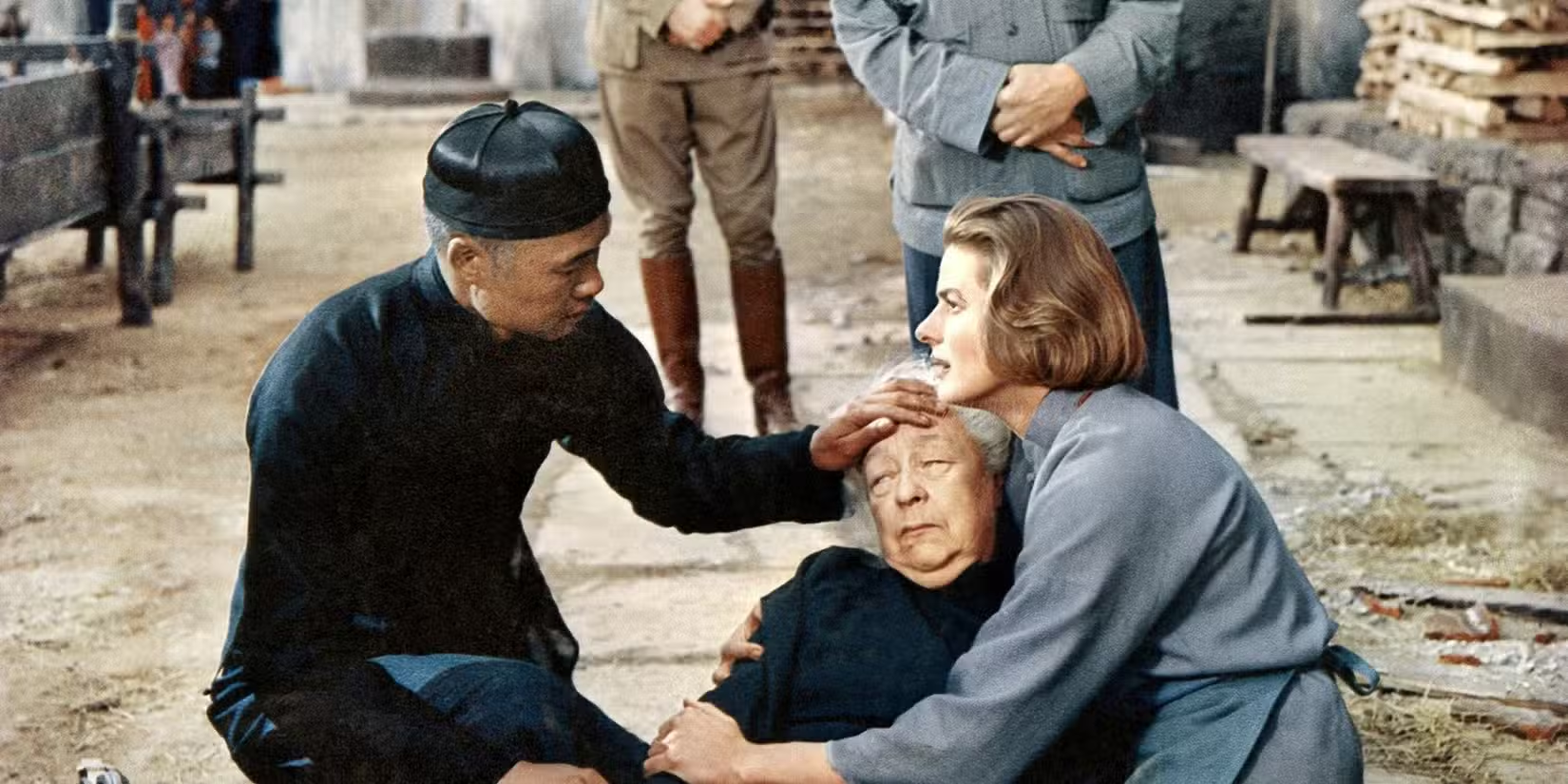
The first time that a movie’s sole nomination was for Best Directing was in 1959, when Mark Robson received the second Oscar nomination of his career, for The Inn of the Sixth Happiness. This was only a year after he had received his first nomination, for the crime drama Peyton Place. As for The Inn, it’s a biopic starring Ingrid Bergman as Gladys Aylward, a British evangelical missionary who ran an inn for traveling merchants in China during the tumultuous years leading up to WWII.
It was only Robson who received a nomination, with the DGA having been the only precursor award he’d been nominated for beforehand.
Advertisement
Though terribly underappreciated nowadays, this is one of Ingrid Bergman’s most essential movies, where she delivers a phenomenal performance that was nominated for a BAFTA and a Golden Globe. When it came time for the Oscars, however, it was only Robson who received a nomination, with the DGA having been the only precursor award he’d been nominated for beforehand. It was a perfectly well-deserved nomination, too. Robson bring a dramatic, moving tone to this sweeping historical epic, which doesn’t have a single dead spot throughout its nearly 3-hour runtime.
6
‘Alice’s Restaurant’ (1969) — Arthur Penn
Image via United Artists
Advertisement
Alice’s Restaurant is an adaptation of the 1967 folk song “Alice’s Restaurant Massacree” by Arlo Guthrie. Movie adaptations of singular songs aren’t exactly typical, but this dramedy (in which Guthrie stars as himself) shines thanks to its uniqueness. It follows a bohemian musician who, after dumping trash in the bottom of a ravine, gets arrested for littering and is sent on a bizarre journey. It’s a simple, laid-back, countercultural gem that’s kind of like if Easy Rider went easier on the sociopolitics and much heavier on the vibes.
Some have criticized the film for being a bit too politically lukewarm, but it’s such a warm, funny, and welcoming slice-of-life flick that it’s impossible to hate it outright. The Academy certainly didn’t hate it, as director Arthur Penn was Oscar-nominated without having been a part of any precursors. This was his third Oscar nomination after The Miracle Worker in 1963 and Bonnie and Clyde in 1968. Penn’s direction is a complex balancing act of charming humor and countercultural melancholy, a balancing act that he admirably succeeds at. His direction is far and away the most brilliant part of this rather imperfect film, and as such, his Oscar nod was nothing to complain about.
5
‘Fellini Satyricon’ (1969) — Federico Fellini
Image via United Artists
Advertisement
There has never been an Italian filmmaker more popular, important, or groundbreaking than the great Federico Fellini. Studying his filmography is the best possible way of learning about the trajectory of 20th-century Italian cinema: The auteur began his career as an essential voice in the Italian Neorealist movement, and one can track the country’s move away from that tradition by tracking Fellini’s shift toward more subjective, psychologically personal cinema. By the time he made Fellini Satyricon, the director had already moved as far away from any kind of neorealist aesthetic current as he could possibly get.
Lavish and hedonistic, this episodic series of disjointed mythological tales set in 1st-century Rome is one of Fellini’s most divisive yet audacious works. Precursors didn’t adore Satyricon, but some of them certainly recognized it (it received a Best Foreign Language Film Golden Globe nomination). When the Oscars came, however, it was only Fellini’s brilliance that received recognition. It’s not like anyone’s complaining: This was a well-earned nomination for an artist that was nominated for 12 Oscars throughout his career (but never won), for a film that presents some of the most adventurous, visually striking, and artistically confident direction of any ’60s motion picture.
4
‘Blue Velvet’ (1986) — David Lynch
It was incredibly divisive among critics and audiences alike when it originally came out, but today, David Lynch‘s cult classic Blue Velvetis recognized by many as one of the greatest movie masterpieces of the 20th century. The late David Lynch was a genius madman with a camera, an easy choice for the title of “most important surrealist filmmaker of modern times.” For this sexually-charged neo-noir masterpiece, some started seeing Lynch as a master of subversive cinema, while others heavily criticized how explicit his work was. In the end, though, after a pretty decent run throughout the 1986-87 awards season, Lynch made it all the way to his second Best Directing nomination, and third Oscar nod overall.
Advertisement
Blue Velvet may have been controversial back in ’86, but with the years’ passage, this Oscar nomination has come to age as one of the most inspired and satisfying of the decade. Erotic, sensual, intense, and as perfectly dreamlike as the rest of Lynch’s filmography, Blue Velvet is a nearly faultless example of what the work of an auteur in full control of his craft looks like. The way Lynch pushes both the characters and the audience to constantly shocking—but never exploitative—places was more than enough to make him worthy of that Oscar nod.
3
‘The Last Temptation of Christ’ (1988) — Martin Scorsese
Willem Dafoe as Jesus in The Last Temptation of ChristImage via Universal Pictures
There are those who would refer to Martin Scorsese as the single greatest living filmmaker, and no one would blame them. He’s made several of the greatest films in history, but like any great director worth their salt, his career hasn’t been without its fair share of controversy. There’s really not much of a question as to what Scorsese’s most controversial picture is: That title would have to go to The Last Temptation of Christ. This religious drama penned by frequent Scorsese collaborator Paul Schrader was based on the equally-controversial novel by Nikos Kazantzakis, and is a fictional exploration of the spiritual conflict of Jesus’ human side. Despite the “fictional” part, however, various Christian groups across the world attacked and boycotted the movie, calling it blasphemous.
Advertisement
With time, that rage has cooled down and cinephiles have come to appreciate this criminally underrated gem as what it is: One of Scorsese’s biggest masterpieces and greatest epics. Despite all the controversy and no significant precursors to his name, Scorsese obtained the Best Directing Oscar nod. The decision has aged beautifully. Meditatively paced and shockingly powerful (both intellectually and emotionally), Last Temptation offers some of Scorsese’s strongest 20th-century work. His direction has arguably aged even better than that of the 1989 Oscar winner, The Last Emperor‘s Bernardo Bertolucci.
2
‘Short Cuts’ (1993) — Robert Altman
Image via Fine Line Features
Robert Altman was one of the greatest and most important voices of the New Hollywood film movement, offering some of the era’s most subversive and brilliantly satirical films, often with huge ensemble casts. He kept doing terrific work for the rest of his career, too, which obviously includes the ’90s. His best film of that decade? There’s hardly any question about it: It has to be Short Cuts, an anthology movie inspired by nine short stories and a poem by Raymond Carver.
Advertisement
The movie was a tragic box office flop, but it performed wonderfully with critics, who labeled it a beautifully complex ensemble piece. For his flawless balance between humor and emotion, his ability to keep the story engaging throughout every second of the 189-minute runtime, and the fact that he pulled equally-exceptional performances out of every actor in his star-studded cast, Altman made his way to the fourth Best Directing (and fifth overall) Oscar nomination of his career, following a decent precursor run. It’s easily one of the best films of this masterful director’s career; so, if anything, it deserved even more Oscar nominations.
1
‘Mulholland Drive’ (2001) — David Lynch
Los Angeles palm trees dissolve into Betty (Naomi Watts) in Mulholland Drive.Image via Universal Pictures
Who else but David Lynch could possibly be deserving of the honor of being the sole recipient of an Oscar nomination for one of his films twice? In all fairness, as one of the greatest films of not just the 21st century, but of all time, Mulholland Drivedeserved many nominations on top of Best Directing. At a minimum, Best Picture, Best Actress for both Naomi Watts and Laura Harring, Best Supporting Actor for Justin Theroux, and a Best Screenplay nod for one of the best scripts of the 2000s would have been in order. But it’s a tried-and-true sad fact of life that the Academy doesn’t always get things right (particularly when it comes to arthouse and surrealist films), so a Best Directing nomination is better than nothing.
Advertisement
It also couldn’t have happened for a more deserving directing work. Mulholland Drive is widely praised as Lynch’s best film, and as such, as the best directing work of his career. What starts out as a quirky, melodramatic, mysterious critique of the Hollywood Dream slowly starts transforming into a waking nightmare, and Lynch handles that transition like a pro. Dreamlike, thought-provoking, and full of fascinating symbolism and imagery, Mulholland Drive has aged as the greatest film of 2001 by a decent margin. No shade to Ron Howard or A Beautiful Mind, but this would have been remembered as a far stronger and more satisfying Best Picture and Best Directing recipient.
Starfleet Academy had a satisfying Season 1 finale, but as I watched, I kept asking myself a blunt question: “why do I like this so much?” Sure, the episode was free of many things I hated from earlier stories, including the vulgar slang and potty humor of earlier episodes. It also focused on drama and characterization instead of terrible comedy, which is a major improvement over the first half of the season. Still, I couldn’t shake the feeling that something else made this episode infinitely better than most of what had come before.
That’s when it hit me: it was the characters. Or, more precisely, the lack of characters: thanks to the season finale’s premise, several characters are left out of the episode altogether, and other characters who appear are sidelined in favor of focusing on a few key storylines. The result was that this episode (“Rubincon”) is a shining example of what this new Star Trek series is capable of. But it’s also proof of a simple fact: Starfleet Academy has way too many characters, and it needs to let some of them go in order to become a successful show.
A Seriously Crowded Cast
Starfleet Academy has, to put it mildly, a huge cast of characters. There are 11 main characters who are prominently featured in almost every episode. For comparison, Star Trek: The Next Generation started with nine main characters, but this included Tasha Yar, who died midway through Season 1. It also includes Wil Wheaton, who left after Season 4. This means that for just a little under half of its iconic run, TNG sported only seven main characters, which made it easy for episodes to focus on the entire cast.
In case you’re wondering, Star Trek: The Original Series had only eight main characters. Deep Space Nine had nine main characters, and that’s counting Worf, who joined in Season 4. Voyager also held steady at nine main characters, eventually substituting Kes for Seven of Nine. At 11 main characters, Starfleet Academy is obviously overcrowded by the standards of the franchise, and its limited number of episodes per season keeps us from getting to know everyone.
Time Is The Fire In Which We All Stream
Star Trek: Discovery began what would become a fairly depressing trend with NuTrek shows: a limited number of episodes per season. While the so-called Golden Age of Star Trek had 26 episodes per season, shows like Starfleet Academy only get 10 episodes per season. That means that even if SFA gets four full seasons (a goal that seems increasingly difficult to meet), it will end with fewer episodes than Voyager got in only two seasons!
That’s important because, each season, Starfleet Academy only gets 10 episodes to develop its 11 main characters. There’s just not enough time to do so, and some characters really get the short end of the stick. For example, Genesis is the only cadet who doesn’t get a solo episode devoted to her; the closest thing she gets is a side story with Caleb, where we learn that her dark secret is that her previous instructors thought she would never be a good captain.
Advertisement
The Season 1 finale puts her in the captain’s chair, but she inexplicably doesn’t get to do anything notable while she’s in command except announce that she has to pee. Unfortunately, this lack of resolving her story highlights a big problem with Genesis: because she’s also a highly driven, Type A overachiever, she is often written as “Darem with boobs.” But Darem got his own episode, a romantic subplot, and a special effects-heavy sequence where he saved the ship; comparatively, Genesis got absolutely nothing, making her character feel weirdly redundant.
Main Character Syndrome
Given the limited number of episodes and the outsized number of lead actors, it’s also bizarre how much screen time Starfleet Academy devotes to supporting characters. We got entire episodes focused on stories with the War College and its frosty chancellor, only for them to all disappear from the narrative in the last two episodes. We also get a lot of screentime dedicated to weird comic relief characters, including Tarima’s beta brother and that one cadet who swallowed her comm badge.
Compounding this is the fact that Caleb Mir is undeniably the main character of Starfleet Academy’s first season. This isn’t inherently a bad thing: Caleb has proven to be a very compelling character, and actor Sandro Rosta has the charisma and magnetic screen presence of a leading man. But every moment spent developing Caleb is a moment not spent developing anyone else. This is to the show’s detriment, but the Caleb focus of season finale “Rubicon” revealed the easiest way to improve Starfleet Academy: namely, Paramount needs to thin this cast out!
Less Is More
The Starfleet Academy Season 1 finale, “Rubincon,” had a reduced number of characters for a simple reason: the previous episode had most of the minor and some of the major characters stuck inside Federation space when supervillain Nus Braka trapped everyone there with futuristic mines. Lura Thok (the half-Klingon, half-Jem’hadar) was trapped back home, as was Admiral Vance. Similarly, Chancellor Kelrec and the rest of his War College brute squad were stuck inside Fed space.
This left us with a streamlined crew of cadets, and the show wasn’t afraid to sideline a few of them, too: as mentioned before, poor Genesis doesn’t get to do much more than look pretty and sit in the captain’s chair. Darem, meanwhile, gets to do even less. But as a result, everyone else gets to shine: Chancellor Ake gets to dramatically defend Federation honor during a show trial, the Doctor saves the ship, and Kraag saves the Doctor. Caleb gets to save his biological mother and his surrogate mother, all while cementing his relationship with Tarima, who uses their newfound bond to help locate the bad guys and ultimately save the day.
That was all it took for Starfleet Academy to shine: by giving fewer characters the spotlight, it made it easier to develop everyone else while delivering a tight and compelling episode of Star Trek. This new spinoff has already shot its second season, and superfans are crossing their fingers that this won’t be the last voyage for these plucky cadets. But for this futuristic show to survive, it will need to take a cue from the past. Namely, ditching some of these main characters, occasionally sidelining others, and doing what The Next Generation always did so well: focusing on just one or two characters per episode, ultimately giving everyone a chance to shine.
In recent years, there have been several movies about the origins of popular American products. Apple released a film about Beanie Babies a few years ago, which means that we can probably expect a film about Labubus soon. Hulu released a movie about Cheetos, titled Flamin’ Hot, while Jerry Seinfeld directed an absurdist comedy about Pop-Tarts for Netflix, titled Unfrosted. This year, John Cena will star in The Matchbox Movie, which was probably green-lit because of the culture-defining success of Greta Gerwig‘s Barbie. This trend began a decade ago, with a movie that traced the origins of McDonald’s. Unlike Barbie, which positioned itself as a feminist fable, or even Flamin’ Hot, which highlighted the contributions of the immigrant population, the McDonald’s movie had fewer layers than a Big Mac. It was, quite literally, about how an ambitious businessman took a mom-and-pop operation and turned it into a massive corporation. The ambitious businessman was, in fact, the protagonist of the story and not the villain.
The businessman was played by Michael Keaton, who had been freshly nominated for an Oscar for his performance in Birdman. The film also featured Nick Offerman and John Carroll Lynch as brothers Richard McDonald and Maurice McDonald, who created an assembly line of sorts that significantly reduced the time it took to cook burgers. Impressed by their operation, salesman Ray Kroc (Keaton) urged them to create franchises before buying them out some years later. The movie was directed by John Lee Hancock, who previously made the war film The Alamo, and has since directed the “copaganda” movie The Highwaymen and the Se7en rip-off The Little Things.
Plenty of movies were based on plays. So whip out your program and find your seat because the quiz curtain is about to rise.
Advertisement
Here’s the Pro-Capitalism Movie that Netflix Has Blocked for Capitalist Reasons
The movie in question is The Founder, which grossed $24 million worldwide against a reported budget of $25 million. It earned solid reviews and is now sitting at a “Certified Fresh” 80% score on the aggregator website Rotten Tomatoes. The website’s consensus reads, “The Founder puts Michael Keaton’s magnetic performance at the center of a smart, satisfying biopic that traces the rise of one of America’s most influential businessmen — and the birth of one of its most far-reaching industries.” The movie also featured B.J. Novak, Laura Dern, and Linda Cardellini. However, it is among the 140 titles that Netflix has restricted access to this month for subscribers to its ad-supported tier.
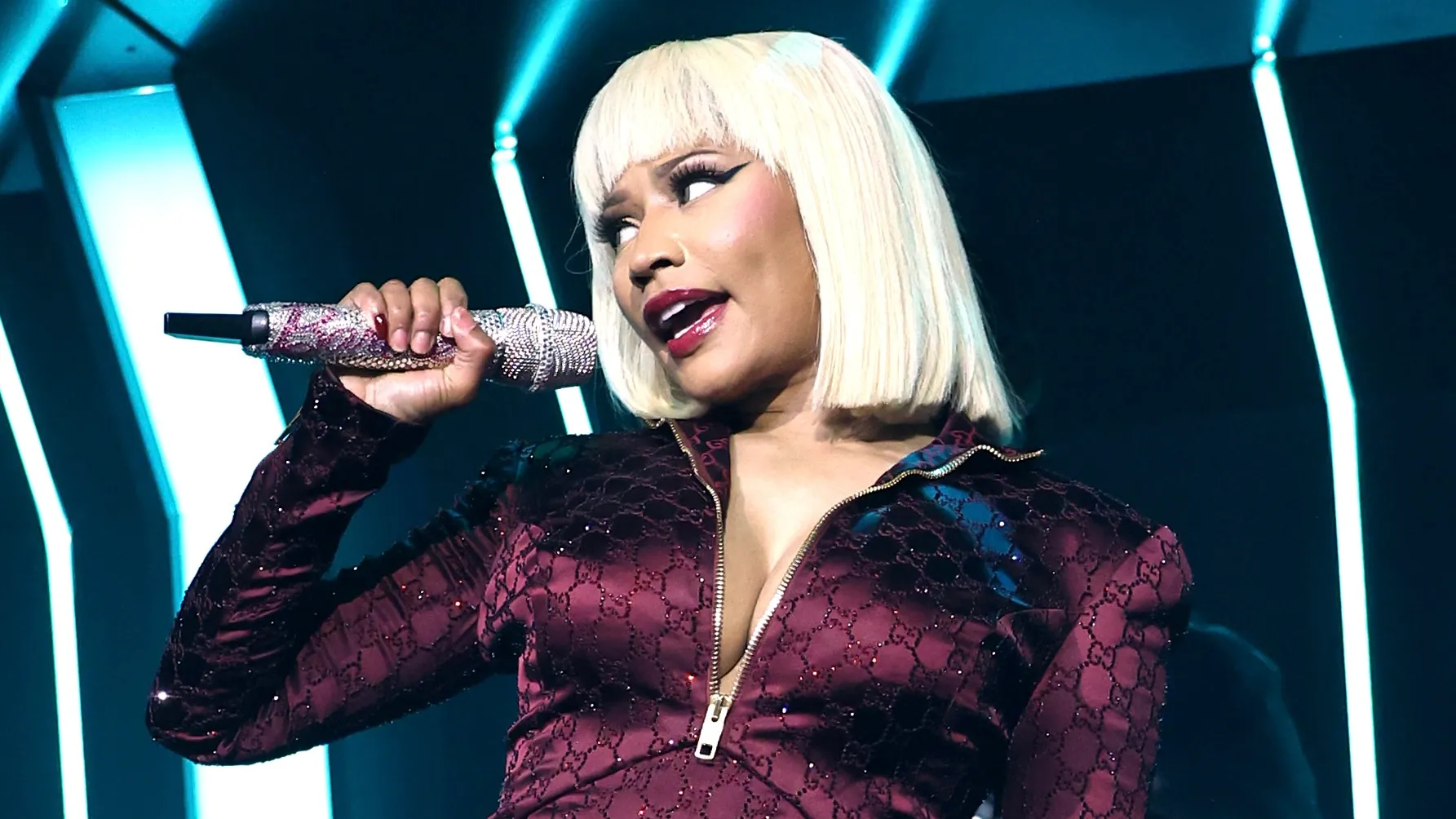
Nicki Minaj Shares Message About The World Losing Its Mind
On the evening of Friday, March 13, Minaj took to X, formerly known as Twitter, to repost a message about neurodivergent people initially being rejected but now being unable to be replaced.
From there, Minaj reposted a message about the CEO of Palantir declaring that neurodivergent people own the future. Additionally, Minaj noted the group as her “tribe.”
Advertisement
*takes my rightful place in society with the rest of my tribe*
Neurodivergents of Gag City gather here.
It’s our time
*looks menacingly @ the “normals”.
*begins implementing the payback they never saw coming*
X wins b/c they understand community. Not just identifying the communities—but enhancing the actual community itself.
Enhancing the experience that allows the community to function completely outside of the overall population w/o feeling alienated from said population.
To note, per the University Hospital, neurodivergence covers a wide range of conditions from those diagnosed with autism, to ADHD, bipolar disorder, obsessive-compulsive disorder, speech disorder, Tourette syndrome, and other conditions.
Instagram user @kerry.smalls wrote, “Your best friend the reason why babe”
While Instagram user @spiritualword added, “The call is coming from inside the house.”
Advertisement
Instagram user @theesinnamonxo wrote, “I love how you actin like you haven’t lost yours Nicki😒”
While Instagram user @chasitychanell added, “You included Ms. Ma’am”
Instagram user @artby.bae wrote, “Like her president isn’t the one causing all of this hell 😂”
While Instagram user @_pettyking added, “Yes. Most of all YOU.”
Advertisement
Instagram user @zyairevidal wrote, “The call is coming from inside the house”
While Instagram user @shaydolce added, “Starting with you.”
Instagram user @_jefe_kail wrote, “She about to make me curse …”
While Instagram user @ms.magikal added, “The kettle calling it black or however it goes 😂😂😂😂 Chile”
Advertisement
More On The Recent Events With The Rapper & The World
As The Shade Room previously reported, in November 2025, Nicki Minaj sparked reactions when she spoke at the UN and supported Donald Trump’s addressing of alleged Christian persecution in Nigeria.
In January, Minaj continued to surprise fans when she appeared at Trump’s account Summit, held his hand, and called herself his “number one fan.”
Most recently, Minaj’s apparent alignment with Trump’s MAGA party made the rapper spark even more reactions when she doubled down on feeling as though she is not “transphobic.”












:max_bytes(150000):strip_icc():format(jpeg)/The-top-50-teen-movies-of-all-time-022626-0097f68069674174b51e2db6f8ed1966.jpg)




:max_bytes(150000):strip_icc():format(jpeg)/Apple-thriller-series-078-03112026-34923575df2c4161b2ca82493a960e0d.jpg)
:max_bytes(150000):strip_icc():format(jpeg)/Ed-Sheeran-Cherry-Seaborn-BRIT-Awards-031426-b7f5eef49ba54648a475c9786d09592a.jpg)
:max_bytes(150000):strip_icc():format(jpeg)/PSYCHO-Anthony-Perkins-ARRIVAL-amy-adams-VERTIGO-James-Stewart-020626-e1e15ca45edc45f2bc3467bd87c01370.jpg)