Entertainment
‘The Odyssey’ Is Actually the Most Christopher Nolan Film He’s Ever Made

It’s no secret that Christopher Nolan has built one of the most impressive resumes in modern Hollywood. By refusing to repeat himself and always maintaining his unique filmmaking style, he’s created a broad body of work that includes noir mysteries, superhero blockbusters, science fiction, historical drama, and, with the release of The Odyssey, a mythological epic. However, within the seemingly-disparate 13 movies Nolan has directed, a remarkably consistent set of ideas stick out. Nolan’s fascinations with time, identity, obsession, guilt, and sacrifice appear across nearly all his movies: Interstellar focuses on the long journey home and the emotional cost of absence; The Prestige centers on obsession; The Dark Knight trilogy examines what it means to be a hero.
That’s why his adaptation of The Odyssey doesn’t feel like the unexpected career choice some thought it was when the film was first announced. Previously, Nolan has made a point to present a certain realism in his movies, with even more fantastical works like Inception and Tenet feeling conceptually grounded in reality.
However, despite his general aversion to the fantastical elements of filmmaking, he embraces them with The Odyssey — and rather that serving as a rejection of his previous work, this decision builds on every movie he’s made before. It’s the themes that he infuses into the movie that has already led to its massive success, both financially and critically, despite a campaign mounted against the film deriding it as “woke,” with many believing it was doomed to fail. Even though the noise outside was loud, Nolan was determined to make the movie he envisioned, by infusing it with what he’s learned along the way.
Nolan’s career has largely been defined by stories about people who find themselves in circumstances with the potential to unravel their lives, and whose defining strengths threaten to become their greatest weaknesses. J. Robert Oppenheimer’s pride and pursuit of knowledge becomes his curse, a creation that could bring about humanity’s end in the wrong hands. Bruce Wayne’s desire to protect others threatens to destroy the life that he knows while he fights crime as Batman. Inception‘s Dom Cobb grapples with his past and his PTSD, while it causes him to spiral downwards.
Odysseus, portrayed in The Odyssey by Matt Damon, is far from an ordinary person; he’s a Greek general who has found himself far from home, stuck in what seems like an endless cycle of physical and mental challenges on his quest to get home to his wife Penelope (Anne Hathaway) and son Telemachus (Tom Holland). Odysseus very much feels like an amalgamation of characters like Oppenheimer, Bruce Wayne, and Cobb, among many others of Nolan’s protagonists. Nolan’s version differs from Homer’s original character in a number of ways, with Damon’s performance feeling more like an original character from the director and less like a Greek hero. It works here because Nolan knows what works for him, how to get the best out of the actors in the moment, and what to keep in place to allow the characters feel real — and his filmography shows us that.
Odysseus and his men are no saints; they burned an entire city, butchering its population, and thus offended the Gods and were punished for their wickedness. While we as an audience have not committed the sins they have, we know what it feels like to feel guilt and chastise ourselves for it. In a world filled with gods, monsters, witches, and an underworld designed to torment the living, his characters still manage to feel grounded, so that you can identify with them.
‘The Odyssey’ Embraces the Blockbuster Spectacle Christopher Nolan is Known For

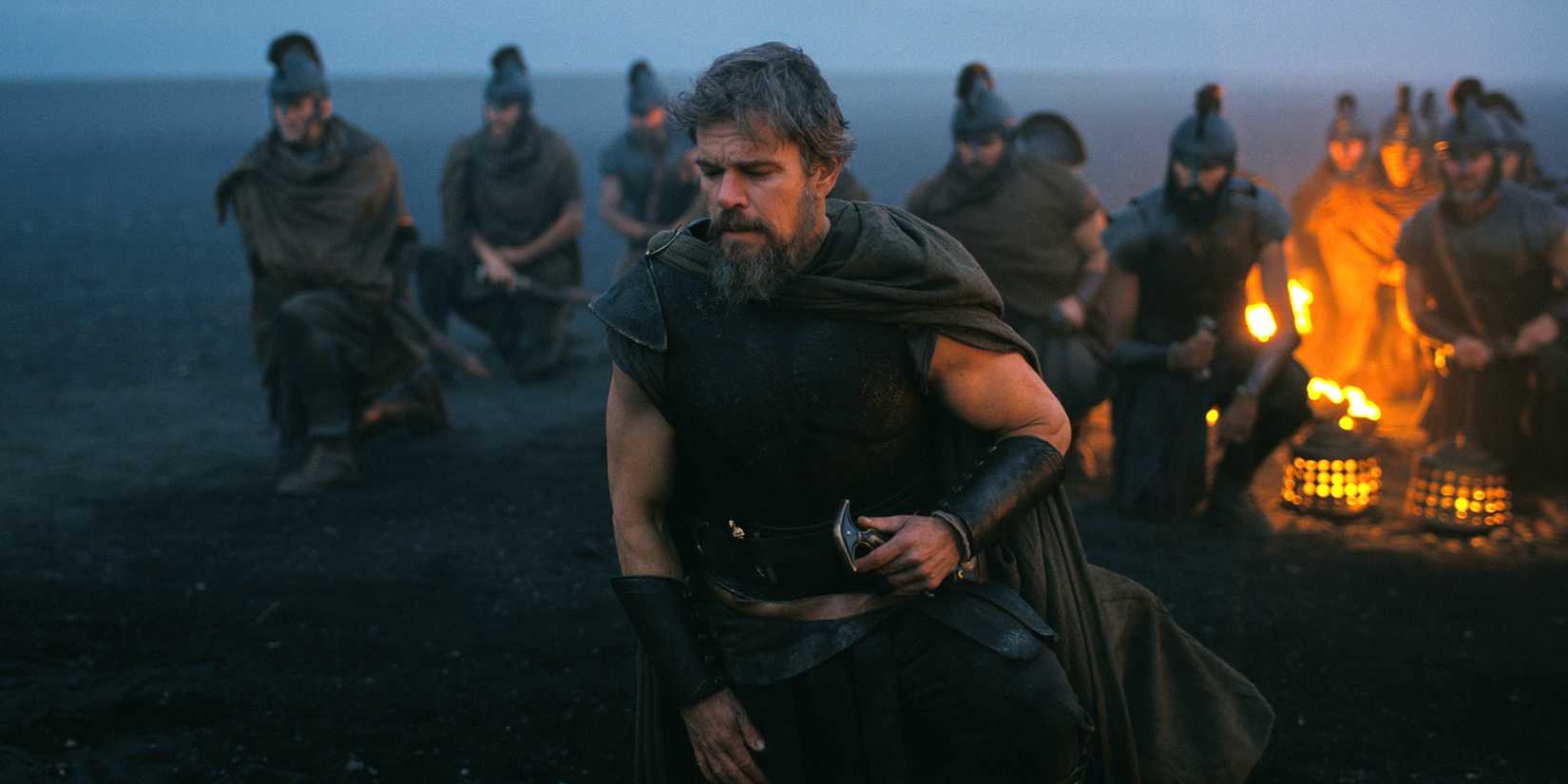
While The Odyssey works fantastically as a character piece, examining desire, trauma, desperation, and longing, Nolan doesn’t shy away from what he’s known for: spectacle. The fall of Troy unfolds almost like a horror scene, as the Greek army gleefully massacres the Trojan population, military and civilian alike. Despite the ghastly violence on screen, Nolan knows how to film it to enrapture the viewer. You feel every arrow shot, every explosion. These are all methods he utilized in films like Dunkirk and Interstellar, which keep the audience focused on the screen and let the visuals tell a story.
In scenes following Odysseus’ crew’s encounter with the Cyclops, the battle against Scylla and Charybdis, and trying to survive a fight with the giant Laestrygonians, The Odyssey never feels small. It’s loud, it’s violent, and it’s full of dread, all qualities that you can find in almost any Nolan film. That said, even with the blockbuster angle, some of the film’s biggest moments come at the smallest of times. Odysseus’ conversations with crew mates, Penelope, Telemachus, and Eumaeus, his loyal servant played by John Leguizamo, are among the movie’s most pivotal.
It’s this delicate balancing act that Nolan has perfected in the past, where he delivers action that can keep you visually engrossed — but those moments have no weight if the audience loses sight of Odysseus’ desire to return home. Nolan continues to show that he can make spectacle serve the character instead of merely overshadowing it.
Looking across Christopher Nolan’s career, The Odyssey doesn’t feel like a dramatic change in direction. Rather, it is the culmination of everything he has worked toward so far. His mastery of non-linear storytelling, complex heroes, blockbuster action, and immersive world-building are all perfectly suited for this project. For the first time, it doesn’t feel like he’s taking on another ambitious challenge. Rather, it feels like the movie he’s been waiting for his entire career.

- Release Date
-
July 15, 2026
- Runtime
-
173 minutes
You must be logged in to post a comment Login