What makes us human? According to Stanley Kubrick‘s 2001: A Space Odyssey, it’s our ability to use tools that separate us from our simian ancestors. In his sci-fi epic, Kubrick boils down the entire story of humankind from its inception as apes, discovering how to utilize tools to overpower their natural enemies, all the way to humanity’s inevitable rebirth, deep into the space age. However, scientists have long since decided that this theory about the cornerstone of human civilization is false. In fact, many animals use tools, not just humans. Then what makes us humans unique? Perhaps surprisingly, the sci-fi film series that succeeds in getting the answer right is Planet of the Apes.
Since the original 1968 film, and the novel that inspired it, Planet of the Apes has been a powerful allegory for the human race’s treatment of “the other,” and our tendency to blow up the paradise we inhabit as a result. Therefore, what makes us human, when compared to our ancestral apes, is not our use of tools and weapons of mass destruction, but rather, our ability to develop such plans in the first place. In short, language is the cornerstone of our species. It’s notable that in the original film, Taylor (Charlton Heston) finds himself in a world where apes are well-spoken, but more importantly, humans are portrayed as mute and therefore primitive. Language is often how we take pride in our national and regional identities, but it’s also resulted in incessant conflict, as the recent reboot trilogy explores.
Advertisement
‘Rise of the Planet of the Apes’ Gives Apes the Gift of Language
Andy Serkis putting his arm on James Franco’s shoulder in Rise of the Planet of the ApesImage via 20th Century Studios
2011’s Rise of the Planet of the Apes serves as both a prequel and a reboot to the original series of films. It changes certain details within the canon, but ultimately tells the story of how Earth became the ape-governed world discovered in the 1968 movie. The film focuses on Caesar (Andy Serkis), a chimpanzee born with an experimental cure for Alzheimer’s passed down from his test-subject mother. Caesar embarks on a startling evolution, becoming fluent in sign language thanks to his human guardian, Will (James Franco). The science-fiction premise that this film poses is essentially just Caesar’s linguistic journey.
Gifted with exceptional intelligence, Caesar is depicted as being just as conscious as humans. It’s not long before the cruelty of man, particularly against apes, leads Caesar to inspire a revolution, and it’s through language that Caesar not only forms his small army of apes, but it’s also how he declares to the humans that they refuse to be oppressed any longer. Caesar’s “No” in the face of cruelty from Dodge Landon (Tom Felton) remains one of the most bone-chilling moments of the franchise, and that is precisely why.
Advertisement
Andy Serkis, Toby Kebbell, and Jason Clarke standing together in Dawn of the Planet of the ApesImage via 20th Century Studios
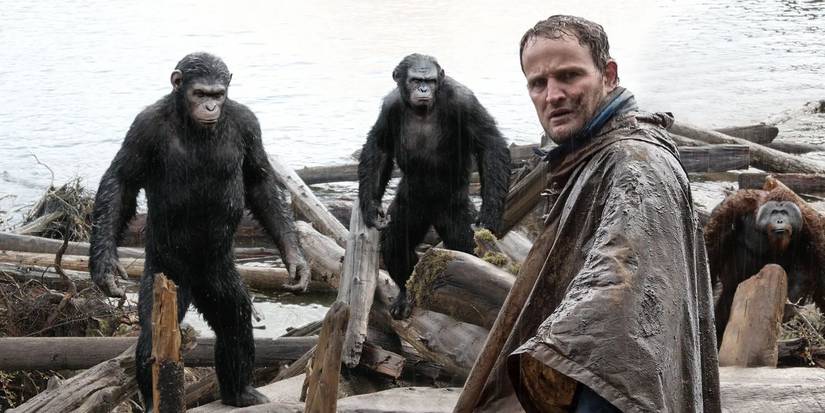
Set ten years after the events of the previous film, 2014’s Dawn of the Planet of the Apes establishes a world in turmoil. Caesar’s tribe of liberated apes continues to inhabit the Muir Woods near San Francisco, while the experimental Alzheimer’s cure has resulted in a virus that has eliminated countless humans. A small group of surviving humans led by Dreyfus (Gary Oldman) live in the city, and the film establishes an uneasy peace between them and the apes. It’s clear that both species have resorted to hunting and gathering to survive, and with fluent communication within both camps, apes and humans are on equal footing at last. The trouble begins when the humans wish to work on a dam within the apes’ territory, and it’s clear that neither side wishes for this to result in conflict.
Dawn of the Planet of the Apes is where the series gets to explore the true implications of language, and the burden of intelligence that comes with it.Among both camps are those willing to trust the other (Caesar and Jason Clarke‘s Malcolm) and those whose pride and pessimism risk peace in favor of victory (Dreyfus and Toby Kebbell‘s ape Koba). This film displays that, with complex language comes philosophy, and individual ideologies inevitably branch off. Caesar soon comes to the sobering realization that anyone equipped with the tools of language has the potential to make the same mistakes as humans. Going into the trilogy’s final installment, Caesar becomes a bitter ape, uncertain whether his species is any more worthy of that power than its predecessors.
Advertisement
Collider Exclusive · Sci-Fi Personality Quiz Which Sci-Fi Hero Are You Most Like? Paul Atreides · Captain Kirk · Princess Leia · Ellen Ripley · Max Rockatansky
Advertisement
Five iconic heroes. Five completely different ways of facing an impossible universe. One of them shares your instincts, your values, and your particular way of refusing to back down. Eight questions will tell you which one.
🏜️Paul Atreides
🖖Capt. Kirk
✊Princess Leia
🔦Ellen Ripley
Advertisement
🔥Max Rockatansky
Advertisement
01
How do you lead when the stakes couldn’t be higher? The way you lead under pressure is the most honest thing about you.
Advertisement
02
What is your greatest strength in a crisis? The quality that keeps you alive when everything else fails.
Advertisement
03
What is the thing you’d sacrifice everything else for? Your deepest motivation is your truest compass.
Advertisement
04
How do you relate to the people around you? Who you are to others under pressure is who you really are.
Advertisement
05
You’re facing a threat that no one else believes is real. What do you do? How you respond when you’re the only one who sees it defines everything.
Advertisement
06
What has your heroism cost you personally? Every hero pays. The question is what — and whether they’d pay it again.
Advertisement
07
How do you feel about the rules of the world you’re in? Every hero has a relationship with the system. What’s yours?
Advertisement
08
When everything is on the line, what keeps you going? The answer is the most honest thing about you.
Advertisement
Your Hero Has Been Identified Your Sci-Fi Hero Is…
Your answers point to the iconic sci-fi hero who shares your instincts, your values, and your particular way of facing the impossible.
Advertisement
Arrakis · Dune
Paul Atreides
You carry a weight most people would crumble under — the knowledge of what you’re capable of, and the burden of what you might have to become.
You see further ahead than others and you plan accordingly, even when the vision frightens you.
You are driven by loyalty to your people and a sense of destiny you didn’t ask for but can’t escape.
Paul Atreides is not simply a hero — he is someone who understands the cost of power and chooses to bear it anyway.
That gravity, that willingness to carry what others won’t, is exactly you.
Advertisement
USS Enterprise · Star Trek
Captain Kirk
You lead with instinct, warmth, and an absolute refusal to accept a no-win scenario — because you’ve always believed there’s a third option nobody else has thought of yet.
You take the mission seriously without ever taking yourself too seriously.
Your crew would follow you anywhere, not because you demand it, but because you’ve earned it.
Kirk’s genius isn’t tactical — it’s human. He reads people, bends rules with purpose, and wills outcomes into existence through sheer conviction.
That combination of warmth, audacity, and relentless optimism is unmistakably yours.
Advertisement
The Rebellion · Star Wars
Princess Leia
You are the kind of person who holds the line when everyone else is losing faith — not because you’re fearless, but because giving up simply isn’t something you’re capable of.
You lead through conviction. Your voice carries because your belief is unshakeable.
You gave up everything ordinary the moment you chose the cause, and you’ve never looked back.
Leia is not a supporting character in her own story — she is the moral centre of the entire rebellion.
That same fierce, principled, unbreakable core is what defines you.
Advertisement
The Nostromo · Alien
Ellen Ripley
You are not reckless, not grandiose, and not particularly interested in being anyone’s hero — you just refuse to stop when it matters.
You see threats clearly, you document the truth even when no one listens, and when the time comes you handle it yourself.
Ripley’s heroism is earned, not performed. She doesn’t have a speech — she has a flamethrower and a plan.
You share her composure under the worst possible pressure, and her refusal to pretend the monster isn’t there.
When it counts, you don’t flinch. That’s everything.
Advertisement
The Wasteland · Mad Max
Max Rockatansky
You have been through fire that would break most people — and what came out the other side is something the world underestimates at its peril.
You don’t ask for help, don’t need validation, and don’t wait for anyone to tell you the rules no longer apply.
Your loyalty, when it finally arrives, is absolute — but it’s earned in silence and tested in action, not in words.
Max is not a nihilist. He is someone who lost everything and found, against his will, that he still has something worth protecting.
That bruised, stubborn, ultimately human core is exactly yours.
Advertisement
‘War for the Planet of the Apes’ Takes Language Away from the Humans
More years have passed by the time we are reintroduced to this world in 2017’s War for the Planet of the Apes. When Caesar’s family is murdered by a rogue human army, we’re introduced to a version of Caesar far more cynical than we’ve ever known before. As per 1968’s Planet of the Apes, It’s revealed that the simian virus has evolved to deprive infected humans of their ability to speak, leaving them a primitive shell of their former selves. Disgusted by the idea of humans as the next generation’s speechless animals, an army Colonel (Woody Harrelson) urges his men to euthanize their infected loved ones and wage war on the apes.
Advertisement
Like Caesar, the Colonel’s greatest power is his ability to influence people through speech. The Colonel’s manipulation tactics even result in getting specific apes to work for him. Caesar’s mission this time is much darker than in previous stories, with hate in his heart for the Colonel. Caesar eventually realizes that killing the Colonel would only succeed in fulfilling the destiny that he fears so much. When the Colonel is infected by the virus, he recognizes just how much power he has lost by losing his speech. The Colonel decides to kill himself, rather than become a voiceless primate. This marks the official hand-off between humans and apes, with the planet of humans finally becoming the planet of the apes; not by apes killing humans, but rather, by the apes gaining language and humans losing their greatest tool as a species.
The Planet of the Apes Franchise Represents the Cyclical Nature of Life
Freya Allan as Mae standing in a dirty river while people run away behind her in Kingdom of the Planet of ApesImage via 20th Century Studios
With Kingdom of the Planet of the Apes attempting to further fill in the gaps between the original films and the prequel trilogy, the overall symbolism of the franchise begins to become clearer. Language represents power and intelligence; the ability to communicate effectively, whether through spoken language — or even gestures — is closely linked to characters’ social status throughout the entirety of the franchise. The films explore themes of oppression, hierarchy, and prejudice through the lens of language, highlighting how these linguistic differences can shape power dynamics.
Advertisement
Planet of the Apes fully succeeds in its symbolism because of its ability to tell this story naturally throughout several decades in-universe. Whereas a franchise like Star Wars has a tendency to box itself in — telling stories where audiences already know the beginning and ending points and often the fates of the characters themselves — Apes has a more ambiguous middle period to play with, and audiences get to watch the story unfold organically.
One of the most harrowing, but also familiar aspects of the franchise is the cyclical nature of its story. History tends to repeat itself, a lesson humans begrudgingly continue to learn. Through Planet of the Apes, audiences can watch humanity’s failures in real-time, equating them to the evolutionary cycle that has known Homo sapiens as the top of the food chain since their existence. From the 1968 original to the recent release of Kingdom of the Planet of the Apes, this franchise relies entirely on exploring language and how this difference between the apes and humans is integral to the new world they both find themselves in.



You must be logged in to post a comment Login