Entertainment
The Sitcom Trope That Makes No Sense But Every Show Does It
By Robert Scucci
| Published


For the sake of convenience and continuity, every single sitcom somehow has a soundproof kitchen that’s seemingly located in another dimension where guests can’t hear conversations across an open floor plan. On a technical level, this trope makes sense because erecting an entirely new set for secret conversations to take place would prove to be a cumbersome ordeal. But how much disbelief are we supposed to suspend when sitcom characters like Frasier Crane talk loudly about their guests who are clearly within earshot?
Magically Sound Proof Kitchens


The only sitcom in recent memory that actually acknowledged this trope during its run was How I Met Your Mother. In the episode “Okay Awesome,” Marshall and Lily are frustrated after inviting their new boring friends, Claire and Austin, over for a wine-tasting party. When Marshall steps into the kitchen to air his grievances about Claire and Austin, it’s revealed that Claire is standing right behind him, having heard every word. It’s a rare instance of a sitcom recognizing that an open-concept apartment doesn’t magically become a private confessional just because somebody crossed into the kitchen.
Even then, it’s implied that if Claire hadn’t breached the kitchen’s threshold, Marshall would have gotten away with his mean-spirited jabs about Claire and Austin’s 30-year fixed mortgage and ultrasound photos. Given how the episode concludes with Marshall and Lily literally climbing out of their bathroom window to meet up with the rest of the gang at the club, “Okay Awesome” didn’t need to lean into the soundproof sitcom kitchen trope because it’s not like they were trying to save face in the first place. If anything, having Claire overhear the entire conversation from the living room would have better sold the joke while poking even more fun at one of television’s oldest unwritten rules.
Pokes Fun At The Concept

From this point forward, we never see Claire or Austin in any significant capacity again, so who cares if their feelings get hurt over some critical commentary when their hosts rudely abandon their own party to meet up with the rest of the gang anyway? Their friendship was clearly doomed regardless, which makes the need for a magically private kitchen feel even more unnecessary.
I’m willing to forgive How I Met Your Mother because it at least acknowledges the absurdity of the trope instead of pretending it isn’t happening. Most sitcoms simply expect us to accept that crossing an invisible line into the kitchen somehow creates a cone of silence, but “Okay Awesome” briefly calls attention to how ridiculous that idea actually is before going right back to business as usual.
The Most Egregious Examples Can Be Found In Frasier

But I can’t say the same thing about Frasier, where Frasier Crane routinely has crucial conversations in his kitchen with his booming baritone voice while his guests sit less than 10 feet away in the living room. One of the most egregious examples of the soundproof sitcom kitchen trope comes in “Daphne Dates a Niles Doppelganger,” when Niles has a complete meltdown over hesitating to tell Daphne how he feels, only to watch her start dating a man who’s practically his exact double.
While the episode implies that conversations taking place in Frasier’s kitchen can’t be heard anywhere else in the apartment, it completely undermines that logic moments later. As Frasier mingles with his guests in the living room, he immediately hears Niles accidentally drop and shatter one of his antique coffee cups in the kitchen (Catherine of Aragon!), proving that sound can, in fact, travel freely between the two rooms. If Niles breaking a coffee cup carries across the apartment, there’s no reason an emotionally distraught Frasier ranting at full volume shouldn’t.
The Rare Exception
If sitcoms are going to use this trope, they should at least commit to it. The kitchen can’t only become a soundproof bunker when the plot demands a private conversation, only for noises to travel freely across the exact same distance moments later. Either sound carries through an open floor plan or it doesn’t.
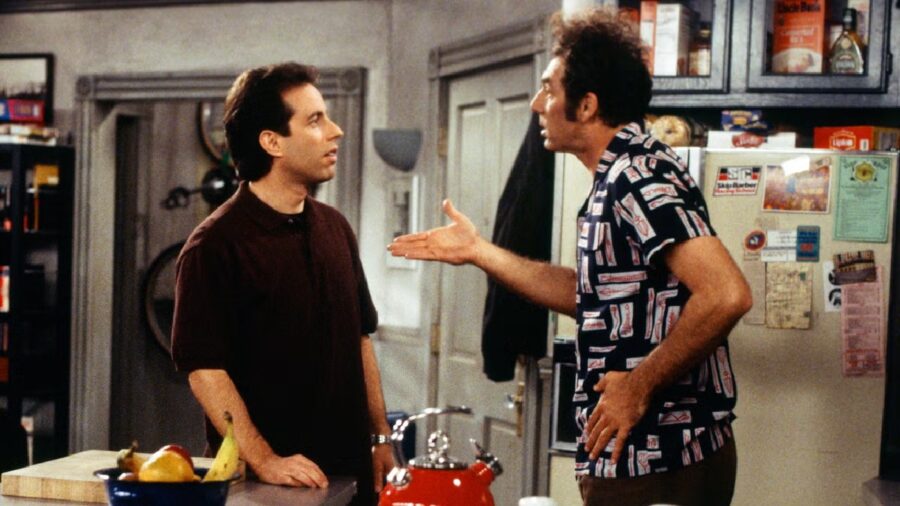
That’s also why the trope feels less noticeable in sitcoms like Seinfeld and It’s Always Sunny in Philadelphia. Those shows thrive on characters openly scheming against one another, insulting each other to their faces, or making no effort to hide their selfish intentions in the first place. When everybody’s already saying the quiet part out loud, there’s far less need for a magically silent kitchen to keep the story moving.
You must be logged in to post a comment Login