Entertainment
These 6 Viggo Mortensen Movies Are His Only True Masterpieces

This list is not about Viggo Mortensen’s most famous roles alone, even though the top is dominated by the fantasy trilogy that turned him into a permanent part of modern movie history. It is about the films where Mortensen’s presence becomes inseparable from the movie’s full power.
Mortensen has never built his career around obvious movie-star vanity. His best performances feel lived-in before the story even starts. He carries history in posture, silence, appetite, exhaustion, violence, humor, and the way a character looks at another person before deciding what kind of truth to give them. All six movies on this list contain the kind of acting that stops feeling like performance and starts feeling like a person being tested in public.
‘The Lord of the Rings: The Fellowship of the Ring’ (2001)


Aragorn (Viggo Mortensen) enters The Lord of the Rings: The Fellowship of the Ring like a man who has spent years avoiding the very story everyone else is walking into. He is dirty, watchful, guarded, and physically capable without seeming eager to prove it. That first impression matters enormously. The film already has hobbits, wizards, elves, ancient evil, mythic objects, and a world loaded with history. Aragorn gives that world a human kind of danger and an anchor. He looks like someone who knows exactly how badly courage can end.
Mortensen’s brilliance in the first film is restraint. He makes Aragorn’s nobility feel unwanted, almost burdensome. His protection of Frodo (Elijah Wood), his fear of Isildur’s (Harry Sinclair) weakness, his tenderness with Arwen (Liv Tyler), and his loyalty to Boromir (Sean Bean) all come from a man fighting against inheritance as much as Sauron. The death of Boromir works so strongly because Aragorn’s grief has no decoration. He gives Boromir comfort, accepts the broken sword of brotherhood between them, and then has to keep moving. That is the Aragorn foundation: reluctant king, exhausted soldier, decent man. Mortensen makes all three visible at once.
‘Eastern Promises’ (2007)
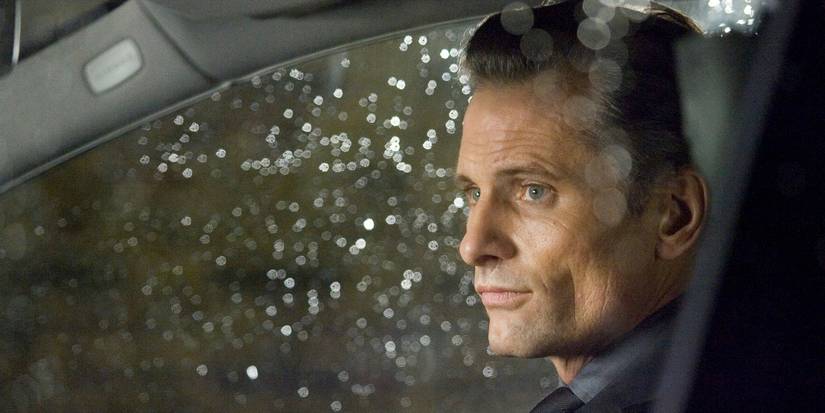
Nikolai Luzhin (Viggo Mortensen) is one of Mortensen’s most terrifying characters because he never begs the audience to admire his control. He simply has it. In Eastern Promises, Nikolai moves through London’s Russian criminal underworld as a driver, fixer, enforcer, and silent observer inside the orbit of Semyon (Armin Mueller-Stahl) and Kirill (Vincent Cassel). Every gesture feels measured. Every word feels rationed. Even his politeness has threat inside it.
The bathhouse fight is the scene everyone remembers, and rightly so, because Mortensen strips the character of clothing, weapons, and social disguise while somehow making him more frightening. Yet the performance is larger than that one brutal fight. Nikolai’s tattooed body tells a story he refuses to speak aloud. His relationship with Anna (Naomi Watts) introduces moral risk without turning him soft. His handling of Kirill mixes manipulation, contempt, and strange protection. Mortensen makes Nikolai unreadable in a way that feels earned, then lets small flashes of conscience cut through with devastating precision. It’s like David Cronenberg gives him a criminal world built on ritual and rot and Mortensen gives that world its most dangerous secret.
‘Captain Fantastic’ (2016)

A brilliant, stubborn father raising his children off the grid, training them in survival, literature, politics, music, combat, and radical self-sufficiency is a role that could easily tip into fantasy-parent worship or smug anti-society sermonizing. Mortensen saves Captain Fantastic from that trap by playing Ben as deeply loving and deeply wrong in ways he cannot fully see. Ben Cash (Viggo Mortensen) could have been unbearable in the wrong hands. That’s not the case here.
The movie hurts because Ben’s devotion is real. He does not neglect his children through laziness. He has built an entire life around preparing them to think, question, endure, and resist. Mortensen makes that devotion magnetic, then slowly lets the damage show. The children are extraordinary, but they are also isolated. They can quote philosophy and hunt for food, yet some of them barely understand ordinary social life. The funeral fight over their mother Leslie exposes the limits of Ben’s certainty. He wants to honor her wishes, protect her memory, and defend his family’s way of life, but love has started turning into control. The masterpiece is in watching a father discover that being right is not the same as being good enough.
‘A History of Violence’ (2005)

Tom Stall (Viggo Mortensen) is terrifying in A History of Violence. You can realise this before even understanding why. At first, he appears to be a gentle small-town husband and diner owner, a man with a quiet marriage to Edie (Maria Bello), two children, and a life built around ordinary decency. Then violence enters the diner, and Tom kills with a speed and precision that instantly changes the entire movie. The shock is not only that he can do it. The shock is how naturally his body remembers.
Mortensen’s performance is a masterclass in divided identity without theatrical tricks. Tom begins to lose control over the person he has been pretending to be, or maybe the person he has worked brutally hard to become. When Carl Fogarty () starts calling him Joey, the film turns every denial into a test. Mortensen makes Tom’s fear, anger, shame, and buried reflexes fight inside the same stare. The staircase sex with Edie, the confrontation with Richie (William Hurt), and the silent family dinner near the end all expose different wounds.
‘The Lord of the Rings: The Two Towers’ (2002)

Aragorn (Viggo Mortensen) in The Lord of the Rings: The Two Towers is where he stops feeling like a man hiding from a crown and starts becoming someone others can survive around. Mortensen’s work here is less romantic than in The Fellowship of the Ring and less triumphant than in The Return of the King. That middle position gives the performance its force. He is exhausted, muddy, bruised, and constantly making decisions with incomplete information. He has no throne, no army of his own, and no certainty that the world will last long enough for destiny to matter.
His scenes in Rohan are crucial because Aragorn has to become useful before he becomes kingly. He listens to Théoden (Bernard Hill), challenges him without humiliating him, respects Éowyn (Miranda Otto) without exploiting her feelings, and steadies Legolas (Orlando Bloom) and Gimli (John Rhys-Davies) when fear begins to spread. At Helm’s Deep, Mortensen gives Aragorn command without turning him into a speech machine. He is in the mud with everyone else, shouting orders, pulling bodies, looking at children sent to fight, and understanding exactly how desperate the defense is. The greatness of this film is not just spectacle. It is the sight of a future king earning trust before anyone has the luxury of believing in crowns.
‘The Lord of the Rings: The Return of the King’ (2003)

Aragorn (Viggo Mortensen) in The Lord of the Rings: The Return of the King is the masterpiece that completes him without making him less human. The Return of the King could have turned him into pure myth — heir revealed, sword reforged, army summoned, crown claimed. Mortensen keeps pushing against that simplicity. Even when Aragorn finally accepts who he is, he does not become grand in a hollow way. He becomes clearer. The doubt is still there, but it no longer rules him.
His best moments are not only the obvious heroic ones. The look he gives the dying Théoden (Hill) carries respect and sorrow. His decision to march on the Black Gate is not confidence; it is sacrifice turned into strategy. His speech before the final battle has force because Mortensen plays it as a man asking terrified soldiers to spend their lives buying Frodo a chance they cannot even see. Then comes the coronation, where the entire trilogy’s emotional debt gathers in one simple gesture: Aragorn bowing to the hobbits. Mortensen understands that the king’s highest act is gratitude. That is why this performance remains untouchable. He gives the trilogy its warrior, its doubt, its mercy, and finally its grace.
You must be logged in to post a comment Login