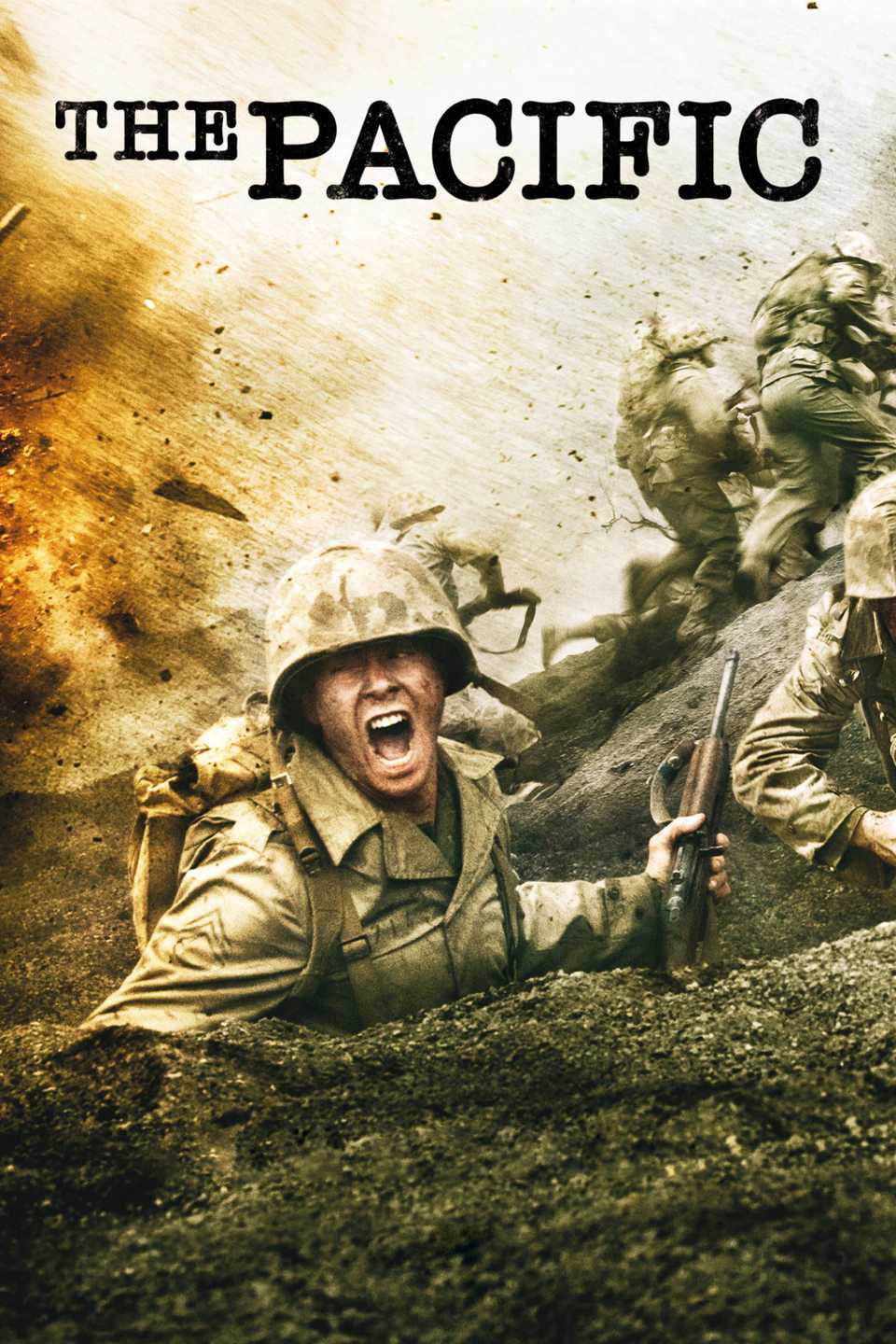
Spanning September 1, 1939, to September 2, 1945, WWII remains the most disastrous conflict in human history, involving dozens of countries and resulting in the highest death toll of any war. In the decades since it ended,the war has inspired countless film and television projects, many of which continue to provide an authentic recounting of the devastating events. One standout is The Pacific, widely regarded as one of the best WWII miniseries ever made, which remains compelling nearly two decades later.
Having aired on HBO from March 14 to May 16, 2010,The Pacific offers a brutal look at WWII through the eyes of U.S. Marines in the Pacific Theater. As a spiritual successor to Band of Brothers, the 10-episode series focuses on real soldiers involved in some of the war’s toughest campaigns, combining large-scale battle sequences with intimate storytelling. Its honest, unflinching portrayal—paired with emotional depth and a strong commitment to historical accuracy—cements The Pacific as one of the most powerful war dramas ever created.
Advertisement
Collider Exclusive · TV Medicine Quiz Which Fictional Hospital Would You Work Best In? The Pitt · ER · Grey’s Anatomy · House · Scrubs
Advertisement
Five hospitals. Five completely different ways medicine goes sideways on television — brutal, chaotic, romantic, brilliant, and ridiculous. Only one of them is the ward your instincts were built for. Eight questions will figure out exactly where you belong.
🚨The Pitt
🏥ER
💉Grey’s
🔬House
Advertisement
🩺Scrubs
Advertisement
01
A critical patient comes through the door. What’s your first instinct? Medicine under pressure reveals who you actually are.
Advertisement
02
Why did you go into medicine in the first place? The honest answer says more about you than the one you’d give in an interview.
Advertisement
03
What do you actually want from the people you work with? Who you want beside you under pressure is who you are.
Advertisement
04
You lose a patient you fought hard to save. How do you carry it? Every doctor who’s worked a long shift has had to answer this question.
Advertisement
05
How would your colleagues describe the way you work? Your reputation on the floor is usually more accurate than your self-image.
Advertisement
06
How do you feel about hospital protocol and procedure? Every institution has rules. What you do with them is a choice.
Advertisement
07
What does this job cost you personally? Nobody works in medicine without paying a price. What’s yours?
Advertisement
08
At the end of a long shift, what keeps you coming back? The answer to this question is the most honest thing about you.
Advertisement
Your Assignment Has Been Made You Belong In…
Your answers have pointed to one fictional hospital above all others. This is the ward your instincts, your temperament, and your particular brand of dysfunction were built for.
Advertisement
Pittsburgh Trauma Medical Center
The Pitt
You are built for the most unsparing version of emergency medicine television has ever shown — one that puts you inside a single fifteen-hour shift and doesn’t let you look away.
You need your work to be real, not romanticised — meaning over drama, honesty over aesthetics.
You find purpose inside the work itself, not in the chaos surrounding it.
You’ve made peace with the fact that this job takes from you constantly, and gives back in ways that are harder to name.
Pittsburgh Trauma Medical Center demands exactly that kind of person — and you would not want to be anywhere else.
Advertisement
County General Hospital, Chicago
ER
You are the person who keeps the whole floor running — not the most brilliant in the room, but possibly the most essential.
You show up, do the work, absorb the losses, and come back the next day without needing the job to be anything other than what it is.
You care about patients as individual human beings, not as cases to solve or dramas to live through.
You believe in the system even when it fails you — and you understand that emergency medicine is about holding the line just long enough.
ER is television about endurance. You have it.
Advertisement
Grey Sloan Memorial Hospital, Seattle
Grey’s Anatomy
You came to medicine with your whole self — your ambition, your emotions, your relationships, your history — and you have never quite managed to leave any of it at the door.
You feel things fully and form deep attachments to the people you work with.
Your personal and professional lives are permanently, chaotically entangled — and that entanglement drives both your greatest disasters and your most remarkable saves.
You understand that extraordinary medicine often happens at the intersection of clinical skill and profound human connection.
It’s messy at Grey Sloan. You would not have it any other way.
Advertisement
Princeton-Plainsboro Teaching Hospital, NJ
House
You are drawn to the problem above everything else — the symptom that doesn’t fit, the diagnosis hiding underneath the obvious one.
You’re not primarily motivated by the patient as a person — though you are capable of caring, even if you’d deny it.
You work best when the stakes are highest and the standard answer is wrong.
Princeton-Plainsboro exists to house one extraordinary, impossible mind — and everyone around that mind is there because they’re smart enough to keep up.
The only way forward here is to think harder than everyone else in the room. That is exactly what you do.
Advertisement
Sacred Heart Hospital, California
Scrubs
You understand that medicine is tragic and absurd in almost equal measure — and that the only sane response is to hold both of those things at the same time.
You are warm, self-aware, and funnier than most people in your field.
You use humour to get through terrible moments — and at Sacred Heart, that’s not a flaw, it’s a survival strategy.
You lean on the people around you and let them lean back. The laughter and the grief are genuinely inseparable here.
Scrubs is a show about learning to become someone worthy of the job. You are still very much in the middle of that process — which is exactly right.
Advertisement
‘The Pacific’ Delivers a Ruthless Take on WWII
There are relatively few stories about the Pacific Theater of WWII—and even fewer that truly stand out—but The Pacific rises above the rest. For much of the miniseries, especially its premiere, “Part One,” the focus centers on three key Marines: Private First Class Robert Leckie (James Badge Dale), Corporal Eugene Sledge (Joseph Mazzello), and Gunnery Sergeant John Basilone (Jon Seda), who serve in the 1st, 5th, and 7th Regiments of the 1st Marine Division. Their interconnected perspectives, shaped by vastly different backgrounds, unfold across some of the war’s most significant campaigns, including Guadalcanal, Cape Gloucester, Peleliu, Iwo Jima, and Okinawa, all fought against the Japanese.
Advertisement
The Pacific opens in the weeks following the surprise attack on Pearl Harbor on December 7, 1941, beginning with the story of Guadalcanal. Leckie enlists for reasons that are not entirely clear, while Sledge, eager to fight, is unable to serve after being disqualified due to a heart murmur. Meanwhile, Basilone and his fellow non-commissioned officers, Manny Rodriguez (Jon Bernthal) and J.P. Morgan (Joshua Bitton), learn from Chesty Puller (William Sadler) that the Marine Corps is entering the Pacific Theater to face the might of the Japanese Empire. In August 1942, the Guadalcanal campaign began.
Unlike its predecessor, Band of Brothers, often regarded as almost poetic in its portrayal of war, The Pacific feels more like a nightmare, adopting a darker, albeit more intimate style that makes viewers invested in every characters’ fate. And by highlighting distinct campaigns, the miniseries underscores why so many young men enlisted—to serve their country and make their families proud.
However, before they are deployed, viewers are shown the quiet moments leading up to it, when family dinners carry greater emotional weight, and even finding someone to write home to feels essential. As the story unfolds, the men’s intertwined journeys span multiple fronts, offering a broader yet personal perspective of the Pacific Theater—an approach later carried forward in Apple TV’s Masters of the Air—while firmly establishing its own distinct identity.
Advertisement
‘The Pacific’ Is Rooted in Firsthand WWII Accounts
Since The Pacific is inspired by real-life events, it draws heavily from firsthand accounts, particularly Sledge’s With the Old Breed: At Peleliu and Okinawa and Leckie’s Helmet for My Pillow. Additional inspiration comes from Sledge’s memoir China Marine as well as Red Blood, Black Sand, the memoir of Chuck Tatum (Ben Esler), a Marine who fought alongside Basilone at Iwo Jima. Basilone himself, who died during the five-week Battle of Iwo Jima (February 19 to March 26, 1945), did not leave behind any written account of his experiences.
Beyond its source material, the miniseries was developed by Bruce McKenna, who also served as principal writer, researcher, and co-executive producer. He executive-produced alongside Steven Spielberg, Tom Hanks, and Hanks’ Playtone co-founder Gary Goetzman. McKenna had also previously contributed to Band of Brothers, writing three episodes of the acclaimed 2001 miniseries.
Upon release, The Pacific was widely praised for its striking visuals and unflinching depiction of the brutality of WWII in the Pacific, quickly becoming a favorite among critics and audiences. However, compared to Band of Brothers, it was sometimes criticized for a more fragmented narrative structure. Despite this, the series—HBO’s most expensive—earned 24 Emmy nominations, including a nod for McKenna for Outstanding Writing for a Miniseries, and won eight awards overall, including Outstanding Miniseries.
All in all, The Pacific remains one of the most realistic portrayals of WWIIand does not try to soften the brutality of war. Based on vivid firsthand memoirs and created by an experienced team, the miniseries perfectly blends large-scale battles with personal stories in a way few war dramas ever manage. Even years later, it still stands apart—not just as a companion to Band of Brothers, but as an unforgettable experience of the Pacific Theater.


You must be logged in to post a comment Login