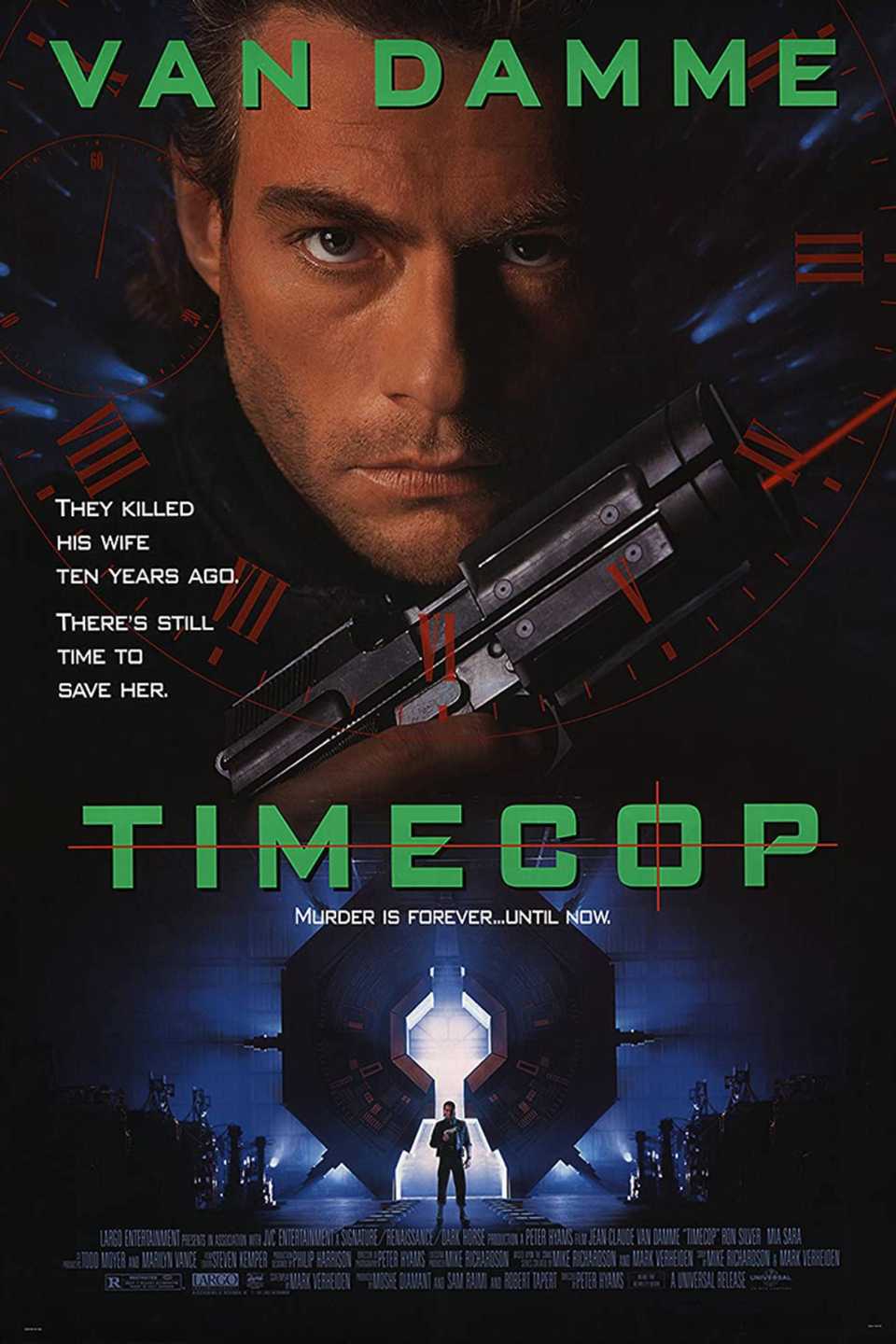
No one in the history of ever will suggest that Jean-Claude Van Damme and his films have wrongfully been denied recognition as Academy Award contenders, with 2008’s JCVD really the only film that one could make an argument for. Guilty pleasure, yes — Sudden Death is a personal favorite — but up there with Citizen Kane? Not so much. But Van Damme does what he does well, and one of his best sci-fi films, Timecop, married his martial arts skills with a time travel concept that works better than it arguably should. It’s also his most successful film, which is why, in 1996, ABC ordered a series based on the film. That’s right: Timecop became a TV show in 1997, and you probably didn’t even realize it.
‘Timecop’ TV Series Features a More Established Time Enforcement Commission
Timecop, the movie, features Van Damme as Max Walker, an agent for the Time Enforcement Commission, or TEC, in 2004. TEC is a federal unit designed to stop criminals from going back in time, which is a thing since 1994, and prevent “time ripples,” changes made in the past to alter future events. Timecop, the TV show, takes place in 2007, and replaces Max Walker with TEC agent Jack Logan (Ted King). The TEC that Logan works for has evolved since Walker’s day into a more established unit with more agents and frequent trips to the past. Why, you may ask? Well, surprisingly, time travel technology has leaked beyond the government’s walls, and, shall we say, independent business operators are making time sleds and sending criminals into the past, for a hefty fee.
Advertisement
Advertisement
Collider Exclusive · Sci-Fi Survival Quiz Which Sci-Fi World Would You Survive? The Matrix · Mad Max · Blade Runner · Dune · Star Wars
Five universes. Five completely different ways the future went wrong — or sideways, or up in flames. Only one of them is the world your instincts were built for. Eight questions will figure out which dystopia, galaxy, or desert wasteland you’d actually make it out of alive.
💊The Matrix
🔥Mad Max
🌧️Blade Runner
Advertisement
🏜️Dune
🚀Star Wars
Advertisement
01
You sense something is deeply wrong with the world around you. What do you do? The first instinct is often the truest one.
Advertisement
02
In a world of scarcity, what resource do you guard most fiercely? What we protect reveals what we believe survival actually requires.
Advertisement
03
What kind of threat keeps you up at night? Fear is useful data — if you’re honest about what you’re actually afraid of.
Advertisement
04
How do you deal with authority you don’t trust? Every dystopia has a power structure. Your approach to it determines everything.
Advertisement
05
Which environment could you actually endure long-term? Survival isn’t just tactical — it’s physical, psychological, and very much about where you are.
Advertisement
06
Who do you want in your corner when things fall apart? The company you keep is the clearest signal of who you actually are.
Advertisement
07
Where do you draw the line — if you draw one at all? Every survivor eventually faces a moment that tests what they’re actually made of.
Advertisement
08
What would actually make survival worth it? Staying alive is one thing. Having a reason to is another.
Advertisement
Your Fate Has Been Calculated You’d Survive In…
Your answers point to the world your instincts were built for. This is the universe your temperament, your survival instincts, and your particular brand of stubbornness were made for.
Advertisement
The Resistance, Zion
The Matrix
You took the red pill a long time ago — probably before anyone offered it to you. You’re a systems thinker who can’t help but notice the seams in things.
Advertisement
You’re drawn to understanding how the system works before figuring out how to break it.
You’d find the Resistance, or it would find you — your instinct for spotting constructed realities is the machines’ worst nightmare.
You function best when you have access to information and the freedom to act on it.
The Matrix built an airtight prison. You’d be the one probing the walls for the door.
The Wasteland
Mad Max
The wasteland doesn’t reward the clever or the well-connected — it rewards those who are hard to kill and harder to break. That’s you.
Advertisement
You don’t need comfort, community, or a cause larger than the next horizon.
You need a vehicle, a clear threat, and enough fuel to outrun it — and you’re good at all three.
You are unsentimental enough to survive that world, and decent enough — just barely — to be something more than another raider.
In the wasteland, that distinction is everything.
Los Angeles, 2049
Blade Runner
You’d survive here because you know how to exist in moral grey areas without losing yourself completely.
Advertisement
You read people accurately, keep your circle small, and ask the questions others prefer not to answer.
In a city where humanity is a legal designation rather than a feeling, you hold onto something that keeps you functional.
You’re not a hero. But you’re not lost, either.
In Blade Runner’s world, that distinction is everything.
Arrakis
Dune
Arrakis is the most hostile environment in the known universe — and you are precisely the kind of person it rewards.
Advertisement
Patience, discipline, and political awareness are your core strengths — and on Arrakis, they’re survival tools.
You understand that the long game matters more than any single victory.
Others come to Dune and are consumed by it. You’d learn its logic and earn its respect.
In time, you wouldn’t just survive Arrakis — you’d begin to reshape it.
A Galaxy Far, Far Away
Star Wars
The galaxy far, far away is vast, loud, and in a constant state of violent political upheaval — and you wouldn’t have it any other way.
Advertisement
You find meaning in being part of something larger than yourself — a cause, a crew, a rebellion.
You’d gravitate toward the Rebellion, or the fringes, or whatever pocket of the galaxy still believes the Empire’s grip can be broken.
You fight — not because you have to, but because standing aside isn’t something you’re capable of.
In Star Wars, that willingness is what makes all the difference.
So it falls on the agents of the TEC, including Logan and his partner (and eventual love interest), Officer Claire Hemmings (Cristi Conaway), to go back in time, and capture and arrest these criminals before they alter history. They’re aided by Dr. Dale Easter (Kurt Fuller), the TEC’s chief historian with the wacky ability to cite major historical events that happened in the year any movie was released, and Captain Eugene Matuzek (Don Stark), the head of the TEC and the only character (but not actor) to carry over from the film.
Advertisement
The series plays out like a conventional, “case-of-the-week” police procedural. In one, Logan goes back to Germany in 1944 to prevent advanced technology from being handed over to the Nazis, allowing them to turn the V-2 into a nuclear missile and effectively changing how World War II plays out. In another, Logan traipses to 1956 to prevent the death of a Hollywood actress who, in the future, gives birth to a U.S. president. And in the pilot episode, Logan heads to 1888 to confront Jack the Ripper, only to find that his nemesis, a mid-21st century time traveler by the name of Ian Pascoe (Tom O’Brien), has killed old Jack and taken his place, determined to “kill five times as many women” as the original.
‘Timecop,’ the TV Series, Is No ‘Timecop,’ the Movie
Say what you will about Timecop the movie, but it was filled with action, looked spectacular, and was dark and gritty, covering up flaws through sheer, enjoyable spectacle. The only thing Timecop, the TV series, shares with the film is flaws, but with nothing to hide them. Van Damme’s Walker was an agent with a vendetta and the determination and skills to see it through; Logan is a cop, like any other cop, except a time-traveling one. The martial arts and exquisite, original fight scenes, such as the famed “kitchen counter splits,” are jettisoned for banal shootouts and solving mysteries. The look of the film is the result of a high budget; the look of the series reflects its $15 million budget. And it’s early 8 p.m. time slot essentially neutered the show, forcing it to abandon the darker elements of the film.
The 1997 crime classic also stars ‘Goodfellas’ icons Robert De Niro and Ray Liotta.
Advertisement
Timecop was ravaged by the critics, with the Chicago Tribune saying, “There is only so much time in a day, and Timecop… fails to make a sufficient case for one-twenty-fourth of it,” USA Today suggesting that “Timecop doesn’t boggle the mind. It’s merely a bog,” while both the Detroit Free Press and the Newark Star-Ledger cited it as “dull and predictable.” So, despite winning a bidding war among the networks to land the show based solely on the premise, ABC pulled the plug after only 9 of the 13 filmed episodes made it to air.
So, all that said, you’re forgiven if you didn’t realize that Timecop the movie begat Timecop the TV show. The series was forgettable from the start, and unless you can travel back in time and stop it from ever having happened in the first place, Timecop is best left alone. What’s disappointing is that the premise had a lot of potential, but it wasn’t used effectively. DC’s Legends of Tomorrow has a similar concept, but uses it far more imaginatively. Van Damme it all anyway. But here’s an interesting fact: in 1996, the year that ABC ordered the series, Jean-Claude Van Damme was on television. Not as Max Walker, but as a fictionalized version of himself, filming Outbreak 2, in a cameo on NBC’s hit series Friends, which, funnily enough, he would have liked to have gone back in time and done a better job of.




You must be logged in to post a comment Login