Entertainment
This Star Trek Movie Fixed the Franchise, and It’s Not the One You’d Expect

Though Star Trek is one of the most bankable franchises in the world today, Star Trek: The Original Series debuted in 1966 to low ratings, and only avoided cancellation after its second season due to an organized letter-writing campaign. Local TV syndication of the original series’ first three seasons led to a resurgence, which led to conventions, merchandising, and eventually, the promise of a new series: all the newfound fan interest prompted Paramount to announce Star Trek: Phase II in 1977, a new series with the original cast returning (except for Spock). But when that series never made it to air, the road for Star Trek: The Motion Picture opened up.
The film was a modest success, but derided for its slow pacing and lack of action — issues which were corrected by the far-better received Star Trek II: The Wrath of Khan, which promptly saved the franchise. Only it didn’t: Star Trek IV: The Voyage Home celebrating its 40th anniversary this year, did, by repairing a franchise most didn’t recognize had been broken.
‘Star Trek II: The Wrath of Khan’ Broke the Franchise (and Its Follow-up Didn’t Help)

Star Trek II: The Wrath of Khan is widely heralded as the best film to feature the original cast, and rightly so. Ricardo Montalban‘s Khan makes a seamless transition from television baddy in “Space Seed” to full-blown movie villain, in turn bringing out the best in Captain Kirk himself,William Shatner. The battle scenes are remarkable and full of action, and the death of Spock is among the most heartbreaking moments in the sci-fi genre.
It was not, however, even the most shocking moment in the film’s production; that honor would have to go to creator Gene Roddenberry‘s active attempts to sabotage the film.While much of that can be attributed to Roddenberry’s indignation at being ousted from his creative role in the film franchise, he did make a point: Paramount sold Star Trek‘s soul for Star Trek II: The Wrath of Khan‘s bigger box-office. Roddenberry felt the movie militarized Starfleet, with its excessive violence at odds with the pacifist ideals he had instilled in the franchise from the start, best exemplified in Starfleet’s Prime Directive. One can debate if his views are justified or not, but it’s hard to deny the distinct change in tone from the first film to the second, from philosophy to frontier justice.
And if Star Trek II: The Wrath of Khan “broke” Roddenberry’s vision of the franchise, Star Trek III: The Search for Spock stepped on the pieces. Its very existence is attributed to reversing the death of the ever-popular Spock (Leonard Nimoy), tainting the film’s legitimacy within the franchise. The militarization of Starfleet was still very much in play, and the exploration and discovery that drove the original series had fallen by the wayside. But the biggest thorn in the creator’s side came from the decision to destroy the USS Enterprise, which Roddenberry saw as an essential part of the franchise, as important as any one character. While the film did serve as a Band-Aid of sorts, with the themes of loyalty and friendship hewing far closer to Roddenberry’s vision, it didn’t fix what had been broken.
How ‘Star Trek IV: The Voyage Home’ Fixed the Franchise
The Star Trek franchise was at a crossroads: would the fourth Star Trek film continue the box-office-friendly trajectory it was currently on, arguably more Star Wars than Star Trek; or would it restore Roddenberry’s vision? The answer: Both. Star Trek IV: The Voyage Home stood out as the highest-grossing Star Trek movie until the release of 2009’s Star Trek, which rebooted the franchise.
Otherwise known as “the one with the whales,” Star Trek IV: The Voyage Home sees the crew in exile on Vulcan after the events of the last film, set to return home, voluntarily, to face the consequences of their actions. Only their travel back to Earth coincides with the arrival of a giant, cylindrical probe that renders anything in its path powerless, with a signal aimed at the Earth’s oceans.
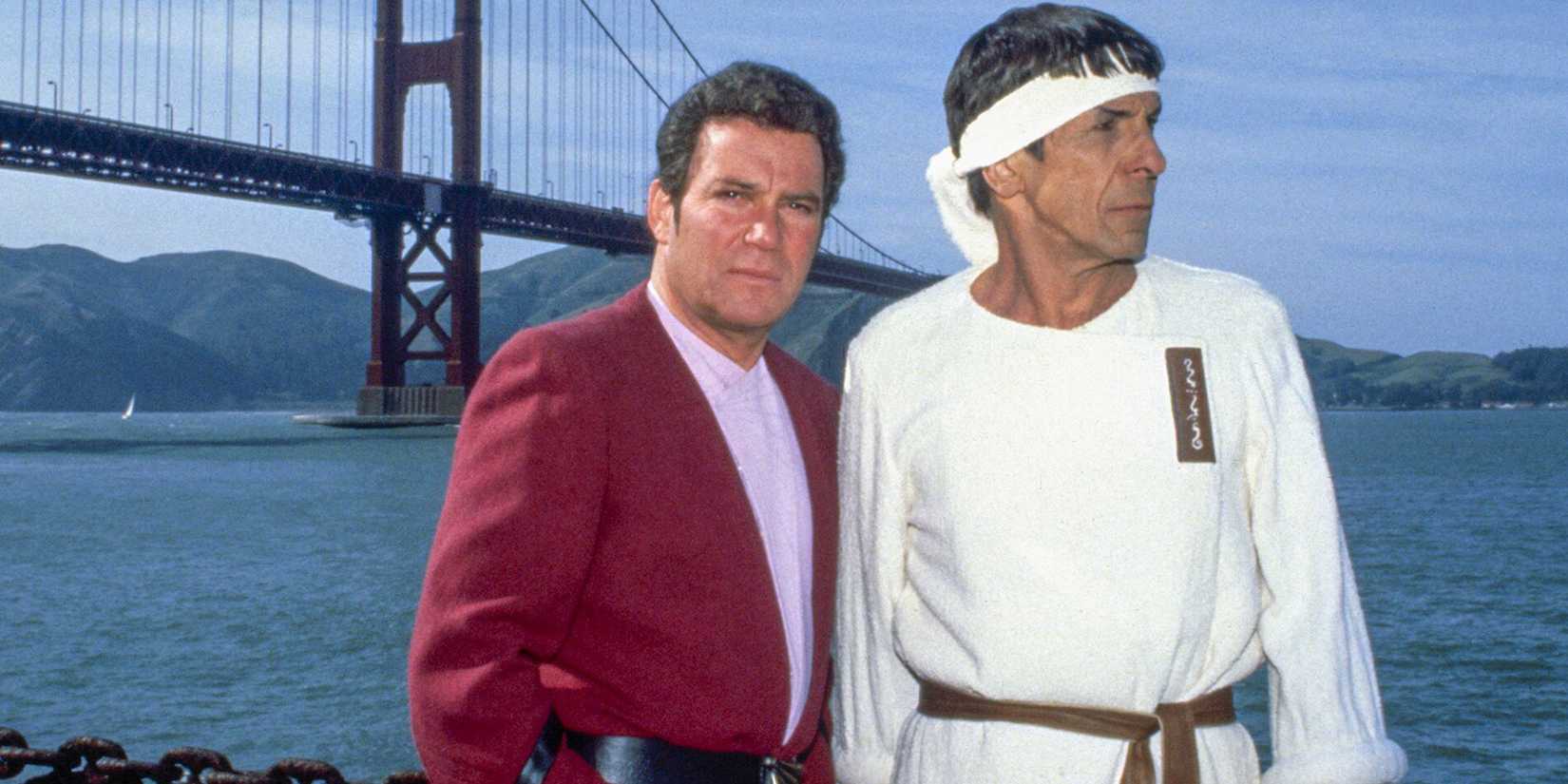
Here is where the film starts franchise repairs. Other sci-fi films would have spent the entire run time searching for a way to destroy probe, wrapping up the movie with a spectacular final battle that sees it blown to bits. But Star Trek IV allows the crew of the ex-USS Enterprise to take the time to study what the monolith is searching for, before realizing that it is the sound of extinct humpback whales. And the plan they formulate involves not confrontation, but going back in time to explore the “strange new world” of 1986 San Francisco.
Again, it would have been easy to simply take what they needed and go, but the peaceful, right way to do it is to gather what is necessary without resorting to violence. This also gives each crew member a chance to shine, and brings back the humor and optimism that had been missing from the last two installments. And when the whales they plan on taking home are under threat from a whaling ship, they hilariously uncloak their Klingon Bird of Prey and teach the whalers a lesson they’ll never forget. They bring the whales back to the future along with cetologist Dr. Gillian Taylor (Catherine Hicks), a return to the casual disregard of a sacred timeline that has been an element of the series from the start. The whales answer the signal, the giant monolith goes away, and all is well in the Federation — and the franchise — again.
In David Alexander‘s Star Trek Creator: The Authorized Biography of Gene Roddenberry, Alexander notes that Roddenberry loved the film; its anti-war, pro-environment and optimistic messaging, combined with the central dilemma being resolved with intelligence and humor, endeared it to the Star Trek creator. It was, and is, a return to form, capped off with the introduction of the newly christened USS Enterprise, NCC-1701-A, righting the wrong and symbolizing that the franchise has been fixed. Until Star Trev V: The Final Frontier screwed it up again, that is.
You must be logged in to post a comment Login