Entertainment
When Everyone Is Different No One Is, Star Trek Proves It
By Joshua Tyler
| Updated


Star Trek has a new show out, and this is a list of its characters, as Starfleet Academy itself describes their identities and origins.
- Caleb Mir: A human orphan.
- Jay-Den Kraag: A half-human, half-Klingon hybrid.
- Lura-Thok: A half-Jem’Hadar, half-Klingon hybrid.
- Sam: A sentient hologram who is only a few months old.
- Darem Reymi: A Khonian.
- Genesis Lythe: A Dar-sha hybrid.
- Tarima Sadal: A Betazoid with extreme-powers.
- Nahla Ake: A Lathanite, hundreds of years old.
- The Doctor: A sentient hologram, hundreds of years old.
Who stands out from that group? Caleb, because he’s a human, and I am confident I can pronounce his first name. The rest are like the roster of an unsuccessful superhero team with names I can’t remember or say. I don’t know what most of these words are; it’s a bunch of newly invented letter configurations with no real meaning. It all runs together into one big blob of alphabet nothing.
I’m pretty sure “nahala ake” is the sound people make when they sneeze.
Star Trek’s Original Characters

Now here’s the cast of the original Star Trek series, as the show would have described them.
- James T. Kirk: A human from Iowa.
- Spock: A half-human, half-Vulcan from the planet Vulcan.
- Leonard McCoy: A human from Georgia.
- Montgomery Scott: A human from Scotland.
- Sulu: A human from Japan.
- Chekov: A human from Russia.
- Uhura: A human from Africa.
Among that group, Spock stands out as unusual and exceptional, because he’s very different from the types of people we’re used to. It doesn’t diminish the others, who become extremely well fleshed-out characters through their personalities and actions. However, it does give Spock an unusual starting point.
If I’d never watched Star Trek, I wouldn’t know how to pronounce Uhura, but I also don’t expect to be able to pronounce African names right off the bat. So that’s a good thing.
The Next Generation’s Characters

Let’s try a different Star Trek show. Here’s the cast of Star Trek: The Next Generation.
- Jean-Luc Picard: A human from France.
- William Riker: A human from Alaska.
- Data: An android.
- Beverly Crusher: A human woman.
- Geordi LaForge: A human man.
- Deanna Troi: A half-Betazoid empath.
- Tasha Yar: A human woman from a colony.
- Worf: A Klingon.
Who stands out in that group? Worf, because he’s a Klingon and that’s weird on a Federation starship. I know how to say “Worf!” without anyone telling me. Better still, it’s a fun word to say. Try it: “Worf!”
Data also stands out because he’s a robot. He also has a four-letter name, and it’s made up of a word I already know.
What’s going on with that Betazoid? She sounds interesting. Her last name is odd but simple and easy to remember. Would a half-Betazoid stand out if everyone with her on the ship was a half-something? No, no, she would not.
The Characters Of Deep Space Nine
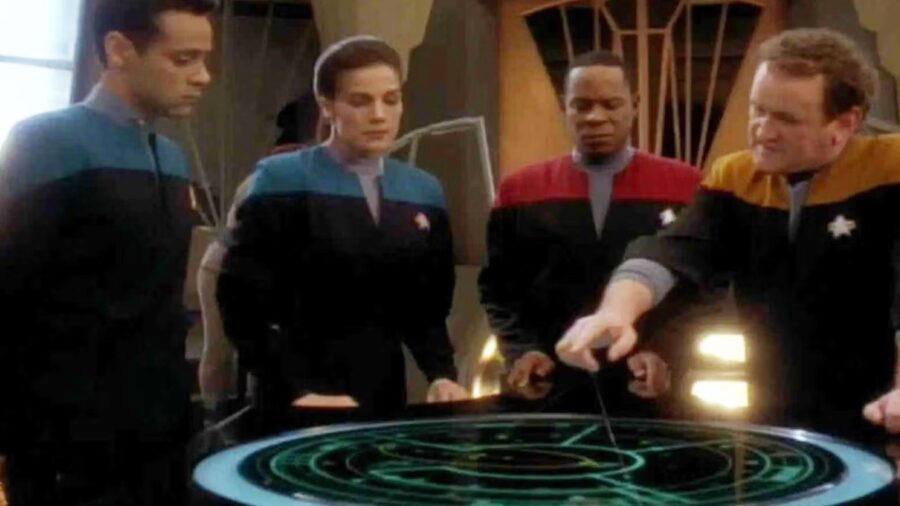
Let’s try Star Trek: Deep Space Nine. That Star Trek show takes place on a totally alien space station, which means if any Star Trek series has a good reason to have a really wild group of characters, it’s Deep Space Nine.
- Ben Sisko: A human from Louisiana.
- Kira Nerys: A Bajoran terrorist.
- Miles O’Brien: A human from Ireland
- Odo: A shapeshifter
- Jake Sisko: A human from Louisiana.
- Jadzia Dax: A Trill from Trill.
- Julian Bashir: A human doctor.
- Quark: A Ferengi.
Who stands out in that group? Now it’s getting more complex. But half the cast is still composed of straightforward human characters with straightforward human names, people I can understand without a 5-episode story arc to explain their superpowers.
Ben, that’s a nice name for a Captain. Sort of like Jim. Or Jonathan. Or Kathryn. Seems like a person I can understand, and it’s easy to remember.
Deep Space Nine’s strange alien characters also have straightforward, simple names. The shapeshifter’s name is only three easy-to-pronounce letters. So is the last name of the Trill. Kira’s name is only four letters and close enough to a normal English name that I can probably guess how it’s pronounced. Her last name (actually, it’s more like her first name; it’s a Bajoran thing), Nerys, is rarely used on the show, so it doesn’t matter much. And because I took high school science, I already know how to say the word “Quark.”
Deep Space Nine managed the increased complexity of its cast’s origins and identity and then intentionally kept their names straightforward and simple. Then it gave the audience a lot of human characters mixed in with the aliens, so they had someone to easily identify with, without the need for extensive explanation
How Too Much Difference Creates Sameness

When you compare the cast of Starfleet Academy to the shows that came before it, you start to see the problem with the modern push to cram differences into everything. When all characters are a deviation, a subversion, or a novelty, difference isn’t contrast anymore; it’s the baseline.
Classic Star Trek worked because difference was relative. Spock stood out because everyone else was human. Worf mattered because Klingons were rare. Data was compelling because he was the only android in the room. The audience had a stable “normal” to measure against, which made the outsiders meaningful. Identity had narrative weight because it created friction.
In Starfleet Academy, there is no friction. When every character is defined primarily by how unusual they are, uniqueness collapses into sameness. The half-Klingon isn’t strange because there are multiple hybrids. The hologram isn’t unusual because the show already treats the artificial as routine. Nothing challenges the world because the world is already maximally diversified.
Half the fun in classic Trek is in exploring the differences between people who are otherwise the same. Those characters weren’t defined by their identity, which gave them more room to grow into individuals with their own selves, defined by their actions rather than a bunch of made-up words.
By defining your characters with diverse identities, this doesn’t create richness, it creates homogenization. Everyone occupies the same narrative lane: “I’m different, but I belong.” When that’s everyone’s story, it stops being a story and becomes wallpaper. Difference only matters when it’s rare enough to cost something. Without contrast, identity becomes aesthetic rather than dramatic.
In trying to make everyone special, Starfleet Academy and most other modern shows doing the same thing prove that distinction requires limits. Without those limits, all differences blur into none.
You must be logged in to post a comment Login