Fashion
Six Decades On, Celia Birtwell Is Still Setting the Pace of British Fashion


Article by: Fashanista
There is a particular kind of British fashion figure who never quite retires, who simply keeps turning up at the right shows in the right decades, quietly reshaping what “cool” means for a new generation while everyone else assumes she’s tending roses in Shropshire. Celia Birtwell, 85, is exactly that figure. And this autumn she is having, improbably, one of the biggest moments of her career.
A new exhibition, Ossie Clark + Celia Birtwell, opens at London’s Fashion and Textile Museum, revisiting the partnership that made her and her late former husband the defining design duo of Britain’s psychedelic late 1960s and early 1970s. At the same time, Birtwell has just co-designed Burberry’s entire London Fashion Week collection with creative director Daniel Lee — a collaboration she mentioned to a journalist almost as an afterthought, tucked between talk of her grandchildren and her ongoing battle with fine hair and unforgiving hot rollers.
That mismatch between how Birtwell describes her own life and what she is actually still doing is, in a way, the whole story. She has never traded on the mythology of her past the way the fashion industry might expect her to. Yet that mythology is extraordinary, and it is worth remembering exactly why.
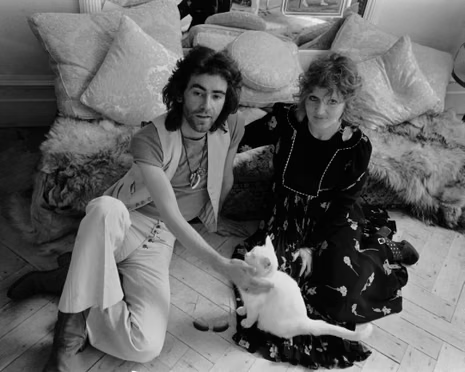

In the years between Mary Quant’s miniskirt and the arrival of punk, Birtwell and Clark were London’s most fashionable couple, full stop. She drew the botanical, dreamlike prints — chiffon patterned with loose, romantic doodles that somehow captured the entire loosening of manners and morals happening around them. He cut those fabrics into bias-cut dresses that blended old Hollywood glamour with rock’n’roll recklessness. Together they ran Quorum, the Chelsea boutique where Talitha Getty, Marianne Faithfull and Anita Pallenberg came to shop and to be seen. Two Beatles, Cecil Beaton and Brigitte Bardot once sat in the audience at one of Clark’s shows. He later designed stage costumes for Mick Jagger and toured with the Rolling Stones. David Hockney’s 1970-71 portrait of the couple, Mr and Mrs Clark and Percy — painted while Birtwell was pregnant with their second child — didn’t just capture a marriage; it canonised an era.
The romance behind the clothes was, by Birtwell’s own account, a mixed blessing. She met Clark as an art student in Manchester, introduced by a friend eager to show her “a really mad boy.” He was, in her recollection, dazzling in those early years — turning up from Portobello Road with vases and fabric scraps he thought she’d love, bringing home a new record every week. “The first two or three years were very nice,” she says now, with the understatement of someone who has had five decades to make peace with what came after. Clark left her at home, pregnant, the day after their wedding to honeymoon alone in Barbados. He was openly bisexual, prodigiously gifted, and, in Birtwell’s words, ultimately more interested in partying than in almost anything else. Fame only accelerated that. The marriage ended in 1974, and Clark’s later years brought addiction, bankruptcy and, eventually, his murder at 54 by a former boyfriend.
It would be easy for an exhibition built around that history to lean into tragedy, or into nostalgia for its own sake. But what makes this particular fashion moment interesting is how directly the past is being folded into the present rather than simply displayed behind glass. Birtwell isn’t just the subject of a retrospective; she’s an active collaborator on a major luxury house’s current collection. That is a genuinely unusual position for a designer whose signature prints are more than half a century old, and it says something about where fashion is looking right now.
The industry has spent the past several seasons in a prolonged flirtation with 1970s bohemia — sheer fabrics, romantic floral prints, loose bias cuts, a general softness in silhouette that owes an obvious debt to exactly the aesthetic Birtwell and Clark pioneered. Daniel Lee’s decision to bring her in directly, rather than simply gesturing at the era through a moodboard, is a tacit acknowledgment that the real thing still has more to say than any pastiche of it. There’s a lesson there for an industry often accused of recycling its own history without crediting the originators: sometimes the originator is still very much alive, still has ideas, and would rather be asked than referenced.
For Birtwell, the renewed attention seems to sit lightly. She talks about Pattie Boyd’s figure and Ossie’s talent with the same warmth she brings to complaints about Carmen rollers scorching her hair. That ease is its own kind of style — a refusal to perform either grief or triumph on demand, even while both are clearly present. She has, by all accounts, spoken with real sorrow elsewhere about losing David Hockney, her friend and one-time chronicler, whose portrait of her and Clark remains perhaps the single image most responsible for keeping their story alive in the public imagination.
What the Fashion and Textile Museum show and the Burberry collaboration together suggest is that Birtwell’s real legacy was never just the prints, or even the marriage that generated so much period gossip. It’s a way of working — instinctive, unhurried, personal — that the current fashion cycle, for all its algorithms and trend forecasting, still can’t quite manufacture on its own. Sixty years on, that apparently remains in short supply, and increasingly valuable.
You must be logged in to post a comment Login