

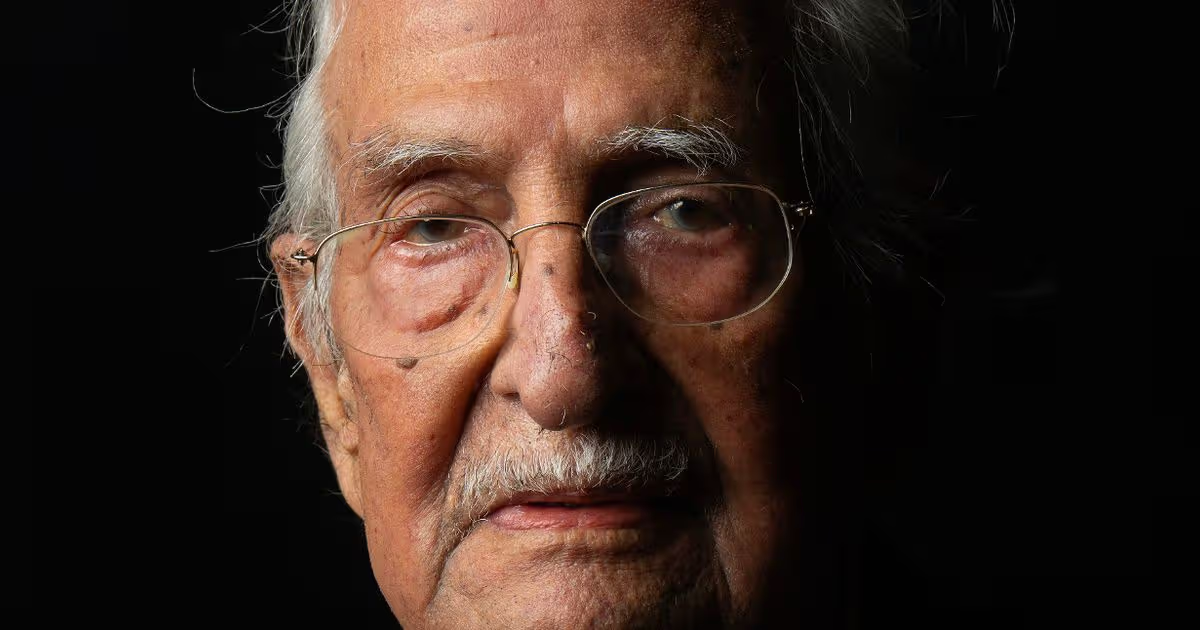
It is a day Yavar Abbas never thought he’d see in his lifetime. Now he hopes to stay alive to see the King lay the first wreath at a memorial for the British Indian soldiers who fought in World War I and World War II.
A 105 year old war hero who moved the King and Queen to tears at the 80th anniversary of VJ Day, said he was “thrilled” to “still be alive” to see the launch of a memorial to the United British Indian Army.
Tearful veteran Yavar Abbas was given a hero’s welcome as he spoke at a parliamentary reception to launch the Freedom Fountain memorial in the Speaker’s House.
An “enormous” two metre banyan tree fountain is to be erected in Cambridge to honour those volunteers of the ‘forgotten’ Indian Army who served in World War I and II.
A massive 1.3 million Indian soldiers served in the First World War and more than 2 million fought in the Second World War. More than 87,000 died in the latter. In Burma they saw some of the harshest and most brutal conditions of World War II as they fought the Japanese.
READ MORE: One of the last hero Chindits from the ‘forgotten army’ has diedREAD MORE: ‘A stranger asked me one question and it saved my life – so now I save others’
But despite their bravery they were not honoured with their own memorial in the UK until now.
It is hoped the memorial, in the shape of a Banyan Tree, India’s national symbol, will be built in time for Remembrance Day.
Announcing the Freedom Fountain memorial, Veteran Yavar Abbas said: “I could not have wished for a better thing to have happened in the closing years of my life, than to be privileged to be associated with this noble cause.”
Yavar was a combat cameraman who served in the 11th Sikh Regiment, and twice escaped death. He ended up in Hiroshima after the two atomic bombs were dropped on Japan where he encountered “utter desolation”.
The “thrilled” veteran said: “Bridging Worlds Freedom Fountain, is my humble opinion, a beautifully conceived project to memorialise a remarkable organisation – the British Indian Army 1898 – 1947. I am proud to have served…”
Talking about why the Indian Army was so special he explained they were volunteers and four million of its troops took part in “two of the most terrible wars imaginable”.
“My wish is that I will live long enough to see the King lay the first wreath on our proposed monument,” he said.
“And it is also my wish that a replica will find a suitable place in the hallowed grounds of the National Arboretum.”
Last year Capt Abbas stood on stage in front of King Charles III and Queen Camilla and went off script telling the nation he wished “to salute my brave King who is here with his beloved Queen in spite of the fact that he’s under treatment for cancer.”
The King and Queen became visibly emotional. Yavar went on to tell the crowd he had been free of cancer too for the past 25 years, receiving a round of applause.
Capt Abbas said he now hopes to still be alive when his beloved King lays a wreath at the memorial in Cambridge. Organisers are half way to raising the £180,000 needed to pay for the stunning memorial.
The Speaker, Lindsay Hoyle, who hosted the launch, said: “The British Indian Army was one of the greatest volunteer forces in history, yet for many years insufficiently recognized in our national story.
“Events such as this help ensure that remembrance is inclusive, accurate and shared. That is why. We are so honored tonight to be joined by Captain Yavar Abbas who is an incredible 105 years old.
“Captain Abbas served during the Second World War with the 11th Sikh Regiment, and is one of a diminishing generation of veterans whose lived experience connects us directly to that period of history, and we mustn’t forget about the people that served with you and those who didn’t come back from that conflict.
“His life story reflects the wider contribution of Commonwealth soldiers who’ve shaped the service of Britain’s war time history…Thank you for your service in the Second World War. It was for our freedom and our democracy that you ensured we’re here today.
“I salute you for all you’ve done and the sterling service of your comrades.”
Colleen McLaughlin Barlow, the artist behind the design, said she had “faced a huge challenge.”
“How to create a memorial that history, politics, and circumstance have never allowed to exist.
“There hasn’t been a fully inclusive memorial to all these men from different countries, cultural and religious backgrounds, nothing to honour all of them and their huge contributions in both world wars.
“I reached back into their histories, the histories of the soldiers to imagine how they would want to be remembered.
“I’m sculpting an enormous banyan tree which will be cast into bronze using recycled metals.
“The banyans is the national tree of India and it has these astonishing aerial roots that grow down from the branches and into the ground and then new tree trunks rise up and the entire Forest spreads laterally.
“It’s this heaving interwoven mass of enduring life. The tree is a symbol of endurance, shelter, and continuity across generations, eternity.”
She explained water will “weep gently down from the branches” into a stone pond.
Abdul Kayum Arain, Chair of Trustee, Bridging Worlds (CIO) and Freedom Fountain lead told The Mirror: “Millions served, many died, and for decades their sacrifice went largely unrecognised.
“The Freedom Fountain is our way of saying: we remember, we honour you, and you belong in Britain’s story.
“The Freedom Fountain is about recognising a truth that has been overlooked for too long – that millions from the United British Indian Army helped secure the freedoms we all enjoy today. This memorial is not about the past alone; it is about dignity, belonging, and ensuring those sacrifices are finally remembered.”
Yavar told The Mirror: “I feel very excited about it. We should have had a memorial for the Indian Army a long, long time ago.
“The Indian Army was disbanded in 1947 because of Partition and has remained unhonoured up to now.
“It’s important to Britain, it’s more important to India, it is important to Pakistan, important to everybody.
Appealing for donations after organisers were granted charitable status, he added: “It’s a public monument. It’s not supported by any Government. It is supported by the British public.
“ I have approached the King for support, and the project has gone to him. It’s an open secret that I declared my love for the King loudly from the steps of the Arboretum.
“I share his values, his ideas, his love for nature, his regards for the environment, his views about integration.
“He wants to celebrate the immigrants who’ve done great service to this country.”
One of the team fighting for this memorial Adam Moghadas said of the soldiers in the Indian Army: “They served as infantry, pilots, medics, engineers and support staff. They’re all united by courage and sacrifice. Their contribution has, in my opinion, shamefully been overlooked.
“I think it’s also important to highlight that these service personnel did so while serving an empire that denied them equality, freedom and a voice. And I think that makes it all the more significant that these volunteers were fighting for ideals that they were not allowed yet to fully claim. And that contradiction, in my opinion, makes their service all the greater.”









































You must be logged in to post a comment Login