
International Dawn Chorus Day (May 3 for 2026) is a great time to hear the UK’s birds at their most vocal. While we can enjoy the variety and beauty of birdsong, for the birds themselves it serves more practical purposes – to attract a mate and establish and defend a breeding territory.
Birds can produce complex vocal sounds, which we refer to as “song” because they have a vocal organ called the syrinx – which, unlike the larynx possessed by mammals like the human, can make two distinct notes simultaneously. This ability to generate notes in rapid succession is helpful because birds hear their song and the songs of other birds differently to humans.
Research suggests that they are able to perceive small and rapid changes in sound much more clearly than we can, meaning what we may hear as a single or buzzy note will be distinguished by them as multiple notes. Birdsong to a bird is something of much greater complexity than we can apprehend.
International Dawn Chorus Day brings casual bird appreciators, ornithological experts and dedicated twitchers together in a celebration of birdsong. In our series, experts give their insights on nature’s chorus.
While I understand that I hear bird song very differently to the creatures that make it, my background as a music producer, field recordist, sound artist – and keen amateur birdwatcher (and listener) – has made me think about which notable musicians and pieces of music might have something in common stylistically with the songs of certain birds. The following is both speculative and entirely subjective and I would welcome other ideas and opinions.
Blackbird
Whether delivered from rooftop or treetop, their sweet, tender and calming song, which has been likened to human whistling, can often be heard book-ending our daylight hours. Bobby McFerrin’s whistled introduction to Don’t Worry Be Happy captures something both of the blackbird’s performance and sense of ease it can create in the listener.

Though joined by visitors from colder climes in autumn and winter, our breeding population of blackbirds are common year-round residents in UK gardens and woodlands.

Nightingale
There are few wildlife experiences in the UK that can match hearing a nightingale singing at close range, and this summer visitor – a scarcer cousin of the blackbird and song thrush – should be in full voice by International Dawn Chorus Day. The dynamics, dexterity and variation in its song are extraordinary, and it is no surprise that it has inspired poets such as Keats, Milton and Rossetti, and composers including Stravinsky, Beethoven and Rimsky-Korsakov.

When thinking about a musician who can get some way to matching the expressiveness of the nightingale, Italian American operatic soprano Amelita Galli-Curci’s 1927 recording of the Russian popular song The Nightingale (Solovey) by Alyabyev
captures something of the bird’s style with her nimble and vivid flourishes.
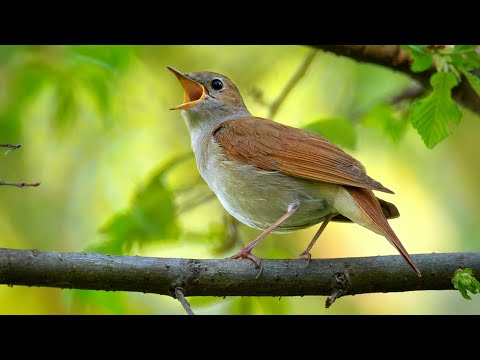
However, the nightingale is known for never performing the same song twice, and as
one of nature’s great musical improvisers, a better match might be the solos of jazz saxophonist John Coltrane.

In Bye Bye Blackbird Coltrane combines fast-paced bursts of melody with more thoughtful and lyrical sections, evoking something of the nightingale’s song. Coltrane is also quite a loud player and nightingales, as anyone who has heard one in the flesh will know, are loud – you can’t miss them.
Reed warbler

A wetland reedbed bird that arrives in the UK in mid-April, the reed warbler
couldn’t be further from the melodic and rhythmic variation of the nightingale. It prefers an almost monotonic song.

The hypnotic main riff on New York DJ and producer Joey Beltram’s Energy Flash comes to mind for its rhythmic solidity, while its subtle filter adjustments evoke the bird’s buzzy modulation.
Sedge warbler

The reed warbler, or at least its sound, might not be out of place in a subterranean Berlin techno club at 4am, but its reedbed neighbour the sedge warbler is much more of a bebop hep cat. Its fast and complex patterns combining staccato sections with more melodic phrases could recall the sharp accents and raid trills of “the Bird” himself – legendary saxophonist Charlie Parker.
But for me, the sedge warbler is too buzzy and raspy for the smooth tones of a tenor sax, and the rapid-fire delivery of trumpeter Fats Navarro on cuts like Wail or The Chase is a better fit.

Blackcap
One of our more common migrant warblers in the UK, the blackcap’s loud and
frequent song can be heard in wooded areas across the country. To my ears, its
volume and power is matched only by its tunelessness, with every note sounding just
a little flat or sharp in relation to what proceeds and follows.

It is reminiscent of an enthusiastic singing talent show auditionee belting out Anastasia’s I’m Outta Love. Nine out of ten for effort, but a much lower score for the precision of its pitching.
Bittern

The elusive bittern is usually a bird to be heard but not seen. Another denizen of the reedbed, its booming song can be likened to someone blowing across the top of a very large bottle or beginning to play a giant didgeridoo and then thinking better of it. Like the reed warbler, it prefers to stay hidden among the reeds where it provides some serious sub bass accompaniment to that other bird’s techno riffing. Think of a bleep-and-bass classic like LFO by LFO.

I hope you enjoy the variety and virtuosity of song on offer in your own garden, local park or woodland on International Dawn Chorus Day. Or like me, you can head for the rave going on at your nearest wetland nature reserve.
You must be logged in to post a comment Login