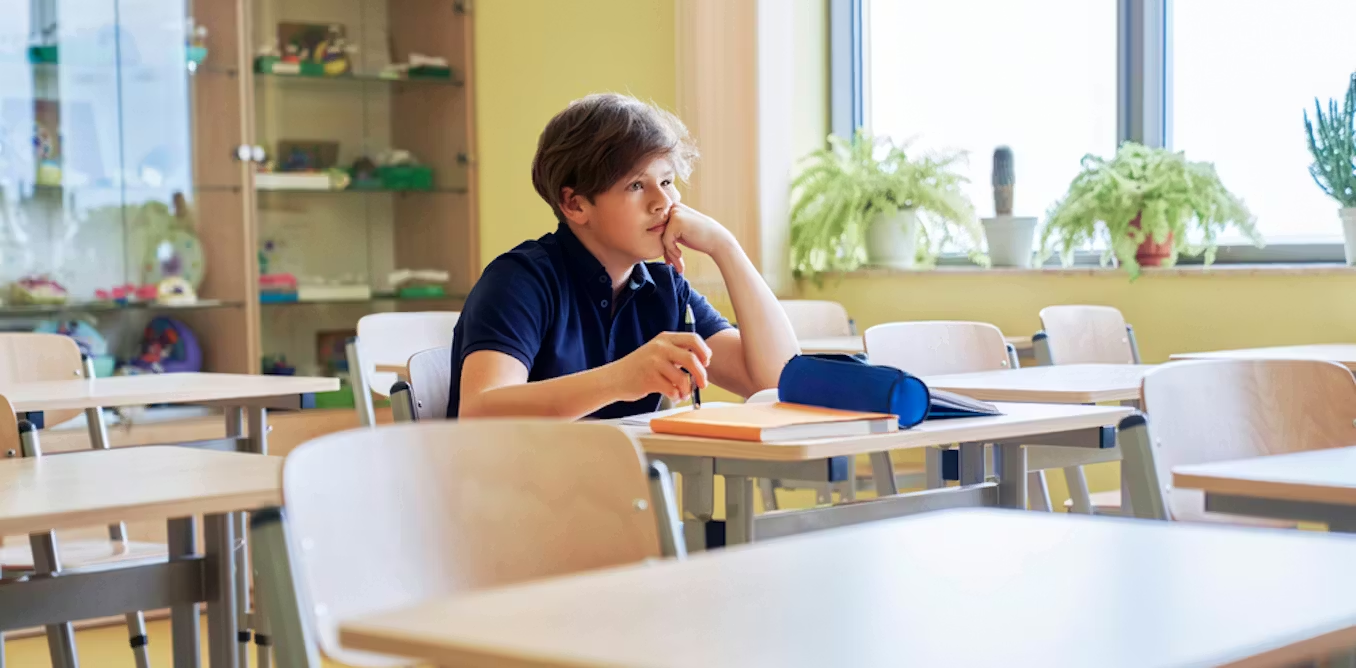
Persistent concerns about poor behaviour in UK secondary schools have led to the widespread implementation of disciplinary behaviour management strategies. These include the use of isolation rooms, where children are sent to work alone.
In some schools, it may also include zero-tolerance sanction systems such as “Ready to Learn”. This is an approach in which a graduated sanction system is applied for non-compliance: any minor rule-breaking gets a warning, and any further infractions mean going to isolation.
However, a new wave of research is challenging the long-standing dominance of punitive strategies. My ongoing research with colleagues has shed light on the perspectives of young people, school staff and behaviour experts, revealing the need for a critical reassessment of school behaviour management policies and practices.
Our study on behaviour in schools was initiated by members of our Young People’s Advisory Group, which provides a way for young people aged between ten and 18 to contribute to health and care research. The young people raised deep concerns about the impact of disciplinary behaviour management strategies being used in secondary schools.
We systematically reviewed the evidence to investigate the impact of disciplinary strategies on students, and found they may have a negative impact on mental health and wellbeing and behaviour. We then interviewed 15 young people and 17 secondary school staff and experts in behaviour to understand their views and experiences.
The young people we worked with felt that disciplinary behaviour management strategies, particularly isolation use, were ineffective at addressing poor behaviour. They also believed that it had a negative effect on their mental health and wellbeing, as well as their academic and social lives. They described the Ready to Learn approach as harsh, confusing, and inconsistent. One said:
If you had the wrong-coloured socks on or something like that you’d get a warning or a detention. Then that would lead to you getting angry and you’d get an isolation.
Another commented that: “They don’t try to find out why you’ve done it or anything like that. They just put you in isolation. They don’t really care.”
Addressing causes
The young people voiced a preference for disciplinary approaches rooted in relationships and understanding. Approaches that seek to address the causes of behavioural issues, rather than those that rely on sanctions and exclusionary practices. One suggested:
People would go to a room and sit down on a table with everybody, work together to work out what they did wrong in the lesson, how they could be better next time. And not only what and how, but why. Why is this occurring and then that would also create a platform for anyone to seek help and support of any needs that they had as well.
We also talked to school staff. Some described Ready to Learn as beneficial due to its clarity, consistency, and ability to reduce classroom disruption. Its centralised structure, affordability, and simplicity were seen as advantages. However most expressed the desire for a more therapeutic approach alongside Ready to Learn.
One teacher said:
What we’re missing, is a complementary or alternative narrative at whole-school level to RTL [Ready to Learn]. So, the idea of RTL sitting as a structure but alongside therapeutic or trauma-informed, more relational approaches to dealing with behaviour.
Interestingly, both school staff and experts in behaviour agreed on what encourages positive behaviour. They mentioned clarity, consistency, fairness, and – crucially – positive communication and relationships. They described what works: a supportive school culture that is warm and structured with predictable routines and boundaries, and high expectations delivered with empathy and support.
Here, the use of relational practices is key. This approach recognises behaviour as a form of communication, and aims to build relationships with students to help them understand their emotions and behaviour rather than punishing them.
One student described how this could work:
Talking to the student, trying to help them. Even if they’ve got anger issues and they’re being rude all the time, they could have something that’s causing them to be like that. I think that would be more beneficial.
But relational practices are rarely used. “We aren’t trained, we don’t have that expertise,” a deputy headteacher explained. “So even if we had time for it, we can’t necessarily implement it because we don’t know what we’re doing if I’m honest.”
MAYA LAB/Shutterstock
Schools face significant structural and cultural barriers. Government and most school policies encourage disciplinary behaviour management strategies and a focus on academic outcomes. They are embedded in schools and staff fear change and loss of control. Some school staff see their role as to impart knowledge, not provide pastoral care. Most lack training and expertise in relational approaches and schools face resource constraints.
Disciplinary behaviour management strategies offer an illusion of control but are failing to improve behaviour in meaningful and lasting ways. With growing evidence, especially from those directly affected, suggesting that they may be doing more harm than good, a rethink is needed.
This isn’t about going soft on behaviour. It’s about creating compassionate, inclusive schools that are smart about how they view and respond to poor behaviour.