Some days it can seem as if the whole of the tech world is hanging on the latest update to one graph.
The graph in question is made by a non-profit research institute called METR and it assesses the software development capacities of different AI models.
For many months now, this chart has been provoking excitement and unease in anyone who watches artificial intelligence because it shows a striking exponential trend – that is, a doubling in growth.
According to METR, or Model Evaluation and Threat Research, AI is getting twice as good at the startling rate of roughly every seven months.
Advertisement
The latest results turned the dial from feverish to panicked, because it showed the trend not just continuing, but actually speeding up.
METR tests AIs by assessing their ability to complete longer and longer human software tasks.
Many in tech compare the situation to the COVID pandemic because of the deceptive way doubling turns from apparently small increases to monstrous leaps.
“Nothing, nothing, nothing, everything,” was how a UK tech entrepreneur and AI researcher described the situation to me a few months ago, at a time when the METR chart was already looking fairly vertiginous (although, in retrospect, it feels as if we were barely approaching the foothills).
The progress since then makes many feel like we are rapidly approaching “everything”.
After the chart’s release, one METR researcher sent a note to his old college friends, which he posted on social media, saying: “I feel very confident now that it’s going to be totally insane and chaotic, like many orders of magnitude more chaotic than anything the world has experienced in our lifetimes.”
Advertisement
This isn’t even an unusual sentiment in tech right now. The chief executives of leading AI companies make similar statements all the time.
‘Ten times the impact of Industrial Revolution’
Even Demis Hassabis, the most measured of the AI leaders, regularly says that AI will have 10 times the impact of the Industrial Revolution, in a tenth of the timespan.
A widely-shared newsletter responding to the METR chart put it more simply: “When must I start kicking and screaming at you that it is… happening.”
Advertisement
But what exactly is “it”? On closer inspection, it becomes harder to tell.
For a start, look at what the METR chart actually measures.
The graph that shows why AI is going to be so huge
Advertisement
The details are technical, but roughly speaking it measures the length of a task that an AI can complete 50% of the time – meaning they fail as often as they succeed.
Some way off full automation
A business which turned its operations over to an AI which could complete a task half the time wouldn’t last very long.
Even 80% success – which METR also measures – wouldn’t be close enough for anything approaching full automation in a corporate environment.
Advertisement
Then there is the precise location of the dots on the chart, which even METR researchers admit they are unsure about.
Advertisement
Why you shouldn’t ask AI to generate your passwords
“We’re increasingly nervous about the measurements that we’re putting out there,” said Joel Becker, a member of METR’s technical staff, referring to the extremely large range of possible values – the confidence interval – on the group’s Claude Opus 4.6 evaluation.
“We don’t want to hide behind that. I think that’s real uncertainty.”
Advertisement
A key reason behind the uncertainty is that it is increasingly difficult for organisations like METR to find tasks that are hard enough to test the AI properly.
That, in itself, tells a story.
Nevertheless, with markets moving based on small changes in AI assessments, it is important to remember that a few small tweaks in METR’s tests might have changed the result in a meaningful way.
AI researchers are resigning – what does that mean?
Advertisement
The rate of AI progress might be speeding up, but it could just as easily be slowing down.
Becker, who said he had stopped paying into a pension since understanding the trend in AI development, told Sky News he believed that AI was not yet able to improve itself, triggering the science fiction fear of an explosion of AI capabilities.
Nevertheless, he said that “it probably is the case today that AI tools are meaningfully speeding up the degree to which AI professionals are able to make progress on building better and better AIs”, which is significant in its own right.
“I want to communicate that the situation is serious, that it’s fast-moving, that it appears not to be slowing down, that it is accelerating,” Becker told Sky News.
Advertisement
“It could be associated with extraordinarily positive possibilities… and on the other side, there may be extraordinary, dangerous things that might follow.”
How is AI affecting employment?
At present, employment statistics in the UK and the US show little sign of any impact from AI.
Adverts for software engineering jobs on the job search platform Indeed are actually rising.
Advertisement
Becker said he thought coders had a future, for a while at least.
“There’s all these AI professionals inside the labs, you know, they’re doing real work. I imagine they’ll keep doing not so similar work for the next year to maybe many more years than that.”
But he cautioned: “Economic statistics are referring to what happens some number of months ago and not what’s happening exactly today.
“And I think some of the extraordinary progress that we’ve seen, especially in software engineering, but also in other fields, from AIs becoming more capable, has happened only in the past few months.”
Advertisement
The speed of development in AI is so fast now it’s becoming extremely hard to measure.
Gold Dancer had to be put down after suffering a broken back when winning the Mildmay Novices’ Chase on day two of the Grand National Meeting at Aintree.
The horse dragged his back legs through the final fence when leading Regent’s Stroll and was ridden out to win by four lengths under Paul Townend for trainer Willie Mullins.
Gold Dancer was immediately pulled up after crossing the finish line, with Townend dismounting and screens erected for veterinary experts to assess and treat the horse but the seven-year-old was put down.
Owners Gigginstown said: “He’s been put down. He broke his back. It’s terribly sad for the horse.
Advertisement
“What could Paul Townend do? He felt fine, it was just when he pulled up that something was wrong.”
Emma Slawinski, chief executive at the League Against Cruel Sports, said: “Year after year we see horses dying at Aintree for people’s entertainment and a cheap bet. Sadly, Gold Dancer is the latest victim of this heartless spectacle, which flies in the face of animal welfare.
“The public and businesses should boycott the Aintree Festival, refuse to bet on the racing, and stop watching the ITV coverage and advertising which glosses over the animal cruelty.
“The government needs to act as the British Horseracing Authority and Jockey Club is prioritising gambling profits over the lives of the horses.”
Advertisement
Two horses, Willy De Houelle and Celebre D’Allen, died at last year’s Aintree Festival.
Gold Dancer has tragically lost his life after suffering a catastrophic injury while winning the William Hill Mildmay Novices’ Chase at Aintree. The seven year old had produced an almost perfect round and was cruising towards a dominant win before faltering at the last fence.
Despite the setback, the Willie Mullins-trained runner still managed to claim victory by nearly five lengths, but harrowing scenes unfolded at Aintree afterwards. The horse limped past the winning post before jockey Paul Townend swiftly dismounted. Veterinary teams immediately attended as barriers were put in place, before the heartbreaking announcement was made.
Eddie O’Leary, racing manager for the Gigginstown stable, said: “He’s been put down. He broke his back,” adding “It’s terribly sad for the horse. What could Paul Townend do? He felt fine, it was just when he pulled up that something was wrong.”
Advertisement
Earlier in the race, Miami Magic and Jordans Cross both suffered falls, although ITV confirmed that both horses were able to walk back to the stables afterwards.
Aintree Racecourse issued a statement addressing the tragic incident, saying: “The winner of our second race of the day, Gold Dancer, was pulled up after the line and dismounted,” reports the Mirror, reports the Irish Mirror.
“He was immediately attended to by our expert veterinary team but sadly he could not be saved. Our heartfelt condolences are with his connections.” ITV’s Ed Chamberlin confirmed: “The winner was immediately attended by veterinary team but sadly could not be saved.” The Jockey Club, which operates 15 racecourses nationwide and runs both the Cheltenham and Aintree Festivals, is continuing its work to minimise dangers in the sport.
Emma Slawinski, chief executive at the League Against Cruel Sports, said: “Year after year we see horses dying at Aintree for people’s entertainment and a cheap bet. Sadly, Gold Dancer is the latest victim of this heartless spectacle which flies in the face of animal welfare.”
Advertisement
Gold Dancer had finished runner-up in the Jack Richards Novices’ Limited Handicap Chase at the Cheltenham Festival in March. The horse had previously won at Tipperary and Galway in Ireland while trained by Mullins, after beginning his racing journey in France.
Regent’s Stroll finished second in the 2:20 at Aintree, with Salver claiming third position.
Put 90g smooth peanut butter, 2 tbsp lime juice, 2 tbsp rice vinegar, 2 tbsp soy sauce, 2 tbsp honey, 2 tsp sesame oil, ½ finely chopped red chilli (deseeded), 1 grated garlic clove, 1½cm square piece of fresh root ginger (peeled and grated to a purée) in a food processor or blender with 2 tbsp hot water and blitz, or mix everything together with a fork, beating vigorously. You should have quite a smooth mixture. Cover and set aside.
As a researcher investigating how electric brain stimulation can improve people’s powers of recollection, I’m often asked how memory works – and what we can do to use it more effectively. Happily, decades of research have given us some clear answers to both questions.
Sensory memory, which can last only milliseconds, registers raw information such as sights, sounds and smells. These are first processed by the brain’s five primary sensory cortices (visual cortex for sights, auditory cortex for sounds and so on).
Working (short-term) memory holds and manipulates a small amount of information over several seconds or more. Think of this as your brain’s mental workspace: the system that lets you do mental arithmetic, follow instructions and comprehend what you’re reading. So it mainly involves the prefrontal cortex – the front part of your brain that supports attention, decision-making and reasoning.
Advertisement
Finally, long-term memory stores information more permanently, from minutes to a lifetime. This includes both “explicit” memories (facts and life events) and “implicit” ones (skills, habits and emotional associations).
For long-term memories, the hippocampus and temporal lobes – located deep within the brain, around the sides of your head near your temples – contribute largely to memories involving facts or life events, while the amygdala (near the hippocampus), cerebellum (at the back of the brain) and basal ganglia (deep in the brain) process emotional or procedural memories.
Anshuman Rath/Shutterstock
Working memory often acts as a conscious gateway to long-term memory – but it has its limits. In 1956, the American psychologist George Miller proposed that we can only hold about seven “chunks” of information in our working memory at any time.
Advertisement
While the exact number is debated to this day, the principle holds: working memory is limited. And that limitation can shape how effectively we learn and remember things.
But you can also get your memory working more effectively. Here are five easy steps for improving both your working and long-term memory.
1. Put your phone away
Smartphones reduce your working memory capacity. Even just having a phone nearby – no matter if it’s face down and on silent – can reduce performance on memory and reasoning tasks.
The reason is that part of your brain is still subtly monitoring it. Even resisting the urge to check notifications consumes mental resources – which is why researchers sometimes call smartphones a “brain drain”. The solution is simple: put your phone in another room when you need to focus. Out of sight really does free up mental capacity.
Advertisement
2. Stop your mind racing
Stress and anxiety can take up valuable mental space. When you’re worrying about something or are distracted by racing thoughts, part of your working memory is already in use.
Relaxation training and mindfulness practices can improve both working memory and academic performance, probably by reducing stress levels. And if meditation feels intimidating, try breathing techniques such as “cyclic sighing”. Inhale deeply through your nose, take a second shorter inhale, then slowly exhale through your mouth. Repeating this for five minutes can calm the nervous system and create better conditions for learning.
3. Get chunking
Everyone can expand their working memory using the technique of chunking – grouping information into meaningful units. In fact, you probably already do it to remember some phone numbers or lists of words – breaking long sequences into bite-size chunks that your brain can recall as a mini-group.
Advertisement
Video: National Geographic.
The same principles apply if you’re delivering a presentation, to help your audience remember your key points more effectively. Chunking would involve grouping ten case studies, say, into three or four themes, each with a short headline and single key takeaway.
Repeat this structure on each slide: one idea, a few supporting details, then move on. By organising information into meaningful patterns, you reduce cognitive load and make it more memorable.
4. Become a retriever
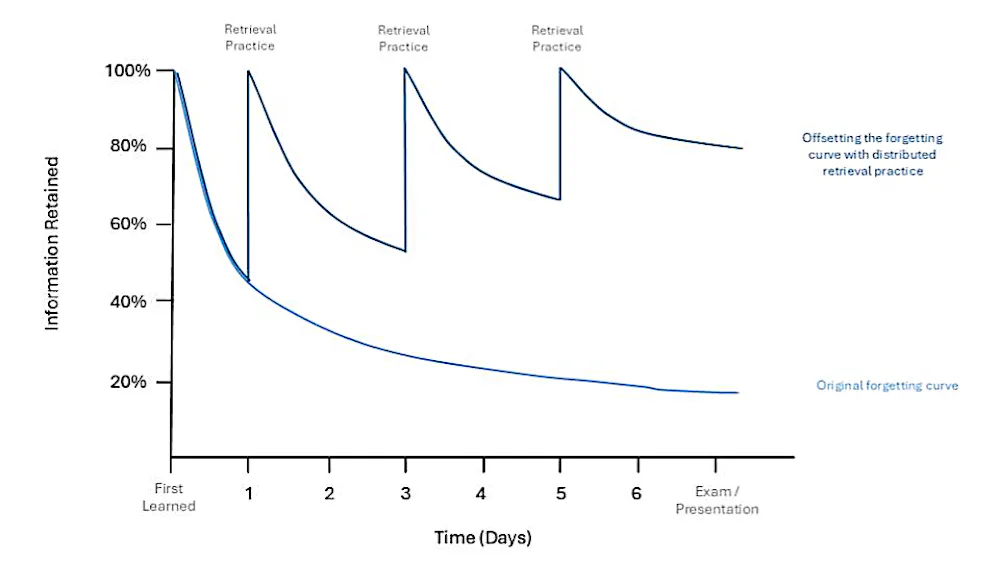
In the 19th century, German psychologist Hermann Ebbinghaus demonstrated how quickly we forget information after learning it. Within about 30 minutes, we lose roughly half of what we have learned, with much more fading over the next day. Ebbinghaus called this the forgetting curve. The light blue line on the chart below illustrates this.
However, there is a way of ensuring that more sinks in when you are trying to learn a lot of information in a short period of time: retrieval practice.
When preparing to give a talk or studying for an exam, rather than simply rereading your notes, keep testing how much you remember. Use flash cards, answer practice questions, or try explaining the material out loud without notes.
Memory works through associations. Each time you successfully retrieve information, you link the material to new prompts, examples and contexts. This builds more cues to accessing the information, and strengthens each memory pathway. Often when we “forget”, the memory isn’t gone – we just lack the right retrieval cue.
5. Give yourself a break
Research shows that memory is more effective when study or practice sessions are spread out, rather than massed together. If you are studying for an exam, build solid blocks of downtime into your revision schedule. The dark blue line on the chart above illustrates how spacing out your practice sessions can help you remember more information over time, by adjusting Ebbinghaus’s forgetting curve.
Advertisement
One study suggests leaving gaps between each revision session that equate to 10-20% of the time left until your exam or presentation. So, if your deadline is five days away and you do hours of revision a day, you should still take between a half and full day off in between sessions. In other words, don’t overdo it – you probably won’t see the rewards!
If you only remember one thing from this article about improving memory, make it this. Memory isn’t just about intelligence, it’s about strategy. Small changes in how you study or work can make a real difference in how well, and how long, you remember crucial information.
Chelsea midfielder Enzo Fernandez will remain unavailable for the upcoming home match against Manchester City despite apologising for recent comments about Madrid, head coach Liam Rosenior says.
Fernandez was handed a two-match internal ban by the club last week after he gave an interview during the international break in which he expressed his admiration for the city of Madrid.
The Argentine has repeatedly been linked with a move to La Liga club Real Madrid.
His agent, Javier Pastore, said this week that “we cleared the air” with Chelsea after Fernandez missed last Saturday’s 7-0 FA Cup victory against Port Vale, and had hoped that the ban would be reduced to one match.
Advertisement
However, Rosenior says Fernandez will miss Sunday’s Premier League fixture against Manchester City as Chelsea have decided to stick to their original punishment, despite the Argentine apologising for his comments.
“I had three or four [conversations] with Enzo,” said Rosenior.
“He’s apologised to me, he’s apologised to the club, and we’ll deal with that after a massive game on Sunday.
Tottenham manager Roberto de Zerbi says he is “not better” than predecessors Thomas Frank or Igor Tudor as he prepares to take charge of his first game at the Premier League strugglers.
Sunderland will be Spurs’ first opponents under the Italian, who was appointed on 31 March with the club one point outside the relegation zone with seven games remaining.
De Zerbi is Tottenham‘s third manager of the season after Frank and Tudor – the latter only lasting 44 days and seven matches in the role.
“I am proud and happy to be here and I have to say thank you to Vinai [Venkatesham] and Johan [Lange] because they showed me a big, big confidence,” said De Zerbi on Friday.
Advertisement
“I’m sure about the level of the players because I was very, very close to bringing many of these players to my former teams in the past.
“I think I am not better than Frank or Tudor because I consider them very good coaches.
“I try to bring my style, my character, my personality and my strengths to achieve our target, which is the most important part now.”
Tottenham have not won a domestic league game in 2026 and only two since 26 October 2025.
Advertisement
They were also knocked out of the Champions League in the last 16 by Atletico Madrid 7-5 on aggregate.
Since 1950, Spurs have only spent one season outside the top flight, which was back in 1977-78.
“For me, it was a big opportunity because Tottenham are a very important club in the Premier League and the Premier League is the best league in the world,” said De Zerbi, who previously managed Brighton between 2022 and 2024.
“I love the qualities of the players and the crucial part that there was 12 days before the first game and for me it was important to have more than one week. I thought it would be important to understand the problems.
Advertisement
“The message for my staff and players is that we have to deserve the support because the fans are suffering like us. But for the fans, there is just one club. The players can change but for the fans, their club is unique.
“We have to make them happy with the right spirit and the right behaviour on the pitch. Then it’s easier to make points.”
Tottenham travel to the Stadium of Light to face 11th-placed Sunderland on Sunday (14:00 BST kick-off).
A car was driven through a hedge at a supermarket as suspects attempted to escape from police following an attempted ATM theft. Police were called at 1.11am this morning (April 10) following reports of an attempted theft of an ATM machine at Morrisons at Parsons Green in St Ives.
Advertisement
A group of men in a dark SUV were involved in the incident but fled in the car empty handed. The vehicle was driven through a hedge, which caused damage to the car and left behind some debris.
Officers arrived at the scene seven minutes later and searched the area but could not locate the car or people involved. Officers remain at the scene.
An investigation into the attempted theft has been launched. Anyone with information such as CCTV, doorbell or dashcam footage of the incident should report it to the police.
A spokesperson for Cambridgeshire Police said: “We were called at 1.11am today to reports of an attempted theft of an ATM machine at Morrisons in Parsons Green, St Ives.
Advertisement
“A group of men in a dark SUV were involved in the attempted theft but fled in the vehicle empty handed. The vehicle was driven through a hedge during the escape, causing damage to the car and leaving debris behind.
“Officers arrived at the scene less than seven minutes later, and a search of the area was carried out to no avail.
“Police remain at the scene and an investigation has been launched. Anyone with any information including any CCTV, doorbell or dashcam footage, is urged to submit this online quoting incident 29 of 10 April. Call 101 if you do not have internet access.”
To get more news and top stories delivered directly to your phone, join our new WhatsApp community.Click this linkto receive your daily dose of CambridgeshireLive content.
Advertisement
We also treat our community members to special offers, promotions, and adverts from us and our partners. If you don’t like our community, you can check out any time you like. If you’re curious, you can read ourPrivacy Notice.
DEIR AL-BALAH, Gaza Strip (AP) — Friday marks six months since Gaza’s ceasefire deal took effect, a milestone largely lost in the confusion over the new and even more fragile ceasefire in the Iran war.
The ravaged Palestinian territory of 2 million people has seen the most intense fighting stop between Israeli forces and Hamas-led militants. But most of the ceasefire work remains to be done, from disarming Hamas and ending its two-decade rule to deploying an international stabilization force and beginning vast reconstruction. Gaza residents are in limbo, with limited aid entering through a single, Israeli-controlled border post.
Such challenges could represent what’s to come in the latest war, as U.S. President Donald Trump’s approach to peacemaking appears to be stopping bombardment and leaving the bigger picture for others to work out.
Whether Trump can force through that kind of deal on Iran, with more actors in play and global markets quivering at every statement, is yet to be seen.
Advertisement
The Board of Peace goes quiet
Focusing on a deal’s details is crucial. Already the Iran war’s two-week ceasefire has created deadly confusion over Lebanon as Israel insists the deal doesn’t apply there and continues to attack the Iranian-backed Hezbollah, while Iran insists it does and threatens to upend the agreement. Israel made a surprise announcement Thursday authorizing direct negotiations with Lebanon, despite the lack of diplomatic ties.
Not long ago, the U.S.-created and Trump-led Board of Peace kicked off with $7 billion in pledges and sweeping intentions of resolving not only Gaza but other conflicts that emerge around the world.
Nine days after the board’s initial meeting, the U.S. and Israel attacked Iran.
The Board of Peace has not met again, and it’s still waiting for Hamas to respond to its proposal on disarming, a major concession and perhaps the hardest step. Hamas’ charter calls for destroying Israel.
Advertisement
Advertisement
A U.S. official said Hamas has not been given a definite deadline to respond to the proposal but added that “patience is not unlimited.” The official was not authorized to comment publicly and spoke on condition of anonymity.
The lack of a deadline can weaken pressure to act. Meanwhile, diplomacy is busy putting out different flames.
Board of Peace director Nickolay Mladenov told the U.N. Security Council last month that the world should not lose sight of Gaza as a new war flared. The choice in Gaza is between “a renewed war, or a new beginning; the status quo, or a better future,” he added. “There is no third option.”
Advertisement
‘It’s as if there’s no ceasefire at all’
Palestinians might suggest a third option: neglect.
Six months into the Gaza ceasefire that took effect on Oct. 10, little beyond the largely silenced explosions has changed.
Vast tent camps house most of the territory’s population. Other residents shelter in damaged apartment buildings. Health workers and other humanitarian workers say there has been little progress in the expected surge of medical supplies and other aid.
Advertisement
Sign up for Morning Wire:
Our flagship newsletter breaks down the biggest headlines of the day.
Advertisement
The U.S. 20-point ceasefire plan for Gaza is largely failing on the humanitarian front, five international aid groups said in a scorecard released Thursday. They said conditions have deteriorated further in Gaza since the Iran war began.
“During the first two weeks of March 2026, trucks entering Gaza declined by 80%, and the price of basic goods increased dramatically,” they said. Medical evacuations have stalled.
Palestinians expressed fading hopes for any immediate improvement in their lives.
Advertisement
“There is pollution and disease. It’s as if there’s no ceasefire at all,” said Maysa Abu Jedian, a displaced woman from Beit Lahiya.
“The war is still ongoing and life is still terrible as it is,” said Eyad Abu Dagga, also sheltering in a camp in Khan Younis.
Tents rippled in the breeze, and children played on the sand against a backdrop of shattered buildings.
While the heaviest fighting has subsided, Israeli forces have carried out airstrikes and fired on Palestinians near military-held zones. Militants have carried out shooting attacks on troops, and Israel has said its strikes are in response to that and other ceasefire violations.
Advertisement
As of Thursday, Israeli attacks have killed 738 people in the six months since the ceasefire, according to Gaza’s Health Ministry. The ministry, part of the Hamas-led government, maintains detailed casualty records that are seen as generally reliable by U.N. agencies and independent experts. It does not give a breakdown of civilians and militants.
Funerals for two cousins were held Friday in Gaza City, a day after they were killed. “We were standing idly, drinking coffee, next to each other. We suddenly saw a (projectile) hitting the men,” said Anwar Saleh, an eyewitness. Israel’s military said it had struck a “terrorist” in northern Gaza.
Overall, the health ministry says 72,317 Palestinians had been killed since the war in Gaza began with the Oct. 7, 2023, Hamas-led attack on Israel.
‘Sustained diplomatic pressure at the highest levels’
Unwavering focus on Gaza, once at the heart of a passionate international outcry, has been lost with the rise of a new regional war. That, too, has decreased pressure for progress on the ceasefire.
Advertisement
The humanitarian groups’ scorecard notes that any forward movement on aid issues in the Palestinian territory has “generally required sustained diplomatic pressure at the highest levels, particularly from the United States. That pressure, however, has not been applied consistently or at the scale needed to secure full implementation.”
The Trump administration is not the only player to be distracted. The entire Middle East, including key Gaza mediators Egypt and Qatar, now focuses on Iran and that war’s effects on their economies.
With the added uncertainty over Israel’s renewed war with Hezbollah in Lebanon, there could be even less interest from countries to contribute troops to a Gaza stabilization force. One of the few confirmed troop contributors, Indonesia, already has seen three of its peacekeepers in southern Lebanon killed in recent days.
___
Advertisement
Anna reported from Lowville, New York. Associated Press writers Matthew Lee in Washington and Edith M. Lederer at the United Nations contributed.
Pleasence appeared in four episodes of Coronation Street, where she played the character Monica Sutton, a small recurring role in early 1968.
In a statement shared on social media, her agency said: “We are very sad to announce the passing of our dear client, Angela Pleasance.
“During her career which spanned more than six decades, Angela appeared in more than sixty different screen roles.
Advertisement
“Some of her most memorable roles were in films including From Beyond the Grave and A Christmas Carol.
“In 1968, the actress joined Coronation Street in a guest role as a character named Monica Sutton.
“She then went on to work extensively in TV and appeared in shows such as Doctor Who, Happy Valley, Casualty and Whitechapel, in which she had a regular role for a series, The Bill.
“Angela also had a minor role in the 2002 Hollywood movie Gangs of New York.”
Advertisement
Her agency added: “While never defined by any one genre, her contribution to the British industry remains a distinctive and much-admired part of her legacy.
“Our thoughts are with her family at this very sad time.”
Coronation Street star Craig Charles on why he left the ITV soap
Craig Charles played taxi driver Lloyd Mullaney on Coronation Street from 2005 to 2015.
His character, which was popular with viewers, was notably involved in the show’s dramatic 50th-anniversary tram crash storyline, which was broadcast live.
Advertisement
It was in May 2015 that Craig announced he would be leaving Coronation Street for Red Dwarf, BBC Radio 2 and BBC Radio 6 Music.
Craig said: “The death of my brother, and my unexpected departure as a result, did change my life.
“It made me re-evaluate things and made me ask: ‘If that had happened to me, would I be happy with what I had achieved?’
Islamabad entered a state of lockdown on Friday as Pakistan’s capital prepared to host high-stakes negotiations to end the US-Israeli war on Iran.
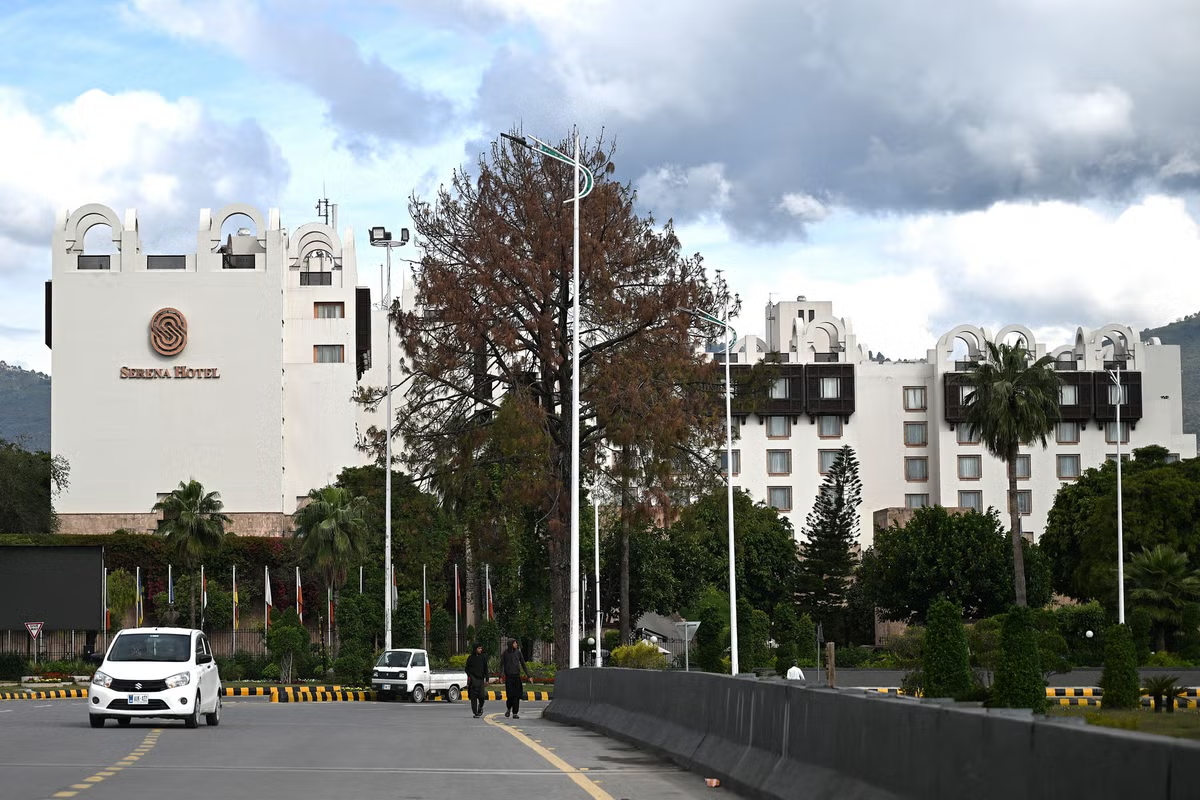
Army and paramilitary personnel guarded the roads around Serena Hotel, the venue of the talks, as police beefed up security across the city. On Wednesday, the luxury hotel’s management had asked its guests to check out by 5pm as the government had requisitioned the property for an “important event from this evening until Sunday”.
Pakistan’s political and military leaders achieved a major diplomatic breakthrough by mediating a ceasefire between the US and Iran early on Wednesday. The ceasefire was declared less than two hours before the deadline on US president Donald Trump’s threat to obliterate a “whole civilisation” if Iran did not open the Strait of Hormuz, a critical maritime route that usually carries a fifth of the global supply of oil and gas.
Although the truce was immediately threatened by Israel’s deadly strikes on Lebanon which killed hundreds of people, it paved the way for American and Iranian diplomats to gather in Pakistan and negotiate an end to nearly six weeks of intense fighting.
Advertisement
Pakistani soldiers arrive for deployment at the Red Zone in Islamabad (AFP via Getty)
The diplomats will be under great pressure to pull off what some analysts are describing as “mission impossible” – a deal that brings peace to the Middle East and stabilises a world economy battered by the closure of the Strait of Hormuz.
In preparation for the meeting, the government declared public holidays on Thursday and Friday while police imposed strict traffic restrictions in Islamabad.
“The Red Zone and surrounding areas are closed to all types of traffic except official vehicles. Citizens are requested to avoid unnecessary travel,” the city police said in an advisory.
The Red Zone is a city landmark housing key government offices and foreign missions.
An army truck drives past Serena Hotel in Islamabad (AFP via Getty)
The heightened security measures are informed by the threat of terrorism, which remains real and present. There was a suicide bombing in Islamabad as recently as February and it was one of the triggers for the Pakistani airstrikes that fuelled weeks of fighting with neighbouring Afghanistan.
Islamabad accuses the neighbouring country of sheltering Islamist and ethnic insurgents responsible for carrying out terror attacks on its soil. Kabul denies the allegations.
Advertisement
“Given those risks, the lack of preparation time and the high-profile nature of these talks, this is a very challenging visit from a security perspective and speaks to the importance this administration places on the negotiations,” Elizabeth Threlkeld, director of the South Asia Program at the Stimson Center, said.
A view of the Red Zone in Islamabad (AFP via Getty)
The US is expected to send a delegation headed by vice president JD Vance to conduct the talks in Islamabad, while Iran is set to be represented by foreign minister Abbas Araghchi and parliament speaker Mohammad Bagher Ghalibaf.
Gulf nations such as Qatar and Saudi Arabia, both of which are parties to the conflict, may also send delegations to Islamabad and hold talks on the sidelines.
A Pakistani army helicopter flies over Islamabad ahead of the talks between the US and Iran (AFP via Getty)
Pakistani interior minister Mohsin Naqvi assured US chargé d’affaires Natalie Baker of elaborate arrangements for the visiting diplomats.
The newspaper Dawn reported that a 30-member US team was already in Islamabad to assess the security preparations.
Security analyst Zahid Hussain said the challenge for Pakistan was not just protecting the venue but to prevent diplomacy from being overtaken by forces outside the room.
Advertisement
Aside from this, analysts say, there isn’t much Pakistan can do. “What it lacks is meaningful leverage to compel concessions if the US and Iran are not willing to come to terms,” Ms Threlkeld said.


















![[KLPGA 2026] iM Financial Group Open 2026 / Round 2 (ENG Commentary)](https://wordupnews.com/wp-content/uploads/2026/04/1775832050_maxresdefault-80x80.jpg)






































You must be logged in to post a comment Login