

Connect with us
DAPA Banner
DAPA Coin
DAPA
COIN PAYMENT ASSET
PRIVACY · BLOCKDAG · HOMOMORPHIC ENCRYPTION · RUST
ElGamal Encrypted MINE DAPA
🚫 GENESIS SOLD OUT
DAPAPAY COMING

NewsBeat

Albanian’s revolt over Ivanka Trump’s plans to build $1.4 billion island resort | News US

Published

on

Albanian's revolt over Ivanka Trump's plans to build $1.4 billion island resort | News US

To view this video please enable JavaScript, and consider upgrading to a web
browser that
supports HTML5
video

Albania is the hipster’s holiday choice this summer. It was only a matter of time before a Trump got in on the act.

Advertisement

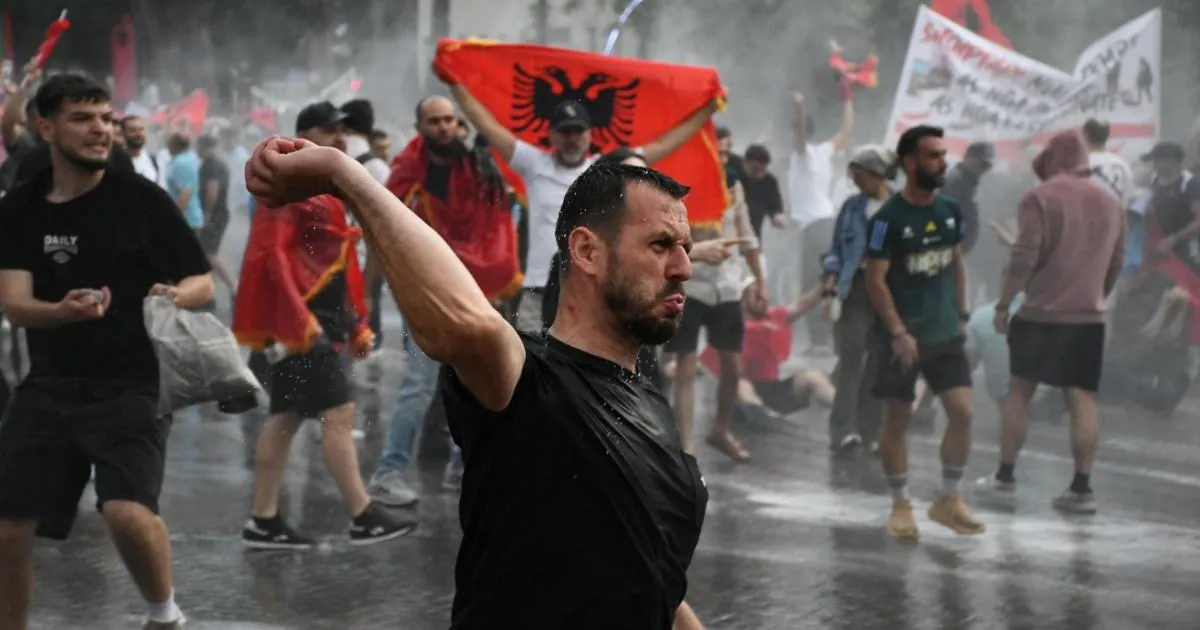
Despite hundreds of Albanian protesters being washed away by water cannons, Donald Trump’s daughter Ivanka is reportedly going ahead with her plans to transform a Cold War-era military base into a luxury island resort.

In an interview this week Ivanka Trump said she stumbled upon Sazan Island – complete with thousands of sprawling nuclear bunkers -‘ by accident’ on holiday with her husband, Jared Kushner.

‘We were on a friend’s boat, and we stopped for a swim. Effectively, that’s how we found it,’ she said.

‘We swam to the island. We went on a hike, barefoot all the way up to the top, and we were just captivated. And it’s stayed with us ever since. For me, this is, it feels more like a challenge than anything else.’

Advertisement
There has been resistance to Jared Kushner and Ivanka Trump’s plans
Copyright: GETTY IMAGES

Where is Sazan Island- now dubbed Trump Island?

rendering of Sazan Island development back by Ivanka Trump and Jared Kushner
Rendering of the Sazan Island development back by Ivanka Trump and Jared Kushner
(Picture: Studio Genesis)

Sazan is Albania’s largest island and is a designated military exclusion zone located in a strategically important location between the Strait of Otranto and the mouth of the Bay of Vlorë.

Underneath the beautiful cliff faces and crystal blue waters lie at least 3,600 Soviet-style nuclear bunkers built during the Cold War.

The 1,400 acre Mediterranean island is also home to at least ten miles of underground tunnels stretching back from the Communist era.

Other bomb shelters and buildings designed to store military supplies and ammunition are also arranged around the area.

Advertisement

Experts have even warned about the presence of unexploded mines dotted across the stunning landscape that will need to be cleared -no wonder Trump called it a ‘fixer-upper’.

Undeterred, Ivanka revealed: ‘Over the course of many years, we developed the opportunity to help realise its potential and transform it, but with a lot of restraint and care.’

She hired some of the ‘greatest living architects’ to make designs blend with the already dramatic surroundings as if the buildings almost ‘rise from’ the land.

rendering of Sazan Island development back by Ivanka Trump and Jared Kushner
A luxury hotel development backed by Ivanka Trump and Jared Kushner
(Picture: Studio Genesis)

Albanian Anger

But Ivanka’s venture has drawn opposition from environmental campaigners and critics of long-time Socialist Prime Minister Edi Rama.

The couple also hope to carry out a multibillion-dollar project that includes building hotels along the coast of Zvërnec, where wildlife such as flamingos and sea turtles nest.

Advertisement

Since late May, barbed wire has been erected to keep protesters from the excavators and other heavy machinery arriving clear to the land from the pine trees.

Activists have clashed with police at the site, hanging up signs like ‘Albania is not for sale,’ ‘Hands off Albanian soil’ and ‘Sazan is not a private island, it belongs to the Albanian people.’

TIRANA, ALBANIA - JUNE 3: People stage a protest against a planned tourism project in the Zvernec area of the city of Avlonya (Vlora) as they gather on the Boulevard of the Nation??s Martyrs in Tirana, Albania on June 3, 2026. People protest the sale of a stretch of coastline in Zvernec as part of a tourism project reportedly linked to U.S. President Donald Trump??s daughter, Ivanka Trump, and her husband, Jared Kushner. (Photo by Olsi Shehu/Anadolu via Getty Images)
Hundreds protest the sale of a stretch of coastline in Zvernec linked to Donald Trump’s daughter, Ivanka Trump, and her husband, Jared Kushner (Picture: Getty)
TIRANA, ALBANIA - JUNE 3: Police use water cannons against the protesters during a protest against a planned tourism project in the Zvernec area of the city of Avlonya (Vlora) as people gather on the Boulevard of the Nation??s Martyrs in Tirana, Albania on June 3, 2026. People protest the sale of a stretch of coastline in Zvernec as part of a tourism project reportedly linked to U.S. President Donald Trump??s daughter, Ivanka Trump, and her husband, Jared Kushner. (Photo by Olsi Shehu/Anadolu via Getty Images)
Police use water cannons against the protesters (Picture: Olsi Shehu/Anadolu via Getty Images)

‘From start to finish there has been a total lack of transparency,’ Aleksandër Trajçe, executive director of the country’s leading conservation group, the Protection and Preservation of the Natural Environment in Albania (PPNEA), told The Guardian.

‘We have seen no public consultation or public documentation regarding permits, and so now what we are saying is, if they remove the bulldozers, remove the fence and restore the habitats to what they were, then we can start talking.’

Albanian opposition leader Sali Berisha said that while he supports the renovation projects, he expressed concerns that Rama could have been ‘seeking to buy political influence’ from Trump.

Advertisement

But Rama insists the plans are in tune with Albania’s ambition to become a major global tourism destination.

‘Albania should not be a country that fears an extraordinary project like this one, where exceptional partners have come together to invest €4billion,’ Rama said.

‘There is absolutely no chance that the investment will stop as long as I am here,’ he said.

But after the backlash, Rama insisted: ‘There is not a project yet.

Advertisement

‘There is no such thing as a Trump family island.

‘There is no such thing as the family of the American president taking over protected areas where flamingos will be killed by them.’

Advertisement

Source link

Continue Reading
Click to comment

You must be logged in to post a comment Login

Leave a Reply

NewsBeat

On Question Time the ‘plucky plumber’ feels the glare of the spotlight as Burnham shows his hand

Published

on

Manchester Evening News

To quote the great tactician and thinker Mike Tyson: “Everybody has a plan until they get punched in the face.”

In political terms, BBC Question Time’s Makerfield by-election special was the equivalent of a prize fight. In the turquoise corner stood Robert “Plucky Plumber” Kenyon, Reform UK’s candidate and local councillor. In the red corner stood Andy “King of the North” Burnham, Mayor of Greater Manchester, former cabinet minister and, if the political gossip is to be believed, a man with one eye on a considerably larger prize than a parliamentary seat in Makerfield.

If that makes this sound like an even contest, it is worth considering the tale of the tape.

Click here for our dedicated Makerfield by-election newsletter with exclusive interviews and analysis

Advertisement

Burnham has spent decades in politics. He has sat around Cabinet tables, fought leadership contests, survived Westminster and appeared on enough Question Time panels to know exactly where the audience is likely to turn. Kenyon, by contrast, is a councillor and a plumber.

Whether unblocking a toilet on a wet Monday morning is preferable to being confronted by a BBC audience armed with printouts of your social media history is a matter only he can answer.

The challenge facing Kenyon was obvious before the programme even began. Earlier in the day he had appeared on BBC Radio Manchester with Mike Sweeney, where he described Burnham as a political titan and portrayed the contest as something of a free hit. Expectations were low. If he performed well, he would exceed them. If he struggled, he was up against one of Labour’s most recognisable figures.

Yet there was another issue hanging over him. A succession of difficult interviews during the campaign had raised questions about both his policy knowledge and a trail of controversial comments that stubbornly refused to disappear. Question Time offered an opportunity to reset the conversation.

Advertisement

It did not quite work out that way.

The first question concerned trust in politics. Burnham answered with a theme he has spent years developing. Westminster, he argued, is too focused on point-scoring and not enough on problem-solving. It is “party first rather than place first”. The system does not properly serve places like Greater Manchester. What is needed is a more collaborative style of politics and a fundamental change in how power is distributed.

Whether or not one agrees with the diagnosis, it is a case Burnham can make almost from memory.

Kenyon’s answer was more straightforward.

“Get normal people into politics,” he said. People who care about where they live and do not see politics as a stepping stone.

It is a line that neatly captures Reform’s broader argument. The country has too many professional politicians and not enough ordinary people willing to speak plainly.

Advertisement

The irony was that, as the evening progressed, Kenyon often appeared the most scripted person on the panel.

There were moments where he seemed less like a man expressing his own views than somebody trying very hard to remember the precise wording approved by a communications team. The anti-politician occasionally looked more cautious and rehearsed than the politicians.

The most uncomfortable exchanges centred on his past comments about women.

Audience members returned repeatedly to the issue. One declared: “I’d rather have a career politician than a plumber who is a sexist.”

Advertisement

Kenyon insisted he would not accept the label. He acknowledged making mistakes. He said comments made 15 years ago did not reflect who he is today. He spoke about being raised by his mother, grandmother and older sister.

“I’ve got nothing but respect for women,” he said. It didn’t quite convince – it sounded almost like ‘how can I hate women, my mum is one’?

Yet the strangest moment came when he was challenged over comments in which he had reportedly described himself as a sexist. His reply was a single word. “Allegedly.” The audience laughed.

It was one of those exchanges that lasts only a few seconds but lingers far longer. The problem for Kenyon was not that anyone thought he was seriously denying the charge. It was that a room which was clearly waiting for contrition got a punchline instead.

Sarah Wakefield, the Green Party candidate, pressed the issue further. Having spoken to Carol Vorderman, she said Vorderman remained upset by the comments and challenged Kenyon to look directly into the camera and apologise. He did not.

Instead, he returned to the same defence he had used throughout the evening. The comments were old. They had been taken out of context. He had made mistakes. He would not say those things today.

It was a perfectly coherent defence. It just was not the answer some audience members wanted.

Advertisement

If Kenyon spent much of the evening on the defensive, Burnham’s challenge was always likely to come later.

The death of Henry Nowak and the subsequent controversy around policing has become one of the most emotionally charged political issues of recent weeks. There had been widespread anticipation about how Burnham would respond.

The discussion produced some of the programme’s most serious moments.

Conservative candidate Michael Winstanley described the footage as heartbreaking and appalling. Kenyon spoke of the anger many people felt and argued there was a perception of two-tier policing.

Burnham’s response was careful. He rejected the idea that Greater Manchester Police operated such a system, praised Chief Constable Sir Stephen Watson’s leadership and emphasised the importance of maintaining public confidence across all communities.

At the same time, he accepted that national guidance required scrutiny.

“I think it’s right that the Government are reviewing this guidance,” he said. “I don’t think this guidance has got it right.”

It was a nuanced position. Acknowledging public concern while avoiding the broader claims made by Reform. The larger clash came over political rhetoric.

Advertisement

Burnham criticised Nigel Farage’s use of the word “rage” in relation to the case and warned politicians about the consequences of their language.

“I’m mayor of Greater Manchester,” he said. “I know my words have consequences.”

He spoke about the danger of “poison dripping into our streets” and argued politicians should be working to find common ground rather than deepening divisions.

Advertisement

Kenyon, for his part, unequivocally condemned the disorder that followed.

“Violence is not the answer,” he said.

Elsewhere the discussion ranged across housing, immigration and economic growth.

One audience member posed a question that neatly captured the tensions running through modern politics. She announced she intended to vote for Burnham before immediately declaring that she could not stand Keir Starmer.

Advertisement

Burnham used the opportunity to make the case for his own political project. Greater Manchester, he argued, has become the country’s fastest-growing city region under devolution. The answer to Britain’s problems is not less local power but more.

Then came the moment everybody had been waiting for.

Would he challenge for the Labour leadership?

Burnham stopped just short of a formal declaration while somehow managing to leave little doubt about his intentions.

Advertisement

“I think Wes Streeting seems to have launched a leadership contest,” he said. “So if that is running, I would seek to join it.”

It was not quite a campaign launch.

For a by-election candidate supposedly focused on winning a single parliamentary seat, it was a striking intervention. Throughout the evening Burnham repeatedly framed Makerfield as part of a bigger argument about changing Labour and changing politics. This was the clearest indication yet that he sees the two as connected.

By the end of the programme, the shape of the evening had become clear. Burnham looked exactly what he is: an experienced politician entirely comfortable in a live television debate.

Kenyon looked like a candidate still adjusting to the scrutiny that comes with national attention. He survived the evening without a catastrophic mistake and occasionally landed points of his own, particularly when discussing immigration and housing. But he never quite managed to escape the controversies that had followed him into the studio.

Perhaps the oddest thing about the night was that Reform’s candidate, the man running against professional politicians, often looked more constrained by politics than anyone else on the panel.

Question Time is a difficult format because audiences can sense the difference between conviction and choreography. Burnham understood that instinctively. Kenyon sometimes appeared caught between speaking naturally and sticking to the script.

Advertisement

And in politics, as Mike Tyson might have put it, that is often what happens after the first punch lands.

Source link

Continue Reading

NewsBeat

Nintendo Switch 2 is a year old today and we still don’t know what to make of it

Published

on

Nintendo Switch 2 is a year old today and we still don’t know what to make of it
Happy birthday Switch 2 (Nintendo)

As the Switch 2 celebrates its first birthday, GameCentral looks back at the highs and lows of Nintendo’s most recent console and tries to predict where it goes from here.

Since the internet, and the real world beyond it, increasingly only deals in extremes it’s difficult to talk about the Switch 2 in any kind of nuanced fashion. It is neither the best thing ever nor the worst and determining exactly where it sits along that gradient is not easy. Today is its first anniversary, which is slightly awkward as there’s reason to hope there’ll be a major Nintendo Direct next week which will, possibly, answer some of the questions we’re about to pose.

Looking at the console with the benefit of 365 days of hindsight, we’d say that that the hardware itself was largely faultless. The design hasn’t changed much, of course, and it could do with a longer battery life and maybe a better screen, but for the price it’s almost perfect, with the click of the magnetic Joy-Cons still seeming magical to this day.

It’s still baffling that Nintendo has made no attempt whatsoever to demonstrate the power of the console – we didn’t get so much as a tech demo pre-launch – but multiple third party games have made it clear it’s far more powerful than you would expect, with excellent versions of everything from Resident Evil Requiem and Cyberpunk 2077 to Final Fantasy 7 Rebirth and Star Wars Outlaws.

Advertisement

The remake of Star Fox 64 does seem to be a step up, in terms of technical prowess, but other upcoming games, like Splatoon Raiders and Fire Emblem: Fortune’s Weave, still look like Wii U games. Nintendo games are rarely sold on their graphics, but the Switch 2 clearly has raw power to spare and yet it’s not being used – one of many strange decisions orbiting the console.

Ever since the unveiling of the console and its games in April last year, it’s seemed as if Nintendo was only showing and doing the bare minimum. Despite having eight years to prepare, and no deadline to meet in terms of when the console had to be released, everything to do with the Switch 2 has felt hurried and poorly thought out, like a student who was out partying the night before their big report was due and only just scrabbled together what they needed.

Expert, exclusive gaming analysis

Sign up to the GameCentral newsletter for a unique take on the week in gaming, alongside the latest reviews and more. Delivered to your inbox every Saturday morning.

Advertisement

That impression has not changed over the last 12 months, but it has morphed into an industry default for most publishers who, in their wisdom, have decided that it’s best to have as little to look forward to as possible and to know as little about what is announced as can be contrived.

That logic obviously makes sense to someone, somewhere, because it’s taken deep root within so many different publishers, but Nintendo has taken it to an absurd extreme, to the point where it’s now June and we haven’t had a single large scale, first party Nintendo Direct all year. That in turn means we have no idea about anything coming out after July (except that supposedly Fortune’s Weave and FromSoftware’s The Duskbloods will be along at some point, if they haven’t been delayed).

Advertisement

At exactly the point where a first party Direct would seem the most useful to both Nintendo and its customers – considering a price rise is on the horizon – they’ve decided to say less about their future plans than they ever have before.

This seems to be in large part because of the industry wide problem of games costing too much, and taking too long, to make. The Switch 2 may be impressively powerful, but Nintendo’s not used to working with that kind of hardware and that’s no doubt part of the reason behind some of their stranger decisions.

Mario Kart World gameplay of Mario and Bowser driving go karts in the Bob-omb Blast mode
Mario Kart World – a good game but not a classic (Nintendo)

We had hoped, before the Switch 2 became a reality, that Nintendo, who have always benefited from keeping a tight rein on their budgets, would cope better than most with the issue, or demonstrate some new way of avoiding it, but sadly that hasn’t happened.

Instead, the software line-up has been a strange mixture of A-listers and deeply underwhelming lower budget games. Mario Kart World as a launch game makes perfect sense, but the strange way the open world was handled – which was exacerbated by the misleading marketing – left a bad taste in the mouth of many fans. While the continued lack of any DLC at all (why does Donkey Kong only have one extra costume?) is impossible to explain.

Mario Kart World is a good game, and Donkey Kong Bananza is even better, but in hindsight the latter would’ve made a much better Christmas release, rather than having the line-up fizzle out with the deeply disappointing Metroid Prime 4. You can see the sense of releasing Hyrule Warriors: Age of Imprisonment early on, because it meant at least some kind of new Zelda game was available, but surely there was a better choice than yet another brain dead Dynasty Warriors knock-off.

Advertisement

Kirby Air Riders does have its fans, even if we’re not amongst them, but why did Nintendo feel it was so important to release a second cartoon racing game within the launch window? Especially one that was only ever going to be popular in Japan. They did later admit that they’d focused too much on games for their home audience, but surely Nintendo has been in the business long enough not to make that mistake in the first place?

There are many other strange decisions beyond that, including the highly experimental Drag x Drive, which might have been a cult hit if hadn’t been so utterly devoid of content that you could see all there was to see within a couple of hours. Does Nintendo really not employ enough people that they couldn’t have whisked up a quick single-player mode or a proper tournament structure? Or, you know, used any colour other than dark grey for the graphics.

Why did the marketing for Yoshi And the Mysterious Book make it seem like a game for pre-schoolers when it’s actually one of the most inventive and open-ended platformers Nintendo has put out for years, and much better suited to adult players than anyone else.

Advertisement
Pokémon Pokopia screenshot of Ditto falling
Pokémon Pokopia is the best first party Switch 2 game (The Pokémon Company)

And how is it that of all the games Nintendo has released in the last year a Minecraft clone by the makers of Hyrule Warriors turned out to be the most compelling? That certainly wasn’t on our bingo card and it clearly wasn’t on Nintendo’s either, who were caught out by the success of Pokémon Pokopia and have been scrambling to leverage it ever since.

One of the most encouraging annoucement this year (not that there have been many of any type) was the reveal of Pokémon Winds and Waves, which does look like a generational leap from Scarlet and Violet. Having that next year does seem a useful anchor but the overriding problem with the Switch 2’s line-up is the mystifying logic behind how Nintendo has been prioritising its various franchises.

Kirby Air Riders is one thing but why on earth is Star Fox deemed so important all of a sudden, such that it was shore-horned into the Mario Galaxy movie, of all things? A decision that takes on reality-bending levels of bizarreness when you realise that Nintendo hasn’t yet breathed a word about a new Super Mario game since before the Switch 2 was announced.

Why are we a year in and there’s still no sign of Splatoon 4 and instead it has to wait in the queue behind a primarily single-player spin-off? And why was a new Fire Emblem announced so early on when we still haven’t heard anything about far more mainstream games, like a new Animal Crossing?

Advertisement

Not furnishing Mario Kart World with constant updates is one thing but we felt sure that the reason support for Animal Crossing: New Horizons – the breakout hit of the entire franchise – was cut short was so the team could get a new game ready for early on in the Switch 2’s career, so that it could benefit from new content throughout the whole of the console’s life. But instead Nintendo announced a Switch 2 Edition that adds almost nothing of note and implies a new game is several years away.

Nintendo not making sense might seem like their natural state of being, but in reality everything they do is perfectly logical, from their point of view, and only becomes so to others over time. The Switch 2 has been stretching credulity since the beginning though, to the point where everything feels like they switched to Plan B sometime in 2024 and they’ve been on that track ever since.

Animal Crossing characters
Why was a new Animal Crossing not a priority? (Nintendo)

Even if sales at Christmas were less than hoped for, the Switch 2 is still the fastest-selling console of all-time and well ahead of where the Switch was at the same time in its lifetime. But you could tell the Switch 1 was special before its first Christmas, with a GOAT launch window line-up that Switch 2 hasn’t come close to matching.

The changing nature of game development may make the Switch 1’s achievements impossible to repeat (especially given the boost it got from being able to use Wii U ports to fill gaps in its schedule and provide a cast iron classic of a launch title) but that still makes it impossible not to be at least a little disappointed with the Switch 2.

We’ve long ago learnt not to try and predict Nintendo, or believe any rumours about them, even if the one about a Zelda: Ocarina Of Time remake is very persistent. Who knows what they’ll announce next week, if there even is a Direct next week, but while we’d welcome a modernised version of Ocarina Of Time as much as anyone, what we really crave is something new, in terms of both IP and gameplay ideas.

Advertisement

Nintendo always delivers eventually but they’ve certainly not made it easy waiting for that to happen with the Switch 2, which continues to be a great console supported by a merely good games line-up. Other publishers would be happy with far less but the problem with Nintendo’s reputation is that they’ve trained people to always expect the best thing ever, and this time that hasn’t happened. Or at least not yet.

The Legend Of Zelda: Ocarina Of Time artwork of Link and main characters
Maybe the Ocarina Of Time rumours are true or maybe they’re not (Nintendo)

Email gamecentral@metro.co.uk, leave a comment below, follow us on Twitter.

To submit Inbox letters and Reader’s Features more easily, without the need to send an email, just use our Submit Stuff page here.

For more stories like this, check our Gaming page.

Advertisement

Source link

Advertisement
Continue Reading

NewsBeat

Lanarkshire school pupils recognised for developing skills that employers value

Published

on

Daily Record

Strathaven Academy’s Fergus Wood was one of the youngsters who received the Ken Muir Award for Exceptional Achievement.

A group of S5 and S6 pupils from Lanarkshire have received recognition for developing the skills Scotland’s employers value most.

Advertisement

They excelled in teamwork, communication and problem-solving and picked up a national Ken Muir Award for Exceptional Achievement.

Five youngsters from Calderglen High in East Kilbride, St Maurice’s High in Cumbernauld, St John Ogilvie High in Hamilton and Strathaven Academy were selected as part of a Scotland-wide cohort in recognition of the “remarkable personal growth, resilience and workplace-readiness” they demonstrated whilst completing the Powering Futures Challenge Programme – a SCQF Level-6 qualification which sees pupils work in teams to tackle real-life challenges set by business and industry partners. Through the programme, pupils develop practical workplace skills while strengthening links with locally-based mentors working in Scottish businesses.

While over 2000 pupils nationally undertook the Powering Futures Schools Challenge Qualification, the Lanarkshire award winners impressed their teachers with their personal development throughout the programme – and were recognised for growing in confidence, strengthening their teamwork and communication skills and taking meaningful steps towards their future careers.

Fergus Wood of Strathaven Academy was one of the award winners and was nominated for his dedication and drive throughout the entire year, but especially during the final presentation phase. Beyond keeping his team focused anon schedule, Fergus demonstrated remarkable growth in his meta-skills. His newfound confidence and natural leadership not only elevated his own performance but were instrumental to his team’s success.

Advertisement

The Ken Muir Awards for Exceptional Achievement were launched in June 2025 and recognise exceptional achievement of learners who participated in the Powering Futures Challenge Level 6 qualification.

Professor Ken Muir of the University of the West of Scotland – after whom the awards are named – has played a key role in advising the Scottish Government on the future of Scottish education. As a key contributor to the 2023 report, It’s Our Future – Independent Review of Qualifications and Assessment, Professor Muir has called for reforms to Scotland’s system of education, including preparing learners better for the world of work.

Professor Muir said: “We need a culture and mindset shift in Scotland’s education system. Of course, examination grades are important – but these awards, and the ethos of the Powering Futures Schools Challenge Programme overall, is about reimagining what success looks like by valuing and recognising achievement in every sense of the word.

“Whether that is developing communication skills, learning to work in a team, or building confidence in presenting an idea, I am delighted to present these Awards to pupils who demonstrate the immense value of Powering Futures’ exciting and motivating learner-centred approach.”

Advertisement

Jennifer Tempany, co-founder of Powering Futures, said: “We are delighted to celebrate this year’s Ken Muir Award winners, recognising the immense personal growth and achievement they have demonstrated this academic year.

“By connecting these young people directly with Scottish business and industry through a hands-on approach, we are not only celebrating their success but actively opening up vital career pathways and empowering them to confidently shape a sustainable and prosperous future for Scotland.”

*Don’t miss the latest headlines from around Lanarkshire. Sign up to our newsletters here.

And did you know Lanarkshire Live had its own app? Download yours for free here.

Advertisement

Source link

Continue Reading

NewsBeat

Work to refurbish part of local bus station set to begin

Published

on

Wales Online

It will be funded through its public realm programme

Works by Bridgend County Borough Council to refurbish parts of a local bus station have begun.

Advertisement

The project will see improvements made to the clock tower at Bridgend’s town centre bus station over the coming weeks with the site now set to be re-rendered and refreshed.

The work will be funded through the council’s public realm programme and is expected to last for around four weeks in June. Stay in the know by making sure you’re receiving our daily newsletter.

It will be carried out with the aim of improving the appearance of what has been described as one of the “main gateways” into the borough.

A council spokesman said: “The refurbishment forms part of ongoing investment in public spaces across the county borough aimed at creating cleaner, more welcoming environments for residents, visitors, and commuters.

Advertisement

“To allow the works to be carried out safely some temporary changes will be introduced at the bus station.

“The outside footpath serving bays one to eight will be closed for the duration of the works.

“During normal opening hours passengers will still be able to access the bays from inside the bus station building.

“After the bus station closes each evening services that would normally use bays one to eight will instead operate from bays nine to 11 located outside the main building near the bus station entrance.

Advertisement

“These temporary arrangements will apply after 6pm from Monday to Saturda, and after 4pm on Sundays.”

Councillor Gary Haines of Aberkenfig added: “Bridgend Bus Station is one of the first places many people see when arriving in the town centre so it is important that it creates a positive first impression.”

Get daily breaking news updates on your phone by joining our WhatsApp community here. We occasionally treat members to special offers, promotions and ads from us and our partners. See our Privacy Notice.

Do you get a good service from your council?

Advertisement

Do you get a good service from your council?

Source link

Continue Reading

NewsBeat

Solent Freeport joins forces with Solent Growth Partnership to launch new apprenticeship incentive programme

Published

on

Solent Freeport joins forces with Solent Growth Partnership to launch new apprenticeship incentive programme

Solent Freeport has launched a new £50,000 Apprenticeship Incentive Programme in partnership with the Solent Growth Partnership, helping small and medium-sized businesses invest in future talent while creating new pathways into skilled employment for young people across the region.

Source link

Continue Reading

NewsBeat

Pam Bondi puts Todd Blanche on the hook for ‘entire release’ of the Epstein files, transcript reveals

Published

on

Pam Bondi puts Todd Blanche on the hook for ‘entire release’ of the Epstein files, transcript reveals

Former Attorney General Pam Bondi said “I don’t recall” at least 34 times during her closed-door interview with members of Congress investigating Jeffrey Epstein, a transcript of the meeting reveals.

Bondi, who was fired by Donald Trump in April, repeatedly told the House Oversight Committee that her deputy Todd Blanche was “in charge” of the “entire release” of the so-called Epstein files, a chaotic document dump of millions of pages and images stemming from the federal government’s investigations into the dead sex offender.

She also sought to get ahead of any allegations that she was “placing blame” on her successor at the Department of Justice and offered a full-throated endorsement of his position as acting attorney general.

“Todd Blanche is one of the most highly ethical individuals I know, and I think he is making an incredible Acting Attorney General. And he managed this investigation — and it was a Herculean task — with very little error,” she said, according to a transcript of her interview released Thursday. “And Todd did an excellent job, in my opinion, and is doing an excellent job as our Attorney General. I’m not blaming anything on Todd.”

Advertisement

But Bondi — who faced intense bipartisan scrutiny for the Trump administration’s handling of the Epstein files — repeatedly said she could not remember significant details when it came to questions about survivors, redactions in the documents, and the Justice Department’s work on the case while she was in office.

Pam Bondi said Todd Blanche was ‘in charge’ of the ‘entire release’ of the Epstein files during her interview with the House Oversight Committee
Pam Bondi said Todd Blanche was ‘in charge’ of the ‘entire release’ of the Epstein files during her interview with the House Oversight Committee (AP)

She also said she could not recall whether the Justice Department ever investigated high-profile administration figures, including Commerce Secretary Howard Lutnick, about their ties to Epstein, or if the Justice Department was investigating lawmakers who searched for the president’s name in unredacted copies of the files that have been made available to them.

Bondi claimed that she only learned about a controversial prison transfer for Epstein associate Ghislaine Maxwell after she had been moved to a minimum-security prison following her jailhouse interview with Blanche last summer.

Maxwell, she said, “should die in prison.”

“She was a monster, just like Jeffrey Epstein,” she said. “She recruited these young women to a life of prostitution and abuse. And I often think the women that do that are just as bad, if not worse, than the men, because she participated in it.”

Advertisement
A transcript of the closed-door meeting reveals the former attorney general said ‘I don’t recall’ at least 34 times when questioned about critical parts of the government’s investigation into Epstein and the release of the files
A transcript of the closed-door meeting reveals the former attorney general said ‘I don’t recall’ at least 34 times when questioned about critical parts of the government’s investigation into Epstein and the release of the files (Getty)

Blanche, the president’s former criminal defense attorney now poised to be formally nominated for attorney general, “was in charge of the process and the entire release of the Epstein files,” Bondi said.

The Justice Department has released approximately 3 million files following legislation passed by Congress and signed by Trump that compelled their release.

But lawmakers asked Bondi why another 3 million documents still have not been released, sparking allegations of a government-wide cover up to protect powerful public figures accused of exploiting and abusing young women and girls

“To my knowledge, they’ve all been released,” Bondi said.

The release of the files and bipartisan pressure to investigate figures in Epstein’s orbit erupted into a massive political liability for the president and his allies, and the president removed Bondi from her post days before she was initially scheduled to testify to the committee.

Advertisement

The Justice Department sought to block her appearance after she left office, though she later agreed to participate in a closed-door, transcribed interview on May 29 after threats from Democratic lawmakers to hold her in contempt for defying a bipartisan subpoena.

Blanche, who is Trump’s former criminal defense attorney, is expected to be formally nominated as the next attorney general
Blanche, who is Trump’s former criminal defense attorney, is expected to be formally nominated as the next attorney general (Getty)

During her sworn testimony to the House Judiciary Committee in February, Bondi repeatedly deflected questions about Epstein to talk about the stock market and chastised Democrats who questioned her.

“The Dow is over 50,000 right now,” she said after she was questioned about potential indictments against Epstein’s co-conspirators.

The Nasdaq is “smashing records” and Americans’ retirement accounts are “booming,” she said. “That’s what we should be talking about.”

After last week’s interview, Epstein survivor Maria Farmer said Bondi’s “continued evasion of questions about her grave mishandling of the release of the Epstein files was not surprising — it’s a pattern of behavior.”

Advertisement

“At every turn, Bondi has ignored and disregarded the will of Epstein survivors who have waited for justice for decades and even now, as a private citizen, she refuses responsibility for her missteps and failures,” Farmer said in a statement shared with The Independent.

On Thursday, the Republican-led committee referred former Miami Beach Mayor Philip Levine and hairstylist Frédéric Fekkai to the Justice Department for criminal prosecution.

The referral follows the committee’s interview with Epstein’s former assistant Sarah Kellen on May 21. In their letter Blanche, Comer and four other House Republicans urged the Justice Department to use “all available tools” — including providing “immunity for certain witnesses” — to investigate Kellen’s allegations.

Lauren Hersh, co-founder and CEO of World Without Exploitation, which represents Epstein survivors, called the letter an “important step” in the investigation.

Advertisement

“It provides further proof that there are clear investigative leads in the files and underscores the importance of continued transparency, accountability, and a thorough review of all available evidence,” she said.

Source link

Continue Reading

NewsBeat

Conflict over identity politics could lead to civil war in the long term, Kemi Badenoch says

Published

on

Conflict over identity politics could lead to civil war in the long term, Kemi Badenoch says

Speaking to the BBC for the documentary before the sentencing of Nowak’s killer Vickrum Digwa, Badenoch said: “This is not a racist country. But now we are seeing more and more hostility to people of every ethnicity, whether they’re English or not English, because people are bringing political conflict into an area where we didn’t have political conflict.

Source link

Continue Reading

NewsBeat

Where peace talks between the US and Iran currently stand

Published

on

Where peace talks between the US and Iran currently stand

To understand where talks on ending the war between the US and Iran currently stand, all we can confidently assume is that Donald Trump’s pronouncements offer no guide. The US president said an agreement had been “largely negotiated” on May 23.

That proposal would have reopened the Strait of Hormuz in exchange for sanctions relief and the unfreezing of Iranian assets. But it would not have immediately extracted concessions on Iran’s nuclear activities and ballistic missile capabilities. In response to backlash from Republican hawks, Trump subsequently toughened the US position.

The following week, Trump again claimed he was “on the verge” of approving a peace deal and US officials started briefing that Iran had made critical concessions. Iranian officials denied reports they had accepted major concessions on uranium enrichment or the future of their nuclear programme.

Talks were then suspended on June 1 after Iran protested Israel’s offensive in Lebanon, and the US and Iran exchanged military strikes. Trump declared he “couldn’t care less” if the talks were over, but by the evening, was once again insisting negotiations were continuing “at a rapid pace”.

Advertisement

According to Iranian media, the current situation is that Iran is studying the latest US proposal but communications between the two countries are paused. The US and Iran have also traded military strikes in recent days. So why are the two sides seemingly unable to close the gap between their respective positions?

One obvious obstacle is the dysfunctional conditions under which negotiations are taking place. The simple act of communicating through intermediaries creates delays and complications. The fact that messages must then be considered by a reordered and fractured political system that is reluctant to use even basic communications technology for fear of revealing officials’ whereabouts adds another layer of complexity.

But even a more unified Iranian regime operating in peacetime would still have to contend with the message incoherence, unpredictability and unprofessionalism that masquerades as statesmanship in Washington. Iranian officials do not believe Trump has the attention span to negotiate a complex agreement, nor do they believe he can be relied upon to honour any agreement he signs.

In June 2025 and then again in February 2026, Iranian diplomats believed they were engaged in serious negotiations and were already working through the technical details of a potential agreement, only for US and Israeli military strikes to follow shortly afterwards.

Advertisement

This has important implications for the choreography of any deal to end the current hostilities. Iran wants Washington to make concessions – on sanctions relief, ending the US maritime blockade and unfreezing Iranian assets – first before it reciprocates. It also wants any agreement to be legally binding on future US administrations. The former is politically very difficult for Trump and the latter is constitutionally impossible.

Iranian fishermen steering a boat past ships stuck in the Strait of Hormuz off the coast of southern Iran on June 1.
Amirhossein Khorgooei / ISNA News Agency / EPA

Trump himself has made a very unconvincing case that he can force Iran to accept his maximalist demands. These include strict limits on Iran’s ballistic missile programme, an end to its support for proxy groups such as Hezbollah and Hamas and the dismantling of Tehran’s nuclear activities.

And yet he appears desperate to avoid signing a deal that could be compared to Barack Obama’s 2015 nuclear agreement with Iran (known as the Joint Comprehensive Plan of Action or JCPOA). Trump recklessly vandalised the JCPOA by withdrawing the US from the deal in 2018.

The JCPOA contained 159 pages of commitments and technical annexes. It took 20 months for a small army of diplomats and nuclear experts to negotiate. Currently, American diplomacy is being spearheaded by Trump’s son-in-law, Jared Kuschner, and a billionaire real estate magnate, Steve Witkoff. And Trump himself seems unsure on what would qualify as reasonable safeguards for preventing Iran from building a nuclear weapon.

Advertisement

At the same time, Iran’s enriched uranium is thought to be lying in highly hazardous gas form mostly buried under collapsed facilities bombed in the 12-day war of 2025. So the initial process of verifying how much enriched uranium Iran has poses a far greater technical challenge than it did in the lead up to the JCPOA. This in turn affects the negotiations because sanctions relief would be based on how much enriched uranium Iran ships out.

Iran’s strengthened hand

The US is also engaging in talks with greatly diminished leverage. By using military force against Iran, it has already played its ultimate coercive card. Both domestic and international opinion largely views the outcome as a failure.

Iran, by contrast, believes it has survived the conflict. It is now ruled by a generation of leaders shaped by the experiences of this war and by a renewed confidence that hard power and the strategic use of Iran’s geography can be used to reshape the regional order.

This has emboldened Iran to introduce demands that lay well beyond the scope of the JCPOA, most notably its insistence that any wider settlement addresses Israeli military operations against its ally Hezbollah in Lebanon.

Advertisement

It seems highly doubtful that a comprehensive deal can be reached that adheres to Trump’s proclaimed red lines. More realistically, though by no means assuredly, a deal may emerge that sees Iran reopen the Strait of Hormuz in return for financial incentives, with the other issues kicked into the long grass and postponed to an uncertain second phase of negotiations.

The lesson of this war is that the Gulf states will surely have much diminished faith in Washington’s ability to achieve a stable regional order. Its inability to contain Iran, prevent escalation or protect its allies from the consequences of its own failed military intervention is likely to accelerate efforts to build alternative security arrangements within the region.

Source link

Advertisement
Continue Reading

NewsBeat

Banned e-bike rider left boy injured in Thornaby street after crash

Published

on

Banned e-bike rider left boy injured in Thornaby street after crash

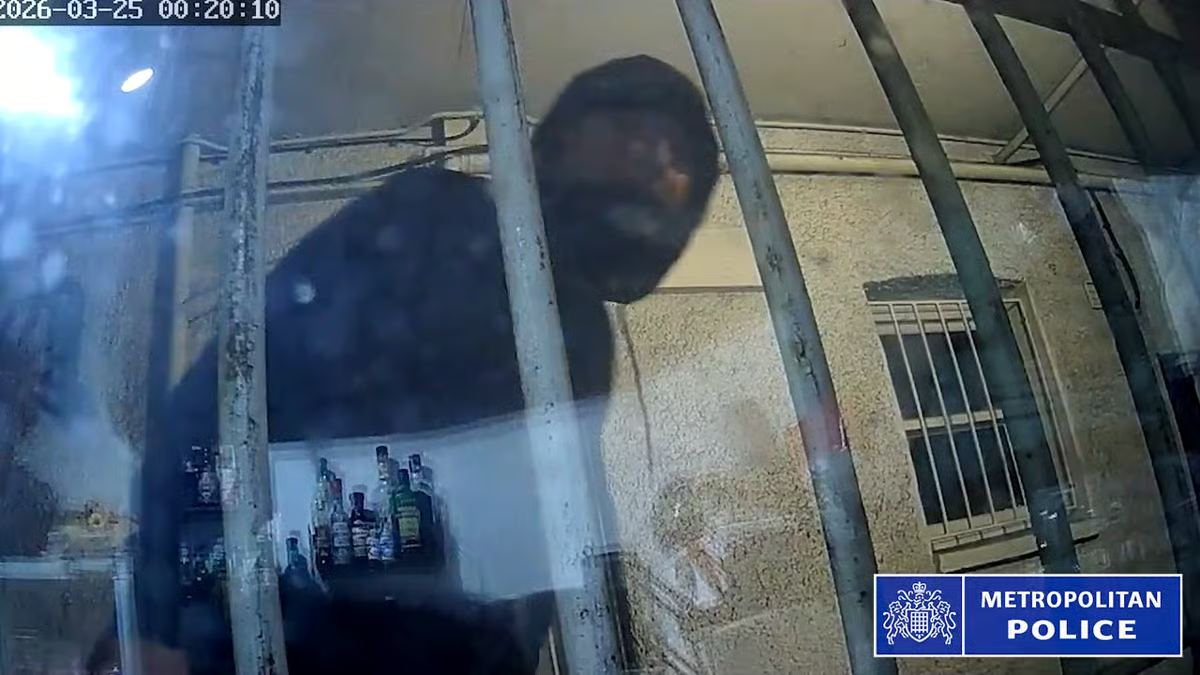
Christopher Taylor was banned from the roads when he smashed into the nine-year-old and made off, claiming to have panicked, Teesside Crown Court heard.

He then commented on a Facebook post showing CCTV of the incident in Thornaby saying he was “truly sorry” and would hand himself in, but failed to and two days later police found him hiding in a kitchen cupboard, trying to conceal himself behind a black bag.

Cainan Lonsdale, prosecuting, said, “thankfully” the boy “only” suffered scratches and abrasions to his back and a cut to the head which required three stitches. He underwent an X-ray but the scan revealed no further injury.

Although his family did not wish to provide a victim impact statement for the court, they did tell police their son had recovered well from treatment.

Advertisement

Mr Lonsdale said CCTV from the scene was shared on social media and the defendant was identified, so he posted a response on Facebook apologising, claiming to be “truly sorry”, pledging he would hand himself in to police.

Teesside Crown Court heard that as he fled Taylor shouted to the boy to get up, but other road users and passers-by in the street did go to his aid. Taylor was said to “to feel sick with shame.”

Despite his pledge to hand himself in, following the incident in Imperial Avenue on March 26, it was only two days later that he was arrested after officers went to his home address in Middlesbrough.

He claimed he had tried to swerve to avoid the boy, who it was accepted had not looked before starting to cross the road.

Advertisement

Mr Lonsdale said Taylor told police he “panicked” and rode off, stopping around the corner in a neighbouring street.

ChristopherTaylor, 34, starting an 18-month prison sentence after colliding into a boy on a pedal cycle and riding off on an illegal e-bike without going to his aid (Image: Cleveland Police)

He said he had intended to hand himself in but accepted the e-bike he was riding was not “road legal” and, therefore, he was uninsured.

Mr Lonsdale said it was estimated Taylor was travelling at between 15 to 20-mph at the time and did attempt to swerve to avoid the boy on the bike but he could not avoid the collision.

Taylor, 34, of Maple Avenue, Grove Hill, admitted careless driving, failing to stop after an accident and having no insurance.

Advertisement

The court heard his 17 previous offences included drink and drug driving, for which he received a 14-month prison sentence, suspended for 18 months, with a three-year driving ban, in November.

Jonathan Gittins, for Taylor, said, “he knows things could have been much worse”, regarding the boy’s injuries, for which he has expressed his shame and remorse, offering an apology to the victim and his family.

Mr Gittins said the defendant did intend to hand himself in, but, again, “panicked”, knowing he was in breach of a suspended prison sentence.

He said since being admitted to custody, at Holme House Prison, Stockton, awaiting sentence, it has been the defendant’s first taste of life behind bars.

Advertisement

Mr Gittins added that it was, “time he hasn’t wasted”, as he has remained “substance free”, with the help of the prison drug and alcohol service, and has been working in the wood mill, making furniture.

Judge Nathan Adams said that viewing the brief CCTV footage of the incident was among the most “distressing” clips he had seen, watching the boy being dragged along the road for several metres before, “being left in a heap”.

The judge told Taylor: “He was quite clearly in pain and distressed, yet you reacted as you did, riding off.”

Judge Adams said just the use of the bike was illegal and noted that Taylor had never held a driving licence.

Advertisement

He activated the 14-month suspended sentence, imposing a total term of 18 months.

Banning him from the roads for a further 42 months, the judge told Taylor: “You have got to realise you must stay off a mechanical vehicle of any kind.

“Otherwise, you will only find yourself serving longer and longer periods in prison.”

Advertisement

Source link

Continue Reading

NewsBeat

Why the electric SUV boom is a problem for climate, health and equity

Published

on

Why the electric SUV boom is a problem for climate, health and equity

Governments and car manufacturers sell electric cars as the future of green transport. But a less visible trend is challenging this story: many electric cars are getting bigger.

The International Energy Agency recently reported that larger models, including sports utility vehicles (SUVs), are taking up a major share of electric car markets.

In China, electric SUVs accounted for more than 60% of electric car sales in 2025. In Europe, SUVs accounted for almost 75% of electric models in 2025. In the US, the figure was even higher, at more than 85%.

SUV emissions are now so large that, if all SUVs were a country, they would be one of the world’s five biggest CO₂ emitters. The problem with SUVs is not only their tailpipe emissions. It is also their size, weight, cost and the way they reinforce car-dependent lifestyles.

Advertisement


À lire aussi :
Why surging sales of large electric vehicles raises environmental red flags


Electric SUVs may reduce tailpipe emissions compared with petrol and diesel SUVs, but they still need larger batteries, more raw materials, more energy and more road space than smaller electric cars. Their greater weight can also contribute to pollution from tyre, brake and road wear, including fine particulate matter linked to respiratory and cardiovascular diseases.

Larger vehicles can also make streets more dangerous, especially for children. A study using Great Britain crash data found that children aged 0-18 hit by SUVs, rather than passenger cars, had 77% higher odds of fatal injury. For children under nine, the odds were more than three times higher.

Advertisement

Switching diesel or petrol SUVs for electric SUVs isn’t the solution.
PV productions/Shutterstock

When roads are dominated by heavy privately owned cars, walking and cycling become less attractive, even for short everyday journeys. This matters because active travel (such as walking and cycling) is one of the easiest ways to build physical activity into daily life while producing little or no direct carbon emissions.

Car-dominated streets affect people unequally. Lower-income households are less likely to own new electric cars, but they still experience the traffic, danger, noise and pollution created by them. This is why the green transport transition needs to be judged by more than the number of electric cars sold. It should also be judged by whether it reduces car dependency and creates healthier, fairer streets.

Avoid, shift, improve

Our new research in the journal Energy Economics uses the avoid-shift-improve framework to assess transport decarbonisation. Avoid means reducing the need for unnecessary car journeys through measures such as teleworking, compact development, and better access to local services. Shift means moving remaining trips to lower-carbon, healthier modes such as walking, cycling, public transport, and bike and car sharing. Improve means making the vehicles that are still needed cleaner, lighter and more energy efficient, including through electrification.

This order matters. If policy jumps straight to improve, it can reduce emissions per mile while leaving the wider system unchanged. A city full of electric SUVs may have no exhaust emissions, but it can still suffer from congestion, road danger, inactive travel, unequal access, non-exhaust pollution and streets dominated by large private vehicles.

Advertisement

Too big to be green?

In our study, the proposed model uses registrations of SUVs as an undesirable indicator of transport decarbonisation. Their growth works against the move towards smaller, lighter and more energy-efficient cars. Larger, more expensive vehicles can deepen car dependence: once people have invested in a costly car, switching to non-car modes of transport can feel like a loss.

The SUV boom illustrates this. Larger vehicles are marketed as safer, more comfortable and more desirable. Advertising presents them as symbols of freedom, family protection and status, helping to make large cars appear normal and necessary even when smaller cars and better transport options could meet many everyday needs.

This conflicts with UK and EU climate goals, which prioritise reducing emissions, improving public health and making sustainable transport more accessible.

There are practical alternatives. Policy can support smaller, lighter and more affordable electric cars where cars are still needed. It can also make walking, cycling and public transport the easiest choices for everyday journeys. This means protected cycle lanes, safe pavements, reliable buses, lower traffic neighbourhoods, and road pricing that reflects the space, weight and pollution costs of larger vehicles.

Advertisement

These measures are not about blaming drivers. They are pro-health, pro-equity and pro-climate. Many people require cars, especially in rural and poorly connected areas. But the goal should be to reduce unnecessary car dependence, not to replace every petrol SUV with an electric SUV.

The future of transport should not only be electric. It should be lighter, healthier, more affordable and less car dependent.

Source link

Advertisement
Continue Reading

Trending

Copyright © 2025