Connect with us
DAPA Banner
DAPA Coin
DAPA
COIN PAYMENT ASSET
PRIVACY · BLOCKDAG · HOMOMORPHIC ENCRYPTION · RUST
ElGamal Encrypted MINE DAPA
🚫 GENESIS SOLD OUT
DAPAPAY COMING

NewsBeat

an ancient Amazonian world revealed from the sky

Published

on

an ancient Amazonian world revealed from the sky

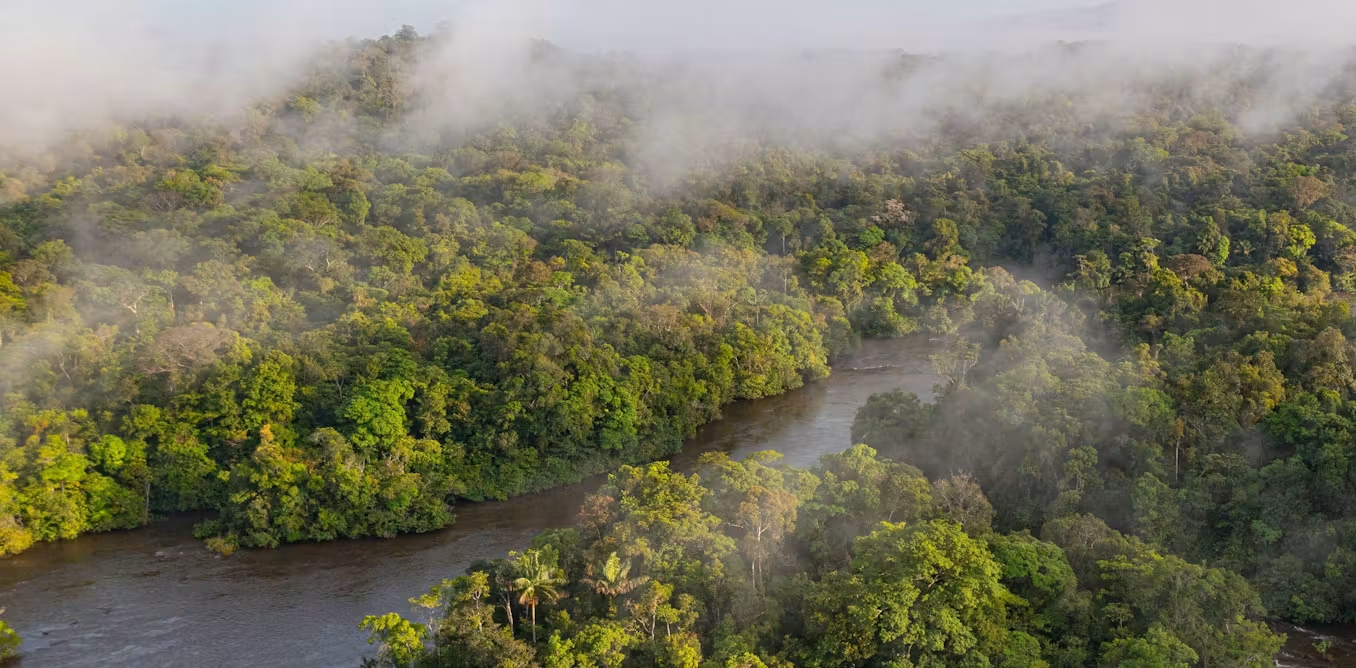
From the air, you see it only through the constant jolt, tilt and shudder of the low-flying Cessna aircraft. The landscape of the Llanos de Moxos, northern Bolivia, appears as a disconnected patchwork of open grassland savannahs, forest islands and lakes.

It feels random, almost unreadable. Only gradually does the pattern resolve itself: raised causeways or paths fanning out to link the forest islands, and a dense, scattered web of canals threading the terrain. Slowly you realise it’s a structured network of intersecting lines, enclosures and roads – the imprint of past human design.

Aerial view of Llanos de Moxos.
Jose Iriarte, CC BY-SA

If you stand on the open savannah, there is almost nothing to see of this ancient network. The horizon feels open, with fires in the distance from local people burning pastures and clearing forest as dry season begins. The old geometry is still faintly perceptible, but you have to know how to look.

Advertisement

Step into the patches of forest and the canopy closes in. The earth softens underfoot and mosquitoes descend in relentless swarms. The sweat on your neck thickens into a humid film, carrying the familiar scent of suncream and the sharper, chemical note of DEET.

In the uneven light between the trees, the landscape dissolves into subtle rises and depressions. Against the rhythmic swish of machetes as our guides cut through the vegetation, your mind tries to piece together the fragments of structures into something coherent. Flying overhead doesn’t reveal anything about this forest area in the way that it does with the savannah. But fortunately recent advances in technology have transformed what we are able to see.

Surveying in the Amazon rainforest

Surveying in the dense Amazon rainforest.
Jose Iriarte, CC BY-SA

Archaeological explorations in this part of the world have been completely changed by lidar in the past couple of decades. Lidar maps an area from a plane or drone by bouncing rapid laser pulses off the Earth’s surface. Some of these pulses penetrate the forest canopy, reach the ground and reflect back to the sensor.

By measuring the return time, the system can generate highly precise three-dimensional models of the terrain. This allows you to strip away the camouflage of vegetation, making it possible to see what lies below the Amazonian forest for the first time.

Advertisement

It reveals the ancient Llanos de Moxos as not simply a collection of settlements, but an entire urbanised landscape. A large part in the south-east of this region belonged to the Casarabe culture, which dominated between around AD500 and 1400. It extends across 20,000km², which is roughly the size of New Jersey in the US.

The Casarabe organised into a hierarchy of four different sizes of settlements (those forest islands mentioned above). The biggest ones – the primary settlements – were as large as 3km² or 300 hectares. That’s enough space for over 400 football pitches, suggesting that they could have accommodated substantial numbers of people.


Welcome to our series on the great mysteries of archaeology. Viking explorers, Amazonian cities, artefacts from before civilisation. Archaeology may be all about the past, but it’s constantly shifting with every scientific discovery. This series will dig into some of the most fascinating debates in the field today.

Advertisement

These settlements connect along the raised causeways to smaller secondary and tertiary sites a number of kilometres away, all of which were permanently inhabited as opposed to empty ceremonial hubs. A fourth tier consists of groups of isolated mounds located out in the pampas, which likely correspond to dwelling areas occupied by farmers who would have worked the fields.

It’s not possible to show a lidar image of these four different types of sites interconnecting because they are too far apart for the resolution available, but the image below of a primary settlement known as Loma Cotoca shows the kinds of things we are now documenting.
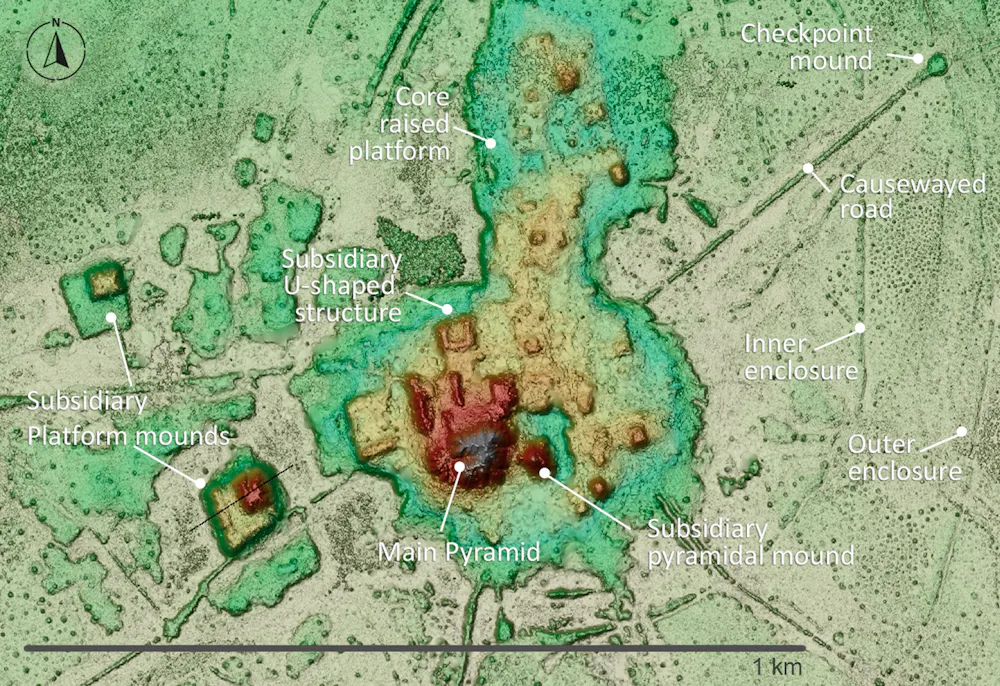
Aerial shot of Loma Cotoca

Lidar shot of Loma Cotoca.
Jose Iriarte, CC BY-SA

It features some very impressive civic-ceremonial architecture: conical pyramids over 20 metres tall and U-shaped structures that may have acted as areas for public gatherings for speeches or ceremonies. These were built on top of man-made platforms rising as much as five metres off the ground and extending over 20 hectares. To be clear, this is all still hiding under the forest, but the lidar data reveals the shape, height and layout of what lies below.

The volume of earth moved to create this architecture would have rivalled – and in some cases exceeded – that of well known Andean monuments such as Akapana a few hundred miles to the south-west on the other side of the Andes. Akapana was the epicentre of the Tiwanaku empire that dominated the southern Andes between about AD600 and 1000.

Advertisement
Akapana pyramid in Tiahuanaco o Tiwanaku.

Akapana pyramid in Tiahuanaco o Tiwanaku, Bolivia.
Wikimedia, CC BY-SA

Yet where monuments like Akapana were surrounded by classic, compact bounded cities with thousands of inhabitants, the Casarabe equivalent was completely different. This was dispersed, low-density living amid extensive green space – a form of tropical urbanism that challenges longstanding assumptions about this area as sparsely populated and only lightly modified. It invites comparison with other low-density tropical urban landscapes such as the Maya in central America and the Angkor in latter day Cambodia.

Equally important is the coherence of the Casarabe system. The settlements are rarely isolated, part of a tightly connected network with shared water-management systems. It was clearly all planned and coordinated, designed not only as living spaces but for integrating the population across the region.

We can see that the Casarabe were sustained by drained-field agriculture: the canals were dug to make the land viable for planting during the wet season. The most prominent crop was maize, but there was a remarkable diversity of other produce. This was all embedded within a landscape that was engineered through reservoirs and farm ponds, which helped the Casarabe sustain cultivation and maintain access to water through the dry season in this extremely seasonal environment.

Also very noticeable is the fact that all the major architectural features and burial sites are oriented north-north-west. This suggests these people may have been led by cosmology, with important celestial bodies or regions of the night sky serving as symbolic reference points – hinting at a world where infrastructure, settlement and belief were inseparable.

Advertisement

Rethinking the Amazon

The Casarabe culture covered much less than 1% of Amazonia, which is the whole tropical interior of South America, spanning close to half of the entire continent. For much of the 20th century, this vast area was viewed by archaeologists as an environment that was limiting for human existence.

Poor soils, scarce game, extreme El Niño floods and droughts, and the challenges of tropical disease were all thought to constrain human populations to small, wandering groups living off the land as best they could. Large, settled societies – let alone towns or cities – were considered unlikely, if not impossible.

This view began to shift in the late 20th century for several reasons. Archaeologists realised that Amazonian people had been domesticating a diversity of plants since the end of the Ice Age. They manufactured some of the earliest ceramics in the Americas, and also devised soils known as Amazonian Dark Earths, which combined charcoal, bone and waste materials with the existing poor-quality soil to make it fertile enough for widespread farming.

Advertisement
Indigenous planting in Peru

Specially engineered Amazonian soils unlocked widespread farming.
Carlos Mora

It also became apparent that just like the Casarabe people, many other cultures across Amazonia had reclaimed vast expanses of seasonally flooded savannahs over several thousand years to create raised and drained field systems.

These discoveries were evidence of long-term settlement and landscape management far beyond what was previously thought possible. It meant Amazonia was not simply a backdrop to human activity; much of the landscape was shaped over the last 13 millennia by the people who lived there.

Enter lidar

Like lasers in the sky, lidar technology has accelerated this transformation in our understanding. The digital process feels near-magical, a “vegetation removal algorithm” that reveals the secrets below.

In practice, however, working with lidar in Amazonia is anything but straightforward. Running such a project here, as I have done, can feel like one of the greatest emotional rollercoasters in field archaeology. It’s all anticipation, frustration and sudden revelation – only comparable, perhaps, with shipwreck exploration.

Depending on what technology is available and most suitable for exploring a particular area, I’ve worked with lidar attached to drones, aeroplanes and helicopters. I’ve learned through trial and error that the technology is only as effective as the logistics and personalities behind it – above all on one occasion when we were trying to integrate a Hungarian lidar sensor with a Brazilian drone.

Advertisement
Shot of a drone and big smiles as it finally worked

Above: the ‘Experimental’ drone; below: the moment it finally worked – the smiles in the control station say it all.
Jose Iriarte, CC BY-SA

Lidar can perform beautifully one day and fail the next, depending on the equipment, weather, terrain, batteries, communications and the sheer difficulty of operating in remote Amazonian conditions.

Flights must be carefully planned in remote areas with limited infrastructure, where convective clouds, smoke from fires, wind and even vultures riding thermals can disrupt data acquisition. You have to arrange fuel in advance and improvise landings wherever a safe clearing can be found. Here’s our team refuelling a lidar helicopter in the football field of a small village in Acre state, western Brazil:

You also have to do constant troubleshooting with the technology, such as making sure it’s calibrated correctly and that the data from different flight paths all aligns. What appears in the final images as a seamless “removal” of the forest is, in reality, the product of improvisation, negotiation and persistence.

Advertisement
Percy Fawcett photograph

Percy Fawcett.
Wikimedia, CC BY-SA

But given all these challenges, it makes the first successful images all the more powerful when they finally appear. The reward is that we’re finally finding the “lost civilisation” that explorers like Percy Fawcett were searching for a century ago, but by cajoling a drone rather than battering through jungle.

Incidentally, this technology also has important uses beyond archaeology. It can help people to locate and harvest crops like rubber or açaí palm fruits without having to clear so much rainforest. It is also used by pioneering projects such as Amazonia Revelada, which helps Indigenous and traditional people of the Amazon to prove their historic presence within an area to ward off modern commercial interests like loggers or farmers, while also protecting the living history and nature embedded in these landscapes.

Other lidar discoveries

Lidar surveys by French and Ecuadorian archaeologists have revealed that the Llanos de Moxos was certainly not the only example of large-scale, highly integrated society in Amazonia. The Upano Valley, which covers some 300-600km² on the mountainous forest of the Ecuadorian eastern flanks of the Andes, offers another striking example – this time from between about 500BC and AD600–700.

Lidar discovery areas

Advertisement
Map of South America showing settlements traced by lidar


Felt, CC BY-SA

In Upano, archaeologists have been able to map a vast network of settlements connected by extensive road systems, with large platforms and clusters of buildings arranged in organised layouts across a broad area.

What stands out is not just the scale – thousands of structures – but the rigour of the planning. The settlements didn’t just grow randomly, but as part of a deliberate design: we see straight lines of flat-topped platforms laid out in repeating rows and connected by straight paths that cut cleanly across the landscape, as you can see below.
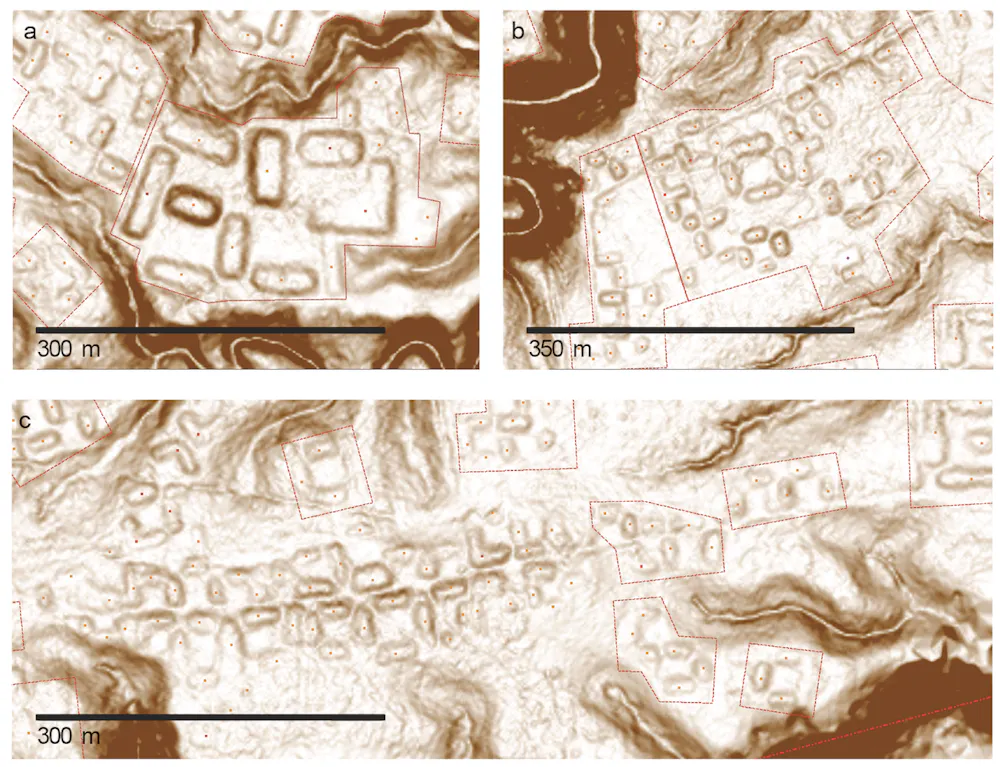
Lidar footage of settlements in the Upano Valley.

Lidar footage of settlements in the Upano Valley.
Jose Iriarte, CC BY-SA

Again, this is not urbanism in the conventional sense of dense, continuous occupation. There would have been none of the vertical stacking of buildings that you’d get in European settlements, and there were also green spaces between platform complexes – much more like a forest city.

Like the Casarabe region, this is a distributed settlement pattern that is both open and highly structured, but the arrangement is much more compact. This reflects the limited flat space available on the upper terraces of the Upano River, which rise up to 100 metres above the surrounding landscape.

Advertisement

Elsewhere in Amazonia, we see more variations. In the Upper Xingu of central Brazil, interconnected settlements were arranged around a shared ceremonial and road network, again suggesting a regionally coordinated social world.

Further north, the Tairona people of the Sierra Nevada de Santa Marta in present-day Colombia built terraced stone towns in the mountains, linked by paved paths. This was a form of urbanism shaped entirely by the demands of steep, high-altitude terrain. Below is a lidar image of one area in this region, with the platforms that would have housed the settlements marked in yellow. Below that, you can see what the platforms look like.

Above: lidar image of settlements at Teyuna-Ciudad Perdida in yellow; below: an actual shot of the platforms that housed the settlements.

Above: lidar image of settlements at Teyuna-Ciudad Perdida in yellow; below: an actual shot of the platforms that housed the settlements.
Daniel Osorio, CC BY-SA

In western Amazonia, Acre adds another important variation. From around AD1–1000, people built large ditched enclosures, or geoglyphs, mainly in the south-eastern part of this region along the upper Purus River. These were square, circular, hexagonal or octagonal mounds, often 1-3 hectares in size, with ditches up to four metres deep. These were probably used as ceremonial gathering places rather than permanent settlements.

After about AD1000, these were followed by what we call circular mound villages, occupied until around AD 1650–1700. They featured rings of mounds around central plazas and straight roads radiating out like the rays of the Sun, often built to align with the four main compass points. These “Sun villages” were true settlements, and formed interconnected networks across the southern rim of Amazonia. You can see an example in the lidar image below.

Advertisement
Circular mound village lidar image at Acre, Brazil.

Lidar image of circular mound village Dona Maria at Acre, Brazil.
Jose Iriarte, CC BY-SA

Taken together, these discoveries fundamentally reshape our understanding of Amazonia. We now see a mosaic of managed landscapes, engineered environments and, in some cases, city-scale societies. What unites them is not a shared blueprint but a shared impulse: the organisation of people, space and movement across large landscapes in ways that were deliberate, durable and distinctly their own.

To stress, Amazonia was not uniformly dense or urban. It supported a diversity of types of settlements, from dispersed networks like Moxos to tighter grids like Upano, each of them adapted to local ecological conditions. They shared a low-density urbanism, in the sense of large, interconnected populations without the density of classic cities.

What we still don’t know

How were these societies organised politically and socially? How did they interact with variations in the climate and environment, ranging from the heavy rainfalls and droughts caused by El Niño to rivers forging new routes that could move them away from a settlement within a few generations?

What, if any, connections existed with mountain societies in the Andes? And perhaps most importantly, since both the Casarabe and Upano ceased to build monuments after 1492, what led to their transformation or decline before the arrival of Europeans?

Advertisement

There is active debate between archaeologists over whether these societies transformed because of environmental stress, internal political change, or shifts in things like trade routes or migration.

In the Llanos de Moxos, one possibility is that a prolonged period of climate change affected the Casarabe water-management systems that were so critical to feeding this thriving society. In the Upano Valley, volcanic eruptions and earthquakes may have disrupted settlements and agriculture, although it’s unclear whether that could have led to the area being abandoned.

It seems likely that as we uncover new things, it will reveal more and more integration between different societies. What we are seeing now in Amazonia is much like looking at a satellite image of a country at night: bright, isolated clusters of light – cities that appear disconnected. But as we continue to expand our coverage and fill in the gaps, I think this will change.

What now appear as isolated clusters may also resolve into extensive networks. For example a study across the southern rim of Amazonia has predicted that the kinds of settlement mounds that have been identified so far are likely to occur across about 400,000km², supporting an estimated regional population of roughly 500,000 to 1 million people in the era before the Europeans arrived.

Advertisement

Entire regions may emerge as previously unrecognised centres of population and landscape management. This could be particularly so for the Llanos de Moxos. The whole area covers as much as 200,000km², depending on where you draw the boundaries, stretching into Brazil and even Peru. It is often divided into several apparently distinct cultural regions — the Casarabe (aka the monumental mound region), and then two others called the platform ridge and zanjas (ditches) regions.

As lidar coverage expands and more archaeological work is conducted, we may begin to understand how these societies were economically specialised. We know, for example, that the fortified villages of the zanjas region had fish weirs spanning hundreds of miles that were capable of capturing vast quantities of migratory fish. The platform ridge region consisted of large drained fields, which could potentially produce surpluses of maize. It is conceivable that these belonged to a broader network that supported the more complex Casarabe centres.

Or perhaps – who knows – the relationships were more fluid and reciprocal. For now, the question remains open. But it is precisely this possibility of deep regional integration that lidar is beginning to bring into view. In time, we may even begin to identify Casarabe outposts scattered across the Llanos de Moxos.

What happens next

There’s still a huge amount to be done with lidar. Vast areas, particularly in the Ecuadorian and Peruvian Amazon – remain unexplored. One recent study suggested that there could be more than 10,000 more urban structures of the kind I’ve been describing still hidden throughout Amazonia, all of them dating from pre-European times.

Advertisement

Looking ahead 20 years, it is likely that our map of Amazonia will look very different. One promising technology is satellite-based lidar systems, which could provide broader, though less detailed, datasets across large areas. Advances in machine learning are also beginning to help us identify archaeological features within massive datasets, speeding up a labour-intensive process.

Against this, there are time pressures in some places. Llanos de Moxos, for instance, is unfortunately in rapid transition. The very ground that holds the traces of ancient networks is being transformed by mechanised agriculture and large-scale terraforming for rice cultivation and pastures.

We also need to keep reminding ourselves that lidar is only the first step. What really matters is how it’s brought together with other lines of evidence. Most sites discovered by lidar have yet to be excavated, so we’ll have to do much of that, looking for everything from bones and plants to ceramics and weapons.

So far, most excavation has been in the Casarabe area of the Llanos de Moxos. The reason, for instance, that we know the culture lived primarily on maize was through the discovery of over 60 human skeletons, which underwent carbon isotope analysis. The same research paper also analysed excavated duck bones to show that the Casarabe were feeding them maize too, suggesting animal domestication in a continent that was not generally known for it.

Advertisement

Another fascinating Casarabe find is a single buried skeleton who may have been a leader, because he had a collar of jaguar teeth around his neck. He was also wearing ear pieces made of armadillo shell, studded with mottled blue stones called sodalite – it’s not clear what these were for.

Male skeleton in Loma Salvatierra

Male burial in Loma Salvatierra, Llanos de Moxos, shows: a) plate of cooper; b) earpieces with pearls of sodalite and armadillo shell; c) a collar of jaguar teeth; d) shell beads; e) bracelet of shell.
Heiko Prümers/Jose Iriarte, CC BY-SA

We’ll also need to obtain more precise dates for key events using techniques like radiocarbon dating, and more pinpoint accurate environmental data to help support theories about ancient changes to the climate – as opposed to the wider regional information we’ve tended to rely on until now. Lake sediments are great environmental archives, preserving evidence of things like vegetation change and landscape disturbance.

Also important is comparing genetic data from excavated bones with people who live in these areas today – in dialogue and collaboration with local communities whose histories, memories and knowledge are essential to understanding these landscapes.

It’s all a question of how lidar is brought together with all this other evidence. The most convincing reconstructions will come from the convergence of all of these. One further major challenge ahead, however, will be to bridge the gap between scientific reconstructions and how past peoples understood and inhabited their world. Archaeology is increasingly rich in data, but we have to relate it to lived experience.

Advertisement

That is no easy feat, but it is essential if we are to move from mapping past worlds to understanding them. Crucially, Amazonia – with its rich, still-vibrant Indigenous societies and ethnographic record – offers an exceptional opportunity to do this, providing rare continuities through which to anchor and critically engage our interpretations of the past.

Lessons for today

My own sense is that we will move towards a view of Amazonia not as an exception, in line with the old view that the people lived within an untouched paradise, but as part of a broader pattern of human-environment interaction. The rainforest will be understood not only as a biological system, but as a historical one – shaped, in part, by the people who lived within it.

This does not mean the Amazonian people who simply lived “in harmony” with nature; the evidence points to something more interesting. Although Amazonian societies developed complex, and at times intensive, forms of land use, the evidence consistently shows that they often did so while maintaining continuous forest cover. Far from the large-scale deforestation that we might assume was necessary for such elaborate forms of human life, their practices created mosaics of managed forest, gardens, orchards, wetlands and settlement areas.

We know partly from lake sediment data that people enriched the forests with species that provided food, building materials, medicines and other resources, from açaí and cacao to palms, cinchona and copaiba. The fact that some of these species endure today suggests that past land use left lasting ecological legacies.

Advertisement
Acai palm

Amazonian açaí is one of numerous species that are not prevalent by accident.
Guentermanaus

In the context of today’s climate crisis, the long-term balance that these people achieved offers a powerful lesson: it is possible to sustain complex societies without destroying the forest, if land use is guided by principles that integrate ecological knowledge, cultural values and a commitment to the continuity of the living landscape.

What lies beneath the Amazon is not just a hidden past. It is a reminder that even the most seemingly untouched landscapes can carry deep histories, waiting – sometimes just beneath our feet – to be revealed.

This article features references to books that have been included for editorial reasons, and may contain links to bookshop.org. If you click on one of the links and go on to buy something from bookshop.org The Conversation UK may earn a commission.


For you: more from our Insights series:

Advertisement

To hear about new Insights articles, join the hundreds of thousands of people who value The Conversation’s evidence-based news. Subscribe to our newsletter.


Source link

Advertisement
Continue Reading
Click to comment

You must be logged in to post a comment Login

Leave a Reply

NewsBeat

HSDC takes over Portsmouth Comic Con 2026

Published

on

HSDC takes over Portsmouth Comic Con 2026

The future of the creative industries was brought vividly to life at Portsmouth Guildhall recently, as students from HSDC South Downs demonstrated outstanding talent and professionalism at Portsmouth Comic Con 2026, taking their learning far beyond the classroom and into a live professional environment.

Source link

Continue Reading

NewsBeat

‘Instinct took over’ says Belfast knife attack hero who tackled suspect with son’s hurling stick

Published

on

Belfast Live

“People have called us heroes but to be honest I’d like to think most people would’ve got stuck in and helped if they could.”

The ‘North Belfast knife attack hero’ has recalled the moment he tackled the suspect with his son’s hurling stick, fearing for the victim’s safety.

Maitiu Mág Tighearnán intervened during the knife attack in the Kinnaird Avenue area of North Belfast on Monday night, June 8, to rescue the victim, Stephen Ogilvie.

Sudanese man Hadi Alodid, 30, appeared at Belfast Magistrates’ Court on Wednesday, charged with the attempted stabbing murder of Mr Ogilvie, threats to kill an NHS radiographer on the same day and possession of a knife.

Advertisement

He has been remanded in custody for four weeks. The court heard that the 44-year-old victim had lost his left eye and received deep cuts to his head, face and back.

32-year-old Mág Tighearnán and a friend said they jumped out of their car to rescue Mr Ogilvie as he lay on the ground. The pair had stumbled across the horrifying incident by chance as they took a short-cut to a petrol station.

Mr Mág Tighearnán, from West Belfast, who had been driving, told the Daily Mail: “I turned into Kinnaird Avenue and I could see another car stopped in the middle of the road a little further up. The woman driving then began reversing at speed as though she was trying to get away from something.

“She stopped as I approached and I drove round her, and as I did so we could see what looked to be two men fighting in the street, with one on top of the other. This was late at night and so we thought we better go and break it up. Andre was in the front passenger seat and he jumped out first.

Advertisement

“He’s trained in Brazilian jujitsu and so he approached them to separate them, but as he got closer he saw the knife. It looked to be a serrated steak-knife but with a broken handle. He shouted to me that the man attacking the other had a knife and to get something to help.”

At this point, Mr Mág Tighearnán said he thought someone was going to lose their life: “I’d taken my son to hurling practice earlier that evening and so I’d got out of the car, gone to the boot and grabbed his hurling stick. Instinct took over and I ran over and I smashed this guy over the head with the hurling stick. Right on the flat side, about three times. As hard as I could.

“Andre was a few seconds behind and he came running in and tried to subdue the attacker with an ankle-hold so he could free the victim. I hit this guy again, hard, but it didn’t seem to phase him. He did stumble back, though and dropped the knife. I think another man who’d been watching came in and kicked the knife away.

Advertisement

“We were trying to roll the attacker onto his stomach to subdue him but he was struggling. The police then arrived and four officers took over before armed tactical support turned up.”

Mr Mág Tighearnán, who runs his own removal company, added that the victim, Mr Ogilvie, was “still conscious but weak with all the blood loss”.

“When he was taken away, he looked to have a horrible injury to his eye. The knifeman was led away by six officers but they were still struggling with him. I’m glad we intervened when we did. It was pure chance that we’d gone that route to the petrol station.

Advertisement

“People have called us heroes but to be honest I’d like to think most people would’ve got stuck in and helped if they could. I just hope the victim pulls through and manages to recover as best he can,” he added.

Maitiu’s proud partner, Aoife O’Reilly, described him as “very, very humble”, adding, “I couldn’t be prouder of Matt. This is my partner and the father of my child who stood in and hopefully saved a man’s life last night.”

A GoFundMe fundraiser has been launched to ‘buy a pint’ for Maitiu, reaching over £20,000 in less than 24 hours, with the organiser, Niall Donnan, saying he has been told that Maitu wants to share some of the funds with the victim.

Maitiu wrote online that he had stumbled on the attack ‘by chance’ and that he ‘got out to protect a young lad’ when he saw what was happening and that the police had yet to arrive.

Advertisement

If you would like to donate and buy a pint for the ‘knife attack hero’ please follow this link.

For the latest on this developing story follow our live blog here.

Source link

Advertisement
Continue Reading

NewsBeat

The Milky Way was rewired by a cataclysmic collision billions of years ago. Now it is on course for another

Published

on

The Milky Way was rewired by a cataclysmic collision billions of years ago. Now it is on course for another

Vasily Belokurov is one of three winners of the 2026 Kavli Prize in Astrophysics. The award is for “uncovering the fossil evidence of past mergers proving that the Milky Way galaxy” was built through the continuous collision and merging of smaller objects.

No matter the time or vantage point, from a pre-Neolithic cave to a post-lockdown London high-rise, the predictability of the night sky has always been humanity’s symbol of permanence and reassuring stability.

Yet this apparent calm is deceptive. Our galaxy, the Milky Way, emerged from chaos and turbulence, and its constellations are full of migrants, exiles and survivors. Right now, it has begun to stretch and distort again, pulled by a massive companion and heading for an inevitable collision.

How can I be so sure? As a galactic archaeologist, my job is to reconstruct the past of our galaxy and read the signs of its future.

Advertisement

Instead of digging through soil, I use the laws of dynamics and stellar evolution to sift through hundreds of millions of stars – searching for the most ancient and chemically peculiar among them, interpreting their orbits and piecing together the events that shaped the Milky Way. One ancient encounter left scars so deep that, billions of years later, they still define the galaxy around us.

I want to understand what governs the lives of these massive cosmic systems: which changes are nature – the slow internal evolution of a galaxy disc – and which are nurture, imposed by collisions and mergers.

Questions about the source of dark matter underpin it all. This is the invisible substance whose gravity holds galaxies together, but whose true identity remains one of the greatest unsolved puzzles in astrophysics.

The Milky Way is the one galaxy where stellar motions can be measured in extraordinary detail. This allows cosmologists including myself to construct our most precise map yet of dark matter: how far it reaches, how dense it is around the Sun, what shape it has and how smooth or lumpy it may be. If we can build this map in enough detail, we may begin to understand not just where dark matter is, but what it is.

Advertisement

Francesca Fragkoudi and Mark Lovell, Durham University.

A cataclysmic collision

Our work has been transformed by a revolution in open sky surveys. From 2000, the Sloan Digital Sky Survey showed what becomes possible when vast astronomical datasets are made public, enabling discoveries far beyond the goals for which the survey was first built.

And since 2014, Gaia, the European space telescope, has taken this transformation to another level by mapping the positions and motions of nearly 2 billion stars, turning the galaxy into a vast archaeological record. No ruins, no shards and no bones – only stars that hold the clues.

Advertisement

The Milky Way mapped with SDSS data.
Vasily Belokurov, CC BY-NC-ND

The clearest giveaway that something cataclysmic took place long ago in our galaxy is the migrants we observe: stars that were not born in the Milky Way.

While native stars mostly travel together, circling the galactic centre in the great rotating flow of the disc, migrants cut across that order. They slide past the locals, plunge into the inner galaxy, then fly back out to its outskirts, again and again.

These unusual orbits go hand-in-hand with unusual chemistry. Most of the migrant stars are less enriched in heavier elements than the locally born population. Their chemical composition is a sign of a slower rate of evolution that is typical of a dwarf galaxy.

This makes the migrants doubly valuable. They are both fossils of the Milky Way’s violent past, and probes of its outer regions, travelling where the local stars rarely go.

Advertisement

How the Milky Way was rewired

One of the central ideas in the theory of cosmic structure formation is that galaxies grow hierarchically. Smaller galaxies fall into larger ones and are torn apart, leaving their stars behind as migrants.

In the Milky Way, the largest ancient structure of this kind is known as Gaia-Sausage-Enceladus. It is the remains of a vanished galaxy that collided with our own between 8 and 11 billion years ago (the “sausage” refers to a pattern in its stars’ motions).

Artist's impression of the young Milky Way colliding with another galaxy around 10 billion years ago.

Artist’s impression of the young Milky Way colliding with another galaxy around 10 billion years ago.
Vasily Belokurov, based on image by Juan Carlos Muñoz/ESO, CC BY-NC-SA

The Milky Way also did not go through that crash unscathed. The collision rewired and reshaped it.

Some of these changes are easily visible in the data. Stars from the old disc were splashed into our galaxy’s halo, becoming exiles in the place where they were born. A new posse of star clusters were also acquired.

Advertisement

At the same time, we think something even more momentous was taking place. The encounter changed the orientation of the Milky Way’s disc, and its alignment with the dark matter halo.

While dark matter is too diffuse to dominate our Solar System, in the outer galaxy it is the main gravitating mass – moving, streaming and, in the standard picture, clumping into a hierarchy of lumps.

Around the Milky Way, this dark matter forms a vast halo, much larger than the luminous part of our galaxy. We often imagine this halo as a sparse, round cloud, but Gaia has helped show this picture is too simple.

The dark halo can be stretched out of shape by a major encounter. Like a ship beginning to list, the Milky Way started to lean – not suddenly, not visibly, but over billions of years.

Advertisement
View of the Southern sky shows the Milky Way and (far right, close to horizon) two galactic neighbours, the Small and Large Magellanic Clouds.

View of the Southern sky shows the Milky Way and (far right, close to horizon) two galactic neighbours, the Small and Large Magellanic Clouds.
H.H. Heyer/ESO via Wikimedia Commons, CC BY-NC-ND

A new galactic dance

Unusually compared with many galaxies of similar mass, the Milky Way was allowed ample time to recover from the shock of the “sausage merger”. No other cosmic cataclysm appears to have shaken our Galaxy since, letting it settle into a quiet, uneventful life. That is, until now.

The Large Magellanic Cloud (LMC), currently our galaxy’s most massive companion, is already pulling at the Milky Way, disturbing its halo again. In an echo of what happened some 10 billion years ago, the Milky Way is being drawn into an accelerating dance with this neighbouring dwarf galaxy, recoiling in response to the LMC’s approach.

This is a dance that only one galaxy is likely to survive intact. A new chapter of migration, survival and adaptation has begun.

None of this spoils the beauty of the night sky – it deepens it. The calm band of light above us is not a symbol of permanence, but the visible reminder of a long survival.

Advertisement

The Milky Way has been broken, rebuilt and is now being disturbed again. Its stars remember the past; their motions reveal the future. What looks eternal is, in truth, a moment in a much longer story.

Source link

Advertisement
Continue Reading

NewsBeat

Unsafe section of Wales Coastal Path to remain closed

Published

on

Wales Online

It has been closed since 2023

A section of the Wales Coastal Path located in Neath Port Talbot looks set to remain closed after “significant ground instability issues” which the local council say risks public safety.

Advertisement

The news came after a group of councillors from the area launched an online petition in May calling for urgent action to re-open sections of the path around Baglan, Briton Ferry, and Sandfields West.

It was started by Labour opposition members who called for the Welsh Government and local council to repair and re-open these sections as soon as possible. Stay in the know by making sure you’re receiving our daily newsletter.

This followed an open letter from 20 members of the local Labour group in Neath Port Talbot to the Welsh Government cabinet minister for rural resilience and sustainability, MS Llŷr Gruffydd.

In it they said the “prolonged closure” of the path had gone on for several years and was becoming a matter of growing frustration and disappointment for residents who previously used it for walking, cycling, and enjoying the natural environment.

They added the closure had affected active travel connections in the borough as well as tourism, health, and local wellbeing.

The latest petition called on Neath Port Talbot Council to formally write to the new Welsh Government for urgent intervention and a clear restoration plan.

It also requested that Welsh Government secure funding in order to repair the path as well as publishing a clear timetable for its reopening.

Advertisement

The petition, led by councillors Josh Tuck, Carol Clement-Williams, and Suzanne Paddison, said: “The Wales Coastal Path is one of our nation’s greatest assets – a world-renowned route that should be a source of pride for communities across Wales.

“Yet for several years major sections around Baglan, Briton Ferry, and Sandfields West have remained closed, fenced-off, and left to deteriorate.

“This unacceptable situation has denied local people access to an important walking and cycling route, damaged tourism and local businesses, and undermined community wellbeing.

“Residents across Neath Port Talbot are increasingly frustrated by the lack of visible progress, the absence of a clear timetable for restoration, and the continued neglect of a nationally-important coastal route.”

Advertisement

However a spokesman for Neath Port Talbot Council said while they were supportive of re-opening the route in principle it was not currently feasible to do so safely or sustainably.

They said: “While acknowledging that the local authority receives funding via Natural Resources Wales to maintain the Wales Coast Path (WCP) the current position as relates to the closure of a section of the WCP in the Baglan/Briton Ferry area is not due to how funding is allocated.

“The route was closed in 2023 following significant ground instability issues, including the formation of sinkholes, which presented an unacceptable risk to public safety.

Advertisement

“While grant funding can support initial works the local authority must also consider long-term maintenance, ongoing safety risks, and legal responsibilities, particularly where the route crosses privately owned land and is not recorded as a registered public right of way as shown on the definitive map.

“While the WCP is recognised as an important route within the county borough the safety of the public is paramount and it is unfortunate therefore that the local authority is unable to re-open this section of the route at this time.

“The local authority remains supportive in principle to the re-opening of the route, however based on the constraints identified through discussions with the landowner, Natural Resources Wales, and Welsh Government it is not currently considered feasible to do so safely or sustainably. The agreed diversion will therefore remain in place at this time.”

Get daily breaking news updates on your phone by joining our WhatsApp community here. We occasionally treat members to special offers, promotions and ads from us and our partners. See our Privacy Notice.

Advertisement

Do you get a good service from your council?

Do you get a good service from your council?

Source link

Advertisement
Continue Reading

NewsBeat

Belfast attack victim Stephen Ogilvie’s father issues ‘please stop’ plea as son in ICU

Published

on

Daily Record

The father of Stephen Ogilvie has issued a plea to those spreading disinformation as his son remains in ICU

The father of a knife attack victim in North Belfast has made an urgent plea to those peddling misinformation online, urging them to ‘Please stop’. Stephen Ogilvie lost an eye and sustained further severe injuries following the assault on Kinnaird Avenue on June 8.

Hadi Alodid, 30, of Duncairn Avenue in Belfast, appeared before the city’s magistrates’ court on Wednesday, facing charges of attempted murder of Stephen Ogilvie, threatening to kill an NHS radiographer, and possession of a knife.

UUP leader Jon Burrows revealed on the morning of June 10 that he had spoken with Stephen Ogilvie’s father, who confirmed his son remains in ICU but is in a stable condition following the attack.

Advertisement

Widespread violence and disorder broke out across Belfast and several other towns in Northern Ireland on Tuesday night in the wake of the North Belfast incident, reports Belfast Live.

Mr Burrows confirmed that the victim’s father had a personal message he wished to convey. He said: “I want to thank Mr Ogilvie for taking the time to speak with me at such a distressing time for his family.

“His son remains in the ICU following the devastating injuries he sustained, but is stable. The injuries inflicted upon him are truly shocking, and our thoughts and prayers are with him and his entire family.

Advertisement

“The victim’s father has also asked me to pass on a direct appeal to those spreading disinformation online: please stop. This has shockingly included false posts on social media at various times that his son has died.

“This is causing immense additional distress to a family already going through an unimaginable ordeal. I echo that appeal wholeheartedly and urge everyone to act with decency and respect for this family.

“I offered my full solidarity and support to the whole family today.”

Mr Burrows continued: “I will be meeting with the Secretary of State tomorrow, where I will be raising issues directly related to this case.

Advertisement

“It is important that those in political leadership engage with issues like immigration, the security of our borders and the protection of all our citizens, whilst also standing unequivocally on the side of law and order. I also appeal again for parents to ensure their children are not out on the streets and involved in disorder.

“Tomorrow I will be asking the Secretary of State to meet the family of Stephen Oglivie in the coming days.”

In a previous statement released via Independent Councilor Stafford Ward, Stephen’s relatives emphasized that they “want to make it clear that overnight unrest is not welcome”.

Advertisement

The family also commended locals who intervened to help the victim and requested privacy from both the public and media.

“We are aware of the tensions and talk of protests following this incident. We want to make it absolutely clear that overnight unrest is not welcome, and peaceful protest is the only way forward.

“We have many migrants who make a deeply valuable contribution to our country, including in our healthcare system and hospitality sector and we depend on them to make our country work. We do not want this terrible tragedy to be used to divide people or fuel hostility,” the family said.

Ensure our latest stories always appear at the top of your Google Search by making us a Preferred Source. Click here to activate or add us as your Preferred Source in your Google search settings.

Advertisement

Source link

Continue Reading

NewsBeat

Superman star Dean Cain’s fall from grace after liking unkind joke about Supergirl actress

Published

on

Superman star Dean Cain's fall from grace after liking unkind joke about Supergirl actress
Dean Cain has once again sparked controversy. How did we end up here? (Picture: Getty Images)

For millions of 90s TV viewers, Dean Cain embodied the ideal man. 

With his movie-star looks, Princeton education, and starring role opposite Teri Hatcher in Lois & Clark: The New Adventures of Superman, Cain became one of the decade’s biggest heartthrobs, helping turn the Man of Steel into appointment television for an entire generation. 

At its peak, the show attracted more than 15 million viewers per episode and made Cain a household name.

Three decades later, however, the actor’s public image looks very different.

Advertisement

What did Dean Cain say about Milly Alcock?

This week Cain found himself at the centre of fresh controversy after appearing to endorse a social media post mocking new Supergirl star Milly Alcock

The backlash began when an X user questioned how Supergirl could have pierced ears if her skin was bulletproof. Another user then replied with an image comparing Alcock to Cha-Ka, a character from the 1970s TV series Land of the Lost.

Cain responded: ‘Dang it… I laughed.’ 

Dean Cain posts vile joke about Supergirl star Milly Alcock's face
Dean Cain agreeing with a joke about Supergirl star Milly Alcock’s face has sparked major backlash (Picture: X)

Backlash quickly followed, with many fans pointing out how disappointing it was to see a former Superman actor appearing to join in with a joke at the expense of a 26-year-old actress about to inherit one of DC’s most iconic roles. 

Many ritics accused Cain of participating in misogynistic appearance-based mockery and undermining a younger performer, with one writing on Reddit: ‘She is like the most conventionally attractive woman ever. We can’t win,’ while another replied: ‘THIS. RIGHT. HERE. They just hate women. Period.’

Advertisement

And the backlash did not prove to be a learning experience for Cain.

Since Sunday, the MAGA-supporting actor has replied to or reposted at least 30 posts related to the Supergirl controversy, interspersing them with messages attacking Maine Democratic Senate candidate Graham Platner and praising President Donald Trump’s appearance at Monday’s NBA Finals game at Madison Square Garden.

NEWPORT BEACH, CALIFORNIA - OCTOBER 19: Milly Alcock attends the 26th Annual Newport Beach Film Festival Honors & Variety's 10 Actors To Watch at The Balboa Bay Resort on October 19, 2025 in Newport Beach, California. (Photo by Jerod Harris/Getty Images)
Alcock is playing Supergirl in the upcoming film (Picture: Jerod Harris/Getty Images)

The incident is only the latest chapter in a long and increasingly divisive transformation.

How did Dean Cain become famous?

Before Hollywood came calling, Cain looked destined for an entirely different career.

Born Dean George Tanaka in 1966, he excelled academically and athletically, playing football at Princeton University before briefly signing with the Buffalo Bills. A knee injury ended his football ambitions and pushed him towards entertainment instead. 

Advertisement

After a series of commercials and guest appearances, he landed the role that would define his career in 1993.

ABC's "Lois And Clark - the New Adventures of Superman"
Cain played Superman in the show Lois & Clark: The New Adventures of Superman from 1993 to 1997 (Picture: Getty Images)

As Clark Kent in Lois & Clark, Cain embodied a softer, more romantic Superman, becoming a fixture on bedroom walls and magazine covers throughout the decade.

The role remains his most famous achievement, despite subsequent appearances in projects including Ripley’s Believe It or Not! and later a return to the Superman universe in Supergirl. 

He also became a major heart throb and source of tabloid intrigue, including a six-month relationship with fellow ’90s sex symbol Pamela Anderson at the beginning of her Baywatch run.

He also, famously, dated Brooke Shields during his time at Princeton.

Advertisement

In recent years, however, Cain has become almost as well known for his political views as for his acting.

What are Dean Cain’s political views?

"God's Not Dead: In God We Trust" Premiere
Cain has become increasingly outspoken about his conservative views in recent years (Picture: Omar Vega/Getty Images)

The actor, who has publicly supported Donald Trump, has increasingly used television appearances and social media to weigh in on culture-war issues. 

He said in an interview with Variety: ‘I love President Trump. I’ve been friends with him forever. Trump is actually one of the most empathetic, wonderful, generous people you’ll ever meet.’

He also joined the board of the National Rifle Association, a pro-gun lobby widely accused of preventing gun-sense legislation aimed at halting school shootings, and became a regular voice in conservative media circles. 

Did Dean Cain really join ICE?

Perhaps the most controversial moment came in 2025 when Cain announced he was joining ICE, the US Immigration and Customs Enforcement agency.

Advertisement

In a video posted to social media, he encouraged others to sign up too, saying the agency was helping to ‘save America’ and support immigration enforcement efforts. 

He said: ‘I am a sworn law enforcement officer, as well as being a filmmaker, and I felt it was important to join with our first responders to help secure the safety of all Americans, not just talk about it. So, I joined up,’ he said.

To view this video please enable JavaScript, and consider upgrading to a web
browser that
supports HTML5
video

Advertisement

‘Since President Trump took office, ICE has arrested hundreds of thousands of criminals, including terrorists, rapists, murderers, paedophiles, MS-13 gang members, drug traffickers…you name it. Very dangerous people who are no longer on the streets.’

He then went on to encourage others to sign up too, pushing how people could ‘earn lots of great benefits and pay’.

As the theme music of Superman played, he told followers: ‘You can defend your homeland for great benefits’. He then cited a $50,000 (£37,000) signing bonus, student loan repayment, enhanced retirement benefits, and special pay.

Advertisement

Dean then added that ICE was ‘helping save America and remove the worst of the worst from America’s streets’.

‘I like that, and I voted for that. They need your help to protect our homeland and our families. Join today if that’s something that’s tickled your fancy…because we need you.’

National Conference of Christians And Jews' 32nd Annual Humanitarian Award Salute to Robert Iger
Cain had a very high profile relationship with actress Brooke Shields in the 90s (Picture: Ron Galella, Ltd./Ron Galella Collection via Getty Images)

The move generated widespread criticism online, with many pointing to what they saw as a contradiction between Superman’s long-standing status as an outsider seeking acceptance and Cain’s support for an agency frequently criticised by immigration advocates.

Some critics also highlighted Cain’s own experiences with racism after he was cast as the Man of Steel in the 1990s.

In a previous interview with Variety, the actor recalled being targeted with racist abuse shortly after landing the role.

Advertisement

‘It was 1993 and I remember a fan going, “We wanted Superman, not Sushi Man”,’ Cain said, referencing a comment about his Japanese heritage.

Cain’s biological father was a Japanese-American serviceman, and the actor has previously spoken about navigating prejudice throughout his career. Despite the remark, he insisted he wasn’t offended.

‘For the love of God, he’s a Kryptonian. He could be green. Does it matter,’ he said.

For some former fans, those comments only deepened the irony. As one social media user put it: ‘To make it worse, he’s literally talked about receiving backlash and being given racist nicknames for being a half-Asian Superman actor. And yet here he is endorsing and actively participating in those same systems of bigotry and shaming.’

Advertisement

What did Dean Cain say about new Superman films?

(FILES) Dean Cain attends the premiere of 'The Promise' at the Chinese theatre in Hollywood, on April 12, 2017. From Uncle Sam to Superman, the US government is deploying patriotic icons and increasingly warlike rhetoric to recruit Americans into enforcing Donald Trump's immigration crackdown. Job ads promising $50,000 signing bonuses to new "Deportation Officers" have flooded social media over the past week, accompanied by jingoistic rallying slogans that declare "America Needs You." White House officials have shared World War I-style posters, including one with Uncle Sam donning an Immigration and Customs Enforcement (ICE) baseball cap, while former Superman actor Dean Cain pledged on Auguit 7, 2025 he will "be sworn in as an ICE agent ASAP." (Photo by CHRIS DELMAS / AFP) (Photo by CHRIS DELMAS/AFP via Getty Images)
Cain has previously spoken out about racism he faced early in his career as a half-Japanese actor (Picture: Getty Images)

Ironically, some of Cain’s most controversial comments in recent years have centred on the very character that made him famous.

Ahead of the release of James Gunn’s Superman reboot last year, the actor criticised the director’s description of the character as an immigrant story, accusing Hollywood of making the iconic hero ‘woke’.

Speaking to TMZ, Cain asked: ‘How woke is Hollywood going to make this character?’

He continued: ‘How much is Disney going to change their Snow White? Why are they going to change these characters [to] exist for the times?’

The comments came after Gunn described Superman as ‘the story of America’ and ‘an immigrant that came from other places and populated the country’.

Advertisement

While Cain acknowledged the character’s origins, he argued there needed to be limits to the comparison.

US-Christmas-Trump
The actor has even made appearances with the Trumps (Picture: Getty Images)

‘We know Superman is an immigrant – he’s a freaking alien,’ he said.

‘The “American way” is immigrant friendly, tremendously immigrant friendly. But there are rules.’

He added: ‘There have to be limits, because we can’t have everybody in the United States. We can’t have everybody, society will fail.’

The remarks sparked backlash online, with critics pointing out that Superman has long been interpreted as a metaphor for the immigrant experience, dating back to the character’s creation by the sons of Jewish immigrants in the 1930s.

Advertisement
ABC's "Lois And Clark - the New Adventures of Superman"
Cain was one of the biggest heart throbs of the 90s (Picture: ABC Photo Archives/Disney General Entertainment Content via Getty Images)

The remarks prompted debate among comic-book fans, many of whom pointed out that Superman has always been, quite literally, an immigrant from another planet.

Now Cain finds himself embroiled in another DC-related controversy just weeks before Alcock’s debut as Kara Zor-El in the upcoming Supergirl. 

Whether it’s supporting ICE, embracing polarising political causes, or laughing along with jokes aimed at younger actors, Cain has spent much of the last decade alienating sections of the audience that once adored him.

And for some former fans, the sight of yesterday’s Superman taking shots at tomorrow’s Supergirl feels like the saddest twist of all.

Got a story?

Advertisement

If you’ve got a celebrity story, video or pictures get in touch with the Metro.co.uk entertainment team by emailing us celebtips@metro.co.uk, calling 020 3615 2145 or by visiting our Submit Stuff page – we’d love to hear from you.

Advertisement

Source link

Continue Reading

NewsBeat

US military plane declares sudden ‘mid-flight emergency’ over UK

Published

on

Daily Mirror

A United States Hercules military plane has been tracked heading westwards across the Atlantic before it suddenly turned around after apparently declaring an emergency and returned to Cardiff

A US military plane has turned around after appearing to declare an emergency and returned to Cardiff Airport.

The USAF C-130H Hercules was tracked heading westwards across the Atlantic before it suddenly turned around for unknown reasons and landed at 1.15pm.

It is understood that the plane transmitted a 7700 code, indicating there is a general emergency, but at this stage it is unclear the reason.

Advertisement

The Lockheed C-130 Hercules is a four-engine turboprop military transport plane made in the United States by Lockheed Martin.

Designed to carry troops, cargo and casualties for medical evacuation, the aircraft is able to take off and land on rough unprepared runways.

When a pilot enters the four-digit emergency code 7700 into their transponder, it immediately alerts air traffic control that the aircraft is in distress and requires priority handling.

Advertisement

The exact nature of the incident is unclear as it acts as a “catch-all” for any emergency situation that isn’t a hijacking (7500) or radio failure (7600).

This is a Breaking News story. You’ll be more likely to see our stories when any big news breaks in future by simply by clicking this link . You can also join The Mirror’s WhatsApp Community or follow us on Google News , Flipboard , Apple News , TikTok , Snapchat , Instagram , Twitter , Facebook , YouTube and Threads – or visit The Mirror homepage .

Source link

Advertisement
Continue Reading

NewsBeat

Nearly half of men delay visiting GP despite urging friends to seek medical help

Published

on

Daily Mirror

A study of 2,000 men found 92% would urge a friend to visit the doctor – but almost half would delay seeking medical help for their own men’s health issues

A survey of 2,000 men revealed that most would urge a friend to visit their GP, with 40% having stepped in when a pal refused to seek help. Of those, 22% said they’ve had to intervene on more than one occasion. Yet 47% admitted to delaying an appointment themselves for exactly the same symptoms.

Advertisement

Just 14% seek help as soon as they notice something is wrong, with 40% typically waiting weeks before booking a GP appointment. More than half (52%) confessed they frequently wait until symptoms become impossible to ignore before seeking medical attention.

Worryingly, almost a quarter (23%) of those who delayed seeking help said their condition later turned out to be serious.

Reasons for postponing an appointment ranged from hoping the problem would resolve itself, to feeling it wasn’t severe enough to warrant a trip to the doctor. Others were put off by lengthy waiting times (21%) or claimed they were simply too busy (18%). Some also felt they needed to “tough it out” (18%).

The research was commissioned by health test provider Medichecks, which has teamed up with former footballer and broadcaster Chris Kamara to urge men to open up more about their health.

Advertisement

The brand has transformed the Trent Navigation Inn in Nottingham into its Well Man Arms Bar, welcoming men to watch football while weaving health discussions into their everyday conversations.

Chris Kamara said: “Football fans can spend hours debating who’s in the starting eleven, whether the manager got it right or who’s coming in during the transfer window. But when it comes to their own health, a lot of blokes go completely quiet.

“What struck me from the research is that nearly every man would tell a mate to get checked out if something didn’t seem right, but many won’t take their own advice.

Advertisement

“We’re brilliant at looking after our mates, but not always so good at looking after ourselves. I know from my own experience how easy it is to brush things off and think, ‘I’ll deal with it later’, the problem is, later can sometimes be too late.

“If we can get even a few men to stop putting things off, book an appointment, get a health check or simply talk to someone about something that’s worrying them, that’s a win in my book.”

The findings also showed that 73% of men believe outdated masculine stereotypes, such as the expectation to stay stoic and suffer in silence, are to blame for many feeling unable to seek the medical attention they need.

Advertisement

Yet attitudes appear to be shifting, with just 17% of those polled, via OnePoll, now admitting they wouldn’t open up to a friend, teammate or family member if something was troubling them.

And once they do make it to their GP, only 13% would feel uncomfortable discussing their concerns with a healthcare professional.

Dr Natasha Fernando, medical director at Medichecks, added: “One of the most striking findings from the research is the disconnect between how men look after others and how they look after themselves.

“The issue often isn’t a lack of awareness, it’s the tendency to put our own health at the bottom of the priority list. The reality is that many serious health conditions, including high cholesterol, high blood pressure and type 2 diabetes, can develop silently with few obvious symptoms.

Advertisement

“That’s why being proactive about your health matters so much, whether it’s booking a GP appointment, having a conversation with a healthcare professional or getting a health check.”

Source link

Continue Reading

NewsBeat

Review – Murder for Two, Bolton Octagon is ‘inspired lunacy’

Published

on

Review - Murder for Two, Bolton Octagon is 'inspired lunacy'

Murder for Two is a breathtaking, madcap romp that will leave you struggling to keep up as an astonishing pair of actors take silliness to a whole new brilliantly barmy level.

Lucy Keirl and Tom Babbage in Murder for Two (Picture: Tony Bartholomew)

The Octagon really does need to install seatbelts for this production where the humour is so rapid, the switch from one character to another is like lightning and where the audience is clinging on for dear life.

This is a real runaway train of a show which relies on the magnificent Lucy Keirl and Tom Babbage to prevent it from running into the buffers.

Originally written as a murder mystery, this production offers an added twist to the award-winning show.

Advertisement

Set in a BBC radio studio in 1959, the scheduled programme has been cancelled at the last minute and the two studio technicians bring to life a musical murder mystery as a last minute replacement.

Somehow it manages to send up just about every genre you can think of from film noir and the Hollywood musical to the golden age of radio.

A leading literary figure is shot dead at home just before his birthday party. A hapless wannabe detective arrives on the scene to be confronted by an eccentric line-up of party guests who all appear to have a motive. Poirot and Marple never had to deal with anything like this that’s for sure.

The Octagon’s ‘in the round’ setting is perfect for this production with props galore turning the radio studio into the murder victim’s home.

Advertisement

Tom Babbage plays Marcus the beat cop with ambitions, aided by an invisible assistant (obviously). He’s the fulcrum around which the whirlwind that is Lucy Keirl revolves.

Lucy Keirl in Murder for Two (Picture: Tony Bartholomew)

It’s unlikely you will ever see another performer work as hard as she does during this play flipping from one character to another in an instant. There’s a French ballerina, a German psychologist, a couple who constantly row, a widow who dreams of Broadway stardom, an innocent girl with a passion for criminology, three surviving members of a boys’ choir (you don’t want to know what happened to the others) and a slightly deranged fireman. I suspect I’ve missed some off the list but you get the gist.

There are no costume changes, new characters are introduced simply by a new accent – some of which are deliberately and hilariously bad -and an immediate change of stance. It’s such a physical performance as she constantly changes posture to seemlessly move from one of this motley crew to another.

In lesser hands this show could become a total car crash. It is so frenetic, so surreal at times and so plain daft at others, the audience could be left wondering what on earth they had come to.

Advertisement

But this inspired duo pull it off remarkably. It may look to be on the verge of spiralling out of control but you know they are in total command.

There is a discipline and precision that you can only sit back and admire.

They interact with the audience, some of the gags are spontaneous and they have licence to improvise which they both seize on with gusto. And they are clearly having just as much fun on the stage as the audience is having in watching them.

Lucy Keirl and Tom Babbage in Murder for Two (Picture: Tony Bartholomew)

As if all the total nonsense wasn’t enough, the show is also a musical with a grand piano taking centre stage. Both actors are consummate players, often at the keyboard at the same time, and the comedy songs and their antics around the piano are one of the joys of the show.

Advertisement

There are elements of the great silent comedies, with Tom Babbage’s facial expressions worthy of any of the great clowns. There is slapstick, sound effects galore and rubber chickens – it’s just not like any other play.

Murder for Two is not going to be everyone’s cup of tea. Be warned it is a celebration of daftness; it is silly, it is anarchic and even has elements of pantomime thrown in.

Subtle it is not. Logical it is certainly not. But what a hoot! It is inspired lunacy from two comedy actors who surely deserve some sort of recognition for their efforts.

Murder for Two runs until Saturday, June 27. Details from www.octagonbolton.co.uk

Advertisement

Source link

Continue Reading

NewsBeat

World Cup 2026 LIVE: Latest news and updates as England prepare for final warm-up friendly

Published

on

World Cup 2026 LIVE: Latest news and updates as England prepare for final warm-up friendly

England, meanwhile, face Costa Rica at the Inter&Co Stadium in Orlando, Florida, in their final warm-up match today. That should include the four late-arriving Arsenal stars, before the squad fly out to their World Cup base in Kansas City, Missouri, on June 13. You can follow all the latest news and updates from across the tournament – including insight and analysis from Dom Smith in the States – with our rolling news live blog below!

Source link

Continue Reading

Trending

Copyright © 2025