Connect with us
DAPA Banner
DAPA Coin
DAPA
COIN PAYMENT ASSET
PRIVACY · BLOCKDAG · HOMOMORPHIC ENCRYPTION · RUST
ElGamal Encrypted MINE DAPA
🚫 GENESIS SOLD OUT
DAPAPAY COMING

NewsBeat

an ancient Amazonian world revealed from the sky

Published

on

an ancient Amazonian world revealed from the sky

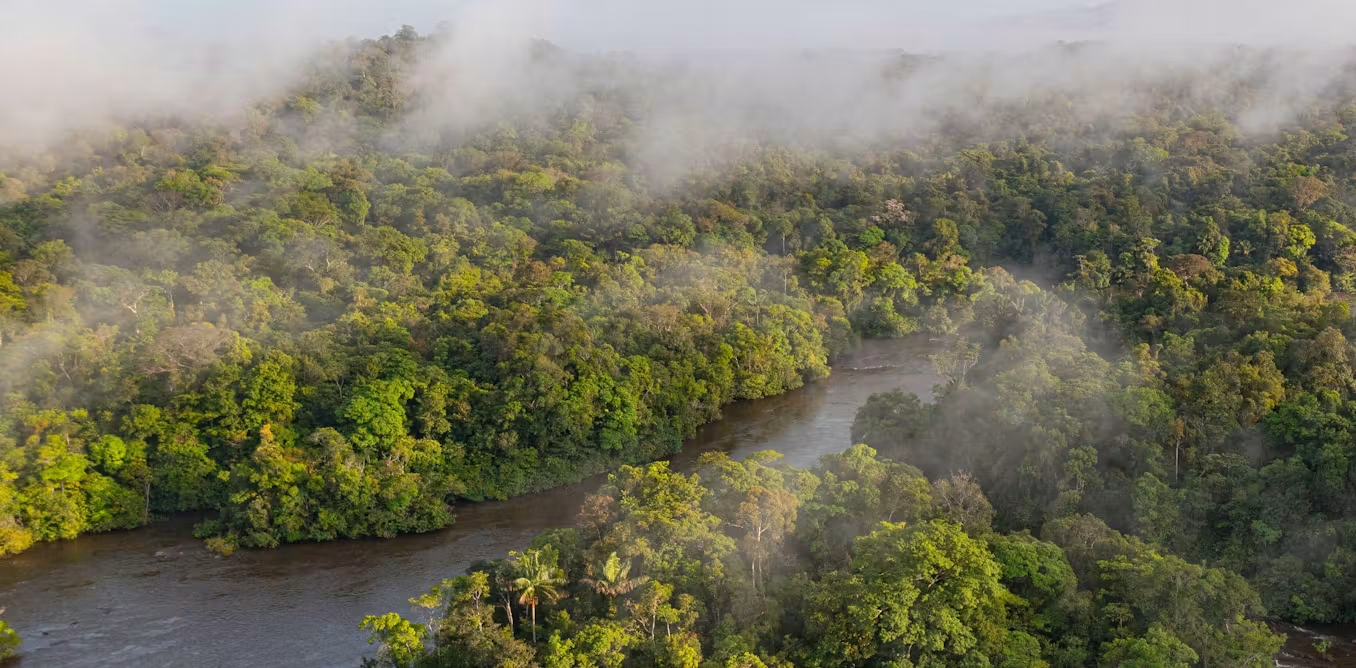
From the air, you see it only through the constant jolt, tilt and shudder of the low-flying Cessna aircraft. The landscape of the Llanos de Moxos, northern Bolivia, appears as a disconnected patchwork of open grassland savannahs, forest islands and lakes.

It feels random, almost unreadable. Only gradually does the pattern resolve itself: raised causeways or paths fanning out to link the forest islands, and a dense, scattered web of canals threading the terrain. Slowly you realise it’s a structured network of intersecting lines, enclosures and roads – the imprint of past human design.

Aerial view of Llanos de Moxos.
Jose Iriarte, CC BY-SA

If you stand on the open savannah, there is almost nothing to see of this ancient network. The horizon feels open, with fires in the distance from local people burning pastures and clearing forest as dry season begins. The old geometry is still faintly perceptible, but you have to know how to look.

Advertisement

Step into the patches of forest and the canopy closes in. The earth softens underfoot and mosquitoes descend in relentless swarms. The sweat on your neck thickens into a humid film, carrying the familiar scent of suncream and the sharper, chemical note of DEET.

In the uneven light between the trees, the landscape dissolves into subtle rises and depressions. Against the rhythmic swish of machetes as our guides cut through the vegetation, your mind tries to piece together the fragments of structures into something coherent. Flying overhead doesn’t reveal anything about this forest area in the way that it does with the savannah. But fortunately recent advances in technology have transformed what we are able to see.

Surveying in the Amazon rainforest

Surveying in the dense Amazon rainforest.
Jose Iriarte, CC BY-SA

Archaeological explorations in this part of the world have been completely changed by lidar in the past couple of decades. Lidar maps an area from a plane or drone by bouncing rapid laser pulses off the Earth’s surface. Some of these pulses penetrate the forest canopy, reach the ground and reflect back to the sensor.

By measuring the return time, the system can generate highly precise three-dimensional models of the terrain. This allows you to strip away the camouflage of vegetation, making it possible to see what lies below the Amazonian forest for the first time.

Advertisement

It reveals the ancient Llanos de Moxos as not simply a collection of settlements, but an entire urbanised landscape. A large part in the south-east of this region belonged to the Casarabe culture, which dominated between around AD500 and 1400. It extends across 20,000km², which is roughly the size of New Jersey in the US.

The Casarabe organised into a hierarchy of four different sizes of settlements (those forest islands mentioned above). The biggest ones – the primary settlements – were as large as 3km² or 300 hectares. That’s enough space for over 400 football pitches, suggesting that they could have accommodated substantial numbers of people.


Welcome to our series on the great mysteries of archaeology. Viking explorers, Amazonian cities, artefacts from before civilisation. Archaeology may be all about the past, but it’s constantly shifting with every scientific discovery. This series will dig into some of the most fascinating debates in the field today.

Advertisement

These settlements connect along the raised causeways to smaller secondary and tertiary sites a number of kilometres away, all of which were permanently inhabited as opposed to empty ceremonial hubs. A fourth tier consists of groups of isolated mounds located out in the pampas, which likely correspond to dwelling areas occupied by farmers who would have worked the fields.

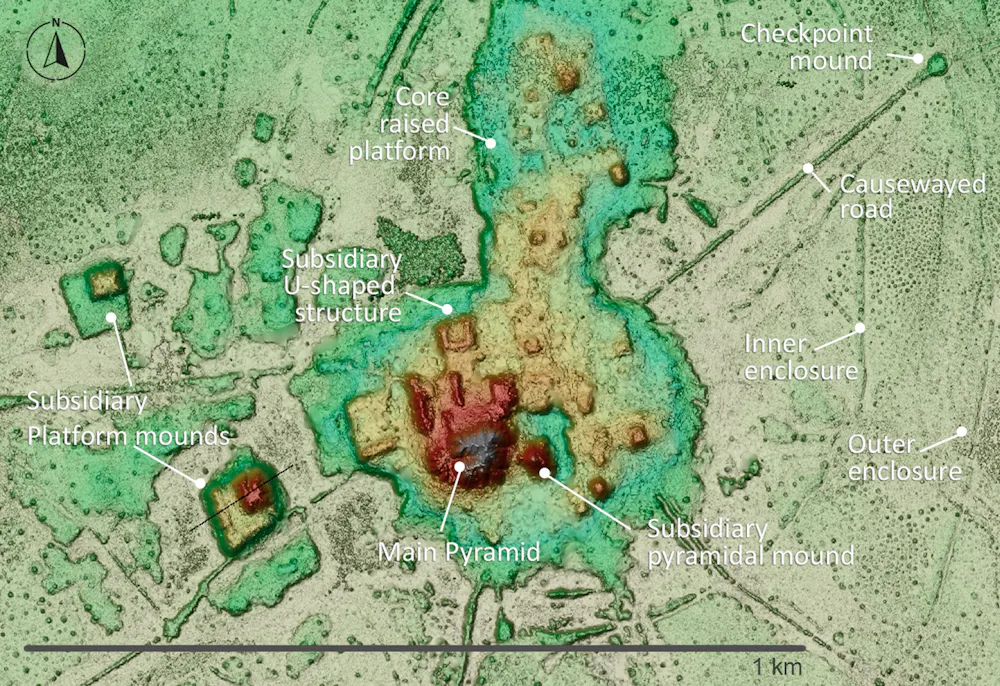
It’s not possible to show a lidar image of these four different types of sites interconnecting because they are too far apart for the resolution available, but the image below of a primary settlement known as Loma Cotoca shows the kinds of things we are now documenting.
Aerial shot of Loma Cotoca

Lidar shot of Loma Cotoca.
Jose Iriarte, CC BY-SA

It features some very impressive civic-ceremonial architecture: conical pyramids over 20 metres tall and U-shaped structures that may have acted as areas for public gatherings for speeches or ceremonies. These were built on top of man-made platforms rising as much as five metres off the ground and extending over 20 hectares. To be clear, this is all still hiding under the forest, but the lidar data reveals the shape, height and layout of what lies below.

The volume of earth moved to create this architecture would have rivalled – and in some cases exceeded – that of well known Andean monuments such as Akapana a few hundred miles to the south-west on the other side of the Andes. Akapana was the epicentre of the Tiwanaku empire that dominated the southern Andes between about AD600 and 1000.

Advertisement
Akapana pyramid in Tiahuanaco o Tiwanaku.

Akapana pyramid in Tiahuanaco o Tiwanaku, Bolivia.
Wikimedia, CC BY-SA

Yet where monuments like Akapana were surrounded by classic, compact bounded cities with thousands of inhabitants, the Casarabe equivalent was completely different. This was dispersed, low-density living amid extensive green space – a form of tropical urbanism that challenges longstanding assumptions about this area as sparsely populated and only lightly modified. It invites comparison with other low-density tropical urban landscapes such as the Maya in central America and the Angkor in latter day Cambodia.

Equally important is the coherence of the Casarabe system. The settlements are rarely isolated, part of a tightly connected network with shared water-management systems. It was clearly all planned and coordinated, designed not only as living spaces but for integrating the population across the region.

We can see that the Casarabe were sustained by drained-field agriculture: the canals were dug to make the land viable for planting during the wet season. The most prominent crop was maize, but there was a remarkable diversity of other produce. This was all embedded within a landscape that was engineered through reservoirs and farm ponds, which helped the Casarabe sustain cultivation and maintain access to water through the dry season in this extremely seasonal environment.

Also very noticeable is the fact that all the major architectural features and burial sites are oriented north-north-west. This suggests these people may have been led by cosmology, with important celestial bodies or regions of the night sky serving as symbolic reference points – hinting at a world where infrastructure, settlement and belief were inseparable.

Advertisement

Rethinking the Amazon

The Casarabe culture covered much less than 1% of Amazonia, which is the whole tropical interior of South America, spanning close to half of the entire continent. For much of the 20th century, this vast area was viewed by archaeologists as an environment that was limiting for human existence.

Poor soils, scarce game, extreme El Niño floods and droughts, and the challenges of tropical disease were all thought to constrain human populations to small, wandering groups living off the land as best they could. Large, settled societies – let alone towns or cities – were considered unlikely, if not impossible.

This view began to shift in the late 20th century for several reasons. Archaeologists realised that Amazonian people had been domesticating a diversity of plants since the end of the Ice Age. They manufactured some of the earliest ceramics in the Americas, and also devised soils known as Amazonian Dark Earths, which combined charcoal, bone and waste materials with the existing poor-quality soil to make it fertile enough for widespread farming.

Advertisement
Indigenous planting in Peru

Specially engineered Amazonian soils unlocked widespread farming.
Carlos Mora

It also became apparent that just like the Casarabe people, many other cultures across Amazonia had reclaimed vast expanses of seasonally flooded savannahs over several thousand years to create raised and drained field systems.

These discoveries were evidence of long-term settlement and landscape management far beyond what was previously thought possible. It meant Amazonia was not simply a backdrop to human activity; much of the landscape was shaped over the last 13 millennia by the people who lived there.

Enter lidar

Like lasers in the sky, lidar technology has accelerated this transformation in our understanding. The digital process feels near-magical, a “vegetation removal algorithm” that reveals the secrets below.

In practice, however, working with lidar in Amazonia is anything but straightforward. Running such a project here, as I have done, can feel like one of the greatest emotional rollercoasters in field archaeology. It’s all anticipation, frustration and sudden revelation – only comparable, perhaps, with shipwreck exploration.

Depending on what technology is available and most suitable for exploring a particular area, I’ve worked with lidar attached to drones, aeroplanes and helicopters. I’ve learned through trial and error that the technology is only as effective as the logistics and personalities behind it – above all on one occasion when we were trying to integrate a Hungarian lidar sensor with a Brazilian drone.

Advertisement
Shot of a drone and big smiles as it finally worked

Above: the ‘Experimental’ drone; below: the moment it finally worked – the smiles in the control station say it all.
Jose Iriarte, CC BY-SA

Lidar can perform beautifully one day and fail the next, depending on the equipment, weather, terrain, batteries, communications and the sheer difficulty of operating in remote Amazonian conditions.

Flights must be carefully planned in remote areas with limited infrastructure, where convective clouds, smoke from fires, wind and even vultures riding thermals can disrupt data acquisition. You have to arrange fuel in advance and improvise landings wherever a safe clearing can be found. Here’s our team refuelling a lidar helicopter in the football field of a small village in Acre state, western Brazil:

You also have to do constant troubleshooting with the technology, such as making sure it’s calibrated correctly and that the data from different flight paths all aligns. What appears in the final images as a seamless “removal” of the forest is, in reality, the product of improvisation, negotiation and persistence.

Advertisement
Percy Fawcett photograph

Percy Fawcett.
Wikimedia, CC BY-SA

But given all these challenges, it makes the first successful images all the more powerful when they finally appear. The reward is that we’re finally finding the “lost civilisation” that explorers like Percy Fawcett were searching for a century ago, but by cajoling a drone rather than battering through jungle.

Incidentally, this technology also has important uses beyond archaeology. It can help people to locate and harvest crops like rubber or açaí palm fruits without having to clear so much rainforest. It is also used by pioneering projects such as Amazonia Revelada, which helps Indigenous and traditional people of the Amazon to prove their historic presence within an area to ward off modern commercial interests like loggers or farmers, while also protecting the living history and nature embedded in these landscapes.

Other lidar discoveries

Lidar surveys by French and Ecuadorian archaeologists have revealed that the Llanos de Moxos was certainly not the only example of large-scale, highly integrated society in Amazonia. The Upano Valley, which covers some 300-600km² on the mountainous forest of the Ecuadorian eastern flanks of the Andes, offers another striking example – this time from between about 500BC and AD600–700.

Lidar discovery areas

Advertisement
Map of South America showing settlements traced by lidar


Felt, CC BY-SA

In Upano, archaeologists have been able to map a vast network of settlements connected by extensive road systems, with large platforms and clusters of buildings arranged in organised layouts across a broad area.

What stands out is not just the scale – thousands of structures – but the rigour of the planning. The settlements didn’t just grow randomly, but as part of a deliberate design: we see straight lines of flat-topped platforms laid out in repeating rows and connected by straight paths that cut cleanly across the landscape, as you can see below.
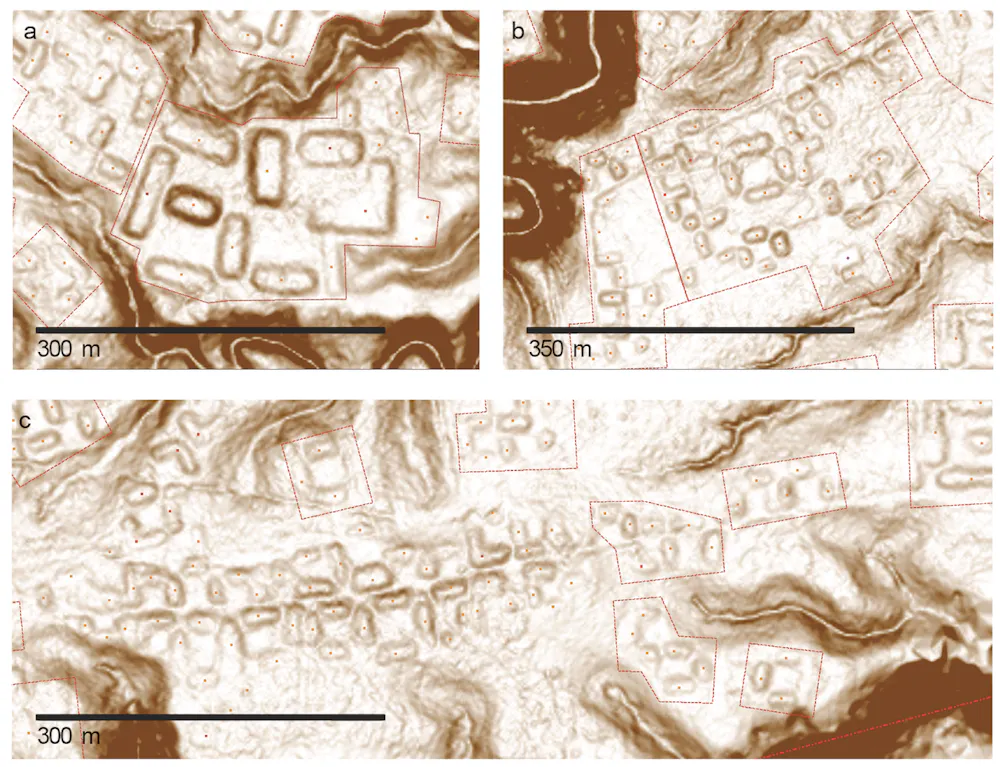
Lidar footage of settlements in the Upano Valley.

Lidar footage of settlements in the Upano Valley.
Jose Iriarte, CC BY-SA

Again, this is not urbanism in the conventional sense of dense, continuous occupation. There would have been none of the vertical stacking of buildings that you’d get in European settlements, and there were also green spaces between platform complexes – much more like a forest city.

Like the Casarabe region, this is a distributed settlement pattern that is both open and highly structured, but the arrangement is much more compact. This reflects the limited flat space available on the upper terraces of the Upano River, which rise up to 100 metres above the surrounding landscape.

Advertisement

Elsewhere in Amazonia, we see more variations. In the Upper Xingu of central Brazil, interconnected settlements were arranged around a shared ceremonial and road network, again suggesting a regionally coordinated social world.

Further north, the Tairona people of the Sierra Nevada de Santa Marta in present-day Colombia built terraced stone towns in the mountains, linked by paved paths. This was a form of urbanism shaped entirely by the demands of steep, high-altitude terrain. Below is a lidar image of one area in this region, with the platforms that would have housed the settlements marked in yellow. Below that, you can see what the platforms look like.

Above: lidar image of settlements at Teyuna-Ciudad Perdida in yellow; below: an actual shot of the platforms that housed the settlements.

Above: lidar image of settlements at Teyuna-Ciudad Perdida in yellow; below: an actual shot of the platforms that housed the settlements.
Daniel Osorio, CC BY-SA

In western Amazonia, Acre adds another important variation. From around AD1–1000, people built large ditched enclosures, or geoglyphs, mainly in the south-eastern part of this region along the upper Purus River. These were square, circular, hexagonal or octagonal mounds, often 1-3 hectares in size, with ditches up to four metres deep. These were probably used as ceremonial gathering places rather than permanent settlements.

After about AD1000, these were followed by what we call circular mound villages, occupied until around AD 1650–1700. They featured rings of mounds around central plazas and straight roads radiating out like the rays of the Sun, often built to align with the four main compass points. These “Sun villages” were true settlements, and formed interconnected networks across the southern rim of Amazonia. You can see an example in the lidar image below.

Advertisement
Circular mound village lidar image at Acre, Brazil.

Lidar image of circular mound village Dona Maria at Acre, Brazil.
Jose Iriarte, CC BY-SA

Taken together, these discoveries fundamentally reshape our understanding of Amazonia. We now see a mosaic of managed landscapes, engineered environments and, in some cases, city-scale societies. What unites them is not a shared blueprint but a shared impulse: the organisation of people, space and movement across large landscapes in ways that were deliberate, durable and distinctly their own.

To stress, Amazonia was not uniformly dense or urban. It supported a diversity of types of settlements, from dispersed networks like Moxos to tighter grids like Upano, each of them adapted to local ecological conditions. They shared a low-density urbanism, in the sense of large, interconnected populations without the density of classic cities.

What we still don’t know

How were these societies organised politically and socially? How did they interact with variations in the climate and environment, ranging from the heavy rainfalls and droughts caused by El Niño to rivers forging new routes that could move them away from a settlement within a few generations?

What, if any, connections existed with mountain societies in the Andes? And perhaps most importantly, since both the Casarabe and Upano ceased to build monuments after 1492, what led to their transformation or decline before the arrival of Europeans?

Advertisement

There is active debate between archaeologists over whether these societies transformed because of environmental stress, internal political change, or shifts in things like trade routes or migration.

In the Llanos de Moxos, one possibility is that a prolonged period of climate change affected the Casarabe water-management systems that were so critical to feeding this thriving society. In the Upano Valley, volcanic eruptions and earthquakes may have disrupted settlements and agriculture, although it’s unclear whether that could have led to the area being abandoned.

It seems likely that as we uncover new things, it will reveal more and more integration between different societies. What we are seeing now in Amazonia is much like looking at a satellite image of a country at night: bright, isolated clusters of light – cities that appear disconnected. But as we continue to expand our coverage and fill in the gaps, I think this will change.

What now appear as isolated clusters may also resolve into extensive networks. For example a study across the southern rim of Amazonia has predicted that the kinds of settlement mounds that have been identified so far are likely to occur across about 400,000km², supporting an estimated regional population of roughly 500,000 to 1 million people in the era before the Europeans arrived.

Advertisement

Entire regions may emerge as previously unrecognised centres of population and landscape management. This could be particularly so for the Llanos de Moxos. The whole area covers as much as 200,000km², depending on where you draw the boundaries, stretching into Brazil and even Peru. It is often divided into several apparently distinct cultural regions — the Casarabe (aka the monumental mound region), and then two others called the platform ridge and zanjas (ditches) regions.

As lidar coverage expands and more archaeological work is conducted, we may begin to understand how these societies were economically specialised. We know, for example, that the fortified villages of the zanjas region had fish weirs spanning hundreds of miles that were capable of capturing vast quantities of migratory fish. The platform ridge region consisted of large drained fields, which could potentially produce surpluses of maize. It is conceivable that these belonged to a broader network that supported the more complex Casarabe centres.

Or perhaps – who knows – the relationships were more fluid and reciprocal. For now, the question remains open. But it is precisely this possibility of deep regional integration that lidar is beginning to bring into view. In time, we may even begin to identify Casarabe outposts scattered across the Llanos de Moxos.

What happens next

There’s still a huge amount to be done with lidar. Vast areas, particularly in the Ecuadorian and Peruvian Amazon – remain unexplored. One recent study suggested that there could be more than 10,000 more urban structures of the kind I’ve been describing still hidden throughout Amazonia, all of them dating from pre-European times.

Advertisement

Looking ahead 20 years, it is likely that our map of Amazonia will look very different. One promising technology is satellite-based lidar systems, which could provide broader, though less detailed, datasets across large areas. Advances in machine learning are also beginning to help us identify archaeological features within massive datasets, speeding up a labour-intensive process.

Against this, there are time pressures in some places. Llanos de Moxos, for instance, is unfortunately in rapid transition. The very ground that holds the traces of ancient networks is being transformed by mechanised agriculture and large-scale terraforming for rice cultivation and pastures.

We also need to keep reminding ourselves that lidar is only the first step. What really matters is how it’s brought together with other lines of evidence. Most sites discovered by lidar have yet to be excavated, so we’ll have to do much of that, looking for everything from bones and plants to ceramics and weapons.

So far, most excavation has been in the Casarabe area of the Llanos de Moxos. The reason, for instance, that we know the culture lived primarily on maize was through the discovery of over 60 human skeletons, which underwent carbon isotope analysis. The same research paper also analysed excavated duck bones to show that the Casarabe were feeding them maize too, suggesting animal domestication in a continent that was not generally known for it.

Advertisement

Another fascinating Casarabe find is a single buried skeleton who may have been a leader, because he had a collar of jaguar teeth around his neck. He was also wearing ear pieces made of armadillo shell, studded with mottled blue stones called sodalite – it’s not clear what these were for.

Male skeleton in Loma Salvatierra

Male burial in Loma Salvatierra, Llanos de Moxos, shows: a) plate of cooper; b) earpieces with pearls of sodalite and armadillo shell; c) a collar of jaguar teeth; d) shell beads; e) bracelet of shell.
Heiko Prümers/Jose Iriarte, CC BY-SA

We’ll also need to obtain more precise dates for key events using techniques like radiocarbon dating, and more pinpoint accurate environmental data to help support theories about ancient changes to the climate – as opposed to the wider regional information we’ve tended to rely on until now. Lake sediments are great environmental archives, preserving evidence of things like vegetation change and landscape disturbance.

Also important is comparing genetic data from excavated bones with people who live in these areas today – in dialogue and collaboration with local communities whose histories, memories and knowledge are essential to understanding these landscapes.

It’s all a question of how lidar is brought together with all this other evidence. The most convincing reconstructions will come from the convergence of all of these. One further major challenge ahead, however, will be to bridge the gap between scientific reconstructions and how past peoples understood and inhabited their world. Archaeology is increasingly rich in data, but we have to relate it to lived experience.

Advertisement

That is no easy feat, but it is essential if we are to move from mapping past worlds to understanding them. Crucially, Amazonia – with its rich, still-vibrant Indigenous societies and ethnographic record – offers an exceptional opportunity to do this, providing rare continuities through which to anchor and critically engage our interpretations of the past.

Lessons for today

My own sense is that we will move towards a view of Amazonia not as an exception, in line with the old view that the people lived within an untouched paradise, but as part of a broader pattern of human-environment interaction. The rainforest will be understood not only as a biological system, but as a historical one – shaped, in part, by the people who lived within it.

This does not mean the Amazonian people who simply lived “in harmony” with nature; the evidence points to something more interesting. Although Amazonian societies developed complex, and at times intensive, forms of land use, the evidence consistently shows that they often did so while maintaining continuous forest cover. Far from the large-scale deforestation that we might assume was necessary for such elaborate forms of human life, their practices created mosaics of managed forest, gardens, orchards, wetlands and settlement areas.

We know partly from lake sediment data that people enriched the forests with species that provided food, building materials, medicines and other resources, from açaí and cacao to palms, cinchona and copaiba. The fact that some of these species endure today suggests that past land use left lasting ecological legacies.

Advertisement
Acai palm

Amazonian açaí is one of numerous species that are not prevalent by accident.
Guentermanaus

In the context of today’s climate crisis, the long-term balance that these people achieved offers a powerful lesson: it is possible to sustain complex societies without destroying the forest, if land use is guided by principles that integrate ecological knowledge, cultural values and a commitment to the continuity of the living landscape.

What lies beneath the Amazon is not just a hidden past. It is a reminder that even the most seemingly untouched landscapes can carry deep histories, waiting – sometimes just beneath our feet – to be revealed.

This article features references to books that have been included for editorial reasons, and may contain links to bookshop.org. If you click on one of the links and go on to buy something from bookshop.org The Conversation UK may earn a commission.


For you: more from our Insights series:

Advertisement

To hear about new Insights articles, join the hundreds of thousands of people who value The Conversation’s evidence-based news. Subscribe to our newsletter.

Source link

Advertisement
Continue Reading
Click to comment

You must be logged in to post a comment Login

Leave a Reply

NewsBeat

Coronation Street’s Betsy Swain future sealed amid ‘exit’ fears

Published

on

Daily Mirror

Coronation Street fans are worried that actress Sydney Martin is about to leave her role as Betsy Swain on the ITV soap after two years of melodramatic twists and turns

Coronation Street fans are worried that Betsy Swain is about to leave the ITV soap. The Speed Daal waitress, who has been played by Sydney Martin since 2024, has been through an awful lot during her two years in Weatherfield.

Advertisement

Just over a year ago, Betsy lost boyfriend Mason in a knife attack, was then shot by her own mother DS Lisa Swain, who faced no consequences for her actions, and was landed in a freak situation when her other mother Becky came back from the dead, having faked it as part of a corrupt police coverup.

Following on from all that drama , Betsy recently discovered a dead body that turned out to be that of Theo Silverton (James Cartwright) at the end of the much-hyped Murder Week.

In scenes set to air in the coming days, Betsy confides in best friend Laure (Cait Fitton) that she’s been offered a place at the London College of Fashion but she’s worried about leaving Dylan. It’s yet to be seen just how Dylan will react and, on top of that, Betsy explains that she is yet to inform her mother.

Advertisement

Fans of the world’s longest-running TV soap have instantly started to speculate that Sydney, who appeared in Assassin’s Guild before joining Coronation Street, is set to make a dramatic exit from the ITV soap.

Taking to X, one fan said: “betsy off to london? [sad face emoji],” whilst another posted a picture of Carla, Lisa and Betsy and said: “Don’t spilt them up please #corrie I think Lisa will take this hard and Carla will help both Betsy and Lisa to see it from each others perspective.

Another said: “You can just imagine Carla saying something like oh you’ll be fine Betsy in London I could tell you stories about what me and Michelle got up to, and Betsy saying something like and even to this day they involve the police.”

Another wondered if this meant some sort of spin-off was on the cards. In the past, the programme has done various spin-offs such as Just Rosie, which followed Rosie Webster (Helen Flanagan) on her quest for a modelling career, whilst a string of DVD releases like A Knight’s Tale and Out Of Africa were issued in the late 2000s.

Posing the theory, the fan wrote on X: “Is there any indication that Betsy going to London could be a limited summer off-shoot series like Hollyoaks Later where all the teens shared a summer house (obviously without the serial killer). But it will be Betsy’s adventures in the big city?”

It all comes after actress Sydney Martin, 24, was revealed to have been cast in a short film titled Favourite earlier this year. Filmmaker Georgia Leigh-Taylor said: “I’m so thrilled to announce the incredible Sydney Martin and the brilliant Isabelle Smith will be playing Mel and Ashley in my upcoming short film called Favourite.

“After graduating from the same acting school, Sydney and Izzy have both been working professionally in television since 2024, building exciting careers for themselves, taking on powerful storylines, and earning well-deserved recognition.

Advertisement

“Favourite is a dual-timeline drama exploring the lives of best friends Mel and Ashley both as teenagers, and as adults.”

Coronation Street airs Monday to Friday at 8:30pm on ITV1 and is available to stream from 7am on ITV X.

* Follow Mirror Celebs and TV on TikTok , Snapchat , Instagram ,Twitter ,Facebook , YouTube and Threads .

Advertisement

Source link

Continue Reading

NewsBeat

Hero teacher knifed in triple stabbing at Manchester high school named

Published

on

Daily Record

This is the heroic teacher stabbed during a triple knife attack at a high school in Blackley. Counter terrorism police have now taken charge of the investigation, Greater Manchester Police confirmed on Thursday evening (June 11), although it hasn’t been classified as a terrorist incident ‘at this time’.

Courageous Maysum Abdullah, 27, sustained a neck wound in the horrifying episode at Co-op Academy Manchester on Plant Hill Road in Blackley on Tuesday morning (June 9).

He dashed to shield pupils as the school went into lockdown following reports of a student armed with a knife. The youngster was swiftly ‘detained’ by staff, according to school authorities.

Three individuals were injured. A 14 year old girl sustained shoulder injuries; a 14 year old boy suffered ear injuries; and Mr Abdullah received wounds to his neck and hand, reports the Manchester Evening News.

Advertisement

All three are now recuperating at home. None of the injuries were considered serious.

A 14 year old schoolgirl was arrested on suspicion of Section 18 assault, before being sectioned under the Mental Health Act. She has since been returned to police custody following evaluation by healthcare professionals.

Advertisement

In a statement released on Tuesday, the Co-Op Academies Trust, which operates the school, said it was ‘incredibly proud’ of the ‘swift’ and ‘brave’ actions of their staff to ‘quickly detain’ the student. On Thursday, GMP announced that ‘as a result of further enquiries, Counter Terrorism Policing North West have now taken primacy for the investigation with the support of Greater Manchester Police’.

“Searches relating to the investigation remain ongoing and counter terrorism detectives are keeping an open mind to the motivation of the attack,” a statement added.

“At this time, it has not been declared as a terrorist incident.”

The officer leading the investigation disclosed that ‘further information has come to light’, which the force has ‘made Counter Terrorism Policing North West aware of’.

Advertisement

Mr Abdullah, speaking to the Manchester Evening News while recuperating at home with his wife, said he was still ‘trying to process’ what had happened and requested privacy. He consented to his name being published, along with a photograph.

His wife Saima previously posted on TikTok to express gratitude for the support received after the incident. She said: “[On Tuesday] I received the devastating news that my husband had been stabbed whilst trying to protect pupils from a serious knife attack in his classroom.

“No one ever expects to receive a phone call telling them that their loved one has been taken to the hospital after being stabbed. I am grateful that his injuries were not life threatening. The wound on his neck and his hand have been treated, however these physical wounds are only part of what our family is now facing.

Advertisement

“My husband entered teaching to make a positive difference in young people’s lives and he is truly a hero for protecting and safeguarding those children.

“Our prayers are with the other two pupils who also suffered injuries and to all the students and staff who witnessed such a traumatic event.

“Thank you to all colleagues, family, friends, hospital staff, the police and members of the community for their support, kindness and wishes during this difficult time.”

Chief Superintendent David Meeney, Commander for Manchester, spoke out about the incident, stating: “Our local detectives have been investigating this incident at pace ever since we arrested a schoolgirl suspect on Tuesday morning. She remains in custody in Manchester.

Advertisement

“This has included ensuring the suspect is checked by health professionals to make an assessment while under the Mental Health Act, and to explore all available evidence to understand why this incident took place.

“Since our last update, further information has come to light that we have made Counter Terrorism Policing North West aware of.

“I know this update will only continue to make our local community concerned by Tuesday’s events. There is no information to indicate any further threat, and our local officers continue to be in the area. We are here to listen and to act, so please speak to our officers with any concerns.”

In a statement released on Tuesday, the Co-op Academies Trust, which oversees the school, said: “Shortly after the start of the school day, an incident occurred on site involving a pupil with a knife.

Advertisement

“The school was immediately placed into lockdown, and staff acted bravely to quickly detain a student before emergency services arrived.

“Greater Manchester Police arrested the student, who remains in custody. Police have confirmed this was an isolated incident with no wider threat to the public.

“Three people, two pupils and a member of staff sustained injuries. They were taken to hospital as a precautionary measure, where they are in a stable condition with injuries not believed to be serious. We are incredibly proud of the swift actions of our staff and the mature response of our pupils.

“While our policies outline strict screening and search powers in line with Department for Education guidance, weapons can unfortunately be small and easily concealed without prior indicators. We had no reason to conduct a search on any student this morning.”

Advertisement

Source link

Continue Reading

NewsBeat

Granddad collected wrong child from nursery – and drove away with her

Published

on

Daily Record

Jody Riley said she was ‘mid panic attack, when nursery staff told her someone had walked away with her daughter

A distraught mum experienced ‘every parent’s worst nightmare’, when she was told a stranger had collected her child from nursery.

Jody Riley, 37, was working when she received the call from her daughter Rosie McDonald’s nursery, Kids Planet Crosby.

Advertisement

She said: “My phone rang at around 2.20pm and it took awhile for the staff member to tell me what had happened, but she eventually told me somebody had picked Rosie up and they were still investigating it.

“They let me know she was back at the nursery safe and everything felt like a blur from there. I had a panic attack and I had to try and calm myself down to go and get her.

“Getting that call is every parent’s worst nightmare and I feel like I’ve had a taste of what that is like now.”

Jody said she was told it was another child’s grandad who had picked up her sleeping two-year-old Rosie and driven away with her for at least 10 minutes before the mistake was noticed, reports the Liverpool Echo.

Advertisement

She said: “Rosie is a light sleeper and wakes up when you pick her up so I’ve just been trying to piece everything together because none of it makes much sense to me.

“I don’t understand how he was able to get through two security doors, enter the toddler room, pick up my sleeping child, and then leave the building, strap her into his car and drive off with her without anyone noticing it wasn’t his child.”

Jody and her partner Gary McDonald, 40, are both business owners and normally pick Rosie up from nursery at either 3pm or 5pm.

Advertisement

Jody explained when she collects Rosie, facial recognition technology is used to let her in and then she has to knock on the toddler room in order to collect her daughter.

She said: “You have to walk past the office and they tell you where your child is.

“Apparently his granddaughter was downstairs in the nursery garden so I don’t understand how this has happened or how he’s been able to walk out of the room with no one stopping him or seeing who had picked her up.

“By the time I got to the nursery she was upstairs, back in the room and when they brought her down to see me she was shouting ‘mummy’ and wrapping her arms around me.

Advertisement

“You could just tell she knew something had happened and it definitely wouldn’t have been nice for her because she’s really clingy with me and her dad.”

Jody said she is still waiting for a lot of questions to be answered on how the incident was allowed to happen.

She said: “The staff were shook up and couldn’t apologise enough but they didn’t have any answers for me.

“At that stage I was still mid panic attack and in shock so I wasn’t asking all the questions I could because I just wanted to see my daughter.

Advertisement

“Obviously I knew she was safe which was the main thing, but in a situation like that you start to worry about everything. I just kept thinking about how long she was missing for before either the nursery or the man noticed and I wouldn’t wish that feeling on anyone.

“I barely slept last night and I feel like the more I process it and the more it sinks in the more questions I have. I still can’t figure it out.”

READ MORE: Scots girl, 7, in hospital after council flat ceiling collapses on top of her

READ MORE: Man guilty of attacking girl in Dundee axe and knife incident

Advertisement

Jody said Rosie won’t be returning to the nursery and she would be looking after her full-time for the foreseeable future.

She said: “She’d only been there for a few months because we really struggled getting her a nursery place. Trying to balance work with looking after her will impact me massively because I won’t be able to get her into another nursery now until at least September.

“At the minute I just want to keep her with me at all times because even though she’s fine and happy, I feel so shaken up. “

A spokesperson for Kids Planet, said: “We can confirm that an incident occurred at our Crosby setting in which a child was mistakenly released to a grandparent who is known to staff, has passed all required security vetting and who is an approved collector for a different child, who was also onsite at the time.

Advertisement

“The child was returned safely to the nursery within minutes, and we are in direct continuous contact with the families involved to offer our sincere apologies and to provide ongoing support while a full investigation takes place.

“The safety and wellbeing of the children in our care is our highest priority, and we take this unprecedented matter extremely seriously, which is why we have implemented immediate measures including supervised working for the team and additional security protocols, as well as working to revise our policies and training.

“In line with our safeguarding procedures, we have made immediate self-referrals to Ofsted and the Local Authority Designated Officer (LADO) and are cooperating fully with both organisations.

“As this remains an active investigation, we are currently unable to offer further comment.”

Advertisement

Source link

Continue Reading

NewsBeat

Reform reinstates councillor who said ‘Nigerians should be melted down to fill pot holes’ | News Politics

Published

on

Reform reinstates councillor who said 'Nigerians should be melted down to fill pot holes' | News Politics
Glenn Gibbins, the candidate for Hylton Castle Ward in Sunderland, has won his seat in this week’s council elections

A Reform candidate who said Nigerians should be melted down to ‘fill in the pot holes’ has been let back into the party.

Glenn Gibbins was placed under investigation after he was elected as the new councillor for Hylton Castle Ward in Sunderland in early May.

In now deleted posts, he ranted on social media he ‘carnt [sic] believe amount of Nigerians in town’ and they ‘should melt them all down and fill in the pot holes’.

The comments – believed to be from march 2024 – sparked widespread condemnatin and led Reform to begin an internal disciplinary process.

Advertisement
Glenn Gibbins (not ?Glen Gibbons? as their leaflets suggest?) is the Reform UK candidate for Hylton Castle ward in Sunderland. He says he is standing for Reform to ?bring back common sense, support our community and restore pride in our town?.
He also said Nigerians should be melted down to fill pot holes

However the party has now confirmed that Cllr Gibbins has been reinstated.

Everything is changing, all the time

Cut through political noise and understand how the Westminster chaos actually affects your life with Metro’s politics newsletter Alright, Gov? Sign up here.

A Reform spokesman said: ‘Following an internal disciplinary process, Cllr Gibbins has been readmitted to the party and issued with a final written warning.

Advertisement

‘He has apologised for making the post and accepts that it was made in extremely poor taste showing poor judgment.’

Other social media posts from Glenn Gibbins showed that hadcomplained about women being on TV, calling Mel and Sue the two ‘unfunniest fat repulsive lesbian hosts ever’.

His views extend to sport, writing during the 2021 Ireland v Japan rugby match: ‘Yet another woman comentator. It’s getting out of controll. There must be a hundred better male comentators but had to give it to a female [sic].

‘Wish they wud stick to cooking, sewing and homemaking [sic].’

Advertisement

Reform deputy leader Richard Tice refused to directly criticise Gibbins at the time reports about the posts surfaced, instead accusing the media of ‘smearing’ his party.

Glenn Gibbins (not ?Glen Gibbons? as their leaflets suggest?) is the Reform UK candidate for Hylton Castle ward in Sunderland. He says he is standing for Reform to ?bring back common sense, support our community and restore pride in our town?.
Glenn was unhappy with Mel and Sue being on TV
Glenn Gibbins (not ?Glen Gibbons? as their leaflets suggest?) is the Reform UK candidate for Hylton Castle ward in Sunderland. He says he is standing for Reform to ?bring back common sense, support our community and restore pride in our town?.
Glenn accusing the government of allowing innocent people to be killed

Asked if Mr Gibbins views represented Reform UK, he said: ‘This weekend we are celebrating our incredible successes.

‘Like any party, we have internal party processes to look where people have said or done the wrong thing.”

He continued: ‘I condemn everything that is wrong and inappropriate.

‘Voters have heard all of this smearing and this sneering against all of us, and they have voted for more Reform.’

Advertisement

Other Reform councillors also faced scrutiny for controversial comments online.

Get in touch with our news team by emailing us at webnews@metro.co.uk.

For more stories like this, check our news page.

Advertisement

Source link

Advertisement
Continue Reading

NewsBeat

Hero teacher knifed in triple stabbing at Manchester high school named as counter terror cops take lead on investigation

Published

on

Manchester Evening News

This is the hero teacher knifed in a triple stabbing at a high school in Blackley. The investigation into the incident is now being led by counter terrorism police, GMP said on Thursday evening (June 11), though it has not been declared a terrorist incident ‘at this time’.

Brave Maysum Abdullah, 27, suffered a wound to his neck in the horror incident at Co-op Academy Manchester on Plant Hill Road in Blackley on Tuesday morning (June 9).

He rushed to protect students as the school was locked down amid reports of a pupil with a knife. The child was quickly ‘detained’ by staff, school bosses said.

Click here to get the biggest stories straight to your inbox in our Daily Newsletter

Advertisement

Three people were hurt. A 14-year-old girl suffered injuries to her shoulder; a 14-year-old boy injuries to his ear; and Mr Abdullah injuries to his neck and hand. All are now recovering at home. None of their injuries were deemed to be serious.

A 14-year-old schoolgirl was arrested on suspicion of Section 18 assault, before being detained under the Mental Health Act. She has now been released into police custody following an assessment by health professionals.

In a statement issued on Tuesday the Co-Op Academies Trust, which runs the school, said it was ‘incredibly proud’ of the ‘swift’ and ‘brave’ actions of their staff to ‘quickly detain’ the student.

On Thursday, GMP said that ‘as a result of further enquiries, Counter Terrorism Policing North West have now taken primacy for the investigation with the support of Greater Manchester Police’.

Advertisement

“Searches relating to the investigation remain ongoing and counter terrorism detectives are keeping an open mind to the motivation of the attack,” a statement added.

“At this time, it has not been declared as a terrorist incident.” The cop in charge of the investigation revealed that ‘further information has come to light’, which the force has ‘made Counter Terrorism Policing North West aware of’.

Advertisement

Mr Abdullah, speaking to the Manchester Evening News as he recovered at home with his wife, said he was still ‘trying to process’ what had happened and asked for privacy. He agreed for his name to be published, as well as a picture.

His wife Saima earlier took to TikTok to thank people for their support following the incident. She said: “[On Tuesday] I received the devastating news that my husband had been stabbed whilst trying to protect pupils from a serious knife attack in his classroom.

“No one ever expects to receive a phone call telling them that their loved one has been taken to the hospital after being stabbed. I am grateful that his injuries were not life threatening. The wound on his neck and his hand have been treated, however these physical wounds are only part of what our family is now facing.

“My husband entered teaching to make a positive difference in young people’s lives and he is truly a hero for protecting and safeguarding those children.

Advertisement

“Our prayers are with the other two pupils who also suffered injuries and to all the students and staff who witnessed such a traumatic event.

“Thank you to all colleagues, family, friends, hospital staff, the police and members of the community for their support, kindness and wishes during this difficult time.”

Chief Superintendent David Meeney, Commander for Manchester, said: “Our local detectives have been investigating this incident at pace ever since we arrested a schoolgirl suspect on Tuesday morning. She remains in custody in Manchester.

Advertisement

“This has included ensuring the suspect is checked by health professionals to make an assessment while under the Mental Health Act, and to explore all available evidence to understand why this incident took place.

“Since our last update, further information has come to light that we have made Counter Terrorism Policing North West aware of.

“I know this update will only continue to make our local community concerned by Tuesday’s events. There is no information to indicate any further threat, and our local officers continue to be in the area. We are here to listen and to act, so please speak to our officers with any concerns.”

In a statement issued on Tuesday, the Co-op Academies Trust, which runs the school, said: “Shortly after the start of the school day, an incident occurred on site involving a pupil with a knife.

Advertisement

“The school was immediately placed into lockdown, and staff acted bravely to quickly detain a student before emergency services arrived.

“Greater Manchester Police arrested the student, who remains in custody. Police have confirmed this was an isolated incident with no wider threat to the public.

“Three people, two pupils and a member of staff sustained injuries. They were taken to hospital as a precautionary measure, where they are in a stable condition with injuries not believed to be serious. We are incredibly proud of the swift actions of our staff and the mature response of our pupils.

“While our policies outline strict screening and search powers in line with Department for Education guidance, weapons can unfortunately be small and easily concealed without prior indicators. We had no reason to conduct a search on any student this morning.”

Advertisement

Source link

Continue Reading

NewsBeat

Lucky fans had special day at Hampden before Scotland squad jetted to World Cup

Published

on

Daily Record

Calum Alexander and Liam Reynolds, participants from the charity AWARE Scotland, were part of a group of supporters who gave the men’s team a rallying cry.

Two lucky lads were among a group of fans who got the surprise chance to give the Scotland squad a World Cup rallying cry thanks to Specsavers,

Advertisement

Calum Alexander (24) and Liam Reynolds (29), participants from the charity AWARE Scotland, were part of a group of supporters who attended Barclays Hampden before the men’s team jetted out to the USA.

They believed that they would be writing postcards to send to the players and enjoying a tour of the national stadium.

While they took in their guided tour and prepared to post their messages, however, little did they know Scotland stars Kenny McLean and Lawrence Shankland were waiting in the wings to surprise them.

Kenny and Lawrence collected the messages of support from the gathered fans to share with the rest of Steve Clarke’s squad.

Advertisement

With the friendly matches now behind them and focus turning to the group-stage kick-off, Scotland fans will be vital in driving the team on. Specsavers was on hand to make sure their messages of support reached the squad directly before they headed off to the US.

Liam, from Cambuslang, went down the personal route, directing his message to Kieran Tierney, asking the left back to ‘score some more goals’ and wishing him the best of luck at the tournament.

And Calum, who is from Mount Florida, urged captain Andy Robertson to get the team ‘hyped up’ and to let him know if he needs any help.

The pair, who both have additional support needs and receive support from AWARE Scotland, enjoyed their day and hope Scotland can be successful Stateside.

Advertisement

Liam said: “It was an incredible experience, and I hope Kieran Tierney gets my postcard!”

Calum said: “It was so amazing and I wasn’t expecting it at all. It was great to wish good luck to the whole team and let them know all of Scotland is behind them.

“I think we’re going to win it all and if they want a hype man, I’m there.”

Tasked with the responsibility of delivering the messages is Lawrence Shankland, who appreciates the support of the Tartan Army as Scotland attempt to make history this summer.

The Scotland striker said: “It was brilliant to meet Calum and Liam and to see their excitement about the tournament.

“We’ve got letters to Kieran Tierney we need to pass on now so it was good to meet them and it’s those small moments that those guys will remember for a long time.

“There’s been a long build up from qualifying and the excitement is building all over Scotland and you can really feel it.”

Advertisement

Specsavers renewed its sponsorship deal with the Scottish FA in 2024, becoming the Official Eye and Ear Care Partner and extending one of the longest-running partnerships in sport.

The agreement runs through to 2028 and includes continued support for referee training and development, as well as raising awareness of grassroots and local football across the country.

*Don’t miss the latest headlines from around Lanarkshire. Sign up to our newsletters here.

And did you know Lanarkshire Live had its own app? Download yours for free here.

Advertisement

Source link

Continue Reading

NewsBeat

’86 47′ etched on the National Mall days before Trump’s birthday | News US

Published

on

'86 47' etched on the National Mall days before Trump's birthday | News US
The numbers have previously been used to show dissent against Trump (Picture: Reuters)

The numbers ’86 47′ have appeared in the green grass on Washington DC’s National Mall in an apparent message to the President.

Days before Donald Trump turns 80 and a UFC match takes place in the area, new aerial photos have revealed the message in the dying grass.

It’s not clear when the numbers were etched into the grass, but they’ve previously been used to snub Trump – ’86’ being code in hospitality to get rid of an order or patron.

And given that Trump is the 47th US President, the rest of the message is quite clear.

Advertisement
Authorities responded to what appeared to be a large tracing of the term 8647 into the grounds of the National Mall in Washington, D.C., U.S., June 11, 2026. A Reuters photographer captured the emerging image from atop the Washington Monument on the Mall's grass shortly before authorities arrived. The arrangement of the numbers was clearly an attempt to show 8647, though the 4 was not fully formed. Federal prosecutors on other occasions have said the term could indicate a threat to President Trump, the 47th U.S. president. REUTERS/Nathan Howard
The National Park Service is investigating the matter (Picture: Reuters)
Authorities responded to what appeared to be a large tracing of the term 8647 into the grounds of the National Mall in Washington, D.C., U.S., June 11, 2026. The arrangement of the numbers was clearly an attempt to show 8647, though the 4 was not fully formed. Federal prosecutors on other occasions have said the term could indicate a threat to President Trump, the 47th U.S. president. REUTERS/ Nathan Howard
Authorities were spotted looking at the grass today (Picture: Reuters)

Earlier this year, former FBI director James Comey was indicted for ‘threatening’ Trump with a photo of seashells spelling out ‘8647’.

The former FBI chief was interviewed by the US Secret Service in May after Trump administration officials claimed that he was advocating the assassination of Trump, the 47th president.

Merriam-Webster dictionary defines ’86’ as slang meaning ‘to throw out, to get rid of or to refuse service to’.

It added: ‘Among the most recent senses adopted is a logical extension of the previous ones, with the meaning of ‘to kill’. We do not enter this sense, due to its relative recency and sparseness of use.’

Advertisement

Comey deleted the post shortly after it was made, writing: ‘I didn’t realise some folks associate those numbers with violence… I oppose violence of any kind, so I took the post down.’

Trump, in a Fox News Channel interview, accused Comey of knowing ‘exactly what that meant’.

‘A child knows what that meant. If you’re the FBI director and you don’t know what that meant, that meant assassination. And it says it loud and clear,’ he said.

Advertisement

Source link

Advertisement
Continue Reading

NewsBeat

Bridlington a first-time buyer hotspot, Rightmove says

Published

on

Bridlington a first-time buyer hotspot, Rightmove says

Average asking prices have increased by 18 per cent annually in Bridlington, according to analysis by Rightmove.

The property website, which looked across Britain but excluded London from the analysis, found that Bridlington and St Helens in Merseyside led the way as first-time buyer price hotspots.

In Bridlington the average asking price for a typical first-time buyer home was £167,321, while the figure stood at £133,106 in St Helens.

Advertisement

First-time buyer homes were defined in the research as those with two bedrooms at the most, including houses and flats.

Rightmove said the fastest-growing areas for asking prices on its list had average prices below £170,000, highlighting continued demand for more affordable homes.

In contrast, several higher-priced southern markets, including Brighton and Southampton, are seeing average first-time buyer prices ease compared with last year, it said.


Recommended reading:

Advertisement

Rightmove said that the average asking price across the research for a typical first-time buyer home is £228,048, down by 0.7 per cent annually.

Colleen Babcock, a property expert at Rightmove, said: “Affordability continues to shape where first-time buyers are looking, and we’re seeing the strongest price growth in areas where homes remain within reach for more people.

“Lower-cost locations are still seeing strong interest, with competition for homes helping to hold prices up.

“In more expensive markets, tenants are taking a bit more time and thinking more carefully about what they can afford, which is keeping growth relatively flat.”

Advertisement

Source link

Continue Reading

NewsBeat

OPINION: Working in Portsmouth: An Honest Look at the City's Job Market in 2026

Published

on

OPINION: Working in Portsmouth: An Honest Look at the City's Job Market in 2026

Portsmouth is the only island city in Britain, and it has the character to match — densely packed, fiercely proud, and shaped above all by the sea. For centuries the Royal Navy has been the city’s heartbeat, and to this day you can feel it: the warships in the harbour, the historic dockyard drawing visitors from across the world, and a workforce with the kind of engineering and maritime skills that don’t exist just anywhere. But Pompey is more than a naval town, and in 2026 its job market is a genuine mix of the traditional and the modern.
If you’re weighing up your next move — leaving education, moving to the area, or simply after a change — here’s a straight-talking look at what work in Portsmouth actually looks like: who’s hiring, what you can expect to earn, and where the real opportunities sit.

Source link

Continue Reading

NewsBeat

Major Welsh landmark to be demolished in explosion

Published

on

Wales Online

People are being asked to watch the dramatic explosion from a viewing area with roads and footpaths shutting

The long-awaited controlled explosive demolition of the chimney stack at the former Aberthaw Power Station is set to take place on Friday.

Advertisement

Aberthaw, in the Vale of Glamorgan, was Wales’ last coal-fired power station and closed in 2020.

A date for blowing up the landmark chimmney stack was only issued on Thursday under advice from police and local authorities.

The chimney is scheduled to come down at 10am on Friday but viewing starts from 8.30am.

Temporary road and access restrictions will be in force near the site leading up to and during the explosion, which will last only seconds and make a loud “thunderclap” noise.

A temporary exclusion zone will also be in force around the demolition area and only authorised personnel will be allowed inside.

Limpert Bay Road and sections of the Wales Coast Path surrounding the site will be temporarily closed for a short period to allow the demolition to take place safely. For the biggest stories in Wales first sign up to our daily newsletter here.

Police officers and other offiicials will be at access points and diversions to advise drivers and walkers.

Advertisement

People wanting to watch the explosion are being asked by police and demolition contractors to use the designated viewing event at Fonmon Castle.

Cardiff Capital Region Energy (CCR Energy), the company leading the project to redevelop the site to produce alternative energy, said earlier this year that it had finished demolishing the turbine hall and deaerator bays at the huge site. Now the tower will go too.

Erith Contractors, which is carrying out the demolition with a team of specialist demolition and explosive engineers, said it is being carried out in accordance with UK legislation, industry best practice, and Health and Safety Executive (HSE) guidance.

It said the demolition will create “a short-duration noise similar to a loud thunderclap” as the chimney stack is brought down.

Advertisement

“While this noise may be noticeable it will be very brief and is expected to last only a few seconds.”

The demolition marks a significant step in the future of the Aberthaw site, which first started operating in the 1960s.

Environmental and risk assessments have been carried out prior to the demolition of the tower including a controlled exclusion zone around the demolition area.

Advertisement

Erith said the demolition date has been released on Thursday under guidance from South Wales Police.

“Owing to the significant public interest in the event communications have been carefully managed to help protect public safety, minimise congestion on the local road network, and ensure suitable viewing arrangements are in place,” the contactor said.

“The site is accessed via a limited road network and it is essential that access remains available for residents, contractors, and emergency services throughout the operation. “

No vibration will be felt outside of the site boundary, the demolition firm added.

Advertisement

“The demolition has been subject to detailed engineering assessment, which confirms that any ground vibration generated will be contained within the controlled site area and remain well below levels that could be felt to the surrounding community.

“As an additional precaution vibration monitoring equipment will be deployed during the demolition to verify performance and ensure that all activity remains within established safe limits.”

Some dust is expected immediately following the demolition. The demolition has been planned to minimise the spread of dust and ensure it remains “within acceptable limits”.

Assurances have also been given that there is no risk from asbestos.

Advertisement

“The chimney stack has undergone extensive surveys and preparation works ahead of demolition,” said Erith.

“Any asbestos-containing materials identified within the structure have been removed by licensed asbestos specialists in accordance with strict health, safety, and environmental regulations.

“The demolition will also be supported by dust-suppression measures and environmental monitoring throughout the operation.

“Based on the surveys and remediation works completed there is no expectation of asbestos being released as a result of the chimney stack demolition.”

Advertisement

Work has also been carried out to protect local wildlife from the effects of the explosion.

Over the last two years ecological surveys have been done across the site to comply with environmental and wildlife protection requirements.

Bird and bat boxes have been installed within the tree line to the east of the site providing alternative nesting and roosting opportunities.

A dedicated peregrine falcon scrape has been installed in the northeast of the site.

Advertisement

The peregrine scrape is now actively being used by a breeding pair of peregrine falcons, which the demolition company said showed the success of the ecological improvements made ahead of the tower being blown up.

After demolition the collapsed material will be assessed and processed and environmental monitoring will continue at the site.

The viewing event is being managed by Fonmon Castle from 8.30am until 11 amand and is subject to availability. You can register to view here.

Get daily breaking news updates on your phone by joining our WhatsApp community here. We occasionally treat members to special offers, promotions and ads from us and our partners. See our Privacy Notice.

Advertisement

Source link

Continue Reading

Trending

Copyright © 2025