
The first modern mention of the Flemish painter Michaelina Wautier (1614–1689) introduces an artist who defies expectation. Referring to her monumental Triumph of Bacchus (1655–59), Gustav Glück, the first art historian to serve as curator of Vienna’s Kunsthistorisches Museum, wrote in 1903 that “even in an age of female emancipation, one would hardly wish to ascribe this picture, which shows a highly vigorous, almost coarse conception, to a woman’s hand”.
And thereby hangs the achievement of Wautier: she may have been able to paint “like a man”, but in most of her works, she does not feel the need to do so. Instead, Michaelina Wautier emerges as an artist with a distinctive style of her own.
The Royal Academy of Arts (RA) in London is currently host to the most complete representation of her work to date. It is a landmark exhibition that reintroduces an artist who in her day was highly successful and championed by the court and elite in Brussels; but, who subsequently almost disappeared from public and scholarly notice for close on 300 years.
Restoring Wautier to a place in the artistic canon through an exhibition in the Royal Academy of Arts seems especially apt for an artist who defies expectation. The RA was the first institution to provide professional training for artists in Britain. Wautier’s work and the RA’s presentation of it shows clear evidence of the sort of training that was at the time the exclusive prerogative of male artists.
The point on her training is made straight away through the image that opens the show, a graceful and confident Study of the Medici Ganymede Bust (1654). The drawing depicts the famous ancient Roman sculpture, which was at the time in Rome. Drawing competently was a much valued skill and the Ganymede suggests not only a meticulously trained artist, but one whose work is up-to-date and reflects contemporary trends.
Wikimedia
Many will be questioning where she sits in relation to the titan of Baroque painting and her contemporary, Artemisia Gentileschi (1593–1654) – the favourite subject of feminist art history. Both women disappear from view after the 1650s, both worked with close relatives (Wautier with her brother, Gentileschi with her father), both were championed by high-ranking patrons. But this is where the similarities end.
Gentileschi’s violent personal history has often overshadowed the discussion of her consummate skill and mastery of her craft. For instance, works like the Beheading of Holofernes (1612) are frequently interpreted as responses to her experience of sexual violence.
In Wautier’s case, however, there just isn’t much known about her life beyond bare facts such as who her parents were, that she shared a studio with her brother in Brussels and that she never married. This lack of information is partially due to the artist’s will going up in the flames of the French bombardment of Brussels in 1695.
So where for Gentileschi it feels as if we can’t separate the art from the biography; in Wautier’s case, there is nothing but the art. And, what wonderful art it is too.
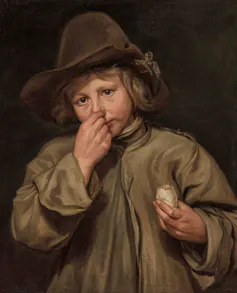
Rose-Marie and Eijk Van Otterloo Collection/Museum of Fine Arts, Boston

Wautier excelled in portraiture, with her elegant palette and her mastery of textures – be it hair or textiles. In her portraits, especially in the depiction of children, she is vivacious and lively and so observant of quirks and foibles. You can see this in her Five Senses (1650) series. For instance, Smell features a little blond boy clutching a rotten egg in one hand and pinching his nose shut with the other, recoiling from the egg’s stench.
Despite their brilliance, however, she never signed her portraits. She did, however, sign two large-scale religious paintings, a Mystic Marriage of Saint Catherine of Alexandria and an intriguing and unusual panel depicting the Education of the Virgin. Both panels centre around educated, confident, elegant female protagonists, defined by their actions.
These paintings defy contemporary ideas that women artists excelled at imitation but lacked the capacity to imagine and create a subject from scratch. Wautier signs these paintings “invenit et fecit”, which translates as “invented and executed”. Here she is staking her claim to possessing the imagination to execute significant work at large scale. She attests to be a master of her craft, and this is nowhere more apparent than in the centrepiece of the Royal Academy’s exhibition, her immense Triumph of Bacchus.
Here, Wautier tackles the epitome of artistic mastery: a large-scale mythological subject that featured in the work of her most significant contemporaries, such as Andrea Mantegna, Titian and of course the artist who dominated the market in Flanders and the Netherlands, Peter Paul Rubens.

Wautier’s Triumph of Bacchus is larger than that of her male competitors, and she combines in her image the fleshiness of the central male nude with the grace and the elegance of Titian. She presents the viewer with a powerful image of a flabby Bacchus reclining in a wheelbarrow, surrounded by his followers. Wautier’s skill in painting a variety of male nudes in a range of poses looks effortlessly competent, with the Bacchus becoming the work that firmly places her within art history, a masterpiece designed to defy the challenge that a woman can not paint like a man.
This one can, but she takes the challenge up a notch with the intriguing inclusion of a self portrait. Wautier depicts herself as an elegant, bare-breasted Bacchante, a female follower of Bacchus, clad in a striking robe of salmon-pink, looking out at the viewer, the only person to do so in the array of figures depicted. Wautier’s Bacchante stands tall and proud, inviting the viewer to look at her. But it’s Wautier who controls this gaze; in the painting, a sallow-skinned faun attempts to grab the Amazonian, composed woman. She shrugs off his leering, and ignores him grabbing her hair. She is in charge.
Michaelina Wautier is on at The Royal Academy in London until June 21, 2026
You must be logged in to post a comment Login