Connect with us
DAPA Banner
DAPA Coin
DAPA
COIN PAYMENT ASSET
PRIVACY · BLOCKDAG · HOMOMORPHIC ENCRYPTION · RUST
ElGamal Encrypted MINE DAPA
🚫 GENESIS SOLD OUT
DAPAPAY COMING

NewsBeat

ANDREW NEIL: I’m told Trump’s physical and mental health are in visible decline – and there’s ever more talk about a ground invasion. 150 days on, he has no good options left in Iran debacle

Published

on

Donald Trump is said to be 'in decline' both physically and mentally, and he is reportedly so frustrated with the war in Iran that he has entered 'revenge mode'

It’s now five months since President Trump launched his war on Iran in cahoots with Israel.

He has precious little to show for it – bar growing frustration at the Tehran regime’s resilience; the despair of America’s allies in the Gulf region and elsewhere; a teetering global economy; rising petrol prices at US forecourts; and personal approval ratings plummeting faster than US munitions are being depleted.

When US and Israeli air strikes began their bombardment of Iran at the end of February, Trump claimed it would all be over in a matter of weeks. The Iranian regime would be humbled, perhaps even deposed. Its missile and drone arsenals would be destroyed, its ability to develop nuclear weapons crippled for a generation, perhaps for ever.

Monday will mark 150 days since February 27, when Donald Trump gave the order to proceed with Operation Epic Fury. Since then, none of those ambitions has materialised. The regime is certainly battered and bruised. But it is still standing – more hardline than ever.

Advertisement

Iran’s military resources have been degraded. But it is still capable of raining down missiles and drones on American military bases and US allies in the region.

Tehran’s ability to develop nuclear weapons has suffered serious setbacks. But it still has the capability to start all over again should it be so minded.

No progress has been made, on the battlefield or in ceasefire talks, to ensure Iran renounces its nuclear ambitions, supposedly the fundamental reason for starting the war in the first place.

Now Iran has something perhaps even more precious than the Bomb, something it did not possess before war broke out: a stranglehold on the Strait of Hormuz, the global economy’s most crucial chokepoint, through which so much oil, gas, fertiliser and other essential commodities used to flow before hostilities broke out. Tehran’s refusal to give up control of this vital waterway is the main reason all peace efforts to date have floundered.

Advertisement

Donald Trump is said to be ‘in decline’ both physically and mentally, and he is reportedly so frustrated with the war in Iran that he has entered ‘revenge mode’

The war isn’t just consuming Trump’s presidency. It’s taking its toll on the President himself. During a recent meeting in the Oval Office, he ranted against Iran’s leaders, calling them ‘scumbags’ and ‘lunatics’ in an expletive-ridden diatribe. There is growing concern for his physical health and mental stability.

‘Donald is deteriorating before our very eyes,’ I was told in Washington this week by a close confidant who sees him regularly. ‘His physical and mental health is in decline. Those around him don’t know what to do about it. It can only get worse. He’s 80 – and it’s showing.’

Advertisement

But it’s not just age – or the decline in cognitive capabilities that can afflict those entering their ninth decade. Trump is lashing out at all and sundry in frustration at the lack of any good options now facing him.

The hardliners in Tehran are now so cocky they even rebuffed a secret US attempt to get the peace process back on track this week.

So the White House is dialling up the rhetoric – Trump is said to be in ‘revenge mode’ – and the President himself sounds ever more bellicose, saying on Thursday that he was ‘close’ to deciding on a ‘massive attack’.

Even senior aides in the White House don’t know what this would mean. The number of influential voices in Washington who think even ramped-up air strikes –as I write, we’ve just had the 14th consecutive night of renewed US attacks on Iran – will cow Iran into submission are now passing few. In truth, nobody around Trump really knows what to do next – or what he will do.

Advertisement

This week two new intelligence reports landed on their desks to add to their despair – which was further increased by their fear that the President has given them scant attention. Their contents were certainly unlikely to improve his mood.

The first, based on analysis from various US intelligence agencies and drawn together by the CIA, concluded that the Iranian regime would not be cajoled into rejoining peace talks by ramping up US air strikes. The US, it said, had underestimated Iran’s ‘staying power’ – that hitting Iran harder was unlikely to make it more ‘compliant’.

The risk now was ‘indefinite limbo’ between peace and war. In other words a stalemate, yet another low-level ‘forever war’ which Trump was elected to avoid.

Or more bluntly, in the terminology used during the Vietnam War almost 50 years ago, a quagmire.

Advertisement

The second intelligence report, involving US and Israeli intelligence, was even more depressing. Drawing on extensive satellite imagery, it revealed that Iran was rebuilding its devastated missile and drone bases far more quickly than either the US or Israel had anticipated.

Missile arsenals were being reconstituted inside mountains. Bridges, ports and military production facilities were being repaired with speed. Even the northern supply lines through which Russia channelled aid to Iran – and which Israel thought it had disrupted – had been ‘restored’. Iran, Israeli intelligence reported, had shown an ‘impressive ability to reconstitute its military capabilities.’

Iran rebuilt its missile bases more quickly than the US or Israel had anticipated. (Pictured: A missile being launched towards US targets in Jordan, Kuwait and Bahrain)

Iran rebuilt its missile bases more quickly than the US or Israel had anticipated. (Pictured: A missile being launched towards US targets in Jordan, Kuwait and Bahrain)

Although there has been talk from Washington about seizing Iranian territory, no conceivable US deployment could suppress Iran for long, says Andrew Neil

Although there has been talk from Washington about seizing Iranian territory, no conceivable US deployment could suppress Iran for long, says Andrew Neil

Advertisement

The sound of war drums is once again emanating from the White House. The media is being briefed on the renewed ‘surge’ of US forces to the Gulf. There are already 17 US warships in the region, including two aircraft carrier strike groups and a marine corps expeditionary group.

They are being joined by more fighter jets and special forces. Bombers stationed at US bases in America and Britain are back on high alert. Even 150 medics have been rushed to a base in Germany which deals with Middle East casualties. All told, including US bases in the region, deployments for the launch of the war back in February plus the latest top-ups, America now has more than 50,000 troops in the region.

But for what purpose? This week in America I listened to several influential figures close to Trump mull over the options. The assumption was that some sort of ground incursion was inevitable. That is certainly the new vibe coming out of Washington.

They talked of seizing Iranian territory on the northern shores of the Gulf to wrest control of the Strait of Hormuz from Tehran. They raised the prospect, again, of invading Kharg Island, from which Iran dispatches most of its oil exports.

Advertisement

There was, thankfully, no talk of a full-scale attack along the lines of the invasion of Iraq in 2003. Iran is four times bigger than Iraq, with a much larger population, a disciplined, well-armed 190,000- strong guard bolstering the regime and terrain tailor- made for guerrilla war. No conceivable US deployment could suppress Iran for long.

But there was, much more worryingly, talk of using tactical nuclear weapons to ‘send a message’ to Tehran and ‘concentrate its mind’ on peace. This took me aback.

‘Do that,’ I snapped ‘and you destroy America’s reputation and standing for the rest of the century. You’ve also paved the way for President Putin to do the same in Ukraine.’

I was met with silence. There is much desperate talk in Trump circles these days. As it happens, I do not believe Trump will resort to nuclear weapons. I’m not even sure he will embark on a major ‘boots on the ground’ escalation, even if that is the growing consensus in Washington. US forces could certainly take Kharg Island. But then what? They’d be sitting ducks for Iranian missile and drone attacks.

Advertisement

Occupying the north side of the Strait of Hormuz would be a far bigger task, requiring more troops than America is currently assembling in the region. The topography lends itself to Iranian guerrilla attacks. Ships transiting the Strait would still be vulnerable to missile and drone attacks launched from further inland.

US forces might then be enticed to go after these sites. That’s how you get suckered into a morass. It’s striking that current US reinforcements to the region do not include a big increase in troop numbers, which a major land attack would require. That’s one reason I remain sceptical of a major ground incursion. The other is US domestic politics.

It took six years for the Vietnam war to become as unpopular as Trump’s war on Iran has become in under six months. Vietnam hit a net approval rating of minus 30 per cent after six years and a mounting death toll with no end in sight. Trump’s war already has the same negative approval rating – and that’s without a monstrous bodybag count.

So far only 18 US military personnel have lost their lives in the current war. Each one, of course, a personal and family tragedy. Even so, it is already the most unpopular war since US polling began. It benefits from not a scintilla of bipartisan support. It has a net approval rating of minus 84 per cent among registered Democratic voters and minus 52 per cent among independents.

Advertisement

Surprisingly, it still enjoys a 72 per cent approval rating among Maga Republicans, despite their contempt for ‘forever wars’. But over half are only ‘somewhat’ supportive rather than ‘strongly’. I would expect that tepid support to evaporate if pictures of bodybags started to dominate broadcast news.

The war has already taken its toll on Trump’s popularity. Almost two-thirds of voters disapprove of his handling of the war, with only a third approving. More than

Trump¿s war on Iran is at risk of defining his presidency, like the Vietnam war defined President Lyndon Johnson¿s, our columnist warns. (Pictured: Johnson with President Nguyen Van Thieu)

Trump’s war on Iran is at risk of defining his presidency, like the Vietnam war defined President Lyndon Johnson’s, our columnist warns. (Pictured: Johnson with President Nguyen Van Thieu)

60 per cent don’t expect any truce he makes with Iran to hold. Almost 80 per cent want him to end the war now. Trump’s overall job approval rating is now under 40 per cent and falling. Iran has proved to be a major drag on his standing. His approval rating on perhaps the most important political metric of all – his handling of the economy – is under water at below 30 per cent.

Advertisement

Much of that reflects the fact petrol prices at the pump are now over $4 a gallon again, which especially hurts Americans now that the summer driving season is underway. Petrol prices dropped when the ceasefire was agreed and it looked like the Strait of Hormuz was open again for business. Now they could be heading for $5 or more – a prospect that terrifies Republican Party managers in the run up to early November’s mid-term congressional elections, when Trump’s control of the House and Senate is at stake.

The resumption of hostilities has effectively closed the Strait of Hormuz. Shipping there has all but halted since July 15. So oil prices have started to soar again.

The benchmark price of Brent crude oil hit $100 a barrel on Thursday. It’s likely to go even higher. This week, urged on by their Iranian paymasters, Houthi rebels in the Yemen hit two Saudi tankers loaded with crude and oil products in the Red Sea.

The Saudis have been piping oil to Yanbu, a port on the Red Sea, to bypass the Strait of Hormuz. If this escape route is now in jeopardy then oil prices will spike much further.

Advertisement

In fact, it is not the price of crude that is the real worry. It is the price of the products refined from it – diesel, petrol, jet fuel. All three are already spiking. Jet fuel, for example, at around $150 a barrel in Europe and America, is now almost twice what it was before this misbegotten war began.

The global economy is now on the brink of a major energy squeeze. It has been staved off to date because major economies such as America, China, Japan and South Korea drew on their strategic oil reserves.

Ways round the Strait of Hormuz (like that pipeline to Yanbu) were used. China cut its crude oil imports by almost two-fifths. All these buffers have now been exhausted.

Nor is the problem just Trump’s Iranian adventure. That has reduced the supply of refined products by around 3million barrels per day (b/d) from the Gulf, on which Europe depends for diesel and jet fuel. On top of that Ukrainian drones have taken out another 2million b/d of Russian refining capacity while China has cut back on its export of refined products, perhaps by another 3million b/d to conserve its own supplies.

Advertisement

It amounts to a triple whammy for the global economy, a perfect storm – and a harbinger of severe shortages of vital refined products to come, which is as yet only vaguely understood.

If, as is the talk in Washington, Trump starts to bomb Iranian power plants and civilian infrastructure – and Tehran inevitably retaliates by hitting the pipelines, ports and even desalination plants of the Gulf States (which depend entirely on these plants for water) – then the word ‘morass’ will not do justice to what’s in store for us during the second half of this year.

I end where I started: Trump has no good options. If he tries to slink away from the mess he’s created, all the vainglorious rhetoric he can muster will not hide the fact that he has presided over the greatest humiliation of America in modern times. But if he doubles down and recklessly raises the stakes with a major military escalation, he risks merely making matters worse – for him, for his party, for America, for the Gulf, for the global economy, for us.

Trump’s war on Iran is now at risk of defining his presidency just as the Vietnam war defined Lyndon Johnson’s all those years ago. It is not a legacy any president should wish to emulate. But, through a mixture of stupidity and bravado, Trump looks like doing exactly that. We will all be the poorer for it.

Advertisement

Source link

Continue Reading
Click to comment

You must be logged in to post a comment Login

Leave a Reply

NewsBeat

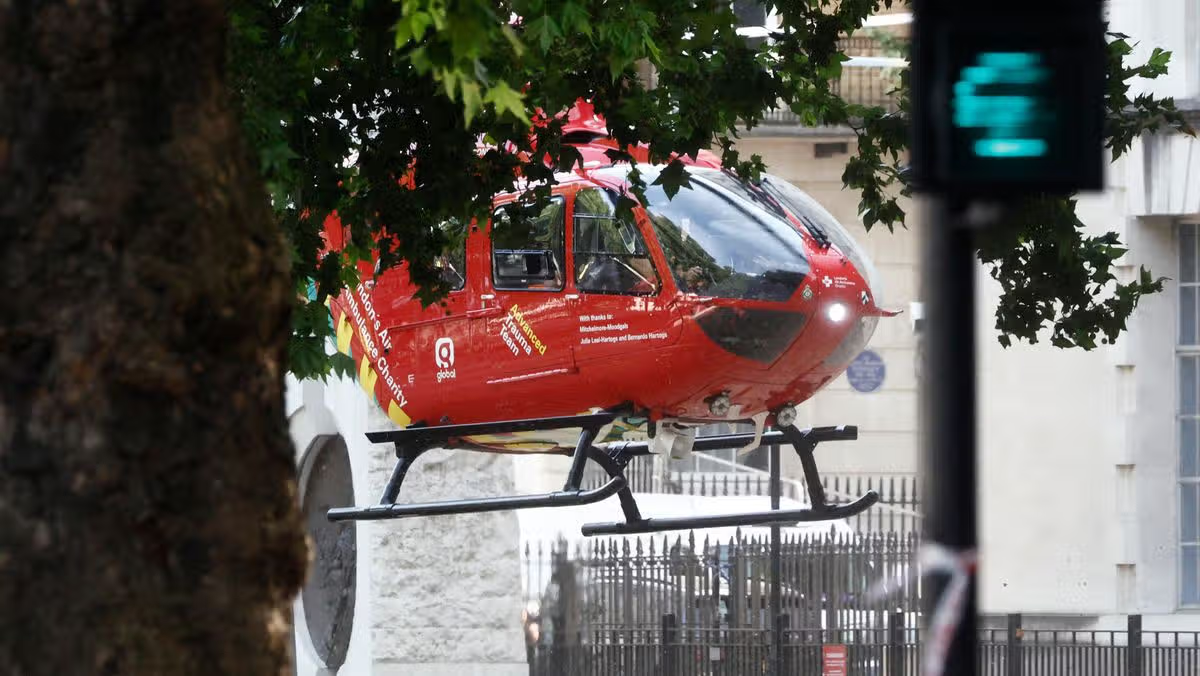
Westminster Bridge: Four police officers seriously injured in horror Thames boat crash

Published

on

Daily Mirror

A couple from the United States said they heard “an explosion” when a police boat travelling at “high speed” struck Westminster Bridge on the River Thames today, injuring five officers.

Jim Bagley, from Gloucester, Massachusetts, told the Press Association: “We were standing in line to get onto the city cruise hop on, hop off tours, and we saw two police boats coming up the river.

“One was an orange boat that went under the bridge and left a great big wave, and then there was a black boat that came up behind it, the police boat.

Advertisement

“It looks to me that he got stuck in the wake of the other boat that had just passed through the bridge and slammed into the wall on the opposite side.

“We didn’t see it happen, but we heard the explosion… the next thing we saw was three people in the water, coming down the river.”

He added: “We were wondering why they were under way at high speed to begin with.”

Katherine Bagley said: “They were both in pursuit of something farther down the river, but they never… the second boat never got to it because it crashed into the bridge with a big bang.”

Advertisement

Source link

Continue Reading

NewsBeat

Most Kids Are Not Yet Year One Ready. These Toys Might Just Change That

Published

on

Most Kids Are Not Yet Year One Ready. These Toys Might Just Change That

We hope you love the products we recommend! All of them were independently selected by our editors. Just so you know, HuffPost UK may collect a share of sales or other compensation from the links on this page if you decide to shop from them. Oh, and FYI — prices are accurate and items in stock as of time of publication.

We all want the best for our kids; that includes setting them up for a successful future.

But, according to the government’s School Readiness initiative, only 37% of kids are ready for year one when they finish reception.

While the government has pledged to boost this number to 75% by 2028, there are things you can do to change that at home.

Advertisement

Most importantly, it can be fun. Learning Resources is an educational toy brand that has a ton of play options available to teach your kids the skills they need to start year one all in the comfort of your own home.

Keep reading for our round-up, and expert advice on how to use the summer for skills progression.

What do kids need to be ‘school ready’?

“There are six key skill areas identified as helping a child become school ready,” explains Samantha Hayhurst, head of marketing at Learning Resources.

Advertisement

“These include fine motor skills, self-care and independence, language and communication, social skills, classroom readiness and early maths and literacy.

“While this list may seem daunting to parents there’s an abundance of ways that families can support development across all areas over the summer before school term begins in September and beyond.”

What parents can do to support

Naturally, you don’t want to eat into their fun time over the school holidays, but there are ways to incorporate learning into play time, Hayhurst explains.

Advertisement

“There are lots of ways you can help to develop school readiness via play so children don’t feel pressured and are engaged in learning new skills,” she says.

Learning Resources has worked with educational experts and teachers to create a guide filled with ideas for fun activities and games parents can play with children to build essential skills.

“We also have a YouTube series of Little Lessons,” Hayhurst explains.

“These bitesize lessons include tips on turning routines into play, concentration skills, recognising their name, early empathy and lots more.

Advertisement

“All of the little lessons are aligned with the six key areas of school readiness with an emphasis on play.”

The best sensory and learning toys to get kids ready for school

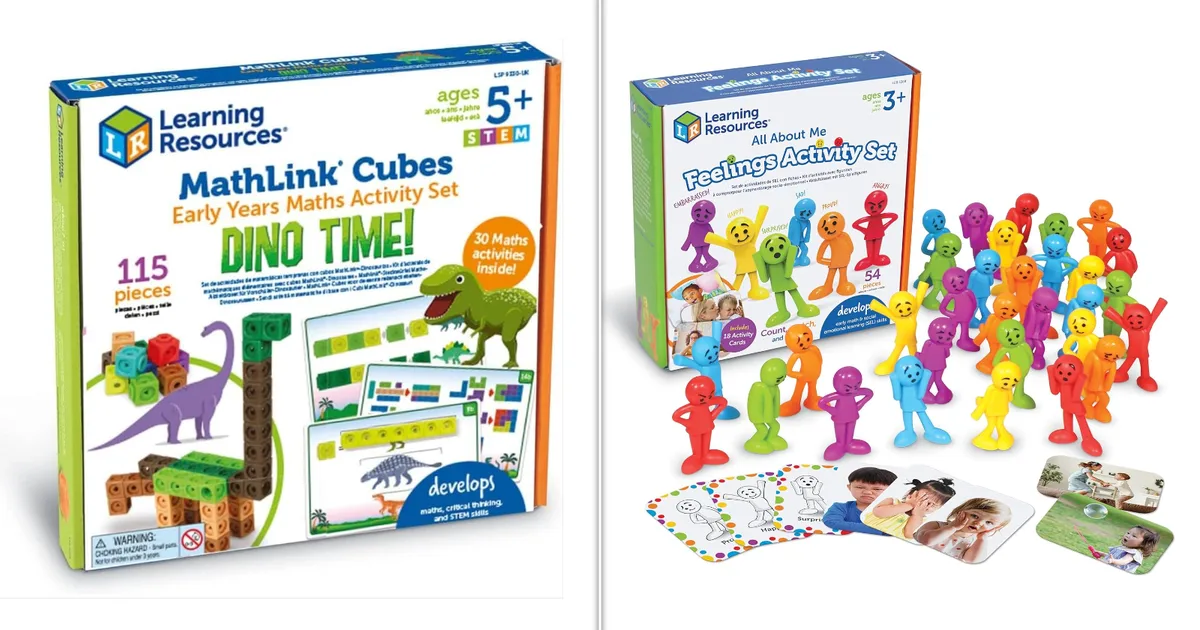
As well as being a fun creative task where kids can draw colourful shapes with the stencils, this kit teaches scissor skills and builds hand strength.

Another toy to help develop their motor skills, this set uses play sand to help your little one learn how to hold a pencil. Beware, things are going to get messy.

“All about Me is a popular first topic during the first few weeks of a new school term where children learn about their own identity and about their peers so products that can enhance social skills and emotional development are not only beneficial but also wonderful to play with together,” says Hayhurst.

“Our All About Me collection not only helps to give children a better understanding about themselves and the world around them, they are also designed to support colour recognition, pattern spotting and matching.”

Advertisement

This set uses counters to help your kid explain what you family looks like.

Meanwhile, these mirrors are to help encourage self-awareness by teaching them about facial expressions, body language, and emotions. On one side is a regular mirror, and the other has a distorted effect for an extra element of fun.

Likewise, this set supports kids to develop emotional awareness and creates a safe space so they can talk about their feelings.

To teach them easy maths skills like adding and subtraction, this dinosaur kit comes with 115 blocks that can be assembled through challenges and puzzles.

Source link

Advertisement
Continue Reading

NewsBeat

York care home with one resident told to improve by CQC

Published

on

York care home with one resident told to improve by CQC

Yearsley Villa, a small residential care home in Huntington Road, has been rated ‘requires improvement’ by the Care Quality Commission (CQC) following its latest inspection.

The care home provides support for two people, both of whom have mental health needs, but only one person was under its care at the time of the inspection in May, according to the CQC’s report.

Inspectors visited the home from May 7 to May 21 and said they found “significant improvements were required to ensure safe, effective, and well-led care”.

Yearsley Villa declined to comment.

Advertisement

Yearsley Villa, a small residential care home in Huntington Road, has been rated ‘requires improvement’ by the Care Quality Commission (CQC) following its latest inspection (Image: Google)

Inspectors said people had not been affected by the “shortfalls identified”, but “people were put at potential risk of poor care due to the concerns found during the inspection”.

They said the care home was “receptive to feedback during the inspection and had started to make some improvements, including updating documentation”. “However, these changes were not yet embedded or sufficient to demonstrate sustained improvement.”

In their report, inspectors said care records at the home “were often incomplete, inconsistent, or lacked detail, and did not always reflect people’s current needs or how care should be delivered”. “There was limited evidence of person-centred planning, including people’s preferences, routines, and goals.

“Risks were not always assessed or mitigated effectively. Risk assessments were either missing or lacked sufficient detail in key areas such as mental health, finances, and behaviours.

Advertisement

“Following incidents, there was limited evidence of review or learning, and appropriate safeguarding notifications had not always been submitted, which is a regulatory requirement.”


Recommended reading:


Inspectors also raised concerns over how medicines were managed at the care home.

They said people were described as “self-medicating” but there were no “clear risk assessments, capacity assessments, or consistent systems to monitor this safely”.

Advertisement

“There were also shortfalls in staff training and recruitment practices,” the report said. “Training was out of date in key areas and recruitment checks had not been consistently completed in line with the provider’s own policy.”

Inspectors raised further concerns about decision-making processes at the care home, which they said “were not always in line with the Mental Capacity Act 2005”.

They found that “capacity assessments and best interest decisions were either absent or not decision-specific, meaning we could not be assured that people’s rights were consistently protected”.

Watchdog finds people satisfised with care but raises concerns over systems

Meanwhile, inspectors said “people expressed satisfaction with their care” and were “positive about their experience of living at the service”, but “found the systems in place did not always support consistent, person-centred care”.

Advertisement

They also found that the facility was caring, writing: “Providers knew people well and we observed kind and compassionate interactions, with people treated with dignity and respect.

“People were supported to maintain relationships and access the community, and feedback reflected a relaxed, family-style environment.

“The environment was safe, clean, and well maintained, with appropriate safety checks in place.

“The provider collaborated with external professionals, including mental health teams, to support people when their needs changed.”

Advertisement

Source link

Continue Reading

NewsBeat

Dad describes hearing screams before diving into sea to help drowning family at West Mersea beach

Published

on

Daily Mirror

Craig Bowe was enjoying a family day trip to West Mersea with his wife and daughter when he heard harrowing screams coming from the sea – he has described the moment he decided to step in and help

A dad on a family day trip to West Mersea has reflected on his attempts to save a mother and daughter who drowned off an Essex beach.

Craig Bowe, 42, was on a day trip from Hertfordshire to celebrate his daughter’s 10th birthday they arrived at the beach at about 11am and recalled seeing the victims having a “great time” together, until several houts later they heard harrowing screams coming from the water on Wednesday evening.

Without hesitation Craig sprang into action and managed to haul Shally and Samiha Rahman from the waves and also helped a seven-year-old boy onto a lifeboat. However, despite his efforts Shally and Samiha – aged 41 and 15 – sadly died at the scene. While the young boy was airlifted to hospital and remained there in a critical condition on Friday.

Advertisement

The tragedy unfolfed at around 5.35pm when Samiha had tried in vain along with her mother Shally to save her seven-year-old cousin from the water . The mother and daughter were reportedly caught in the high tide and, despite the the valiant efforts of teenagers on the beach, were unable to be saved.

Craig, from Northaw, sprang into action after hearing a man screaming in the water and seeing bodies floating. He told the BBC: “When I got there, the first two people I saw were actually face down, so [it was] more serious than I initially thought.”

Speaking about how he helped load the seven-year-old boy and another child, who were about 150 yards (137m) out at sea, onto a lifeboat he said: “I helped sort of shoo him onto the boat, because he was face down too… but the seven-year-old was not in a good way.”

Advertisement

Bowe’s wife, Carly, was among the group of people trying to resuscitate the mother and daughter on the sand. She told the BBC: “I just wanted them to survive and every bit of me was willing her to breathe.”

She added: “Everybody on that beach that day played their part in giving that family the best chance they could to survive. Everyone really stepped up and it was incredible to see.”

Essex Police’s Detective Chief Inspector Al Pitcher said: “My thoughts, and those of my team, are with the friends and family of the woman and girl who died yesterday. We can now confirm they were a mother and daughter from London and we are supporting their family in what is an unimaginable time.

Advertisement

“Since yesterday we have been working to establish the circumstances which led up to this incident. At this stage we believe they were trying to help a seven year-old boy who had got into difficulties.

“The boy was taken to hospital where he remains in a critical condition but the woman and teenage girl, sadly, died. All the people involved in this incident are related to each other.

“As part of our investigation we are working through speaking to dozens of witnesses and taking their accounts, and we are building a picture of what happened. These enquiries are ongoing and I need anyone who has any information to get in contact.

Advertisement

“Finally, I want to thank the first responders who worked tirelessly to try save their lives and I want to pay tribute to their efforts.”

Just days after the tragedy Colchester Council said an independent Royal Life Saving Society (RLSS) UK beach risk assessment was carried out on West Mersea Beach four months ago – and found that life-saving equipment was “not recommended” as it was “unlikely to be deployed effectively”.

Advertisement

A spokesperson the council said “decisions on water safety measures” are “informed by professional risk assessments and advice from specialist organisations”.

A Colchester Council spokesperson said: “We are aware of views that have been expressed regarding additional public rescue equipment. However, decisions on water safety measures are informed by professional risk assessments and advice from specialist organisations.

“As part of our risk assessment process for the site, the council commissioned an independent RLSS UK beach risk assessment in March 2026, which did not recommend the installation of public rescue equipment within the assessed area of West Mersea beach.

“The assessment concluded that, due to factors including the beach profile, tidal range and lateral currents, public rescue equipment would be unlikely to be deployed effectively in an emergency and was therefore not recommended on that stretch of coastline.

Advertisement

“We continue to work closely with partner organisations through the Mersea Water Safety Forum, a multi-agency partnership that brings together organisations with expertise and responsibilities in water safety. Together, the forum assesses local risks and develops and implements measures to help improve safety in and around the water.”

Cllr David King, Deputy Leader and Portfolio Holder for Local Government Reorganisation, Communities and Public Protection, added: “Everyone at Colchester City Council is deeply saddened by the tragic loss of two people following the incident at West Mersea.

“Our thoughts and heartfelt condolences are with their families, friends and all those affected by this devastating incident. We would also like to pay tribute to the emergency services and volunteers who responded.

Advertisement

“This tragedy is a stark reminder of the importance of taking care in and around the water. We encourage everyone visiting any coastline this summer to follow water safety advice and take appropriate precautions to help keep themselves and others safe.”

The Mirror has launched the Save Lives For Sam water safety campaign to tackle the UK’s growing drowning crisis. Backed by MPs, Olympic champions, national water safety organisations and bereaved families, the campaign is calling for urgent action to make our waters safer.

Find out more about the campaign and how you can support it here.

Source link

Advertisement
Continue Reading

NewsBeat

Jaspah Too shop reopens in new Consett location

Published

on

Jaspah Too shop reopens in new Consett location

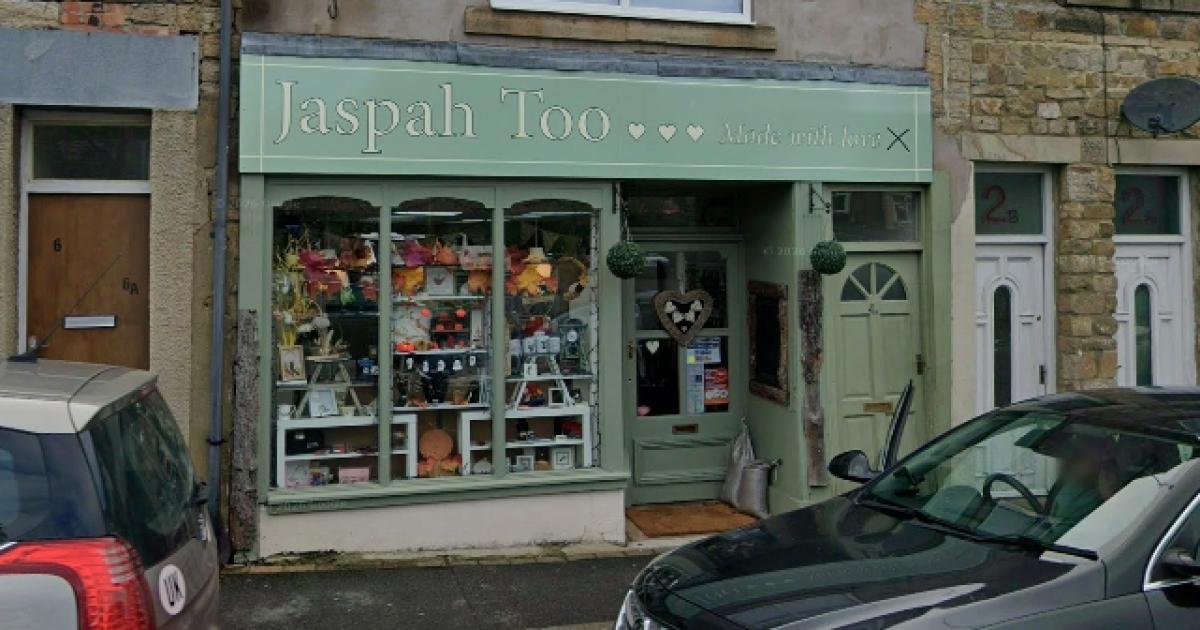
Jaspah Too has moved from Derwent Street to Durham Street in Blackhill, Consett and reopened this month (July 3).

The business stocks handmade gifts and cards created by local people and books by local authors.

The previous Jaspah Too shop on Derwent Street. (Image: GOOGLE MAPS)

The business thanked customers for the support they have already received: “We’d just like to say a huge thank you to everyone who has popped in to see us.

“We’re absolutely loving our new location, and it’s been great to welcome lots of new customers, as well as seeing plenty of familiar faces again.”

Advertisement

The shop sells jewellery, candles, ceramics, skincare, and more.

The shop boasts an almost perfect rating of 4.9 stars on Google.

One review said: “I love Jaspah Too.

“It is my local go-to place when am looking for a gift idea for someone.

Advertisement

“I treat myself too.

“There is so much to look at, so much variety, I always spend a while trying to look at everything.

“The friendly staff are people that make what is on for sale in the shop, and it is interesting to talk to them too.

“Do pop in, you will love it, I’m sure.”

Advertisement

Jaspah Too is open 10 am-5 pm, Monday to Saturday.

Source link

Advertisement
Continue Reading

NewsBeat

Breathtaking gardens 1 hour from Cambridge with tranquil lakes and temples

Published

on

Cambridgeshire Live

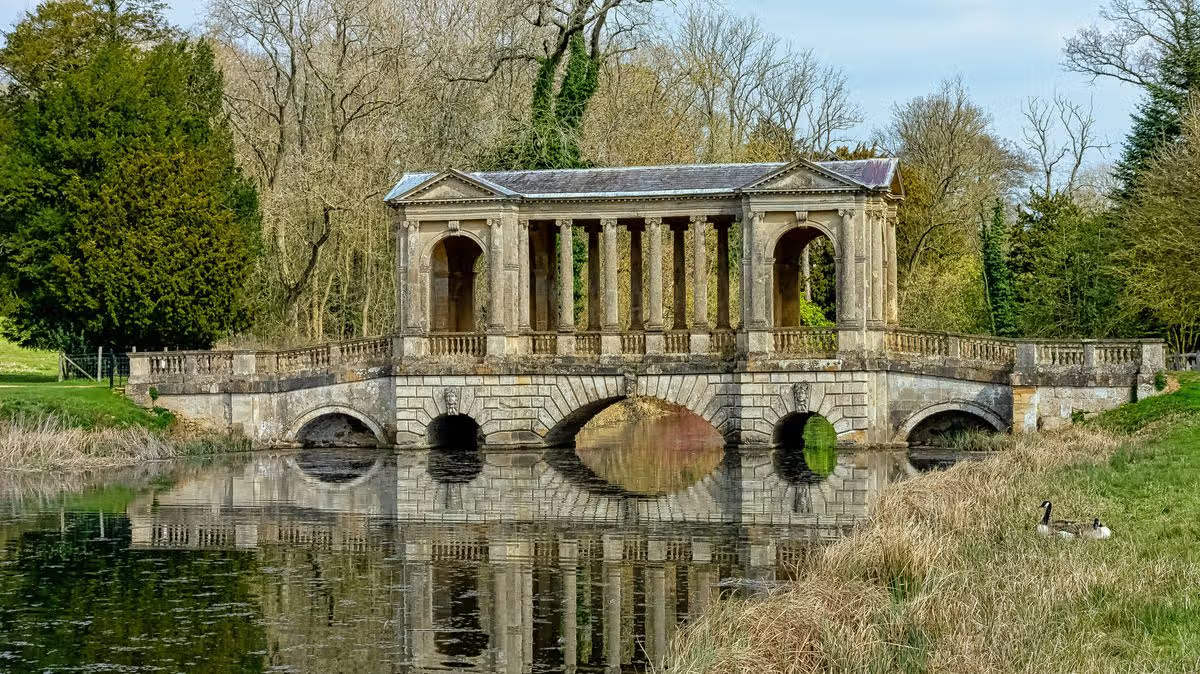
A gorgeous garden location near Cambridge has 250 acres of peaceful nature to explore, including lakes and trees – and it’s home to the ‘most beautiful bridge in Britain’

One of the most tranquil places to visit in the UK is just an hour away from Cambridge. We could all benefit from spending more time outdoors to help clear our heads from the endless hours we spend glued to screens and confined inside, and there’s no finer way to achieve this than heading out for a walk and embracing the natural world.

Britain is brimming with wonderful walking destinations, and one spot just over an hour from Cambridge has recently gone viral online for being home to “the most beautiful bridge in Britain”, alongside a host of other breathtaking attractions. If you’re struggling to find things to do with the children during the summer holidays, this could make for an ideal day trip.

Advertisement

A woman named Braidie shared a video of Stowe House and Gardens on her travel TikTok, where she and her partner, Dan, regularly showcase “hidden gems” across Britain that are well-suited to those on a “budget”.

She said: “Stowe House is one of the most beautiful National Trust properties I’ve ever visited, with its temples, lakes, and amazing bridge. Save for your next UK day out.”

Stowe Gardens is a National Trust property in Buckinghamshire, situated approximately an hour and a half from Cambridge. The gardens offer 250 acres of grounds to explore at your leisure, filled with trees, temples, monuments, shrubs, and peaceful stretches of water.

Content cannot be displayed without consent

Should 250 acres not prove sufficient, there is also a more expansive 750-acre park where visitors can stroll and observe wildlife. The parkland additionally features bridleways for those who enjoy horse riding.

Advertisement

Stowe Gardens are also home to Stowe House, although this is not owned by the National Trust. You can visit the grounds of the house, but the two locations have separate entrances, and you must pay separately to enter each area.

As Stowe Gardens are owned by the National Trust, members of the organisation can visit for free. For non-members, entry costs £18 for adults, and £9 for children aged five to 17, with under-fives going free.

For the house, adults must pay an additional £9.50, or £7.50 if you’re a National Trust member, while children are charged £3, and under-fives continue to enter for free.

Stowe Gardens has an almost perfect 4.4 out of 5 rating on TripAdvisor, with over 1,300 reviews. Those who have visited the location before say the area boasts “great walks and beautiful views,” which are made even better by the on-site café, which serves delicious ice cream and cake.

Advertisement

One person said: “I love these grounds. I can spend hours just wandering around looking at all the different things, then popping into the cafe for a coffee. Everything is kept so neat and tidy. I have never been when I felt like it was too busy; it is always quite tranquil. If you want to while away a few hours in some beautiful gardens with great views then i would highly recommend Stowe Gardens.. Another added: “Beautiful. Lovely walks and even better during the week, no crowds at all.

Very different to the weekend. “. “What I would recommend is looking into getting national trust membership, paying without this is quite expensive, but getting membership means we keep returning to the delight of our dog. Nice Ice cream, and cakes!

“. A third shared: “Another lovely outing to another beautiful National Trust site. It’s a bit out of our usual area, and this was our first visit here.

It was lovely and a beautiful walk. We’d happily visit again.

Advertisement

“.

Source link

Continue Reading

NewsBeat

The X Factor star Lucie Jones gives birth to first baby and shares unique name

Published

on

Daily Mirror

Lucie Jones, who auditioned for The X Factor aged 18 back in 2009, has announced she has given birth to her first baby with a sweet post sharing a number of adorable photos

X Factor star Lucie Jones has given birth to her first child and shares some adorable first photos.

Advertisement

Lucie shot to fame after she auditioned for the popular singing competition at the age of 18 back in 2009 for the show’s sixth series. She finished in eighth place after being eliminated during the live shows. After her stint on the ITV show she went on to represent the UK in Eurovision for the 2017 song contest.

In between X Factor and Eurovision, she established herself as an actress, being picked for countless West End productions and TV shows.

Back in January this year she announced she was expecting her first child with her partner George. Taking to Instagram she said: “We’re so excited and beyond happy to tell you we’re having a baby!

Advertisement

“Nothing comes close to this feeling… we feel like the luckiest people in the world. She’ll be here in July and we cannot wait to meet our little girl.”

Yesterday Lucie took to social media to confirm the birth of her baby. Captioining the announcment: “Elowen Hersey-Jones. We are so lucky to be parents to the most perfect angel on the planet. This little girl has dropped in to change everything and we are utterly besotted.”

She share a slew of snaps of their newborn baby in hospital and her fans were quick to share their well-wishes with the star online. One wrote: “Oh Lucie. She is absolutely beautiful! Congratulations.” Another added: “OMG She’s perfect!!!! Congratulations Mummy & Daddy.”

Content cannot be displayed without consent

A number of celebrities also shared their well-wishes Giovanna Fletcher, who hosts a parenting podcast said: ” huge congratulations”. The Happy Mum, Happy Baby podcast is a popular UK audio show hosted by Giovanna Fletcher where she talks with high-profile parents about the real-life highs and lows of raising children.

Advertisement

Other famous faces including presenter Scarlett Moffatt said: “Huge congratulations and sending so much love and quick recovery mamma. She is absolutely beautiful xxxx”

For more of the latest showbiz news and gossip, follow Mirror Celebs on TikTok, Snapchat, Instagram, Twitter, Facebook, YouTube and Threads.

Source link

Advertisement
Continue Reading

NewsBeat

Tesco brings back free fruit for kids this summer

Published

on

Tesco brings back free fruit for kids this summer

Until August 30, children can collect a free apple while shopping in more than 800 Tesco supermarkets and 77 large Tesco Express stores across the UK. Families using Click & Collect will also receive free apples for children at selected locations.

The move comes as millions of families face the extra cost of feeding children during the six-week school break, when free school meals are unavailable for many households.

But the free fruit isn’t the only support on offer.

Advertisement

Tesco’s Kids Eat Free offer returns

Tesco is also extending its popular Kids Eat Free café promotion throughout the summer holidays.

Families can claim one free Kids Hot Meal Deal, Kids Breakfast or Kids Pick ‘N’ Mix meal with the purchase of any adult café item from just 60p, provided they scan a Tesco Clubcard or Clubcard app.

The offer is available in 317 Tesco cafés across the UK and now runs every day of the week, including weekends, until September 1.

Extra support for families

Tesco has also announced several new initiatives aimed at helping households struggling with the cost of living this summer.

Advertisement

These include:

  • Pre-filled food donation bags costing between £2 and £4, available in larger stores to support food charities Felix and Trussell.
  • A Round Up at the Till campaign running from 3 August to 9 August, allowing shoppers to donate spare change at checkout.
  • Continued investment in its Free Fruit & Veg for Schools programme, which already supports more than 500 schools.

The supermarket says the measures are designed to help children who may miss out on free school meals during the holidays.

Why Tesco is offering free fruit

The announcement comes amid growing concern about holiday hunger.

According to Trussell, food bank support for children remains 34% higher than before the pandemic, while more than 900,000 emergency food parcels for children were distributed through its network last year.

Research from Felix also found that 41% of charities receiving redistributed food have seen demand rise over the past year, with many expecting even greater pressure during the school holidays.

Advertisement

Tesco: ‘Every little bit helps’

Christine Heffernan, Tesco’s Chief Communications and Sustainability Officer, said: “We want to be able to support our charity partners to help those needing a little extra support this summer. Our partnerships with Felix and Trussell are central to this aim.

“When you’re out doing your weekly shop this summer, dropping a few tins into a food collection point, picking up a food donation bag in our stores or rounding up your grocery bill can make a difference to the lives of thousands of children in communities across the UK.”


Recommended reading


How to claim Tesco’s free fruit

Children can pick up a free apple at participating Tesco stores until August 30.

To claim the Kids Eat Free café offer, customers simply need to:

Advertisement
  • Buy any adult café item from 60p
  • Scan a Tesco Clubcard or Clubcard app
  • Have a child present
  • Visit before September 1

With supermarket prices and childcare costs continuing to squeeze household budgets, the offers could help families save money on trips to Tesco throughout the summer holidays.

Source link

Continue Reading

NewsBeat

New UK leader Andy Burnham caps a busy first week with a part-time office move to Manchester

Published

on

New UK leader Andy Burnham caps a busy first week with a part-time office move to Manchester

LONDON (AP) — Andy Burnham is a man in a hurry.

Since entering 10 Downing St. on Monday, Britain’s new prime minister has traveled to the southeast, southwest and northwest of England, and to Scotland, spoken to more than a dozen world leaders and made a flurry of small but symbolic economic announcements: a tax cut on household electricity bills, a 2 pound ($2.70) cap on bus fares and a tax break for pubs.

“We are on borrowed time if we don’t get a move on,” newly appointed Housing Secretary Angela Rayner told the BBC on Friday. “This is a down payment within the first week that says, ‘We get it.’”

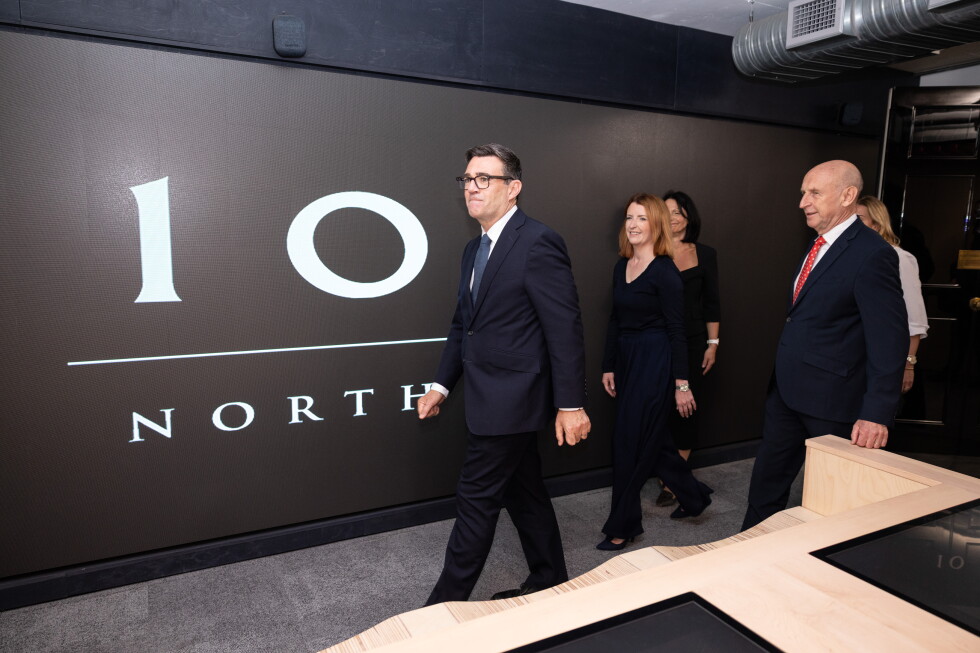
On Friday Burnham gathered Cabinet ministers, senior civil servants and regional mayors at “No, 10 North,” an outpost of the prime minister’s office in Manchester, 165 miles (265 kilometers) northwest of London.

Advertisement

Burnham says he will work at least one day a week from the northern office, which will serve as the cockpit for his goal of spreading economic growth to “every post code” in the land.

Decentralizing power and spreading wealth from southern England to post-industrial cities and depleted seaside towns is key to Burnham’s platform, and he told staff as he arrived at No.10 North on Friday: “This might be the best day of my life.”

Opposition politicians have called the northern office — housed for now in an office building shared with a branch of the cyberintelligence agency GCHQ — a gimmick. But Burnham said it will be “the nerve center for a rewired Britain.”

Writing in The Guardian, he said that for decades too much “decision-making power has remained in London,” and struggling areas of the U.K. “have been unable to turn things around because they simply do not have the necessary power to do so.”

Advertisement

No, 10 North “is about taking power down and placing it in the hands of people who can use it best,” he wrote.

Burnham became prime minister and leader of the governing Labour Party after his predecessor Keir Starmer was forced out after two years in office marred by missteps, scandals and plummeting popularity ratings.

Starmer floundered because he failed to deliver the economic growth he promised in his 2024 election campaign. Burnham says he will be different, but faces many of the same challenges, especially finding a way to reinvigorate an economy that has grown an average of less than 1.5% a year since 2009 and unearthing funds to restore frayed public services.

Foreign policy pressures mount quickly

Burnham, who has little foreign policy experience, also must deal with the same volatile world. He has signaled continuity with Starmer in key foreign policy areas. He reassured President Volodymyr Zelenskyy that U.K. support for Ukraine remains “resolute” and told Danish Prime Minister Mette Frederiksen that Greenland’s future “should only be determined by the people of Greenland and Denmark,” in reference to U.S. President Donald Trump’s stated desire to take over the vast Arctic island.

Advertisement

He’s also facing threatening new rhetoric from Iran. Tehran accused the U.K. of “complicity” in American aggression by allowing the U.S. to use British bases for airstrikes on Iran and said it could face “consequences and repercussions.”

Burnham has maintained Starmer’s policy of letting American forces use U.K. bases to hit targets involved in attacks on shipping in the Strait of Hormuz. Iran’s threat came after Britain banned the powerful Revolutionary Guard and accused it of being behind a series of arson attacks on the Jewish community and Persian-language media outlets in the U.K.

Advertisement

Britain’s Ministry of Defense said “the U.K. stands ready 24/7 to defend itself.”

“The U.K.’s approach to the conflict remains the same – we are committed to defending our people, our interests and our allies, acting in accordance with international law and not getting drawn into the wider conflict,” it said in a statement.

Advertisement

Source link

Continue Reading

NewsBeat

how the viral appeal of pianists in public spaces is not so different from 19th-century music salons

Published

on

how the viral appeal of pianists in public spaces is not so different from 19th-century music salons

Why have public displays of piano playing become so compelling? At railway stations, shopping centres and airports, an instrument usually associated with concert halls bursts into everyday life. In the space of a few moments, shoppers and passengers become an audience – and once a recording of the performance is posted online, this encounter can reach thousands or even millions of people.

TikTok pianists such as @umutpiano (Umut Cetin) skilfully exploit the tension between high-art virtuosity and ordinary public spaces. This 21-year-old from Frankfurt offers a particularly striking example of the format’s viral appeal. As shoppers and commuters gather around him, their reactions become part of the performance and help give his videos their sense of immediacy. His account has attracted approximately 63,600 followers and 10.4 million likes across 246 videos.

This viral appeal mirrors the high-society “hype” of 19th composers and pianists; viewers are not simply watching a technical display, but witnessing a deliberate musical interruption of the mundane. In both the 19th-century salon and the 21st Instagram feed, the thrill lies in the proximity to talent when one least expects it.

Channel 4’s The Piano, currently in its fourth series, has successfully turned the same idea into a TV show. New and self-taught players perform in large train stations while presenter Claudia Winkleman hears their stories. Pop singer-pianist Mika and a guest mentor listen from a nearby observation room and choose one player for the final concert. It is both a talent search and an engaging exploration of the many reasons people make music.

Advertisement

Virtuosity, vulnerability and reinterpretation

The Piano does this in a gentle and inclusive way. In the first episode of the new series in Birmingham New Street station, classical pianist Tiffany Poon brings a concern for technique, interpretation and emotional expression to her role as guest mentor. At Liverpool Lime Street where the second episode takes place, Jamie Cullum approaches the performers from the perspective of a jazz-pop pianist and improviser.

Impressing Poon in the first episode, amateur pianist Ollie’s performance of Chopin’s Ballade No.2 in F major, Op. 38 illustrates the dialogue between technical command and individual expression. In the following episode, 19-year-old Calien’s arrangement of a traditional Scottish bagpipe tune highlights creative reinterpretation.

The 19th century virtuosos were similarly expected to do more than reproduce a score: they improvised, embellished and transformed familiar material according to their own artistic personalities.

Advertisement

As a musicologist, I study music in early 19th century Russia and the development of the nocturne – a reflective “night piece” usually characterised by a singing melody above a flowing accompaniment.

Frédéric Chopin and Claude Debussy are famous for their nocturnes but a lesser-known Irish composer called John Field was instrumental in establishing the genre, making them fashionable during the 1810s and 1820s. These gentle pieces of music were well suited to the intimate atmosphere of the aristocratic salon, where the compositions circulated and acquired wider social meaning.

Drawing people into music

A later episode of The Piano features Paul, a pianist from Glasgow who has lost the use of his right hand following brain tumour surgery. He movingly performs Alexander Scriabin’s Nocturne for the Left Hand, demonstrating how intimacy and poetic expression can transcend technical limitations.

Composed after Scriabin injured his right hand, this work belongs to the tradition of the piano nocturne established by Field, whose lyrical style also rejected empty virtuosity in favour of expressive, melodious lines. Spanning two centuries, the nocturne continues to immerse listeners in a deeply personal musical world.

Advertisement

Sometimes contestants in The Piano perform their own compositions, like a piece about the Grand Canyon performed by Chris in episode one. This also points to an important 19th-century salon trait: the presentation of new music. Salons allowed composers to test works in front of responsive listeners, just as today a busy railway station exposes unfamiliar music to people who were not expecting a concert.

In his nocturnes, Field eschewed overt virtuosic brilliance in favour of lyrical melodies that seemed almost to sing on the piano, immersing listeners in moments of quiet contemplation.

Contemporary accounts describe how the audience would fall silent while he played, absorbed by an intimacy that transformed the piano from an instrument of display to one of reflection. Much like the audience of The Piano, visitors to 19th-century salons understood that unforgettable performances were shaped in equal measure by artistic individuality and technical mastery.

Advertisement

Public piano performances today bring the player close to the crowd. There is no stage, dress code or need to know the work. There is just a pianist and a choice: keep walking, or stop and listen.

In a 19th-century salon, musical reputations travelled through invitations, conversation, print and society gossip. Today, a phone camera and an algorithm can carry a performance around the world before the station crowd has dispersed. The technology and scale have changed, but the emotional transaction remains strikingly similar. One person’s passion for music becomes an affecting, shared experience.

Advertisement

Source link

Continue Reading

Trending

Copyright © 2025