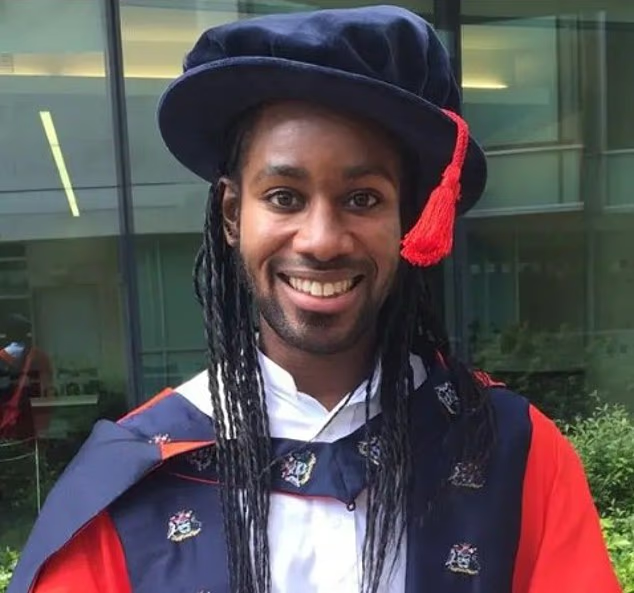
Politicians and academics have called the sudden death of former Cambridge professor Jason Arday a tragedy as Prime Minister Andy Burnham said there should be a ‘moment for reflection’.
And a Cambridge University colleague movingly revealed earlier that Mr Arday had told him ‘I just cannot go on’ hours before his death.
He was found unresponsive at his home in Battersea, south-west London, shortly after 3pm yesterday.
It came after a tumultuous few weeks in which fellow dons had questioned if the 41-year-old academic’s work was original.
It had also prompted an examination of his previous academic posts.
As questions mounted from academics, journalists and broadcasters, Mr Arday resigned from his prestigious role.
He had been Cambridge University’s youngest ever black professor, having been appointed a professor of sociology of education in March 2023.
But after a succession of questions about his past achievements, he quit on August 5.
Professor Jason Arday was found dead at his home in Battersea, south-west London. Police said a 41-year-old had been found and that ‘his death is being treated as unexpected, but not believed to be suspicious’
Cambridge University announced it had ‘begun an investigation following new information about Mr Arday’s academic qualifications and honorary appointments’. Jesus College, where he was a fellow, also launched an investigation.
Mr Burnham said on a visit to Cornwall today: ‘It’s a tragedy on so many levels but particularly for everybody who knew Jason, his family and his friends.
‘We think of them. It is not a moment for any rushing to judgment. It’s a moment for reflection on how things came to this – a really sad, sad and sorry state of affairs. Today we must think of Jason and his contribution and his family and friends.’
Shadow communities secretary Sir James Cleverly said: ‘The death of Jason Arday is tragic, and makes me so angry.
‘Even the most casual observer could see he was a vulnerable fantasist.
‘A number of people at a number of academic institutions have serious questions to answer. They put him into positions he was clearly not qualified for so they could have a black wunderkind to show off, they pushed him into the spotlight for their own benefit.
‘His exposure was inevitable, a case of when, not if.
‘His whole world fell apart.’
In a statement issued by his publisher Simon & Schuster UK, Mr Arday’s family said they were ‘in shock to have lost this amazing father, partner, brother, uncle and son’ but accused his critics of ‘abuse’ and a ‘campaign of misinformation’.
Others accused his critics of racism and said he would not have been subject to the same level of scrutiny if he was white.
Speaking to the BBC, Sir Simon Baron-Cohen, a professor of psychology and psychiatry, said Mr Arday had sent him a ‘last voice note’ with the poignant message on the morning of his death.
Professor Baron-Cohen, a Fellow of Trinity College, who directs the university’s Autism Research Centre and is a cousin of actor and comedian Sacha Baron Cohen, said Mr Arday ‘really was not coping’ since his resignation from Cambridge University just over a week ago after the university announced it would investigate allegations of plagiarism made against him.
‘He wasn’t coping with the loss of his career and his reputation.
‘He felt that he could not go on. He used those words in voice notes and WhatsApp messages to me yesterday morning,’ Professor Baron-Cohen, who said he was ‘still reeling from this awful news’, told Radio 4’s Today programme.
Mr Arday had denied allegations against him and said he was leaving the university because of the ‘toll on him of the relentless allegations’.
‘This is not the end of my work. It is just the end of this chapter. I need time to heal and to simply be myself again and when that time comes, I will return,’ he wrote in his resignation letter.
The allegations against him, which had been swirling for some time in the academic world, centred on whether he had copied chunks of his first major piece of research – his PhD – from another academic without properly crediting them.
Liverpool John Moores University, where he studied for his doctorate, originally investigated the plagiarism claims but said Mr Arday’s qualification still stood.
Nevertheless, passages of his PhD were published on social media by another academic last month alongside the ‘copied’ work, reigniting the debate.
This led to Mr Arday’s other academic work being re-examined along with his record in previous posts at Durham and Glasgow as well as his personal biographical details.
His appointment at just 37 in 2023 had been hailed as remarkable, not least because of his astonishing life story which was lauded by the academic community.
But the details of his life as an autistic man with learning difficulties who had developed academically late and had also undertaken incredible fundraising feats including running 30 marathons in 35 days started to unravel.
In recent days, former classmates have even challenged his claims in his memoir that he was non-verbal until he was 11.
However, paying tribute to Mr Arday, who he called ‘a vulnerable autistic man’, Professor Baron-Cohen said: ‘He was an incredibly kind and gentle, caring and generous man.’
But asked whether he should have been beyond scrutiny over the ‘veracity of what he had done’ because of potential vulnerabilities, Professor Baron-Cohen said he was ‘not saying that he should not be investigated’.
‘Jason believed that there was a racist playbook to discredit black academics at universities and accusations of plagiarism were used to try and bring down black academics,’ he said.
‘He believed that these racist attacks wouldn’t stop until he had lost his career and his reputation.’
He added: ‘What he was saying to me was “they’ve destroyed my life” – it’s not clear who they were but I think he was referring to the media.
‘The personal attacks on him have been so immense.’
Professor Baron-Cohen said he had been to Liverpool John Moores with Mr Arday when the accusations were investigated in February this year and ‘they concluded that the accusation was not proven but rather he had made honest and reasonable errors’.
And he accused former Cambridge professor Nathan Cofnas, who is currently at Ghent University in Belgium, of ‘re-opening’ the allegations by posting the passages from Mr Arday’s PhD online, accusing him of ‘using him as a lightning rod to examine the policy of DEI [Diversity, Equity and Inclusion]’.
He also appeared to criticise Cambridge for initially leaving the investigation to Liverpool John Moores, who had awarded Mr Arday his PhD, before announcing ‘just nine days ago that they would conduct their own investigation into the plagiarism accusation and into his appointment’.
He said the university’s decision had severely affected Mr Arday.
‘Poor Jason felt he had no choice but to resign and in the last ten days I have witnessed his mental health getting worse and worse.’
However, he insisted: ‘We need to let the investigation proceed and we need to understand how this tragedy has happened, but there has to be accountability at lots of levels.’
University of Cambridge vice-chancellor Professor Deborah Prentice said the faculty where he worked was ‘desperately saddened’ to learn of his death.
‘Our heartfelt sympathies go to Jason Arday’s family and friends at this incredibly difficult time,’ she said.
Education Secretary Lucy Powell said she was ‘deeply shocked and saddened’ and urged people to ‘remember there are real people with loved ones involved’.















































You must be logged in to post a comment Login