Labor prosecutors in Brazil filed a lawsuit Wednesday against meatpacking giant JBS, accusing the company of buying cattle from farms where workers were held in slavery-like conditions.
The civil action suit before a labor court in the northern Brazilian state of Para seeks nearly 119 million reais (about $24 million) in compensation, an amount prosecutors say reflects the total value of transactions between JBS and the suppliers.
According to the filing, 53 workers were rescued from properties owned by seven ranchers who supplied the meatpacking company between 2014 and 2025. Those employers were listed in Brazil’s official public registry of companies found to have subjected workers to conditions that are similar to slavery, prosecutors said.
JBS showed “a systematic pattern of negligence,” the prosecutors said. The company did not immediately respond to a request for comment.
Advertisement
Brazil is the world’s largest beef producer, accounting for about 20% of global production. The South American nation recently surpassed the United States, which now accounts for about 19% of the global beef production, according to the U.S. Department of Agriculture.
A statement from Brazil’s labor prosecutors noted that cattle ranching accounts for the highest number of rescued workers nationwide and has also been a major driver of deforestation in the Amazon. Para state is part of the Amazon region.
In March, the Office of the United States Trade Representative included Brazil on a list of 60 countries under investigation for forced labor.
JBS is the world’s largest meatpacking company, with a market capitalization of about $17 billion. It operates plants in the U.S., including in Colorado, where workers staged a three-week strike earlier this year.
Advertisement
___
The Associated Press’ climate and environmental coverage receives financial support from multiple private foundations. AP is solely responsible for all content. Find AP’s standards for working with philanthropies, a list of supporters and funded coverage areas at AP.org.
King Charles III and Queen Camilla are on a four-day trip through the United States
Husna Anjum Senior Live News Reporter and Somaiyah Hafeez
21:13, 29 Apr 2026Updated 21:23, 29 Apr 2026
King Charles III was seen happily shaking hands with Zohran Mamdani, despite the New York City Mayor having previously stated that he would urge the royal to return the Koh-i-noor diamond to India if they spoke.
Mamdani spoke at a press conference hours before the 9/11 ceremony saying: “If I were to speak to the King separately from that, I’d probably encourage him to return the Kohinoor diamond.”
Advertisement
The diamond, originating in the Kollur mine in present-day Andhra Pradesh, India, is set into a royal crown on display in the Tower of London. Seized by the East India Company after its victory in the Second Anglo-Sikh War of 1849, the gem was given to Queen Victoria and has remained part of the Crown Jewels ever since.
But countries including India, Pakistan, Iran, and Afghanistan have all claimed ownership, The Mirror reports. The Koh-i-noor diamond wasn’t used during King Charles III’s coronation, allowing Buckingham Palace to sidestep the controversy surrounding a gem acquired during the age of Empire.
King Charles III and Queen Camilla took part in the wreath-laying ceremony at the National 9/11 Memorial, where they met with first responders and the families of victims of the September 11 attacks. New York City Mayor Zohran Mamdani and other dignitaries also attended the ceremony, which comes ahead of the 25th anniversary of the attacks.
Mamdani and the King were captured shaking hands at the event sharing a friendly conversation. The royal couple’s swing through the city comes midway through a four-day trip marking 250 years of American independence.
It will be the first trip to New York by a reigning British monarch since Queen Elizabeth II visited in 2010. The four-day trip is Charles’ first state visit to the U.S. since he became king.
His mother, Queen Elizabeth II, made four state visits to the U.S. Monday, the king and queen joined President Donald Trump and first lady Melania Trump for tea at the White House.
On Tuesday, Charles and Trump had a closed-door meeting in the Oval Office. The king then delivered a rare speech before Congress, the first by a British monarch since his late mother in 1991, followed by a formal state dinner at the White House.
Advertisement
Want to see more of the stories you love from Belfast Live? Making us your preferred source on Google means you’ll get more of our exclusives… To add Belfast Live as a preferred source, simply click here.
Summer House star West Wilson’s cousin has been accused of fatally shooting their grandmother, according to police.
Gayle Wilson, 75, was reportedly killed in her Missouri home on April 22. West Wilson’s cousin, identified as 28-year-old Dakota Sweeney, was arrested and charged the next day with first-degree murder and armed criminal action, according to the Missouri State Highway Patrol.
A witness told investigators that Sweeney, who lived with his grandmother, opened fire after they argued about him “not assisting with chores” around the house, according to an affidavit reviewed by NBC News. The pair had been in a room together for half an hour when Sweeney shot her “without warning,” the document said.
The shooting occurred just a day before the Summer House cast filmed their reunion episode, NBC News reports.
Advertisement
It’s unclear if Sweeney has obtained an attorney. The Independent was unable to identify Sweeney’s attorney for comment.
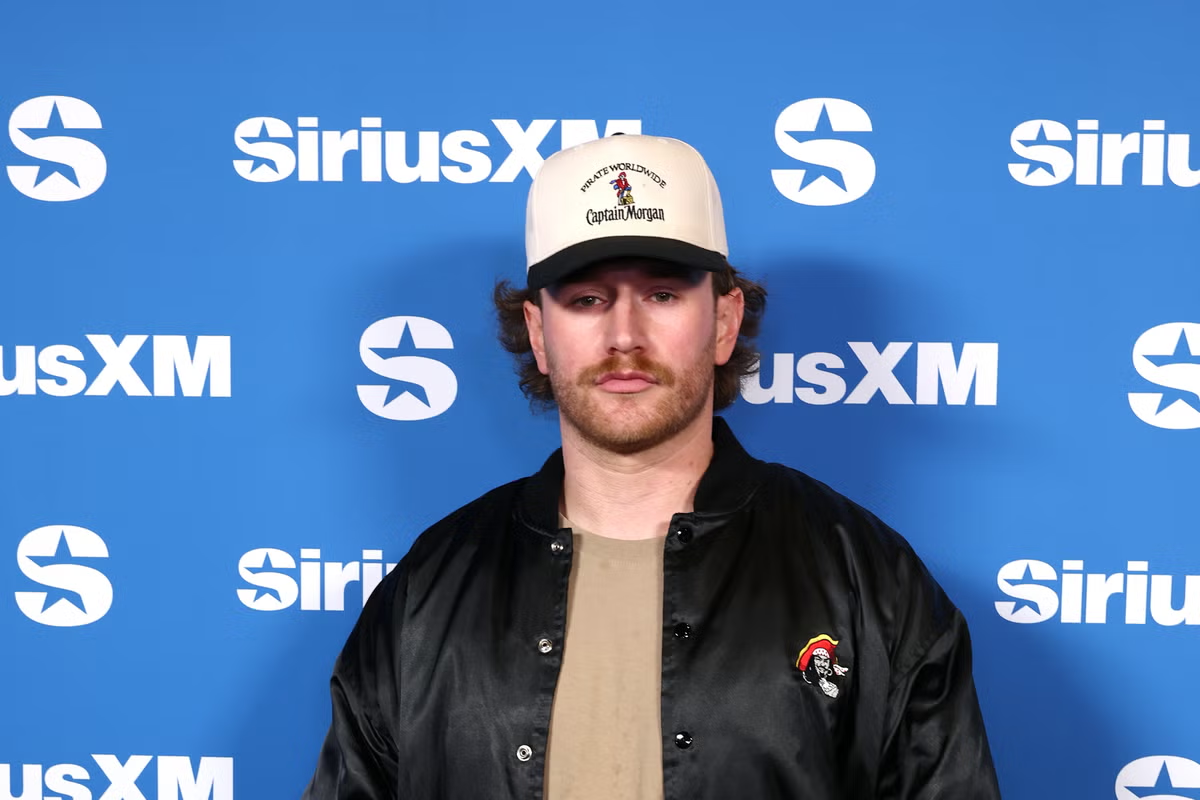
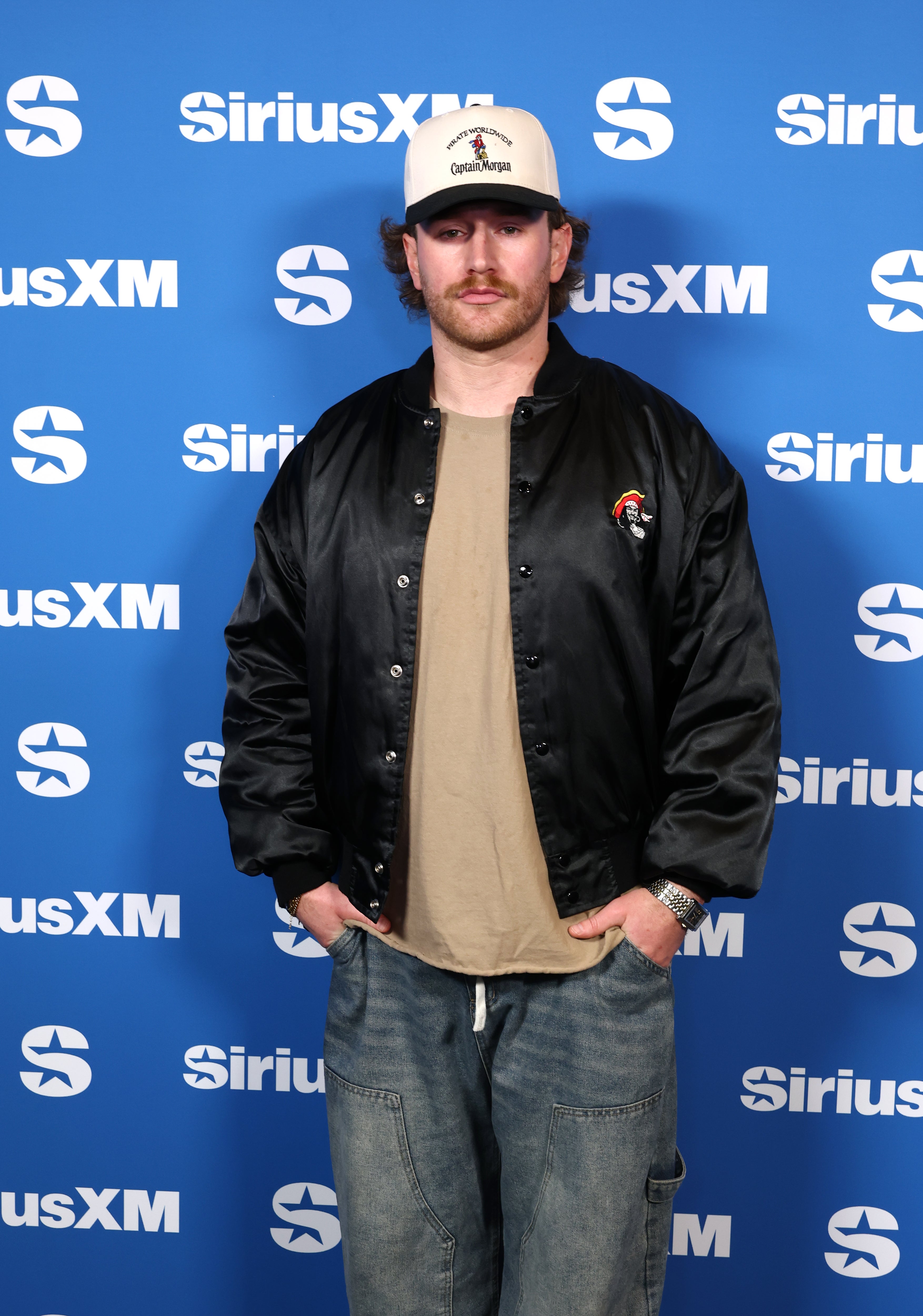
West Wilson stars in Bravo’s Summer House (Getty Images for SiriusXM)
West Wilson stars on Bravo’s Summer House, a reality TV show that follows a group who share a summer house in the Hamptons. He first joined the show during its eighth season. Summer House’s 10th and current season premiered in February.
In the season 10 reunion episode, cast members are reportedly expected to address a romantic scandal, dubbed “Scamanda” by fans, that involves West Wilson and his co-star, Amanda Batula. The episode is expected to air in late May.
The Independent requested comment from a spokesperson for Summer House.
The alleged shooting took place just a day before West Wilson and the cast of Summer House filmed the season 10 reunion episode (Getty Images)
Gayle Wilson’s life was “marked by creativity, kindness, and cherished moments,” according to an obituary posted by Lindley Funeral Homes. She loved to cook, travel and make art, the obituary said.
“Gayle expressed love through culinary delight, often seen bringing smiles with her heartfelt meals and baked treats. Her cooking was the essence of her love language, nourishing both the body and the spirit of those she cherished,” the obituary reads. “Gayle loved to travel, and recently completed her bucket list of traveling to all 50 states of this great nation.”
Advertisement
The Independent has contacted the Missouri State Highway Patrol and Caldwell County Sheriff’s Office for more information.
Research suggests that people who stop taking GLP-1 medications such as Ozempic, Wegovy and similar products are likely to regain the weight they lost within approximately 18 months. A study, which analysed existing research, also found that former users of the drugs put weight back on four times faster than those who had shed pounds through behavioural methods such as dieting and exercise.
Advertisement
Millions of people across the world use GLP-1 drugs to manage their weight. They function by reducing food cravings, slowing digestion and prolonging the feeling of fullness. However, a paper published in the British Medical Journal in January, which examined 37 previous studies involving 9,000 people, concluded that “cessation of weight management medications (WMMs) is followed by rapid weight regain and reversal of beneficial effects on cardiometabolic markers”.
It added: “Regain after [weight management medication] was faster than after [behavioural weight management programmes]. These findings suggest caution in short-term use of these drugs without a more comprehensive approach to weight management.”
GLP-1 drugs utilise active ingredients such as semaglutide, a medication originally developed to manage Type 2 diabetes that is now also prescribed to assist with weight management. Obesity is a chronic and recurring condition that affects nearly two billion adults across the globe and significantly raises the risk of illness and premature death. Researchers from the BMJ noted that weight loss “improves cardiovascular risk factors” and highlighted that a recent trial demonstrated “continuous use of semaglutide over four years reduced major cardiovascular disease events in individuals with existing cardiovascular disease”.
However, the researchers cautioned that the advantages of weight loss on diabetes and other cardiovascular risk factors were diminished by weight being regained once treatment had ceased. They went on to say: “We have shown that weight regain is faster (0.8 kg/month) and a return to baseline weight projected at 1.5 years after cessation of treatment, implying that the benefits on cardiovascular health will probably also attenuate more rapidly.”
Advertisement
They added that because “obesity is a chronic and relapsing condition, prolonged treatment with WMM may be required to sustain the health benefits” and concluded: “WMMs are associated with a reduction in weight and improvements in cardiometabolic health that are attenuated soon after treatment ends, with no evidence of benefit 1.7 years after the cessation of treatment. This evidence cautions against short-term use of WMMs, emphasises the need for further research into cost-effective strategies for long-term weight control, and reinforces the importance of primary prevention.”
The research encompassed studies using “any drug intervention that is currently or has previously been licensed for weight loss, or where there is reason to believe that the drug studied shares a class effect with a currently or previously licensed drug”. Among the various medications examined were semaglutide (used in Ozempic, Wegovy and others), tirzepatide (used in Mounjaro and others), liraglutide (used in Saxenda) and several others, reports the Mirror.
A separate study, published last month by researchers at the University of Cambridge, similarly found that “when individuals stopped taking the medication, they underwent rapid initial weight regain” and noted: “By 52 weeks, individuals had regained 60% of their original weight loss.”
Brajan Budini, a medical student at the School of Clinical Medicine and Trinity College, University of Cambridge, said: “Drugs such as Ozempic and Wegovy act like brakes on our appetite, making us feel full sooner, which means we eat less and therefore lose weight. When people stop taking them, they are essentially taking their foot off the brake, and this can lead to rapid weight regain.”
Advertisement
Researchers involved in the second study suggested that the reason some patients do not return to their original weight even a year after stopping the medications is that, by curbing appetite in the first instance, the drugs “may help individuals develop healthier eating habits, such as reduced portion sizes or more nutritionally-balanced meals, and these habits may persist even after treatment is discontinued”.
Steven Luo, also a medical student at the School of Clinical Medicine and Trinity College, said: “When stopping weight loss drugs, doctors and patients should be aware of the potential for weight regain and consider ways to mitigate this risk. It’s important that people are given advice on improving their diet and exercise, rather than relying solely on the drugs, as this may help them maintain good habits when they stop taking them.”
In response to the release of the BMJ report in January, pharmaceutical company Novo Nordisk, which makes Wegovy and Ozempic, told the BBC: “These findings highlight the chronic nature of obesity and suggest that ongoing treatment is necessary to maintain improvements in weight and overall health for patients, similar to the management of other chronic conditions such as diabetes or hypertension.”
The filing states prosecutors tracked purchases he’d made online using a fake name in the days after, including two chainsaws, an inflatable blue pool, a body bag and a shovel. They allege he also purchased a “burn cage” and made plans to incinerate evidence, the filing states.
The 136 local authorities holding elections in England comprise all 32 London boroughs; 48 district councils; 18 unitary authorities, including Hull, Milton Keynes, Portsmouth and Southampton; 32 Metropolitan boroughs, including Birmingham, Leeds, Manchester and Newcastle; and six county councils: East Sussex, Essex, Hampshire, Norfolk, Suffolk and West Sussex.
A lot of people remain unclear about what their home insurance really covers.
And if this applies to you, you might want to pay attention.
From sheds and plants to outdoor furniture, many assume these items are automatically protected, but coverage can actually vary significantly depending on the policy.
Advertisement
With that in mind, experts at Tesco Insurance have highlighted what is and isn’t covered by home insurance, and where homeowners could get caught out.
Alex Cross, Chief Customer Officer, said: “Gardens are often the heart of the home, especially during warmer months when people are spending more time and money on their outdoor spaces.
“Despite this, many people only check what their insurance covers after something has gone wrong.
“That’s why it’s important to understand what your home insurance policy covers upfront, to avoid unexpected costs later on.”
Advertisement
What home insurance may cover in my garden?
What is often covered in your garden with home insurance?
Fixed outdoor structures such as sheds and greenhouses, along with boundary walls, are usually covered by building insurance.
They are typically protected from damage caused by risks such as fire, flooding, or vandalism, although cover can vary between providers.
What is classed as ‘contents’ in your garden, and which items are covered?
Powered tools, including leaf blowers, trimmers and lawnmowers, as well as other tools and equipment stored in sheds or outbuildings, BBQs, bicycles and outdoor furniture, are often included under contents insurance.
Advertisement
These items may be covered against theft, fire, and damage, subject to policy limits. It’s important to check these limits before taking out a policy, as payouts can be capped.
Are plants in my garden covered?
Trees, shrubs, plants and lawns that you own and are within the boundary of your home may be covered under contents insurance, depending on the policy.
Cover may apply to loss or damage caused by specific risks, such as storm or flood, but is often limited.
Other damage caused by disease, theft or lack of maintenance is commonly excluded. Each provider will be different, so it’s important to check your policy details.
Advertisement
With car & home insurance timing matters far more than you’d think.
Where do gaps commonly occur in your garden with home insurance?
Although many risks can be covered if they occur, understanding gaps can help homeowners avoid unexpected costs and determine whether additional cover is needed.
Common exclusions can include theft of items left unsecured outside and damage caused by weather that doesn’t meet the insurer’s definition of a storm.
Advertisement
Fences are also commonly excluded from cover for storm or flood damage, while wear and tear or poor maintenance affecting outdoor structures and hedges may also not be covered.
Do you find home insurance useful? Let us know in the comments
The horror film is set to be removed from Netflix in a matter of days
Aaliyah Rugg Senior reporter
22:20, 29 Apr 2026Updated 22:20, 29 Apr 2026
A divisive horror film that continues to split opinion among fans is set to disappear from a streaming platform within days. Netflix subscribers have just over one week to catch Night Swim before it is permanently removed from the service.
The horror, starring Wyatt Russell and Kerry Condon, centres on a family as they renovate their swimming pool, which unbeknownst to them is haunted and possessed by a sinister force. An official Netflix synopsis teases: “Terror hides beneath the deceptively calm surface of a family’s swimming pool in this supernatural thriller from James Wan and Jason Blum (Insidious).”
Advertisement
Viewers may also recognise Amélie Hoeferle, Gavin Warren, Jodi Long, Nancy Lenehan, Eddie Martinez as well as Ben Sinclair. Night Swim is scheduled to be removed from the platform on Thursday, May 7. Having originally been released in 2024 on the big screen, it quickly made its way to streaming as audiences remain at odds over its content, reports the Mirror.
One viewer wrote on IMDb: “The reviews make this movie look like a disappointment, however, it’s par for the course for a horror movie. The acting is pretty good, the plot is very intriguing, and the only failure is the effects.
“The monster is not consistent, it looks different literally every time we see it, and the effects are Ghostbusters level, or maybe worse actually. Like, clearly animated. But otherwise it’s a pretty good movie and actually gave me the heebie jeebies once or twice.”
Advertisement
Another described it as “unfairly rated”, adding: “Not sure why many low ratings on this one. I am a horror movie critic and to me, this movie fit every requirements for it to be a good horror / supernatural movie.” They went on to say: “Without revealing spoilers, I’d say this movie is on par with Sinister.”
A third wrote: “I thoroughly enjoyed going to the theater for this movie. It’s an original premise. I’ve never heard of a scary movie about a pool before! This movie evokes all the childhood fearful feelings of swimming in a pool at night.”
However, one viewer countered: “This film was weird. It wasn’t good but not bad. The good thing is effort is definitely put into this film, but the output just isn’t there.”
Advertisement
Another remarked: “The film is terribly clichéd. Take any other horror film and compare it with this one and you won’t see any difference. Quite a good story with water, but when you see the monster you start laughing.”
A third observed: “This movie is 90min but like a never-ending 3-hour ordeal. It’s more of a family drama than a horror movie.”
With a 19% rating on Rotten Tomatoes, opinions remained split as one person wrote: “One of the most anticipated horrors of 2024 but failed big time. It didn’t even tackle how the pool become evil.”
Another concluded: “Everything I could have possibly wanted from a movie about a haunted pool. 5/5 stars. No notes.”
Advertisement
Night Swim is currently available to stream on Netflix
President Donald Trump has reportedly told his aides to prepare for a prolonged blockade of Iran, choosing sustained economic pressure over further strikes or withdrawal.
Oil prices rose on news there was no end in sight to blockade
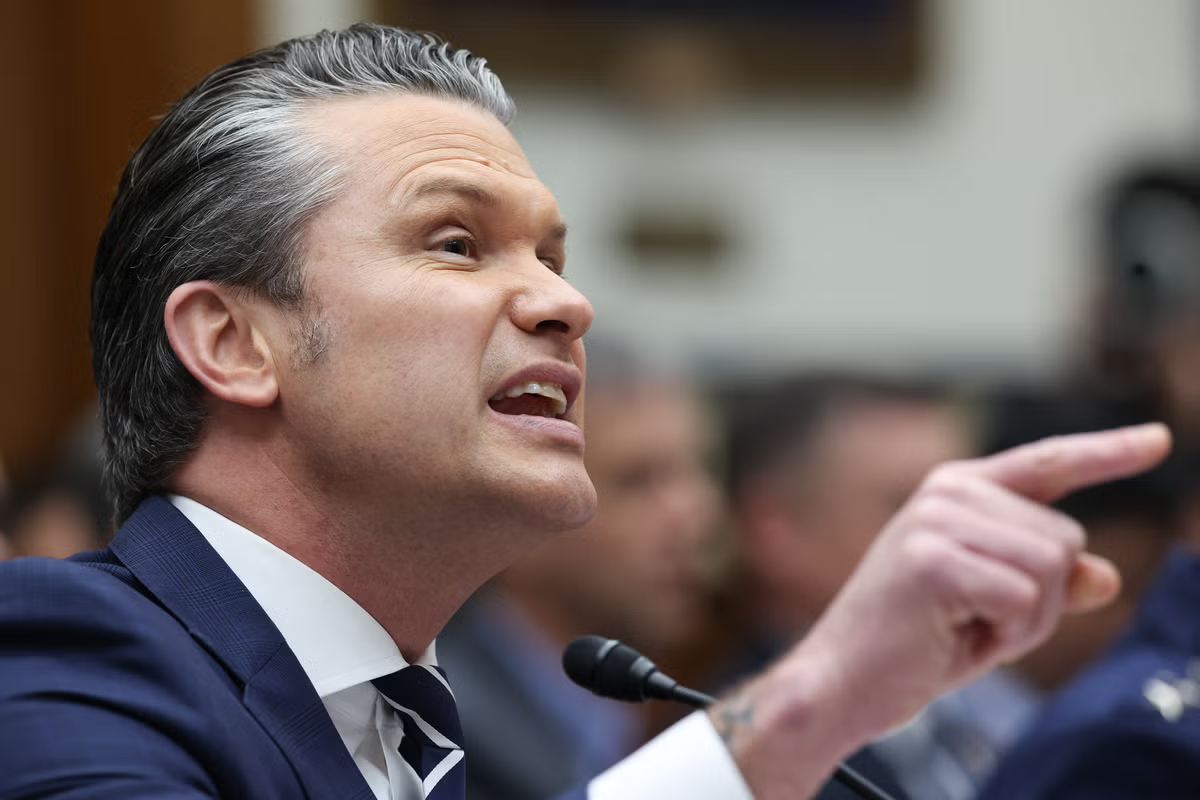
U.S. Defense Secretary Pete Hegseth testifies before Congress on war
Trump claimed Iran has informed the U.S. it was “in a State of Collapse”, though this has not been confirmed by Tehran.
A public spat between Donald Trump and German chancellor Friedrich Merz erupted after the latter said the U.S. was being “humiliated” by Iran
The United Arab Emirates has quit Opec after nearly 60 years, weakening the group and signaling a major shift in global oil politics and regional alliances.
Former US officials have criticized the lack of transparency over the deadly Minab school strike in Iran, calling the Pentagon’s silence “highly unusual”
Maroosha Muzaffar29 April 2026 05:45
Watch: Trump claims King Charles would have probably helped with military strikes against Iran
Trump claims King Charles would have probably helped with military strikes against Iran
Rachel Dobkin30 April 2026 00:52
Advertisement
Major revelation from Hegseth testimony was price tag of Iran war
One of the biggest revelations to emerge from Wednesday’s congressional hearing was that the war in Iran has so far cost an estimated $25 billion.
“Approximately, of this day, we’re spending about $25 billion on Operation Epic Fury,” Jules Hurst, a Pentagon budget official, told the hearing.
Most of that has been spent on munitions, he said.
(Reuters)
Rhian Lubin30 April 2026 00:00
Advertisement
ICYMI: Trump posts extraordinary picture holding assault rifle in new threat to Iran
President Donald Trump issued an astonishing new threat against Iran Wednesday, posting a mocked-up picture of himself brandishing an assault rifle with the strapline: “No more Mr Nice Guy!”
“Iran can’t get their act together,” the President wrote on Truth Social. “They don’t know how to sign a nonnuclear deal. They better get smart soon!”
The threat was accompanied by a meme of Trump, stood against a Middle Eastern backdrop of explosions devastating a hillside, wearing a dark suit and sunglasses and holding the heavy-duty firearm.
Advertisement
Donald Trump says Iran ‘better get their act together’ in latest bizarre post on Truth Social (@realDonaldTrump/Truth Social)
Rhian Lubin29 April 2026 22:45
Trump claims King Charles ‘probably would’ve helped’ US with Iran
President Donald Trump has claimed that King Charles “probably would have helped us” in Iran as he launched another attack on UK Prime Minister Keir Starmer and NATO.
Speaking during the King’s state visit, the president said the royal was a “phenomenal representative for his country” and suggested he would have differed in his approach to the conflict from the prime minister.
“The King loves his country, and he’s a great king, and he’s a great friend of mine. And I think if that it were up to him, he would have probably helped us with Iran,” Trump said.
Advertisement
Rhian Lubin29 April 2026 22:00
Pictured: Hegseth grilled by lawmakers for six 6
Defense Secretary Pete Hegseth was grilled by lawmakers for six hours, mostly about the war in Iran.
(Getty)
(Getty)
(Getty)
(Getty)
Rhian Lubin29 April 2026 21:15
Advertisement
Hearing is adjoured
The hearing is now adjourned after nearly six hours.
Rhian Lubin29 April 2026 20:54
Trump gives rambling answer on whether Ukraine or Iran war will end first
As Hegseth was testifying, Trump appeared to confuse the two countries as he turned an Oval Office meeting to honor the Artemis II lunar mission crew into a wide-ranging media session with reporters.
Advertisement
After four minutes of remarks to honor the NASA crew that traveled to the Moon for the first time since the Nixon administration, the president immediately launched into a question-and-answer session in which he told reporters a recent conversation with Russian president Vladimir Putin had focused on the Ukraine and Iran wars.
“I talked about Ukraine, and I talked a little bit about Iran. I talked about few different subjects, mostly about Ukraine, and we had a very good conversation. I think we’re going to come up with a solution relatively quickly,” he said Wednesday.
Rhian Lubin, Andrew Feinberg29 April 2026 20:37
Advertisement
Second Republican shares concern over Hegseth’s firing of top Army official
A second Republican questioned Pete Hegseth’s firing of Gen. Randy George, one of the top U.S. military officials.
Reps. Austin Scott of Georgia and Don Bacon of Nebraska both expressed their concern over George’s ousting.
“I do want you to know I disagree with the firing of General George,” Scott said. “I’ve sent you a letter. I hope you’ll look forward to seeing the responses on that.”
Rhian Lubin29 April 2026 20:05
Advertisement
Democrat quizzes Hegseth on gas prices: ‘You can’t answer this basic question’
Democratic Rep. Maggie Goodlander of New Hampshire asks Hegseth if he knows what the average price of gas was on February 28, at the start of the war, compared to now.
“Do you know what the average cost of a gallon of gas was in this country on February 28?” Goodlander asked.
“Well, it depends on where you live. If you live in California, it’s 8 bucks and 83 cents,” he replied.
Advertisement
“I gotta say, Mr. Hegseth, you said you’ve got a crack economic team that’s looking at the impacts of this war on the American taxpayer. And you can’t answer this basic question… that should shock the conscience of every American.”
Ant McPartlin and Declan Donnelly have broken their silence on the I’m A Celebrity South Africa finale chaos, promising to reveal full details about the walkouts, Adam Thomas’s win and the tensions with Jimmy Bullard in their upcoming podcast
22:05, 29 Apr 2026Updated 22:05, 29 Apr 2026
Ant McPartlin and Declan Donnelly have addressed the chaotic I’m a Celeb South Africa live final that descended into mayhem last Friday night.
In the teaser for their podcast Hanging Out with Ant and Dec, the pair made light of the pandemonium from the broadcast, with Ant quipping: “If you didn’t see it, I bet you read about it!
“It was quite the night!” Dec remarked, vowing to reveal the “ins and outs” of what unfolded. Ant responded: “It was a weird night of TV,” noting there were “walk-outs” during the show. Previewing the key talking points of their forthcoming podcast episode, the duo pledged to discuss Jimmy Bullard, with Dec saying: “The first question was to Jimmy about why did you call I’m a Celebrity, Get Me Out of Here.”
Advertisement
Ant interjected: “On the night I said I disagreed with him,” seemingly referring to Jimmy Bullard, with whom Ant publicly clashed when Jimmy pressed him to confirm that Adam had been aggressive during the programme.
Dec then suggested that somebody had a “bee in his bonnet” they were eager to air, though the clip didn’t make it entirely clear whom he meant, reports the Mirror.
Dec also disclosed that two of the All Stars had departed the group WhatsApp – Gemma Collins and Adam Thomas. Meanwhile, Ant teased he’d share an anecdote about bumping into Adam Thomas and Jimmy Bullard following the recording. While this trailer merely hinted at what’s in store, the full episode drops on Thursday – meaning fans won’t need to hang around long to catch all the latest behind-the-scenes gossip from the hosts who witnessed the drama unfold first-hand.
Advertisement
Fans were thrilled with the snippets of information shared by the hosts, with some claiming it was shaping up to be their “best podcast ever” and expressing eagerness for this “juicy watch”.
The final episode saw Adam Thomas crowned King of the Jungle, but witness clashes with David Haye and Jimmy throughout the concluding instalment, prompting both Sinitta and Gemma to storm out of the live recording.
Following the show’s conclusion, the actor has admitted he feels ‘dead inside and numb’ about the experience and insisted he won’t return to the programme even if offered ‘£10million’, claiming it’s ‘eaten away at his soul.’ Adam revealed he felt the colour ‘drain from his face’ when Ant and Dec declared him the winner, as his worst nightmare became reality.
Advertisement
Speaking on The Thomas Bro’s podcast with brothers Scott and Ryan Thomas, Adam said: “The most disturbing is that I look at David and even after the show and after everything he did, you know he sent me a voice note and was like ‘oh mate, what a great show that was. I’m so happy you won. Congratulations.’”
And he disclosed the blunt response he fired back to his former campmate. “I just sent him a message back just saying, you know, ‘I think this is where we draw the line and I hope that you find happiness, bro, but I’m done.’”
Bacteriophages, or phages, are viruses that infect and kill bacteria. These microscopic predators are found everywhere from soil and water to food and the human gut. Because they attack only specific bacteria, researchers are increasingly exploring them as tools for reducing harmful bacteria in humans and animals without disturbing helpful microbes.
That makes them especially interesting at a time of rising antimicrobial resistance. This is when bacteria evolve ways to survive drugs designed to kill them. It’s a global health threat driven in part by the overuse of antibiotics in medicine and agriculture. Unlike broad-spectrum antibiotics, which kill many different kinds of bacteria and can also disrupt helpful gut microbes, research has shown that phages may be able to remove harmful bacteria with less disruption to the wider microbiome.
This has led researchers to investigate phages both as nutraceuticals, dietary supplements intended to promote health, and as feed additives in livestock production. In both cases, the aim is similar: reduce harmful bacteria, support gut health and potentially cut reliance on antibiotics.
How phages work
Phages work very differently from antibiotics. Rather than killing a broad range of bacteria, each phage typically infects only particular bacterial species or closely related types of bacteria.
Advertisement
When a phage encounters its target bacterium, it attaches to the cell and injects its genetic instructions. The virus then replicates inside the bacterium until the cell bursts. This releases new phage particles that go on to infect other bacteria.
This precision is one reason phages are attracting attention as a possible way to fight harmful bacteria. Unlike broad-spectrum antibiotics, which can disrupt entire communities of microbes, phages may be able to remove particular harmful bacteria without the same wider effects on the microbiome, according to studies of phage-microbiome interactions and research on antibiotic-associated microbiome disruption.
That raises the possibility that phages could be used not simply to kill bacteria, but to shape communities of microbes in ways that support health. Researchers have explored their potential in food safety, agriculture and human health.
Advertisement
In recent years, researchers and biotechnology companies have begun exploring phages as dietary supplements for humans. The idea is that people could ingest phages to reduce harmful gut bacteria in the hope of restoring balance in the gut microbiome, the community of microbes that lives in the digestive system.
Early findings are encouraging, though still preliminary. For example, one human clinical study found that a commercially available phage product targeting E. coli reduced levels of the bacteria in the gut without causing major disruption to the rest of the microbiome.
Other work has examined phage products designed to support digestive health by targeting bacteria associated with digestive discomfort or dysbiosis, an imbalance in gut microbes. A randomised controlled trial of a phage-based supplement reported improvements in digestive symptoms among participants with mild digestive issues.
This is still an emerging field, and the evidence remains limited. But the results so far suggest phage-based nutraceuticals could eventually form part of diet-based approaches to improving gut health.
Advertisement
There are already signs of commercial interest. In the US, phage products have been approved for certain food safety uses, such as reducing bacterial contamination on foods. Phage-containing supplements are already on sale.
Public acceptance, however, may prove just as important as scientific progress. Because viruses are usually associated with disease, researchers and manufacturers will need to explain clearly why these “good viruses” are different. They occur naturally, they are highly specific and they target bacteria rather than human cells.
Improving animal health through feed additives
Phages may also have an important role to play in livestock production. Farm animals often carry disease-causing bacteria such as Salmonella, Campylobacter and harmful strains of E. coli. These bacteria can harm animal health and contaminate food products. They can contribute to food-borne illness in humans.
Phage-based feed additives are being developed to target these bacteria in livestock. By incorporating phages into feed or drinking water, farmers may be able to reduce harmful bacteria while preserving beneficial microbes that support digestion and the immune system.
Advertisement
Experimental studies have produced promising results. In poultry, phage supplementation has been shown to reduce the presence of Salmonella and Campylobacter, two of the most common causes of food-borne infection worldwide. Research in pigs has also found that phage treatments can reduce harmful E. coli infections, improving gut health and growth.
Phages are also being investigated as alternatives to antibiotic feed additives used to prevent diseases such as liver abscesses – pockets of infection in the liver – in cattle. Because phages replicate only when their target bacteria are present, their effects may naturally taper off once those bacteria are gone, making them a potentially useful way to control infection.
Despite promising research, bacteriophage supplements are not yet widely authorised as feed additives in the UK. Regulators require extensive evidence of safety, stability and effectiveness. Because phages are biological entities that can evolve alongside bacteria, agencies must also consider whether they remain genetically consistent over time and what effects they might have on other microbial communities in the environment.
Even so, regulatory progress is emerging elsewhere. Phage-based food safety products targeting disease-causing bacteria such as Listeria monocytogenes and Salmonella have already been approved in several countries. This includes the US, where they are already being used in food safety applications.
Advertisement
More recently, European regulators authorised the first bacteriophage-based feed additive designed to reduce Salmonella in poultry. That marks an important step towards broader adoption of the technology.
Interest in bacteriophages reflects a wider shift in how microbes are understood in relation to health. If research continues to advance, and regulation keeps pace, phage-based nutraceuticals and feed supplements could become part of a new generation of more targeted ways to shape the microbiome, supporting both human health and more sustainable agriculture.
Tiny though they are, these bacterial viruses may end up playing a significant role in how we manage harmful bacteria.














































You must be logged in to post a comment Login