Connect with us
DAPA Banner

NewsBeat

Cambridge cycle street faces backlash, but some say it will ‘make things better’

Published

on

Cambridgeshire Live

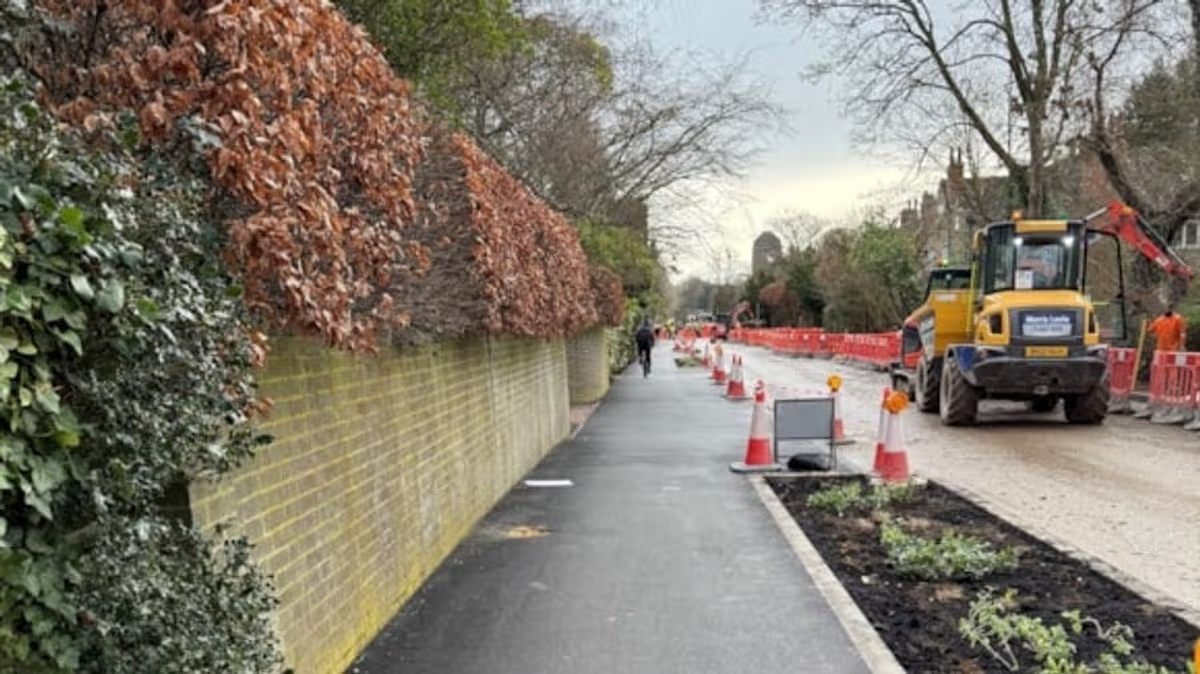
The Greater Cambridge Partnership has submitted plans to build the Comberton Greenway, which will connect the village to central Cambridge via England’s first cycle street

CambridgeshireLive readers have heard that plans have been submitted to build England’s first cycle street in Cambridge as part of the Comberton Greenway. The Greater Cambridge Partnership (GCP) has lodged a planning application to develop the route.

The GCP says the application marks a major milestone for the greenway. Project manager Jonathan Camp said the progress wouldn’t have been possible without local landowners and farmers, and that the final design reflects community input. Surfacing materials were chosen to keep a rural feel, and crossing points for tractors were included as requested.

Advertisement

Early work has already started on some sections, including Adams Road, which will be England’s first Cycle Street. Once finished, the greenway will run from Comberton into central Cambridge.

Planning consent is still needed for certain sections, though work is already underway on key areas. In Comberton, there will be new and improved crossings and lower speed limits. In Coton, street lighting, road surfacing, junctions, and traffic calming measures will be upgraded.

The route starts in Comberton, moves north along Long Road towards Coton, crosses the M11 bridge, goes through Cambridge University’s West Campus, and follows Adams Road, Grange Road, and Sidgwick Avenue before reaching Silver Street.

Commenter Calumen Nomen says: “As a local resident, I can assure Mr Camp that no one in the community wanted any part of this huge waste of time and money. I invite him to reconsider his position. If he won’t, I have a question: the GCP must know how many people currently cycle this route. If there isn’t a clear and sustained increase in a year, will he and his colleagues publicly apologise for the inconvenience and wasted public funds?”

Advertisement

Campete2 said: “It’s hardly a ‘huge amount’ compared to the billions thrown away on road schemes that make congestion worse, a tiny pittance has been set aside to actually make things better.”

Puppypower thinks: “It could all be very interesting to use but for the very unsafe part going over the M11, it’s very uneven and only just wide enough for one cycle so until you widen it it is next to useless.”

John037 complains: “An activity which generally creates little revenue for the city, is going to have an unspecified sum spent on it in order to make life more difficult for those who work, but do not live in the city and possibly not the county.”

Freddly believes: “Projects like this need to take space from car and van drivers who do not cover the real cost of using it. Traffic congestion costs the UK economy billions each year and that is money car and van users are effectively taking from households without a vehicle. Councillors cannot keep pandering to drivers while leaving pedestrians and cyclists to fight over scraps of space.”

Advertisement

Whynot2 retorts: “I can’t understand how you figure that car and van drivers are taking from households without cars. And you completely left lorries out of the equation!”

Campete2 points out: “The reality is that motorists are heavily subsidised, so people without cars end up paying for those who do. Meanwhile, billions are spent on road schemes that often make congestion worse, a far higher sum than what goes to active travel. Motorists benefit most from active travel projects because they help reduce congestion. Low Traffic Neighbourhoods really help ease congestion on nearby roads. Putting money into active travel gives way more bang for the buck than road schemes, which can actually hurt the economy. If we want people to be healthier and the economy to do better, active travel is the way to go.”

Sany P asks: “Why not fix all the potholes on Cambridge roads first? That would make things safer for both drivers and cyclists. The potholes have been there for ages and should be the priority. Building new roads instead of maintaining existing ones is a pointless waste of time, money, and safety. Cambridge City Council has really perfected that approach in recent years.”

Catherine S agrees: “This is a crazy idea. The obvious way into Cambridge from Comberton is through Barton, which already has a designated cycle route that’s recently been improved. Going via Long Road and Madingley Road is a roundabout route. It’s a total waste of money and would destroy land, especially on Long Road. They should be fixing the potholes instead, I had to dodge them just yesterday on my way home. A rethink is definitely needed.”

Advertisement

Do you think the Comberton Greenway will actually make cycling into Cambridge easier, or is it just going to be another expensive project causing disruption? Have your say in our comments section.


Source link

Continue Reading
Click to comment

You must be logged in to post a comment Login

Leave a Reply

NewsBeat

Iran was always going to close the Strait of Hormuz

Published

on

Iran was always going to close the Strait of Hormuz

This is the text from The Conversation UK’s World Affairs Briefing email. Sign up here to receive weekly analysis of the latest developments in international relations, direct to your inbox.


The five-day deadline to open the Strait of Hormuz handed to Iran by Donald Trump on Monday expires some time tomorrow and the Islamic Republic needs to “get serious before it is too late” – or so the US president has announced on his TruthSocial platform.

You’ll recall that this deadline replaced another deadline which was due to expire on Monday night, after which the US and Israel would obliterate Iran’s power plants and plunge the country into darkness. Happily Trump pulled back from this plan, reporting that talks were progressing very well, so he would extend the deadline until March 27.

For their part, Iranian officials denied that negotiations were even underway, while US officials said contacts were at a very early stage. This has prompted speculation that the US president was seizing even the most informal of contacts as an “off ramp” to save face over not following through with his threat.

Advertisement

Certainly Trump’s oft-repeated assurance that the war in Iran has been won and that Iran’s senior officials (whoever remains after Israel’s highly successful campaign of assassinations) are “begging” the US to make a deal looks a rather optimistic assessment from the US president.

Far from collapsing in a heap after the death of the former supreme leader, Ali Khamenei, the regime is showing its resilience. Its targeting of US installations in the region are hurting the Gulf states and there are signs that Israel’s Iron Dome is fracturing in parts under the volume of Iranian missile attacks (this reportedly also happened during the 12-day war last year). Conservative estimates are that the war is costing the US and Israel more than US$1 billion £740 million) a day.


TruthSocial

But it has been Iran’s ability to shut down traffic through the Strait of Hormuz that has arguably turned this into a world war, despite the unwillingness of many of America’s allies, particularly in Europe, to get involved. An estimated 20% of the world’s gas and oil transit the strait each day along with other vital supplies. Or at least it did before the end of February. Now very little is getting through and the consequences are being felt globally.

Advertisement

It’s not as if the US and Israel couldn’t anticipate that Iran would react to their attacks by closing down the strait. Arshin Adib-Moghaddam, an expert in Iranian history at the SOAS, University of London, walks us through nearly five decades in which Iran responded to every crisis by threatening to close the strait. Is is, he argues, a key plan in Iran’s security policy.


À lire aussi :
Iran has been threatening to close the Strait of Hormuz for years – it’s a key part of Tehran’s defence strategy


Meanwhile, it appears that the US is dusting off a 15-point peace plan it developed in May last year and which has already been rejected by Iran.

Critics say the chances of Iran acquiescing to the plan were negligible then and remain so now. It calls for Iran to give up all its uranium and agree to hand control of its civil nuclear programme to an outside panel. And, controversially, it seeks to control what Iran spends the money it gains if sanctions are relaxed.

Advertisement

This has prompted analysts to ask whether this plan was simply produced to give the US an explanation as to why it changed its mind over hitting Iran’s power plants. Bamo Nouri and Inderjeet Parmar, experts in international politics at City St George’s, University of London, think it the resurfacing of this plan is the strongest indication yet that Washington is beginning to fear that it has become embroiled in an unwinnable war.


À lire aussi :
‘Girl math’ may not be smart financial advice, but it could help women feel more empowered with money


Certainly this conflict has not gone the way Trump and his Israeli counterpart Benjamin Netanyahu might have wanted. But – as with the closure of the Strait of Hormuz, this should have been predictable. Jason Reifler, a political scientist at the University of Southampton, asserts that the US in particular, has embarked on this conflict with no clear goals or thought-through strategy.

Advertisement
Map of Straits of Hormuz

The Strait of Hormuz is one of the world’s most important waterways, with 20% of the global trade in oil flowing through a narrow maritime channel.
Wikimedia Commons

Failing to ask for authorisation via the United Nations (and for America, the the US congress) was a bad start, meaning the war had a legitimacy deficit from the word go. The reason for launching the conflict has veered from halting Iran’s nuclear programme to regime change and back again. And the strategy of assassinating Iran’s leadership has produced a rally-round-the-flag effect that few had anticipated.

Add to that the devastatingly effective use of drones by Iran (which the war planners in the US and Israel must surely have picked up on from the experience in Ukraine), means that the two countries are often forced to counter munitions worth US$20,000 with missiles worth millions of dollars. Meanwhile, the pain from Iran’s closure of the closing the strait will only get worse.


À lire aussi :
Iran war lacks strategy, goals, legitimacy and support – in the US and around the world


Holy war?

The US defense secretary, Pete Hegseth, held a religious service at the Pentagon yesterday, at which he called on god to “grant this task force clear and righteous targets for violence”. Hegseth appears to see this as a holy war in which he has clearly cast himself as a crusader, even sporting a tattoo reading, “Daus vult” (god wills it) – reportedly the rallying cry for the attempt to “liberate the Holy Land” in the 11th century.

Toby Matthiesen, senior lecturer in global religious studies at the University of Bristol observes here the way in which all parties to this conflict have used religion to garner support. Of course, claiming the approval of one’s chosen deity is a time-honoured tactic that even Nazi Germany tried. But it feels a little incongruous in the 21st century.

Advertisement
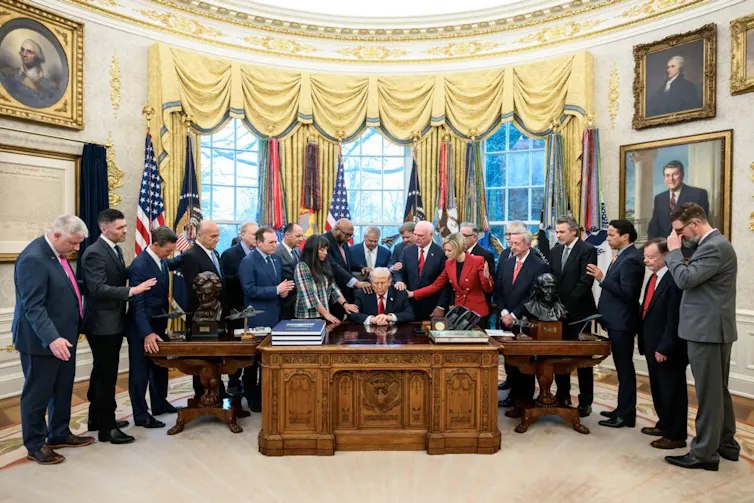
US president Donald Trump at the centre of a huddle of people who are touching him.
The US president, Donald Trump, receives the prayers of evangelical Christian ministers in the Oval Office, March 5.
Image courtesy of the White House.

You could be forgiven for thinking that the sight of Donald Trump in the middle of a prayer huddle in the Oval Office was an amusing oddity. But Benjamin Netanyahu’s reference to the Old Testament story of the Amalekites, whom god told the children of Israel to annihilate, “men and women, children and infants, cattle and sheep, camels and donkeys” is frankly chilling. Parts of the Islamic world has flocked to Iran’s defence (although not with particular enthusiasm in the Sunni countries of the Gulf, which Iran is bombarding with ballistic missiles).


À lire aussi :
God on their side: how the US, Israel and Iran are all using religion to garner support


Trang Chu and Tim Morris, meanwhile, believe that this conflict has been nearly five decades in the making. Just as Iran has always denied the right of Israel to exist as a Jewish state, many people in the US and Israel have long been committed to the destruction of Iran as a theocracy. Accordingly the way the two sides talk about each other has hardened over the years. Language on each side no longer reflects a criticism of their adversary’s behaviours, it has become a verdict on their moral character.

So to Iranians, the US is the “Great Satan”, while Iran is described in America as part of an “axis of evil”. Our experts believe that, this language “not only describes the enemy, but actively participates in creating it”. The observe that once you start to think these sorts of things about your adversaries, the idea of engaging in negotiation tends to become secondary to the desire to simply defeat or destroy them. Which is terribly dangerous, as we’re seeing.


À lire aussi :
How the words that Iran and America use about each other paved the way for conflict

Advertisement


Sign up to receive our weekly World Affairs Briefing newsletter from The Conversation UK. Every Thursday we’ll bring you expert analysis of the big stories in international relations.


Source link

Continue Reading

NewsBeat

East Kilbride school praised by inspectors following recent visit

Published

on

Daily Record

South Park Primary promotes and is guided by Respect, Equity, Ambition, Confidence and Happiness in all that it does after the values were chosen through consultation with everyone connected with the school.

An East Kilbride primary school and nursery that seek to help children to reach for the very best they can do has been recognised for that ethos by inspectors.

Advertisement

South Park Primary promotes and is guided by Respect, Equity, Ambition, Confidence and Happiness in all that it does after the values were chosen through consultation with everyone connected with the school.

When a team from HM Inspectors of Education visited the school, they picked out a range of positive attributes that stem from those core values, including the positive, caring, nurturing relationships between children and staff across the school; all teachers’ commitment to high-quality and ongoing professional development and the positive activities engaged in by the children to achieve success and contribute effectively to the school and local community, which develops their confidence and skills for learning, life and work.

Overall, the primary school was judged in the inspection report to be ‘very good’ in learning, teaching and assessment and ‘good’ in raising attainment and achievement; while the nursery was assessed as ‘very good’ in staff skills, knowledge, values and deployment; learning, teaching and assessment; and children’s progress, and ‘good’ in Nurturing, care and support.

Acting head teacher Yvonne Donaldson said: “We have high aspirations for all of our children and we do our best to challenge and support them in whatever way is needed to let each one flourish according to their own potential, and so it was wonderful to see that the results of this were clear for the inspectors to see.

Advertisement

“I was, of course, delighted that they remarked upon the work of the teachers such as their use of stimulating resources, the ways they enhance and support learning through digital technologies and their drive to continuously improve themselves, which in turn is reflected in the learning and teaching being highly effective.

“However, what was particularly uplifting was what the inspectors saw in the children.

READ MORE: SGN investing £1.3m to upgrade gas network in East Kilbride

“They commented specifically on politeness, manner and kindness, and on the way they lead developments across the school through pupil leadership groups and are involved in participatory budgeting, improvement planning and leading clubs.

Advertisement

“The primary school and nursery are proud of our friendly, inclusive nurturing ethos where all are valued and have a voice, and we make a point of working closely with our whole school community to provide high-quality, stimulating experiences that foster a love of learning, and so for the inspectors to recognise this is not only reassuring, but it also inspires us to build further upon it.”

*Don’t miss the latest headlines from around Lanarkshire. Sign up to our newsletters here.

And did you know Lanarkshire Live had its own app? Download yours for free here.

READ MORE: East Kilbride couple tell of sheltering in hotel during Middle East conflict

Source link

Advertisement
Continue Reading

NewsBeat

Cambs woman, 27, jailed after shoplifting spree

Published

on

Cambridgeshire Live

Her spree began in late February

A 27-year-old woman has admitted to a string of thefts in a Cambridgeshire city. Charlene Monks began her spree in late February 2026, by stealing from Asda, in Rivergate, Peterborough on three separate occasions.

Advertisement

On March 1, Monks, of no fixed address, entered the Co-op, in Waterhouse Way, Hampton Gardens, Peterborough, and went to the checkout to buy alcohol and cigarettes. However, before paying, Monks grabbed the items, now in a carrier bag, and ran out the shop.

Her final theft was at Sainsbury’s in Oxney Road, Parnwell, Peterborough, on March 2, and she was later arrested on March 19.

Monks admitted the thefts, together with two in Southend-on-Sea in Essex, at Cambridge Magistrates’ Court on Friday, March 20. She was jailed for a year after a suspended sentence imposed in January for shoplifting was activated. The court also ordered Monks to pay £1311.41 in compensation.

PC Sam Malton, who investigated, said: “Monks decided to continue offending after arriving in Peterborough, with no regard for the impact her actions would have on the businesses and their staff.

Advertisement

“I urge businesses to continue reporting offences to us, regardless of value, as it helps us to identify those involved and put them before the courts.”

Source link

Continue Reading

NewsBeat

Premium UK chocolate company collapses into administration

Published

on

Premium UK chocolate company collapses into administration

Marasu’s Petit Fours was founded back in 1986 by “master-patissiers” Rolf Kern and Gabi Kohler.

The aim of the business was to supply “London’s top hotels, restaurants and clubs with premium chocolates and petits fours”.

The company grew to become London’s largest producer of premium chocolates, with annual production of over 300 tonnes from its 25,000 sq foot facilities in Park Royal, according to business experts Odoo.

Advertisement

Marasu’s, which was acquired by Prestat Group Ltd in 2006, has provided chocolates to some big-name brands, including:

  • Selfridges
  • Harrods
  • Fortnum & Mason
  • Pret a Manger

Marasu’s Petit Fours at risk of closing as it enters administration

After 40 years, Marasu’s Petit Fours is now at risk of closing.

The premium chocolate company entered administration last month, according to Companies House, along with its parent company Prestat Ltd.

Alessandro Sidoli and Jessica Barker of Xeinadin Corporate Recovery Limited have been appointed joint administrators.

Marasu’s collapse follows a tough few years for chocolate manufacturers.

The Grocery Gazette explains: “Global cocoa prices surged to record highs in 2024 after disease and extreme weather hit crops in Ghana and Ivory Coast, which together account for around 60 per cent of global cocoa production.

“For premium chocolate manufacturers, sharply rising ingredient costs, combined with higher energy and operating expenses, have significantly squeezed margins even for established heritage brands.”

Advertisement

What happens when a company goes into administration?

Put simply, when a company enters administration, it means that it is unable to pay expenses, debts, or other liabilities, according to SquareUp.com.

Companies House adds: “When a company goes into administration, they have entered a legal process (under the Insolvency Act 1986) with the aim of achieving one of the statutory objectives of an administration. This may be to rescue a viable business that is insolvent due to cashflow problems.

“An appointment of an administrator (a licensed insolvency practitioner) will be made by directors, a creditor or the court to fulfil the administration process.”


A statutory moratorium is put in place once a company enters administration, giving it “breathing space” to allow for financial restructuring plans to be drawn up free from creditor enforcement actions.

Advertisement

A company can continue to trade while in administration, but daily management and control is handed over to the administrators.

Companies House continues: “Within 8 weeks it is the administrators’ role to formulate administration proposals.

“Creditors are then asked to vote by a decision procedure to approve the administrators’ proposals.

“If the administration involves a sale of all or part of the company’s business, the proceeds (after the costs of the procedure) will be distributed to creditors in a statutory order of priority.”

Advertisement

Administration will end automatically after 12 months unless the administrator asks the court or creditors for an extension.



Through administration, a company can be:

  • Rescued and passed back to the directors
  • Enter liquidation
  • Be dissolved

Other UK companies that have closed or entered administration/liquidation in 2026 (so far)

It has been a rough start to 2026 for the UK high street, with several retailers entering administration and others announcing widespread store closures.

Major high street retailers, including River Island, Primark, and Poundland, have already been forced to close stores in 2026, while Revolution and BrewDog have shut the doors to 21 and 38 pubs, respectively.

Advertisement


Several other retailers have fallen into administration recently, including:

Meanwhile, four UK travel companies have closed in the opening weeks of 2026:

EcoJet Airlines, billed as “the world’s first Electric Airline”, has also entered liquidation after just three years, resulting in the cancellation of all planned flights.

Advertisement

UK delivery company Yodel is set to be phased out over the coming months after being acquired by InPost.

Tesco also recently revealed plans to cut 380 jobs in stores across the UK, while it’s been reported that Morrisons is looking to sell some of its in-store pharmacies as it continues to cut costs.

It’s not been all bad news for the UK high street, with several major brands announcing new store openings for 2026, including Aldi, M&S, and Superdrug.

Advertisement

Have you tried Marasu’s Petit Fours chocolates before? Let us know in the poll above or in the comments below.

Source link

Advertisement
Continue Reading

NewsBeat

Will Wales’ World Cup play-off go to extra time and penalties or semi-final second leg?

Published

on

Wales Online
Will Wales’ World Cup play-off go to extra time and penalties or semi-final second leg? | Wales Online