






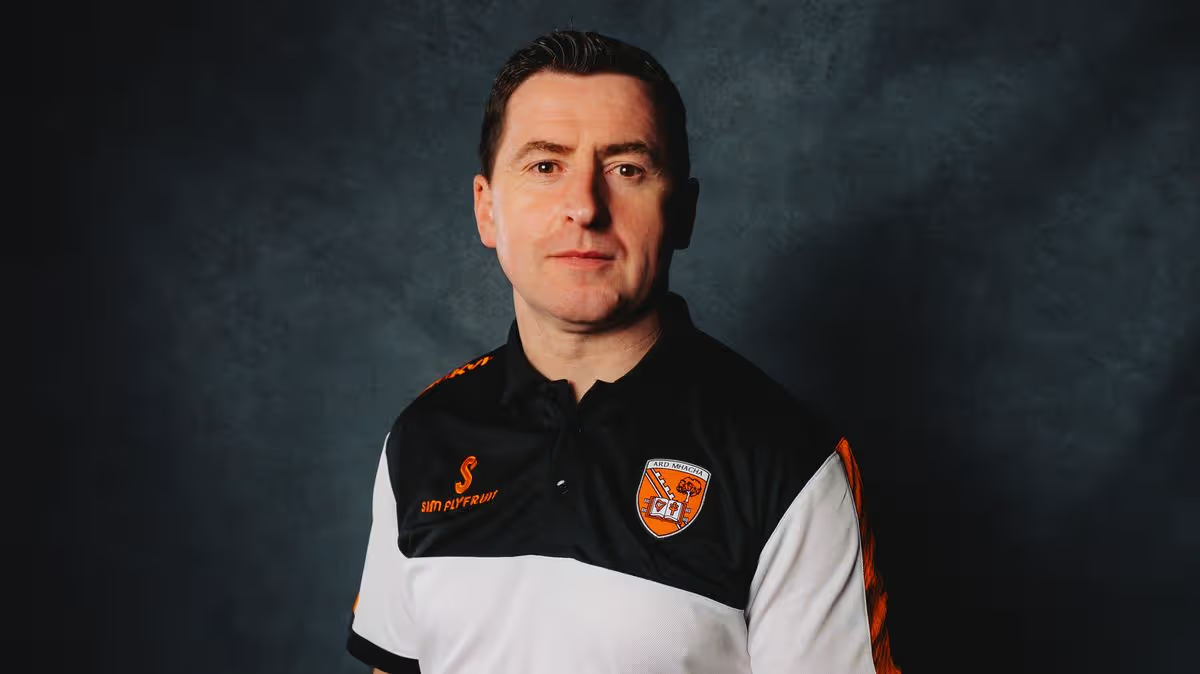
Tyrone failed to challenge for promotion from Division Two this season, but Conleith Gilligan knows they are always capable of raising a gallop against their Ulster rivals
Ulster SFC preliminary round: Armagh v Tyrone (Sunday, 4.15pm, Box-It Athletic Grounds, live on RTE2 and BBC)
“It is still Tyrone.”
Conleith Gilligan isn’t buying the narrative that Tyrone are up against it when it comes to Sunday’s Ulster SFC preliminary round clash with Armagh at the Box-It Athletic Grounds.
One of Ballinderry’s most famous sons, his home parish crosses into County Tyrone.
While he is acutely aware that the Red Hands have endured a lacklustre League campaign, he is fearful of a potential backlash from a team that gave Armagh their fill in the provincial semi-final last season.
When it was put to Gilligan at the recent Ulster SFC launch event that Tyrone are dangerous opposition when their backs are against the wall, he concurred: “Massively. Tyrone’s League campaign was very similar to our own, you’d (Niall) Morgan, (Darren) McCurry, (Michael) McKernan and Darragh Canavan missing a few games.
“They were the same and trying to get up with new and untested players. Similar points, they’d be disappointed in some of the games they lost that they might have won.
“It makes it very dangerous – it’s still Tyrone, it’s still a derby game and the winning and losing of it is massive.
“You’re in the preliminary round, earlier than you’d have wanted to be out but that’s where we’re at. It’s a huge game for both teams in terms of kick-starting their summer.”
Despite the fact that Armagh are 2/5 favourites to progress to a quarter-final meeting with Fermanagh, Gilligan stressed keeping the players grounded wasn’t an issue.
“I don’t think so, I think players are cute enough now to know and the proximity of Armagh to Tyrone… even our younger players would have looked at their younger players winning Hogan Cups and All-Ireland U20s, so there’s no illusion with the younger players as to the quality Tyrone have,” added Gilligan.
“The older players, they’ve been through the mill before and been stung in big games before where they were supposed to be favourites.
“Last year’s Kerry game was the prime example, where the expectation was that Kerry wouldn’t beat Armagh, and look how that turned out.
“The fact that the League is done now, every team’s looking for that one big win to ignite their summer. From a Tyrone perspective, going to Armagh to do that would be high on their list of priorities.”
Armagh’s head-to-head win over Tyrone sent the Red Hands down last season alongside Derry with the duo failing to gain promotion from Division Two this term.
Kieran McGeeney’s side claimed five points in Division One this year – two less than Tyrone in 2025, but stayed in the top flight.
Although Armagh were in Division Two in 2024 when they won the All-Ireland later that summer, Gilligan feels retaining their Division One status was hugely important.
“It was very, very important to stay up,” said Gilligan.
“It’s not the end of the world if you don’t but if you go into Division Two and something happens, you lose players through injuries, you get a couple of bad results and all of a sudden Sam Maguire and Tailteann Cup becomes a question midway through the league.
“At least when you’re in Division One, if you have a bad start there’s a bit of protection in that.
For ourselves, a lot of those players playing those games, you learn an awful lot even from the ones you lose. Even that day in Mayo, we’d some very good performances. The Dublin game, Tomás McCormack came in and was excellent. That’s where the learning happens, he plays the Kerry game in a very similar vein. For younger players, it’s way more important than for the experienced players because you’re just getting way more exposure to better teams and bigger games and crowds, and it gives you slightly better preparation ahead of the Championship.”
Armagh are hoping to have close to a full strength panel to select from with Gilligan reporting that Joe McElroy, Andrew Murnin and Barry McCambridge are “close” to full fitness.
Meanwhile, Gilligan says he doesn’t understand why the hooter rule was changed for the 2026 season, arguing that there was little wrong with the ruling as it was last year.
Seemingly in response to a passage of play at the end of the first half of last year’s All-Ireland final when David Clifford kicked a two-pointer after a prolonged spell of possession for Kerry, the half now ends when the hooter sounds.
However, further issues have arisen, especially in the wake of the League finals.
Meath’s James Conlon cynically dragged down Cork’s Maurice Shanley to stop the rebels launching one last attack in the Division Two final.
In the Division Three decider, Down held possession for over three minutes before trying to engineer a winner over Wexford in normal time.
Gilligan said he is in favour of the hooter being used in some guise, but prefers last year’s version.
“I think the fact it’s definitive is good from the point of view of previously the referee might have had two minutes go up on the board but finds another three, so you don’t really know what you have to do,” stated Gilligan.
“I like that it’s definitive but I still think the way it was previously was better, last year – the final play.
“I still think the hooter is better than not knowing but I don’t see why they wanted to change that.
“Scoring on the buzzer or after the hooter brought great excitement and you could tell what every team was trying to do.
I thought it was good, I don’t understand why they thought changing that rule would add to the game at all, because it didn’t and doesn’t.
“Meath and Cork was probably proof that it’s not a good way when the game was as tight as it is there.”
Want to see more of the stories you love from Belfast Live? Making us your preferred source on Google means you’ll get more of our exclusives, top stories and must-read content straight away. To add Belfast Live as a preferred source, simply click here.
















































You must be logged in to post a comment Login