











A private maternity industry is taking advantage of anxious mothers facing the biggest change of their lives.
An investigation has exposed a regulatory vacuum in the private maternity sector, where experts with as little as three days of training are making life-and-death decisions.
From doulas fatally ‘interfering’ with labour, to money-hungry high-street scan clinics failing to spot severe abnormalities, the cost of this profit-driven industry is being paid in infant lives and shattered families.
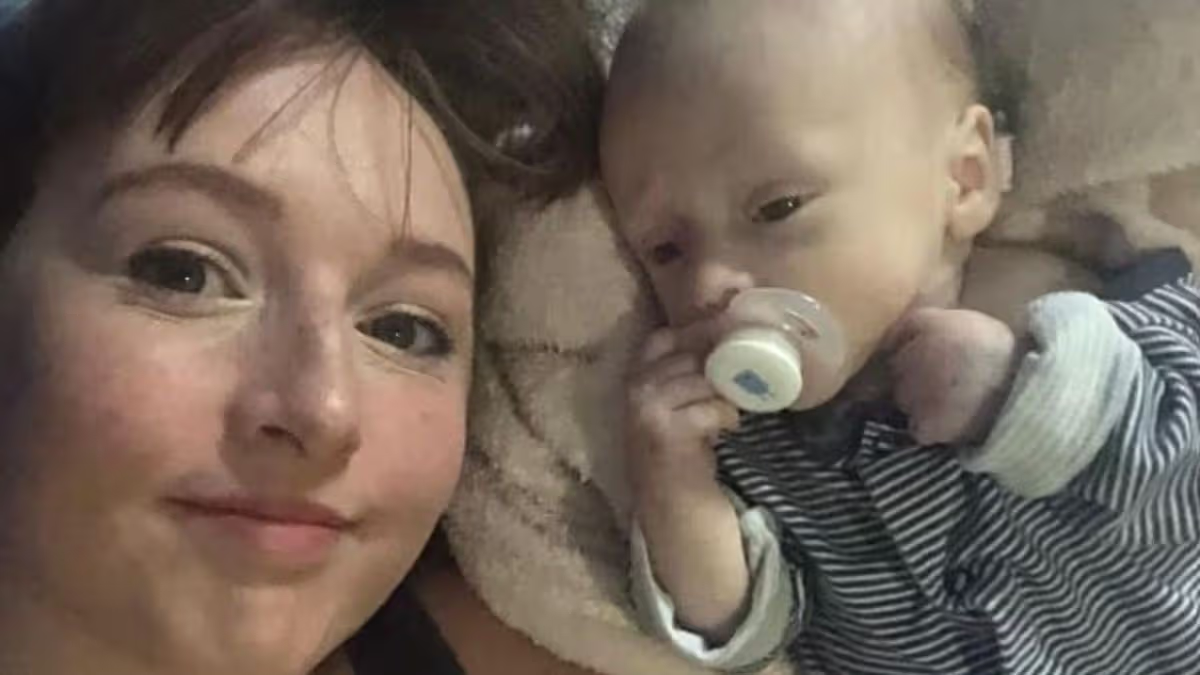
Charlotte Tolley, 36, is a single mum-of-three, one of whom, Lucas, five, requires intense amounts of care. The tot was born with his brain missing – which the private clinic that Charlotte used during her pregnancy didn’t notice.
Currently, anyone with an ultrasound machine can use that title, prompting Charlotte to campaign for change. She is urging other families to not rely on private scans, and for sonography to become a regulated industry.
Charlotte opted for private scans after suffering a miscarriage. At her first NHS appointment, she found herself in the same room where she’d lost her last baby. After discussing options with her midwife, she opted for a private clinic, where they found Lucas to be healthy, even though the abnormality was clearly visible on ultrasound.
Charlotte said: “Everything was quite standard and normal. I specifically asked the sonographer, ‘Can you see anything wrong? Would you be able to see if there’s any abnormalities?’” After he was born, Charlotte knew something was wrong, and the pandemic had begun, so in-person services were becoming less easily accessible.
Lucas struggled to feed, or focus, and suffered from jaundice. After he continued to struggle, Charlotte listened to her “mum gut” and called an ambulance.
She told the Mirror: “Had I not already been a mum of two children, I don’t think Lucas would be here now to be honest with you. He was chronically dehydrated, he was yellow, he had mottled skin, his head was bigger than his body, he looked like an alien where he’d not been able to gain any weight.
“He was constantly in and out of consciousness where he could barely stay awake because he had no energy to him.”
A hospital doctor conducted a cranial ultrasound which sparked panic. Charlotte said: “He dropped the ultrasound machine… and went off. He got on the phone… came back to me and said: ‘Your son has half of his brain missing’.”
Charlotte questioned how could her baby be alive without an entire brain while Lucas was rushed for an urgent MRI which confirmed the news. Charlotte added: “It was so obvious, you know, I’ve never seen an MRI of a brain before in my life, but even I could tell that it wasn’t right.”
Further tests were undertaken on the little boy, only weeks old, including hormone profiling that required bloods to be taken every three hours but his brain didn’t develop. Charlotte said: “He’s completely blind, he’s got cerebral palsy, epilepsy, he can’t chew or eat. I was told at the time, he would never walk, talk, eat, smile, do anything.”
Charlotte met with a solicitor and radiography and ultrasound experts who looked at the scans the private clinic had provided her and confirmed that “undoubtedly you can see there’s a problem.”
“Either he wasn’t qualified enough or he was told not to say anything,” Charlotte said, citing reports by the BBC that indicate some technicians at private clinics were told not to disclose certain information to their clients. She reached an out-of-court settlement with the clinic that was responsible for her failed scans.
If the abnormality had been reported to her, she should have been immediately sent back to the NHS and provided with a pregnancy-safe MRI, giving her the choice of whether to continue with the pregnancy or not.
Charlotte said: “I would definitely have had to terminate the pregnancy because I had two other children, I was a single parent that just left a marriage, and my eldest daughter is autistic as well.”
The progress her son Lucas has made is astounding compared to the “bleak” prognosis he was given as a baby. He walks, uses his cane, and only sometimes uses a wheelchair but still needs intense round-the-clock care.
Charlotte said: “I sometimes almost wish that I could outlive my own son because I’m worried for the future that he will have if he’s left on his own without any support. I do everything for him, and I always will have to even as he gets older, and no parent should ever have to feel like that.”
Charlotte feels strongly about some of these clinics that are cropping up across the UK. She said: “I think these other clinics should be avoided altogether. [Some] are money hungry vultures… they don’t care about the people walking through their doors… they just want to build a franchise, build a name and earn money and that’s it.”
Charlotte wants to make sonography a regulated profession and has started a petition to try and enforce greater transparency in this area.
Amy Heath, Medical Negligence Partner at the law firm, Stewarts who acted for Charlotte warns that her client’s “example is an extreme one, but it’s a good one to show how wrong it can go.” Amy explains that the NHS – for the most part – “mops up” the errors of these private clinics which are “money making enterprises”.
And it’s not just babies at risk, but mothers, too. Ectopic pregnancies occur when a fertilised egg implants outside the uterus, most commonly in a fallopian tube, making it a life-threatening, non-viable pregnancy.
Experts have also warned about the use of unregulated birthing assistants. In January, a coroner warned that more babies could die without greater clarity and guidance over the role of home birthing assistants, after the death of a 15-day-old baby girl.
Newborn Matilda Pomfret-Thomas died of a brain injury in November 2023, which was caused by a lack of oxygen to the brain either before or during birth. Her mother had experienced a difficult home labour and was not immediately transferred to hospital – despite signs of foetal distress, an inquest concluded.
Hampshire assistant coroner Henry Charles noted that midwives from Portsmouth’s Queen Alexandra hospital felt their access “was being restricted by the doula” when the child’s mother went into labour on 29 October 2023.
A midwife who attended the home birth first offered a transfer to hospital at 7.19am when meconium – a sign of foetal stress – was discovered, the coroner said. The offer was turned down, and again at 10am despite “deteriorating” labour as it was “not communicated [to the family] in such a way as to lead to a transfer to hospital”.
Charles said: “The presence and work of a doula did on this occasion negatively impact upon the effective provision of midwifery services in terms of building a rapport conducive to effective advice and care being given.
“I found that [the doula] did not actively discourage midwife access but that she was seen as, in effect, a buffer by members of the midwifery team. The doula was following the birth plan. The doula was supporting the parents per the birth plan, and this appears to have been perceived as grounds for hope that a home birth was still possible.” The coroner has called for a review and regulation on doulas and the training they receive.
In 2023, The Maternity and Newborn Safety Investigations (MNSI) warned that doulas were involved in 29 of the 2,827 maternity investigations it had completed. It said it “found evidence in 12 of the 29 investigations that doulas worked outside of the defined boundaries of their role. The care or advice provided by the doula was considered to have potentially had an influence on the poor outcome for the baby”.
Doula UK pushed back on the idea of regulating the profession to the Mirror, saying in part: “Doula UK members undertake approved training, mentored practice and ongoing professional development, guided by a shared code of conduct. We would therefore recommend parents find a Doula UK registered member.”
Women searching for extra support during one of the most challenging periods of their lives goes beyond pregnancy and labour itself, with unregulated and unqualified “night nurses” also posing a major risk to infants.
An inquest last week heard that a four-month-old baby, the grandson of football manager Steve Bruce, tragically died after being placed in an “unsafe sleeping position” by an unregulated maternity nurse. The parents of Madison Bruce Smith had employed Eva Clements via Ruthie Maternity Services believing she was fully trained, skilled and vetted, and that the firm was well established. In fact, neither was regulated Stockport Coroner’s Court heard.
The inquest was told that Madison’s parents would “never have dreamed” of putting their son asleep in the prone position had it not been for the advice of the maternity nurse, who was said to have informed them all four of her own babies had slept on their stomachs with no problems. Such advice is contrary to recognised safe sleeping guidance from the NHS and health professionals for young babies.
It has since been confirmed that Ruth Asare, head of Ruthie Maternity Services, had no medical qualifications and had only a first aid certificate and a Level 2 diploma in post-natal care, which she gained from a three-day course and a six-month coursework project. Clements said she had a degree in early years education but admitted she also had no medical qualifications.
The case led the senior coroner for south Manchester, Alison Mutch, to issue a prevention of future deaths report to the Secretary of State for Health calling for regulation.
An NCT spokesperson told the Mirror: “Understanding what makes a place safe to sleep is key. The safest place for a baby to sleep is in the same room as their caregiver. This should be for at least the first six months, both day and night. A separate sleep space is considered safest, with the baby on their back on a firm, flat and clear surface.
“Sleeping on their side or front increases the risk of SIDS, so put the baby on their back to sleep as a routine from day one. Once they can move themselves from their back to their front and back again by themselves, there is no need to worry but you can carry on placing them on their back to sleep when putting them in their sleeping space.”
Kate Marsh, midwifery manager for Tommy’s, the pregnancy and baby charity, told the Mirror: “Our hearts go out to the families of Madison and Matilda, whose lives have been devastated by their loss.”
Not every mum who spoke to the Mirror had negative impressions of the private maternity industry but almost all described a sense of anxiety, and a lack of support as their motivation for seeking out these supplementary services.
Nutritionist therapist Hanieh Vidmar opted for private care, citing long waiting times within the NHS, and concerns about overstretched resources
She said: “I think there needs to be more support and education for first time mums when giving birth. They opt in for things like doulas and night nurses thinking they absolutely need one and when they don’t know what they are looking for, and should look for, [it] can cause serious issues. I think that’s the issue.”
A Department of Health and Social Care spokesperson said: “Every parent deserves safe, high-quality maternity care. That is why we are changing the law so that anyone who falsely uses the title of nurse without being properly registered will be committing a criminal offence.
“We’re taking urgent action to rebuild confidence in NHS maternity services – hiring more midwives, introducing new standards to tackle the leading causes of maternal mortality, launching an anti-discrimination programme, and creating systems to identify safety concerns earlier.
“The Secretary of State is also personally chairing a new Taskforce to deliver rapid improvements in maternity and neonatal services, acting on the recommendations from Baroness Amos’ independent national investigation.”
For support after baby loss, please contact Sands’ national helpline on 0808 164 3332 or email helpline@sands.org.uk
Sign Charlotte’s petition to make sonography a regulated profession in the UK here.
Get more Daily Record exclusives by signing up for free to Google’s preferred sources. Click HERE.














































You must be logged in to post a comment Login