This article contains affiliate links, we will receive a commission on any sales we generate from it. Learn more
Advertisement
Lily Allen’s latest tour in support of her West End Girl album is the hottest ticket in the UK at the moment and is coming to Wales next week.
The Cardiff date is on March 18 at the New Theatre and while it sold out months ago, there is still a way to get tickets for the first of two shows the Madeline singer is performing in Wales in 2026.
Allen, whose West End Girl album hit the top of the charts when it was released in October last year and was written following her split from husband, David Harbour, is also playing at the city’s Utilita Arena on Wednesday, June 24. From superstar gigs to cosy pubs, find out What’s On in Wales by signing up to our newsletter here.
Tickets for the New Theatre show on March 18 sold out a while back but there are still options on resale sites like viagogo and Twickets.
Advertisement
So far there is a pair of tickets on sale at viagogo for £221 each.Twickets have none for sale at time of writing but it’s worth checking as the gig gets nearer.
There are cheaper tickets for resale for the Utilita Arena gig on June 24, though. Ticketmaster have them starting at £172 each, here.
Official retailers Ticketmaster and Seat Unique may still have tickets leftover for the UK tour as a whole, too. While the former sold out shortly after their release, the latter still has some VIP and hospitality tickets left over.
If you’ve ever struggled with your sleep (and every week, about 6-10% of us do), chances are you’ve heard of melatonin supplements.
Popular in the US, where, unlike in the UK, melatonin can be sold over the counter, the supplement is said to make you fall asleep faster, increase your quality of sleep, and help you sleep longer.
But what actually is melatonin? How does it work, and does it really help with sleep?
Some research has shown that our Circadian rhythm might matter more than sleep duration when it comes to feeling rested, while other research has suggested that the body clocks of people with insomnia work differently from those without it.
It takes about one to two hours to act, the NHS said.
Does melatonin supplementation actually help sleep?
Advertisement
There is some evidence to suggest that appropriate doses of melatonin supplementation can help people to fall and stay asleep, especially those with insomnia and people with a delayed sleep phase.
It can also be useful in keeping the circadian rhythms of blind people in check.
It’s usually only recommended for short-term use. In the UK, if it’s prescribed, it’s most likely to be for one to four weeks; in some cases, it can be as long as 13 weeks.
Still, “Our body likely produces enough melatonin for its general needs,” The Mayo Clinic added.
Advertisement
Why isn’t melatonin available over the counter in the UK?
Melatonin was once available over the counter in the UK, but since 1995, it’s been reclassified. Formerly treated as a supplement, it’s now regarded as a medicine.
That means only doctors can prescribe it.
Speaking to HuffPost UK previously, Dr Suzanne Wylie, GP and medical adviser for IQdoctor, said, “In the UK, melatonin is classified as a prescription-only medicine, so you can’t buy it over the counter. This is because, while melatonin is a naturally occurring hormone that helps regulate sleep, the correct dose needs to be titrated on a case-by-case basis”.
Advertisement
Here, melatonin often comes in 2mg slow-release tablets. In the US, however, where it’s treated as a dietary supplement, a 2021 paper found that over-the-counter supplements contained anywhere from 74-347% of the recommended dose.
“It can also interact with other medications or underlying health conditions, which is why it’s important to use it under medical supervision,” Dr Wylie continued.
“As a GP, I might prescribe it in certain situations, such as short-term sleep disorders in adults, or for children with neurodevelopmental conditions like autism or ADHD, but for most people, we recommend safer, evidence-based sleep hygiene strategies before considering medication.”
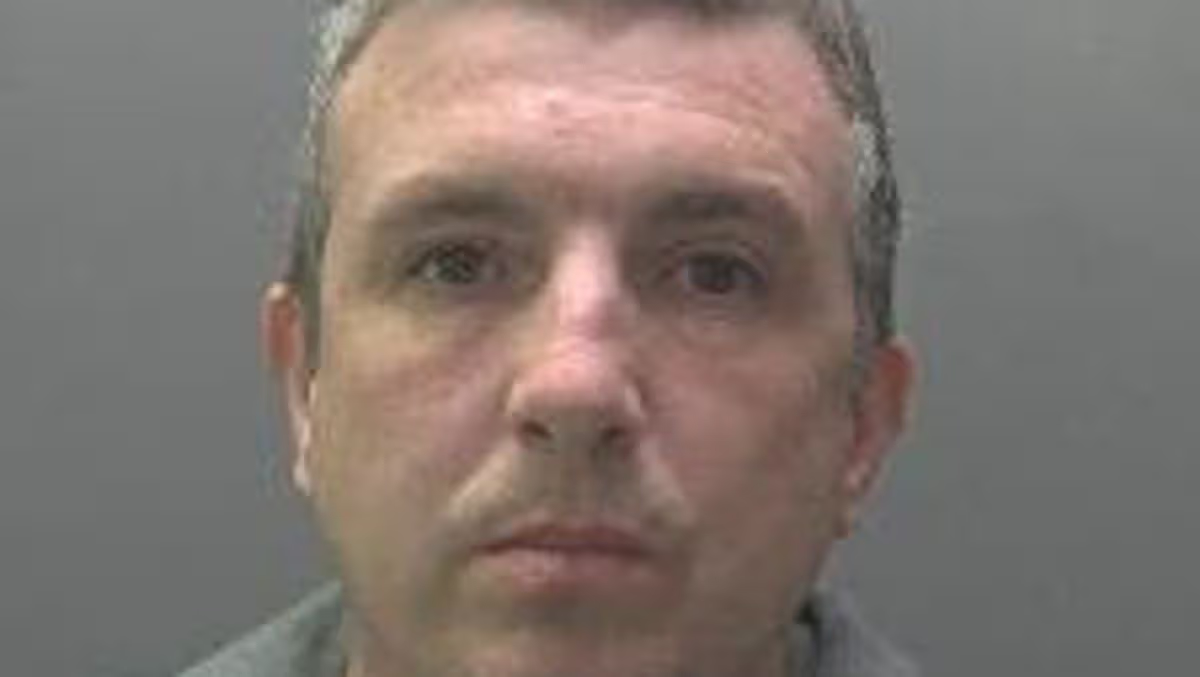
An anonymous person told police that Sean Eaves had a second phone with indecent images of children
A man who secretly took intimate photos and videos of two women and a child has been jailed. Sean Eaves was arrested in 2024 after police officers identified a screenshot of an intimate video of himself and the first victim.
Advertisement
He sent it to her in 2023 though Instagram messenger. Police found evidence linking him to the social media account on his mobile phone. After his arrest he was released on bail.
A warrant was carried at Eaves’ home address in Chatteris a few months later after officers received an anonymous tip-off that claimed he had a second mobile phone containing indecent images of children.
Police recovered a memory card containing 18 indecent videos of a child captured secretly. A second phone found in his car contained a further eight indecent videos and 72 photos of the same child.
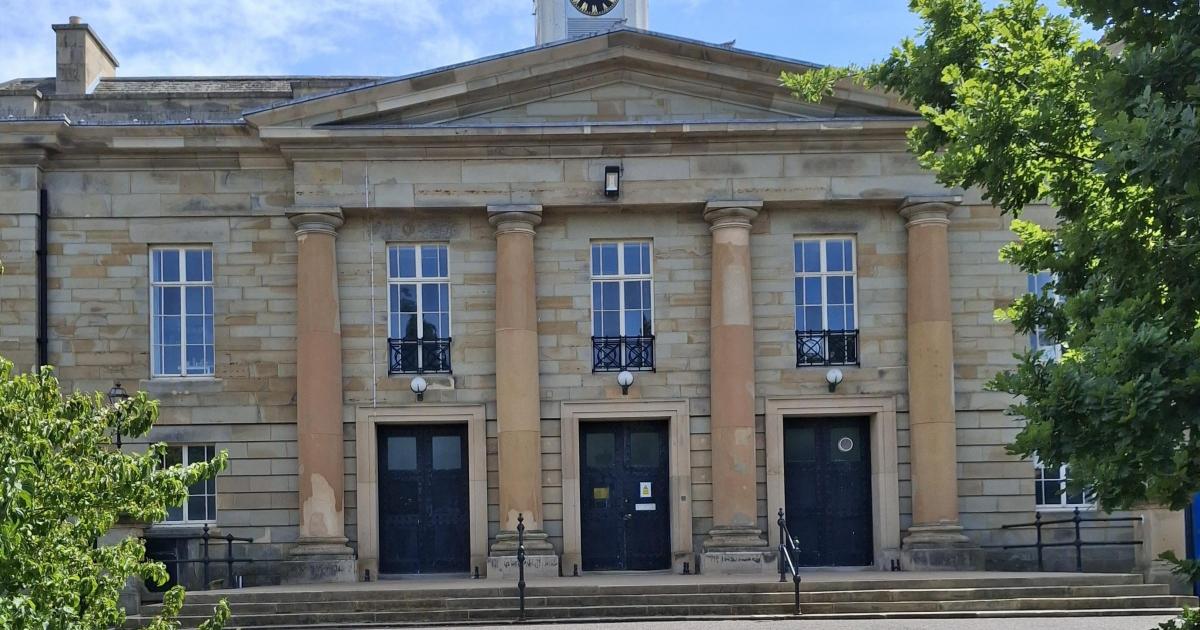
The 41-year-old appeared at Peterborough Magistrates’ Court, where he pleaded guilty to three counts of voyeurism and one count each of disclosing private sexual photographs, filming with intent to cause distress, and taking an indecent image of a child.
Advertisement
Eaves was jailed for six months after sentencing on Friday (March 6). He was also handed a seven-year restraining order for all the victims and a 10-year Sexual Harm Prevention Order. He will required to register monthly at a police station for 10 years.
Detective Constable Amberlie Ford said: “Eaves shamefully took photos of these women and the child without their knowledge, which violated their dignity and privacy, so I welcome the sentence passed down by the courts.
She continued: “I would also like to pay tribute to the victims, whose strength in coming forward and supporting us with a prosecution has led to this result.”
Coming in at number one is an ancient and beautiful Scottish settlement.
Scotland’s “smallest cities” have been ranked from best to worst on a new Britain-wide list shared this week. On Monday, March 9, The Telegraph published a ranking of the 20 smallest cities across the nation, with a total of four Scottish destinations included on the roundup.
Advertisement
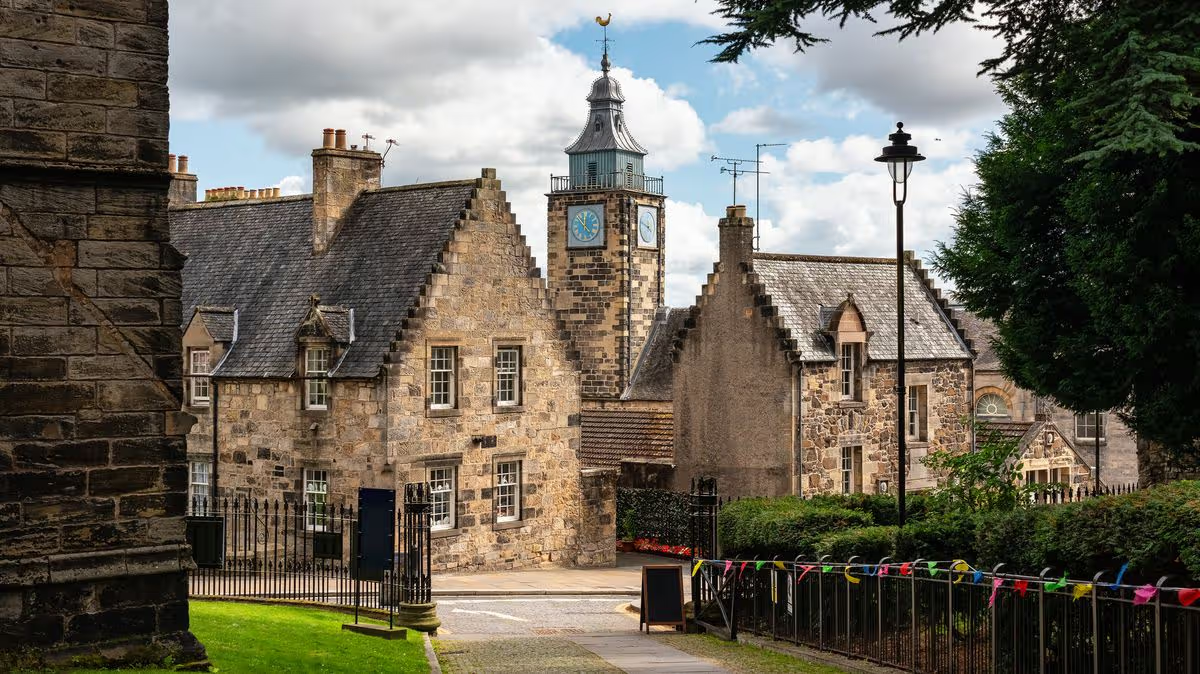
Coming in at number one for Scotland, and placing ninth on the overall list, is Stirling. Home to a population of around 38,000 people, the city was once the capital of Scotland and was previously among the major royal strongholds of the Kingdom of Scotland hundreds of years ago.
Stirling is today known for its various historic attractions and beautiful scenery, as well as its shops and restaurants. Its skyline is dominated by Stirling Castle, which is among the most historically and architecturally significant castles in the country that dates back to at least the 15th century.
Other top attractions in Stirling include the National Wallace Monument and the Stirling Old Town Jail. The former is a 67-metre tower atop a hill overlooking the city that commemorates Scottish hero Sir William Wallace, while the Stirling Old Town Jail offers tours where visitors can learn all about its fascinating and brutal history.
The Telegraph singled out Stirling Castle and the National Wallace Monument as highlights of the city, as well the Old Town Jail. Also praised was the the Stirling Smith Art Gallery and Museum, which is home to what is believed to be the oldest football in the world at almost 500 years old.
Advertisement
The newspaper wrote: “The castle is a centrepiece, and there’s a circular footpath along the old city walls with views across the Lowlands, up to the Highlands and over the rich agricultural lands of the Carse of Stirling. The other looming landmark is the National Wallace Monument.
“The world’s oldest football was discovered during an excavation project at the castle in the 1970s; the cowhide and pig’s bladder ball, which dates back to the 1540s, is on display at the Stirling Smith Art Gallery and Museum. The Old Town Jail is popular with families. Lumo will start a new direct service from London Euston to Stirling in the spring.”
The second-best small city in Scotland according to The Telegraph is Inverness, which has a population of around 48,000 and is the administrative centre for The Highland Council. Known as the capital of the Scottish Highlands, Inverness is another historic city that is known for its beautiful scenery and fascinating heritage.
Advertisement
Among the standout destinations in Inverness as stated by The Telegraph are the Inverness Botanic Gardens and Inverness Castle, which sits on a site where there has been a castle since 1057. The city was also praised for its various high-quality restaurants and pubs.
The Telegraph stated: “The Highlands are lovely, but when you’ve spent a week in the mountains or the bogs, there’s nothing nicer than arriving in Inverness. The town looks posher than it is, but you can always eat well, find a good pub, and the river walks are great. Until recently, aside from the Botanic Gardens and cathedral, there wasn’t much to ‘do’, but the recently opened Inverness Castle Experience is a good rainy-day option.
“An immersive, installation-led, self-guided tour of the north and south towers of what was never actually a traditional castle, it divulges stories about the city and region, from clans to colonialism, and witchcraft trials to modern-day tartan mills.”
Advertisement
Meanwhile, Scotland’s third-best small city according to the ranking is Perth along the banks of the River Tay. The city, which has a population of about 47,000, is known for its huge public parks, beautiful Georgian townhouses, historic cobbled streets, and breathtaking medieval spires.
The Telegraph praised Perth for its medieval walled layout, as well as its various narrow lanes and side streets that can be explored. The newspaper also singled out the Stone of Destiny as a highlight of the city, which can be found in the Perth Museum after it reopened in 2024 following a major £26.5 million redevelopment.
The fourth and final Scottish city to be included on The Telegraph’s ranking of Britain’s smallest cities is Dunfermline, which is located in Fife. Scotland’s newest city, Dunfermline was officially granted city status in 2022 and has a population of approximately 55,000 people.
Advertisement
The newspaper described the Andrew Carnegie Birthplace Museum and Dunfermline Abbey and Palace as among Dunfermline’s standout attractions. The Andrew Carnegie Birthplace Museum tells the story of famous Scottish-American industrialist and philanthropist Andrew Carnegie, while Dunfermline Abbey is the resting place of many of Scotland’s great kings and queens.
The full list of Britain’s 20 smallest cities ranked from worst to best can be found on The Telegraph website.
Scotland’s ‘smallest cities’ ranked from worst to best
The warning was given by a judge to Declan Sains, who is awaiting sentence after admitting a series of offences relating to three boys, committed last summer.
But Judge Richard Clews said he wants the defendant to be assessed for the danger he poses to the public of committing further serious offences before he is sentenced.
Defendant Declan Sains admitted eight charges, including sexual communicating with boys, when he appeared at Durham Crown Court earlier this year (Image: The Northern Echo)
Sains, 28, of HMP Durham, appeared via video link from the prison, in January, when he admitted two counts of causing or inciting a boy to engage in sexual activity, at Bishop Auckland, in July 2025.
He also admitted three counts each of engaging in sexual communication with a child and making indecent images of a child.
Advertisement
Sains, again appearing via video link from Durham Prison, was to have been sentenced at Teesside Crown Court today (Tuesday March 10).
But Judge Clews said given the seriousness of the latest charges the defendant should be assessed for the danger he poses of committing further offences.
He adjourned the case for five weeks to allow the Probation Service to draw up that report.
Remanding Sains to remain in custody until the sentencing hearing, Judge Clews told him not to labour under any misapprehension that he would be receiving anything other than a prison sentence.
“The overwhelming likelihood, if not the certainty, is that it will be a prison sentence.”
The filing reveals that Johnson was himself owed $2.2m by GST. But it alleges he took out $500,000 (£370,000) on 4 June when he knew it was in dire straits.
“Mr Johnson initiated a payment of $500,000 purportedly on account of an unsecured note,” lawyers for an “official committee of unsecured creditors” say in the filing.
Advertisement
“Shockingly, Mr Johnson elected to secretly prefer himself over the athletes and other, non-insider creditors, while at the same time feigning to the public that he was selflessly looking to advance the interests of the athletes.
“Moreover, at the same time, the debtor knew it was in precarious financial straits without sufficient cash to complete its contemplated season.”
Another key accusation in the filing is that Johnson has prioritised paying high-profile athletes such as Josh Kerr over other creditors in order to limit reputation damage.
GST was marketed as a project to “save athletics”, although it only featured some track events and excluded field disciplines. The inaugural season featured four meets – one in Jamaica and three in the US – with ambitious plans to stage meets in Europe and draw in young sports fans around the globe.
Advertisement
Grand Slam Track proved to be a disaster for everyone involved (Getty/The Independent)
“We are maniacally focused on having the youngest fanbase of any sports league in the world in the next five years,” Johnson’s co-founder Steve Gera told The Independent a fewweeks before GST launched. “That’s our north star.”
But ticket sales for the opening in Jamaica were poor and although the US events were better attended, the fourth meet in Los Angeles had to be cancelled as money ran dry, after a major sponsor, Eldridge Industries, pulled out from an agreement thought to be worth close to $40m. GST filed for bankruptcy in December.
Advertisement
Michael Johnson launched the project to ‘save athletics’, but the events gained little traction (AP)
The filing accuses GST of publicly claiming to have $30m in funding when it in fact had only raised $13m, with the money from Eldridge Industries not contractually secured.
GST said in a statement: “On behalf of Grand Slam Track, we are aware of the UCC’s recent allegation that GST secretly paid $500,000 to Mr Johnson instead of paying athletes and vendors. This claim is unfounded and false. As was previously explained to the UCC, Mr Johnson advanced millions of dollars for GST’s operating expenses, including athlete travel, accommodation and costs, only a portion which was repaid through the reimbursement. It is unfortunate that the UCC chose to ignore facts and is instead attempting to discredit the company and Mr Johnson through false statements.”
Winners Alliance, GST’s primary funder, is reportedly owed more than $15m.
It said in a previous statement: “The public record makes clear that Winners Alliance invested more capital, assumed more risk, and ultimately suffered greater financial losses than anyone.
Advertisement
“Winners Alliance invested millions, loaned millions in good faith, and ultimately offered millions more to stabilise Grand Slam Track and maximise recoveries for all stakeholders, including athletes, vendors, and trade creditors alike.”
Banks Homes is looking to build around 50 properties in Sedgefield, on a site bordered by the A689 and Stockton Road.
The developer, based in County Durham, held a public consultation event in December to gather feedback from residents.
The proposed site plan. (Image: Banks Homes)
Kate Culverhouse, community relations manager at the Banks Group, said: “The feedback we’ve had from local people has been very useful in helping us finalise our development designs and we’re very grateful to everyone who took the time to give us their views.
The team said this feedback was used to shape the plans, which now include at least 20 per cent affordable housing, a minimum 10 per cent biodiversity net gain, and alternative heating systems to reduce carbon emissions.
Advertisement
Kate added: “This will be a high-quality development of sustainable new homes, with its location offering excellent transport links both into and away from Sedgefield.
The team plan on submitting the official planning application to Durham County Council later this year.
Access to the site would be via a new junction onto Stockton Road and, if approved, construction could begin by summer 2027.
Selena Gomez fans were stunned when the songstress was seen kissing her husband Benny Blanco’s dirty feet during the second episode of his podcast, Friends Keep Secrets
Following the furore, Selena, 33, insisted she falls “more and more in love” with the music producer each day and now Benny, 38, has lifted the lid on his hygiene, insisting he ‘smells good’. Talking to Ed Sheeran on his podcast, the pair discussed their shower routine as Ed, who revealed he showers twice a day, mused: “I feel like I’m like you. I look like I don’t smell good. But actually you’re the best-smelling person I know.”
Smiling, Benny replied: “I know, I smell good. And I never, like even if I don’t shower…” he trailed off, before his co-host, Lili Dicky, sniffed his pal and said Benny “always smells good.”
In the first episode of the podcast, Benny reclined on Lil Dicky’s couch with his dirty feet visible to the camera. Viewers were appalled by the reveal, with one suggesting: “Those dawgs need to be hosed down.”
Ensure our latest headlines always appear at the top of your Google Search by making us a Preferred Source. Click here to activate or add us as your Preferred Source in your Google search settings.
However, Benny’s wife Selena wasn’t grossed out at all and popped up on the podcast two weeks later, nibbling her man’s dirty toes. Benny’s reaction was immediate. “You like that?” he asked, only for Selena to slap his leg and tell him not to “make it a moment.”
Blushing, Benny gushed: “Oh, no. I wasn’t. I liked it. It made me feel good. I love you so much,” he told her. But fans weren’t having any of it. One user responded: “This is the most disgusting thing”. Another said: “I love Selena, but why [did] she set herself up doing this?” Meanwhile, a third mused: “If she does it in front of everyone, what does she do in private?”
Advertisement
On PDA (public displays of affection) with his wife, Benny said: “In interviews with her — because I know she likes to keep it professional — I try not to show too much, like … ‘cause she’s her own entity. I want her to shine and be her own independent woman.
“So I try so hard. I use every bone in my body not to be googly-eyed over her and not want to kiss her and jump her bones all the time.” Elsewhere in the episode after she kissed his feet, Selena told Benny that their relationship “is probably so healthy and one of the greatest things of life.”
Since the 2010s, breakthroughs in AI have prompted discussion about their implications for work, including a possible “workless” future. Those forecasted to face replacement are no longer only the lower-skilled, but also professionals, once viewed as impervious to technological automation.
The commercialisation of imaging AI models is also fierce: between 1995 and 2024, 950 AI products were authorised by the US Food and Drug Administration, among which 723 were imaging-related. Of these 723, 690 were authorised between 2016 and 2024, compared with only 33 over 20 years from 1995 to 2015.
Advertisement
AI has long been discussed as a threat to jobs and livelihoods. But what’s the reality? In this new series, we explore the impact it is already having on different occupations – and how people really feel about their AI assistants.
The pace of innovation has provoked intense debates about the impact on healthcare professionals, particularly radiologists – doctors specialised in medical imaging. In 2016, Nobel laureate Geoffrey Hinton argued that people should stop training radiologists altogether as AI would outperform them by 2021. This hasn’t happened as yet. Others see AI functioning as an autopilot, deployed to help alongside radiologists.
I wanted to understand how and why AI products are developed, adopted, and used, and what the implications are for professionals. It led me to investigate two use cases in the NHS and to hear directly from radiologists and related health professionals.
Advertisement
Detecting breast and brain abnormalities
The AI products I looked at are designed to detect abnormalities such as tumours or vessel blockages on breast X-rays and brain CT scans, which are crucial indications for breast cancer and stroke.
Although the breast X-rays AI is intended to automate image analysis, in reality, both are only used to support decisions made by consultant-level professionals. This is partly because current UK regulationsblock automation due to a lack of high-quality evidence supporting its effectiveness.
Demonstration of AI models detecting vessel occlusion on brain CT scans. Frontiers in Neurology
When using AI, professionals are not so impressed with its performance either. While hospital auditing can suggest AI accuracy might be better than professionals’ perceptions, AI results often contradict judgements they believe to be correct. Without further analysis of which represents the “reality” better, we can only say that AI’s analysis can differ from that of a human.
The AI is theoretically useful, but actually in practice … I found it not as accurate as, or doesn’t necessarily correlate with, what my analysis would be (Dr A, consultant neuroradiologist).
[An image]… comes through, where [AI] has clearly interpreted bone, which is white on CT, as being blood, which is also white on CT (Dr D, consultant stroke physician).
Advertisement
Professionals can tell when AI is making mistakes in most cases, but they can also be biased – not only against but in favour of AI, regardless of whose analysis is better. Being selective about AI outcomes is becoming a crucial new skill in itself for professionals.
… it’s very easy to look at that [the pictures] face value and say, ‘OK, this is what it’s telling me, and therefore this is correct’.
… but you need to be able to selectively choose what is relevant, and that is a skill in itself – not to get overwhelmed by the information that you’re given and to know what is relevant (Dr A, consultant neuroradiologist).
As decision-supporting tools, AI doesn’t currently replace any tasks that professionals have been doing, though it does augment practices in certain ways.
When it [AI] picks up any abnormalities, it makes us think twice, basically to make sure that that area is either abnormal or not abnormal (Dr S, consultant stroke physician).
Sometimes I have missed very small areas, for example, and the AI has picked it up (Dr J, consultant stroke physician).
Advertisement
Yuxuan Wu presents her work at University of Birmingham 2025 Three Minute Thesis competition.
Reducing the workload
Considering the pace of AI improvement and an increasing number of trials, automation is possible, but mostly likely to be at a task-level, which can reduce the workload of image analysis for radiologists. Given a current workforce shortage, this would ease training and recruitment pressure, rather than creating redundancies.
We’re so grossly understaffed in the UK for radiology that, I don’t think we need a reduction [of radiologists]. We probably don’t need a huge amount more [radiologists], because the diagnostic work will slowly drop off (Dr D, consultant stroke physician).
The potential automation of image analysis could also be beneficial for interventional radiology, which uses real-time imaging techniques to guide live procedures such as tumour removal and emergency treatments such as blood clot removal during stroke.
[AI] is very useful for streamlining the workload for stroke intervention, and also for aneurysm work (Dr L, consultant interventional neuroradiologist).
However, by altering the type and number of images professionals analyse annually, task-level automation could pose challenges for professionals in acquiring and retaining skills, which are still needed for more complex tasks.
Advertisement
That’s a big worry … If AI does all the easy stuff, you don’t know what normal looks like anymore, and that becomes difficult, because you should be trained on what’s normal, or a combination of both [normal and abnormal] .
If AI automates half the analysis, you become less good at assessing, because you’re not seeing so many and not so familiar with the bigger range (Dr J, consultant breast radiologist).
The intertwining, non-linear relationship between medical imaging work and AI observed in my research mirrors situations in other sectors. Early findings from sectors such as accounting, finance and manufacturing show that, instead of mass replacement, the structure and practices of work are changing with AI at a pace and intensity that is much gentler than many predicted. Not only is there a lack of evidence supporting a net job loss due to AI, but benefits such as efficiencies or perceived workload reductions, were also found to be strongest with moderate AI use, than non-or-excessive use, in this pre-print study.
More research is needed to fully understand the future of work, but for now, apocalyptic predictions about professions in an AI era seem to be still some way off.
Advertisement
Yuxuan Wu is the Editor’s Choice award winner in Vitae’s 2025 Three Minute Thesis competition sponsored by The Conversation UK.
The news comes as the city marks No Smoking Day on Wednesday, March 11, with renewed efforts to encourage smokers to quit for good.
Councillor Kelly Chequer, deputy leader of Sunderland City Council and cabinet member for health, wellbeing and safer communities, said: “We know how damaging smoking is to health, and it’s fantastic that fewer people are smoking in Sunderland than ever before, but we really want to help more people go smoke free to improve their health and wellbeing.”
Sharon Pearson, 63, from Washington has quit smoking with the help of the Stop Smoking Service. (Image: Sunderland City Council)
Washington resident Sharon Pearson, 63, recently quit smoking with the service’s help.
Ms Pearson said: “I used a vape and patches to help me quit but having the advisors phone me to check in and remind me how far I’d come encouraged me to keep going.”
Advertisement
She began smoking as a teenager and eventually smoked up to 60 cigarettes a day, a habit that seriously affected her health.
Ms Pearson said: “I was out of breath all the time and I couldn’t walk very far.
“I was just smoking for smoking’s sake and to be honest I don’t know how I could afford it.”
She has now been smoke-free for 12 weeks and says she has seen real improvements in her health.
Advertisement
Ms Pearson said: “I can save money too; I’m putting away the money I spent on cigarettes to spend on holiday with my daughter.”
Help is also available through GPs, pharmacies, family hubs and the free Smoke Free app, which includes expert advice, progress tracking and a vape starter kit.
Councillor Kelly Chequer added: “For many people the idea of quitting can be daunting, but there’s more support than ever before, so I’d encourage anyone wanting to quit to contact the Sunderland Stop Smoking Service to find out what support is right for them.”
Sunderland’s Specialist Stop Smoking Service offers free one-to-one support, nicotine patches, prescription medications and access to a free vape.
Advertisement
Anyone wishing to access stop smoking support can visit sunderlandstopsmokingservice.co.uk or call 0800 169 9913.
SEOUL, South Korea (AP) — North Korean leader Kim Jong Un and his teenage daughter observed tests of strategic cruise missiles fired from a warship, state media reported Wednesday, as North Korea threatened responses to U.S.-South Korean military drills.
Images sent by the Korean Central News Agency showed the two in a conference room looking at a screen showing weapons being fired from the Choe Hyon, a year-old naval destroyer.
Kim Jong Un watched the missiles launches via video on Tuesday and underscored the need to maintain “a powerful and reliable nuclear war deterrent,” KCNA reported in a dispatch that did not mention his daughter.
The girl, reportedly named Kim Ju Ae and about 13, has accompanied her father at numerous prominent events including military parades and weapons launches since late 2022. South Korea’s spy agency assessed last month Kim Jong Un was close to designating her as his heir.
Advertisement
KCNA said the missiles hit target islands off North Korea’s west coast. It quoted Kim Jong Un as saying the launches were meant to demonstrate the navy’s strategic offensive posture and get troops familiarized with weapons firings.
Kim Jong Un observed similar cruise missile launches from the Choe Hyon in person last week, but his daughter was not seen at that appearance.
Tuesday’s missile firings came after the start of the springtime U.S.-South Korean military drills that North Korea views as an invasion rehearsal.
On Tuesday, Kim Jong Un’s sister and senior official, Kim Yo Jong, warned the drills reveal again the U.S. and South Korea’s “inveterate repugnancy toward” North Korea. She said North Korea will “convince the enemies of our war deterrence.”
Advertisement
The 11-day Freedom Shield drill that began Monday is largely a computer-simulated command post exercise and will be accompanied by a field training program. North Korea often reacts to the two sets of training with its own weapons tests.















![Bitcoin Has One Hurdle To Beat Before Going Higher! [Data]](https://wordupnews.com/wp-content/uploads/2026/03/1773233177_maxresdefault-80x80.jpg)