Tom Wernham, senior research economist at the Institute for Fiscal Studies, told the BBC using administrative records to “correct benefit amounts is going to be a big improvement to the quality of the data underpinning the UK’s official income and poverty statistics, and we definitely welcome that”.
People are raving on about the drama series which is believed to be a ‘hidden gem’ and it’s available on a number of TV networks, including Disney+. So have you seen this before?
Christine Younan Deputy Editor Social Newsdesk
06:06, 19 Feb 2026
Looking for the next big TV series to binge-watch? It can be hard finding a new show to watch, especially if you’ve just finished something decent on Netflix or Amazon Prime.
Now people are raving on about a ‘hidden gem’ they found – and it’s available on a number of TV networks, including Disney+. After one TV fan asked for recommendations in a popular thread, many people flooded the comments section where they offered a number of suggestions, one of them being Will Trent, a American police TV drama. The series follows a Special Agent of the Georgia Bureau of Investigations.
Advertisement
As a child, Trent was abandoned and forced to endure a harsh coming-of-age in Atlanta’s overwhelmed foster care system. It was based on one of prolific New York Times author Karin Slaughter’s bestselling books.
The Reddit post read: “Any current network (CBS, ABC, NBC, etc.) TV shows that are any good? Most of the shows I currently watch are on streaming services and I’m wondering if there’s any hidden gems I’m missing out on.”
Many people shared their suggestions, including High Potential and The Rookie.
But plenty of viewers labelled Will Trent as a must-see. The series, which is also available on other network channels, can be streamed on Disney+ for subscribers.
Advertisement
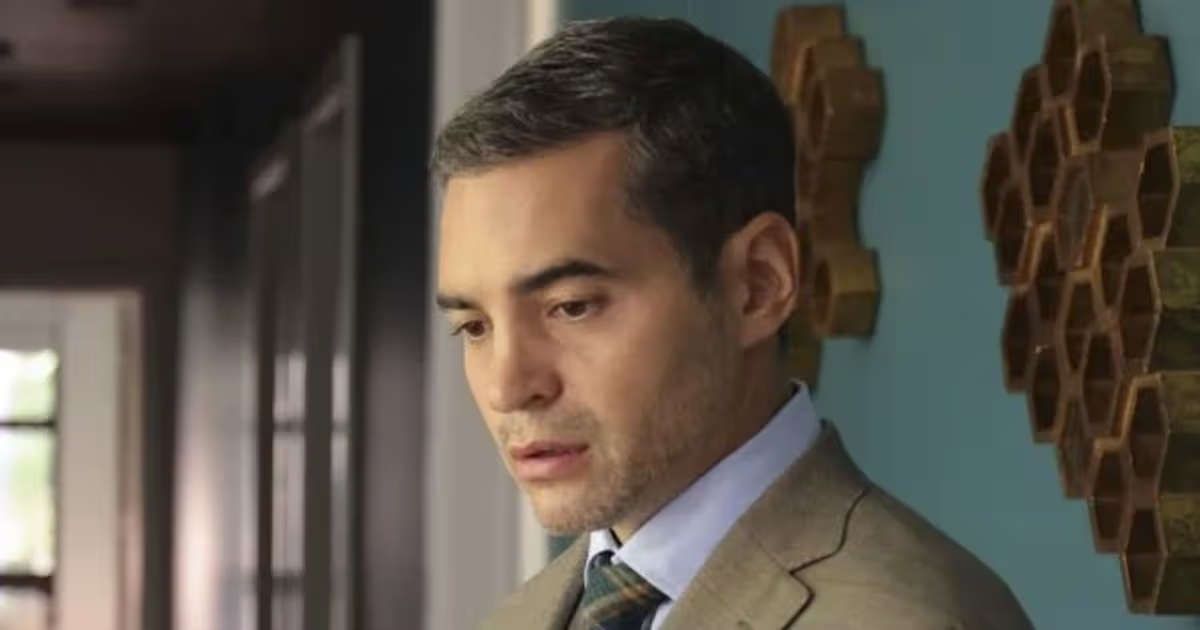
The series was developed by Liz Heldens and Daniel T. Thomsen which stars Ramón Rodríguez and premiered on January 3, 2023, on ABC.
A year later in April, the series was renewed for a third season which landed on January 7, 2025. Then months later, the series was given the green light for a fourth season which finally premiered on January 6, this year.
The series follows Will who grew up in the Atlanta foster care system after being abandoned as a child. Despite being dyslexic and his upbringing having a lasting effect on him, he became a Special Agent in the Georgia Bureau of Investigation (GBI).
Will, a highly observant character, had been assigned a corruption case involving the Atlanta Police Department which shares an office building with the GBI.
Advertisement
The story also shows his on-again off-again relationship with APD Detective Angie Polaski, a childhood friend from the foster care system.
Will Trent has a 7.7 out of 10 rating on IMDb and 83% on Rotten Tomatoes. To watch it on Disney+, you must have a subscription on the streaming platform.
North Yorkshire Police said it happened around 11.45am on Sunday, February 8 on the route between the A64 and Askham Bar Park and Ride and college playing fields.
The force said a naked man approached a woman walking along the path.
Advertisement
The woman is currently receiving support from police officers, the force said.
As North Yorkshire Police launched an appeal for information, a force spokesperson said: “The man is described as approximately 5feet 7inches tall, in his early to mid-30s, and had light stubble and short, light brown hair.
“We’re appealing to anyone who was in the area at the time and witnessed the incident or saw the man to get in touch.
“We also urge anyone else who may have been approached in a similar way to get in touch.
“Alternatively, you can call North Yorkshire Police on 101 and ask for Helen Barrett, or contact Crimestoppers anonymously on 0800 555 111 or via their website.
“Please quote reference 12260023816 when passing on information.”
Under the proposals, sellers and suppliers will also have to register with their local council
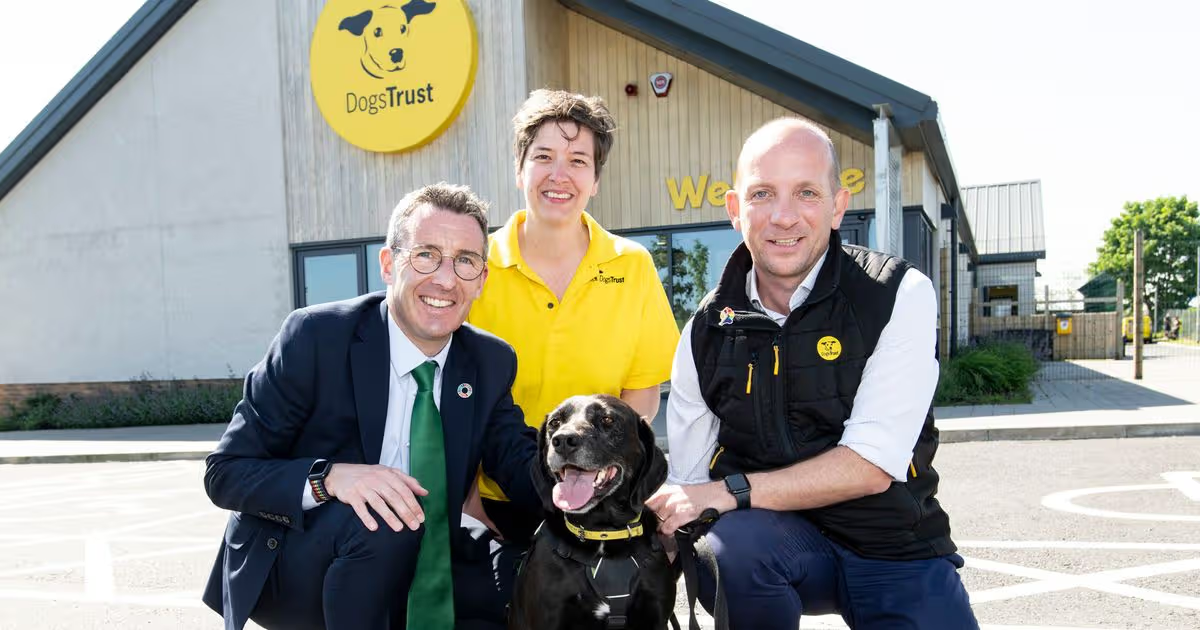
The third-party sale of puppies and kittens is set to be banned, and those selling and supplying puppies and selling kittens under six months will be required to register with their local council under new plans being brought forward by DAERA Minister Andrew Muir.
Advertisement
Minister Muir has published his Department’s Way Forward document and consultation responses following a public consultation on the sale and supply of puppies and kittens in Northern Ireland.
Under the proposals, the registered seller and/or supplier will be required to meet specified conditions of registration. One condition of registration is ‘Lucy’s Law’, which will ban the third-party sale of puppies and kittens. This means that anyone selling and supplying puppies and kittens in Northern Ireland must have bred them themselves.
Minister Muir said: “I am delighted to announce that Northern Ireland will soon have its own version of Lucy’s Law, ensuring that we are giving the same protections to puppies and kittens that exist in other parts of the UK.
“I want owners to have confidence that their new pets have been cared to the high standards of welfare that all animals deserve. This ban on the third-party sale of puppies and kittens, as well as accompanying mandatory registration for sellers and suppliers, will lead to better outcomes for the animals, reducing the risk of disease and improving socialisation and habituation. Purchasing directly from a breeder helps to avoid early separation from the mother, and ultimately, will see more puppies and kittens raised in responsible, caring environments.
Advertisement
“It is clear from the consultation that there is overwhelming support for this vital animal welfare intervention in our society, am I am grateful to those who took the time to respond to the consultation and voiced their views. I look forward to seeing this key commitment from my Animal Welfare Pathway 2025-27 delivered.”
The Minister concluded: “It is anticipated that legislation will be made this autumn, and I have asked that my officials work closely with local councils, who play a vital role in the enforcement of legislation relating to companion animals, in planning for its effective implementation.
“Improving animal welfare is close to my heart as Minister, and Lucy’s Law is about seeing more of our puppies and kittens being given the best start in life.”
Laura Orr, Regional Public Affairs Officer at Dogs Trust and Chair of Northern Ireland Companion Animal Welfare Group (NICAWG) said: “ We welcome DAERA’s proposals following the consultation on the sale and supply of puppies and kittens. NICAWG supports the recommendations, which will require sellers and suppliers of puppies, and sellers of kittens, under six months of age, to register with their local council and for a register of those sellers to be publicly accessible.
Advertisement
“We fully support this proposed ban on the third-party sale of puppies and kittens. Buying directly from breeders offers greater protection for the animals, and helps tackle irresponsible breeding and selling, which is something NICAWG have been campaigning on for many years. We believe robust implementation of the legislation across council areas will be critical, but will lead to improved animal welfare standards for companion animals in Northern Ireland, which is fantastic news.”
Want to see more of the stories you love from Belfast Live?Making us your preferred source on Googlemeans you’ll get more of our exclusives, top stories and must-read content straight away. To add Belfast Live as a preferred source, simplyclick here.
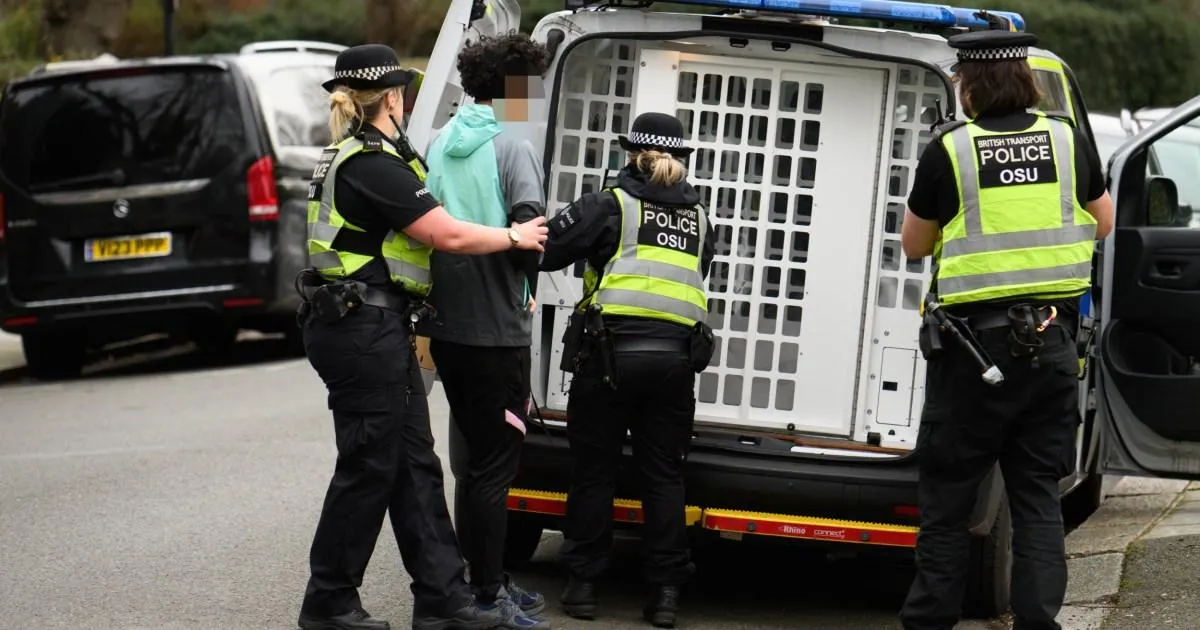
An 18-year-old boy was arrested in Camden yesterday (Picture: Justin Griffiths-Williams)
Making his way home from school in London, a 13-year-old boy was dragged down a flight of stairs, beaten and robbed.
A crowd of teenagers surrounded and attacked him during rush hour at Swiss Cottage train station last month, demanding he hand over his phone and his watch.
The thieves flashed a zombie knife at him, before leaving him terrified and injured on the floor without any of his valuables.
And he is just one of hundreds of victims robbed on the London’s transport network.
Advertisement
But British Transport Police have had enough.
Police Sergeant Brendan Lamb told Metro: ‘Although being robbed at knife-point almost sounds low-level nowadays, it is incredibly impactful and can change the lives of victims.
‘After crimes like this, victims understandably can become very nervous about what used to be their ordinary life. We want them to be able to feel comfortable again.’
And Metro joined them on their hunt to catch the criminals responsible for ruining so many journeys home.
Advertisement
Police at one of the addresses today (Picture: Justin Griffiths-Williams)
The attack
On January 17 at 5pm, the 13-year-old victim was at Swiss Cottage Underground Station where he was attacked.
A group of boys were ‘lying in wait’ before they approached him, dragged him down stairs before kicking and punching him.
As it happened during rush hour, there were multiple witnesses, including a woman who tried to intervene.
Latest London news
To get the latest news from the capital, visit Metro’s London news hub.
Advertisement
But the group of attackers managed to flee, with the victim’s phone and fake Rolex watch.
He was taken to hospital after suffering facial bruising and swelling to both eyes – and police were determined to catch those responsible.
Knocking on doors
Some of the occupants were unwilling to reveal where the suspect was (Picture: Justin Griffiths-Williams)
There were three targets for the yesterday’s arrests. Two 18-year-old boys, and one 15-year-old.
They were suspected of being part of the gang who surrounded the young victim, with two others, aged 16 and 17, already arrested on the day.
Advertisement
The first address proved to be a completely unoccupied building, with neighbours saying only workmen being seen entering and leaving the premises.
The second property, in a newly built block of flats with floor-to-ceiling windows overlooking Swiss Cottage, proved frustrating for officers. Three people – all siblings of one of the suspects -insisted they had no idea where their younger brother was and ‘had not seen him in weeks’.
‘But we will just keep going back here’, BTP Sergeant Danny Douglas said. ‘We are not just going to give up looking for these people.’
In the third and final property, an 18-year-old suspect was arrested and brought out. His terminally ill mum shouting out in frustration at the amount of police present.
Advertisement
‘Knives during robberies are still rare’
Police are determined to catch robbers on the train network (Picture: Justin Griffiths-Williams)
And according to the latest data, the work of officers on the UK’s transport network is pushing crime levels in the right direction – down.
Between October 2024 and September 2025, BTP recorded 361 offences involving a knife or sharp instrument, according to the Office for National Statistics.
Sergeant Lamb said: ‘Robberies involving a knife are not as common as you think, which is why it is vital we catch these criminals.’
But this is down by 26% compared to the previous year, as 487 incidents were recorded.
And as knife crime continues to involve youths, the half-term week struck as the perfect opportunity to launch a concentrated number of arrests as the teenagers involved will be at home.
Advertisement
‘Lives can be changed by crimes like this,’ Sergeant Lamb added. ‘Especially when the victim is so young.’
He said: ‘Just arresting one person, can lead to further lines of enquiry, and have a domino effect where we manage to catch more criminals.’
The film, from Saltburn director Emerald Fennell, is a loose adaptation of the classic gothic novel by Emily Brontë and stars Margot Robbie and Jacob Elordi as Cathy and Heathcliff.
Margot Robbie as Catherine Earnshaw (Image: Warner Bros)
Bridestones Moor, which sits above Todmorden, provided the setting for the movie and accommodated a crew of more than 200 people shooting scenes in the remote landscape.
A VisitCalderdale spokesperson said: “The well-loved Bridestones Moor, above Todmorden, provided a wonderfully wild setting for the movie – and we can see why.
“For one day in March 2025, Bridestones Moor accommodated a crew of over 200 people shooting scenes in this beautifully remote landscape.”
Advertisement
The story has inspired film, stage, and television adaptations over the years, cementing its status as one of the greatest Gothic novels of all time.
First published in 1847, it is the only novel by the English writer and tells the forbidden love story of Catherine Earnshaw and Heathcliff, set against the bleak backdrop of the Yorkshire moors.
The film also stars Shazad Latif as Edgar Linton, Alison Oliver as Isabella Linton, Hong Chau as Nelly Dean and Martin Clunes as Mr Earnshaw.
Complete with a soundtrack by British singer Charli XCX, the cast and creative team hope the film will bring Brontë’s classic novel to a whole new generation of readers.
“If anyone watches this film and then wants to go and read the book, I think we’ll feel like we’ve done our job,” said director Emerald Fennell, 40.
“I truly believe it’s the greatest book ever written, and I think she is a transcendent genius.”
Advertisement
Fennell, who won an Oscar for Best Original Screenplay for her 2020 film Promising Young Woman, says her first priority when making Wuthering Heights was its emotional resonance.
“The first thing is that everything has an emotional resonance,” she explains.
“Whether it’s the performances, the buildings, the textures, or the food, everything has an emotional reason.
“I was lucky not only to work with an amazing cast, but also an incredible crew who were all working on that same emotional frequency.
Advertisement
“So it’s not just, ‘What period are we in?’ It’s more like, ‘How does this make us feel?’”
Wuthering Heights was released in UK cinemas on February 13.
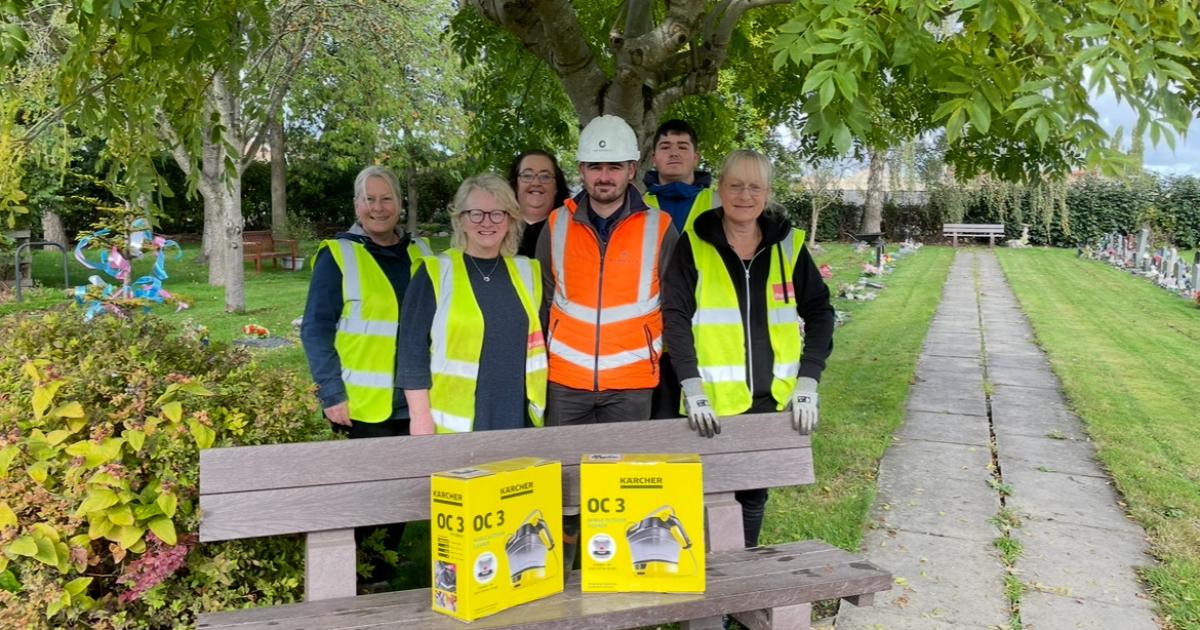
Barratt Homes, currently building its nearby Knights Gate development, gifted the equipment to the Friends of Huntington Cemetery to support the upkeep of headstones.
A spokesman for the Friends group said: “We are extremely grateful to Barratt Homes for their generous donation of power washers.
“This equipment will make a real difference to the ongoing care and upkeep of the cemetery, helping our volunteers maintain the headstones and surrounding areas with dignity and respect.
Advertisement
“Support like this is invaluable to us, and we would like to thank Barratt Homes for recognising the importance of preserving this historic and much-loved community space.”
Barratt Homes’ Knights Gate development is located in New Lane.
Paul Hogan, sales director at Barratt Homes Yorkshire East, said: “We are pleased to donate equipment to the Friends of Huntington Cemetery to support the ongoing maintenance of the headstones.”
As the 2026 Milano Cortina Winter Olympics in Italy play out, the International Olympic Committee (IOC) is once again insisting that any sport under its flag must remain politically neutral. The Olympic charter grounds this position in its fifth “fundamental principle of Olympism”, which states that sports organisations within the Olympic movement “shall apply political neutrality”.
Yet in recent years, athletes from Russia and Belarus have been excluded or tightly restricted, and calls have also been made to ban Israelis, Americans, and others. This raises the question: what, exactly, does “political neutrality” mean in today’s Olympic Games – and what purpose does it serve?
To start with, it’s obvious to most that the IOC cannot be “neutral” in the everyday sense of never getting involved. In 1992, athletes from the Federal Republic of Yugoslavia were not allowed to compete as Yugoslavia because of UN sanctions, and those who did compete did so under the Olympic flag as independent Olympic participants.
But the US faced no Olympic-wide ban after the 2003 invasion of Iraq, widely argued to be illegal under international law. If political neutrality means never making political decisions, then the IOC couldn’t work by definition, because deciding which countries are recognised and eligible to compete is inherently political.
Advertisement
The real question is not whether the IOC makes political decisions, but why it keeps insisting it does not take sides in political conflicts when, to many observers, its actions suggest otherwise.
Countries and organisations sometimes claim neutrality on principled grounds. In the 1980 Moscow Olympic Games, for example, 65 countries boycotted in response to the Soviet invasion of Afghanistan. Four years later, the Soviet Union and most of the Eastern bloc retaliated by boycotting the 1984 Los Angeles Games, citing political hostility and security concerns.
In both of these cases, the Games still went ahead. The IOC presidents at the time, Lord Killanin in 1980 and Juan Antonio Samaranch in 1984, appeared willing to bear the costs of lower attendance, prestige and fanfare in order to uphold the organisation’s claim to political neutrality, amongst other things.
Today, political neutrality increasingly serves a different role. Rather than expressing a clear position that the organisation is prepared to defend, neutrality is used to keep decisions deliberately vague. Instead of clear criteria that say what neutrality is, when it is required, and when it should be abandoned, the IOC responds to each crisis case by case, without explaining why similar conflicts produce different outcomes.
Advertisement
Sport and politics in the real world
This vagueness reduces the need to justify decisions, accountability and responsibility, all while arguing that it takes a principled position of neutrality. Ironically, “political neutrality” is so loosely defined that it is flexible enough to take sides in political conflicts, a strategic ambiguity not uncommon in international politics.
Admittedly, this may be a smart strategy from an organisational point of view. In early March 2022, the International Paralympic Committee (IPC), within 24 hours of saying Russian and Belarusian athletes would be allowed to compete at Beijing 2022 as neutrals, reversed course after several countries warned they would not compete.
A poster by an artist calling himself Badiucao, protesting the violation of human rights in China at the Beijing Winter Olympics in 2022. CTK / Alamy
The IPC probably lost some authority, and perhaps even legitimacy, from this reversal. Yet it begs the question where this leaves the concept of political neutrality and values in general, today.
Sport is often seen as a microcosm of society. Whatever happens in sport reflects society at large – and these Winter Olympic Games are no different. In this sense, neutrality in the IOC reflects a broader pattern we see in daily life – one law for the few, and another for the many, with “political neutrality” a convenient mask for taking sides while claiming not to. It appears to be “neutrality” when it benefits the right countries, and “politics” when it does not.
Advertisement
In these Winter Games, the IOC will speak the words of neutrality but think in terms of politics. Neutrality will be invoked to justify restrictions on some delegations or athletes, like Russia and Belarus, while resisting restrictions on others, like Israel and the US, and deflecting responsibility for explaining the difference.
After a week of competition, this double standard is evident. Russian and Belarusian athletes compete only as vetted “individual neutral athletes” without flags or anthems. Meanwhile, athletes from countries facing well-documented accusations of violating international law and human rights, like Iran, Israel, China, the US and others, participate under full national symbols.
The result is that these Winter Games, like many before them, are a stage where political conflict is managed in practice. Political neutrality today does not remove politics from sport; it is simply another way of reinforcing it.
Families on low incomes could be entitled to support
Millions of families on low incomes are being encouraged to check whether they could receive up to £1,200 in free bonus cash from the Government. HMRC has confirmed its Help to Save scheme is now permanent.
Advertisement
From April 2028, up to 1.5 million more families will become eligible under expanded criteria. This means additional support for people on Universal Credit, including those with caring responsibilities, who could see their savings boosted by a substantial 50% Government bonus.
In a social media post, HMRC said: “Help to Save is here to stay – and more families can benefit. The scheme has been made permanent, and from April 2028, up to 1.5 million more families will be eligible thanks to expanded criteria.”
How the scheme works
Help to Save is a Government-backed savings account targeted at working households on low incomes. It pays a bonus of 50p for every £1 saved over four years – effectively a 50% return funded by taxpayers.
Advertisement
Savers can deposit between £1 and £50 a month, up to a maximum of £2,400 over four years. The maximum bonus available is £1,200.
Key limits at a glance.
Maximum monthly saving £50.
Maximum total saving (4 years) £2,400.
Bonus rate 50%.
Maximum total bonus £1,200.
All savings in the scheme are backed by the Government, meaning deposits are secure.
Content cannot be displayed without consent
Who can apply?
You can open a Help to Save account if:
You are receiving Universal Credit.
You (or you and your partner) had take-home pay of £1 or more in your last monthly assessment period.
You live in the UK
Couples claiming Universal Credit can each open their own account, but they must apply individually. Importantly, if you cease claiming benefits after opening the account, you’re still able to continue saving until the four-year term concludes.
Will it impact your benefits?
For numerous households concerned about exceeding savings limits, there’s reassurance. If you or your partner have £6,000 or less in personal savings, this won’t affect the amount of Universal Credit you receive. This includes funds held in Help to Save. The bonuses themselves also don’t influence Universal Credit payments.
Advertisement
The same £6,000 threshold applies to Housing Benefit, and Help to Save bonuses aren’t counted against it.
Warning about withdrawals
Savers are permitted to withdraw money at any time – however, doing so could diminish the bonus they receive. Withdrawing cash makes it more challenging to accumulate the “highest balance” used to calculate the 50% bonus.
If you close the account prematurely, you’ll forfeit your next bonus and won’t be able to open another Help to Save account.
What’s changing in 2028?
From April 2028, eligibility will expand, making up to 1.5 million additional families able to apply. The move makes the scheme permanent, ending previous uncertainty over its long-term future.
Advertisement
For households juggling rising bills, the scheme offers one of the most generous guaranteed returns available anywhere – a Government-backed 50% boost that would be impossible to match in the normal savings market.
Dogs love sleeping in their owners’ beds for three heartwarming reasons that has left people emotional to learn – and it’s more than just wanting to being comfortable
Alice Sjoberg Social News Reporter
05:06, 19 Feb 2026
Dogs really are a man’s best friend, and you can usually gauge just how much your four-legged companion adores you by the way it behaves around you as its owner. Our dog friends demonstrate affection in numerous ways, from enthusiastic welcomes and physical displays such as leaning against you or licking, to constantly wanting to be near you and presenting you with their favourite toys.
They may also reveal their devotion through sustained eye contact, tail wagging, and even quietly copying your movements like yawning. But there are additional behaviours your furry friend might exhibit that you may not realise stem from how deeply they care for you and crave your company, including their desire to share your sleeping space.
“Dogs love sleeping in their owners bed for these three reasons,” a voice can be heard announcing before getting into the list of explanations.
1. It makes them feel secure
“First of all, you need to understand that for a dog, you are much more than just an owner. You are their anchor, their family, their entire world,” the voice detailed.
Due to this profound connection, they frequently feel protected in your presence and yearn to be beside you during their most vulnerable moments, particularly while sleeping at night.
Advertisement
The voice clarified: “Sleeping close to you gives them a deep sense of security and strengthens the emotional bond they feel.
“It’s their way of saying ‘I love you and I feel safe with you’,” they concluded.
2. It helps keep them warm
Content cannot be displayed without consent
“Secondly, dogs love warmth,” the video continued.
Similar to humans, dogs enjoy snuggling into a comfortable and cosy bed to maintain warmth during chillier periods. The experience becomes even more appealing when they can sense your body heat beside them.
Advertisement
“Your presence turns the bed into the perfect cocoon for a restful night. To them, you’re like a living blanket – warming and reassuring at the same time,” they explained.
3. They want to protect you
“The third reason goes a bit deeper,” the video said before it went on to reveal the third reason.
“Finally, all dogs have a built in pack protection instinct. Even when they sleep deeply, they remain alert,” they said.
They continued: “By sharing your bed, they feel like they’re guarding you just as much as you’re caring for them. This protective role is deeply rooted in their nature. And it’s yet another way your bond grows stronger.”
Advertisement
The video’s caption added: “Your dog isn’t just your pet – they see you as family and their whole world. Sleeping next to you gives them security, warmth, and a chance to protect their pack.”
Viewers quickly flooded the comments section with their reactions, with numerous people expressing support for allowing their dogs to share their beds.
“Dogs love sleeping in their owners bed for these three reasons,” one person wrote, while another shared: “I end up on the edge of the bed while my dog is stretched out.”
“I don’t know how anyone could reject a dog sleeping on the bed with them,” one individual expressed.
Advertisement
Yet, another viewer countered: “Never let your dog sleep in your bed at night.”
Ulster Unionist MLA Doug Beattie said that the system for deporting criminals “isn’t as robust as it should be and certainly isn’t transparent”
An Ulster Unionist MLA has hit out at the system in place to deport foreign criminals who are jailed for serious crimes in Northern Ireland.
Advertisement
This comes as Justice Minister Naomi Long revealed that 145 custodial sentences were handed out to 138 foreign prisoners in Northern Ireland in the last five years.
The figures were revealed after Doug Beattie asked the Minister to detail the number of foreign nationals that have received a custodial sentence of one year or more, in the last five years; the number of those who received a custodial sentence of one year or more and were reported by the Northern Ireland Prison Service to the Home Office Foreign National Offenders Returns Command for deportation, on completion of the custodial element of their sentence; and the number that were unable to complete their licence element of their sentence, as monitored by the Probation Board Northern Ireland, because they were deported.
In her response, Justice Minister Naomi Long said: “The Home Office is responsible for any deportation of foreign nationals. The Northern Ireland Prison Service (NIPS) is responsible for holding those in their custody as directed under the warrant of committal issued by the sentencing court.
“The NIPS is responsible for informing the Home Office of all sentenced foreign national offenders within ten working days of sentencing: thereafter, the Home Office investigate the case and all decisions pertaining to the individual’s immigration and deportation status are a matter for them.”
Advertisement
In recent weeks, the system for deporting criminals has come under greater scrutiny following the case of murdered Ballymena man Victor Hamilton in July 2022. Two foreign nationals, Mario Menezes and Michael Hanrahan were each sentenced for withholding information relating to the murder.
Michael Hanrahan was released back into the community on license only to be returned to prison on breach of his license, and Mario Menezes was not returned to prison following sentencing due to time served.
Ulster Unionist Justice Spokesperson Doug Beattie, MC MLA, commented: “The case surrounding the murder of Victor Hamilton in Ballymena has raised several concerns. This stems from the sentences handed out to two foreign nationals that should, under Home Office rules, have been deported as they were sentenced to one year or more. In one case, the individual was sentenced to six years for the manslaughter of Victor, served three years, then should have been deported. However, this individual was released into the community on license only to be returned to prison on breach of that license. “A second individual involved in the murder of Victor Hamilton was given a two-year sentence, a year to be served in prison. However, due to time served, he was released on sentence by the judge and released back into the community. At no stage was the family of Victor informed of what was happening with either man by anyone within the criminal justice system. “It is clear that the Home Office, through the Foreign National Offender Returns Command, is responsible for deportation orders of foreign nationals. Yet they must be triggered by the Northern Ireland Prison Service, and it seems the system isn’t as robust as it should be and certainly isn’t transparent. These figures provided by the Justice Department should create a realisation that for every case there is a victim, and these victims need to be kept better informed.”
Want to see more of the stories you love from Belfast Live?Making us your preferred source on Googlemeans you’ll get more of our exclusives, top stories and must-read content straight away. To add Belfast Live as a preferred source, simplyclick here.