






Secret National Intelligence Council assessment completed in February concluded neither limited airstrikes nor prolonged military campaign would result in new government taking over in Iran
A US intelligence evaluation, completed just before the United States and Israel initiated a war in Iran, concluded that American military intervention was unlikely to result in regime change in the Islamic Republic, according to two individuals privy to the findings.
The National Intelligence Council’s assessment in February determined that neither limited airstrikes nor an extended, sustained military campaign would likely lead to a new government taking power in Iran, even if the current leadership were eliminated, said the two individuals, who requested anonymity to discuss the classified report.
This conclusion undermines the administration’s claim that it can achieve its goals in Iran relatively swiftly, possibly within a few weeks.
READ MORE: Trump Iran LIVE: President says ‘war is complete’ in major update on conflictREAD MORE: Donald Trump’s eight word message to Iranian Supreme Leader Mojtaba Khamenei
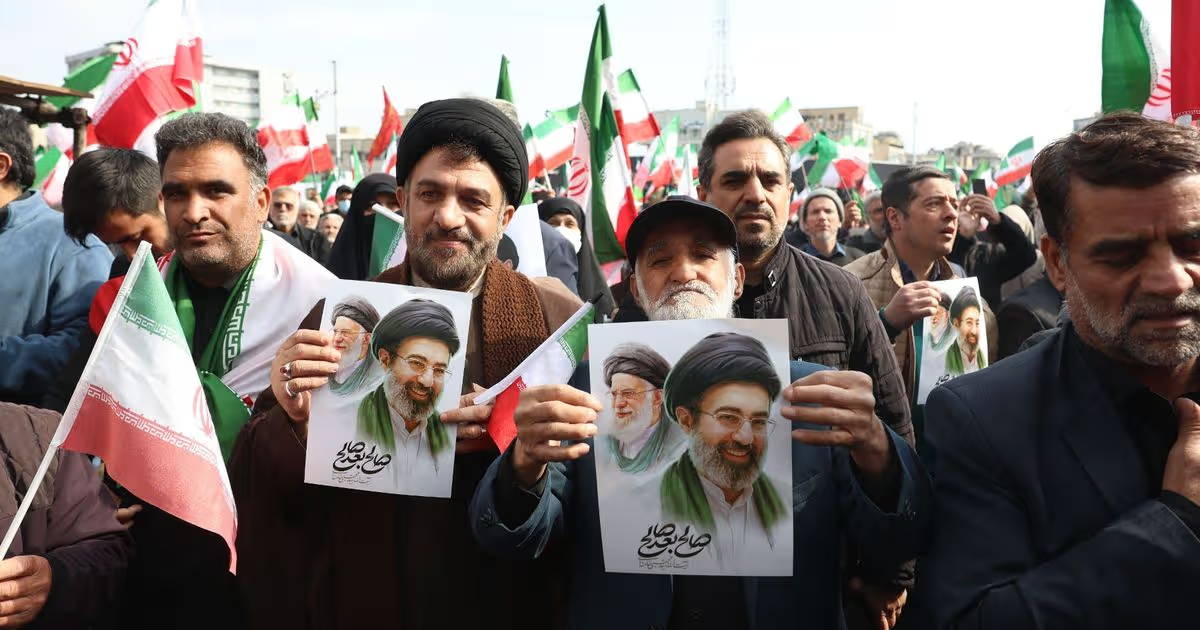
The administration has maintained that it is not pursuing regime change in Iran, even as the strikes have eliminated many figures in the Iranian leadership and President Donald Trump contemplates who he would prefer to see leading the country. The intelligence evaluation concluded that there was no single powerful or unified opposition coalition ready to assume control in Iran if the leadership were eliminated, according to those familiar with the report.
It found that Iran’s establishment would strive to maintain continuity of power if Supreme Leader Ayatollah Ali Khamenei were killed, the individuals stated. Following the assessment’s conclusions, Iran’s senior clerics on Sunday selected a new supreme leader, Mojtaba Khamenei, to replace his father, who was killed in the war’s initial strike.
The son is understood to harbour views that are even more extreme than his father’s, and his appointment is a powerful signal of defiance from Iran’s leadership and a clear indication the government won’t stand down easily. The specifics of the assessment were reported previously by The Washington Post and The New York Times.
Trump and other senior administration figures have offered varying justifications for the strikes that commenced on February 28, claiming they were essential to hinder Iran’s nuclear weapons programme or to forestall an Iranian ballistic missile assault. Whilst Defence Secretary Pete Hegseth has stated the war is not targeted at regime change, Trump has indicated it’s something he wishes to achieve.
A spokesperson for the Office of the Director of National Intelligence declined to comment on the assessment on Monday and directed questions to the White House. Director Tulsi Gabbard dismissed the council’s acting chairperson last year following the publication of a declassified NIC memo that conflicted with statements the Trump administration has employed to justify deporting Venezuelan immigrants.
Trump, going back to his first term, has been profoundly sceptical of the U.S. intelligence community and has regularly rejected its findings as politically driven or part of a “deep state” attempt to undermine his presidency. Richard Goldberg, who served as director for countering Iranian weapons of mass destruction at the National Security Council during Trump’s initial term, pointed out that there’s also a degree of doubt towards the intelligence community due to some of its significant misjudgments in recent years.
American intelligence agencies largely failed to foresee the swift downfall of the Afghan government to the Taliban that occurred in 2021, with most evaluations suggesting a much slower takeover. And prior to Russia’s invasion of Ukraine in 2022, the ODNI, the Defense Department and the CIA incorrectly predicted that Kyiv would rapidly succumb to a larger and better equipped Russian military.
Goldberg, currently a senior adviser at the Foundation for Defense of Democracies, a hawkish Washington think tank, described an intelligence assessment as “almost like an op-ed from the intelligence community.”





.jpeg?quality=75&auto=webp&width=960)