
Connect with us

NewsBeat

Closely followed inflation measure worsened to start the year

Published

on

Closely followed inflation measure worsened to start the year

WASHINGTON (AP) — An inflation gauge closely monitored by the Federal Reserve moved higher in January in the latest sign that prices were persistently elevated even before the Iran war caused spikes in oil and gas costs.

Prices rose 2.8% in January compared with a year earlier, the Commerce Department said Friday, slightly below December’s increase in a report that was delayed by last fall’s six-week government shutdown. The shutdown created a backlog of data that is nearly cleared.

Yet excluding the volatile food and energy categories — which the Fed pays closer attention to — core prices rose 3.1%, up from 3% in the prior month and the highest in nearly two years.

On a monthly basis, prices rose 0.3% in January, while core prices jumped 0.4% for the second straight month, a pace that if sustained would lift inflation far above the 2% annual target set by the Fed.

Advertisement

The data has since been overtaken by the war with Iran, which began Feb. 28 and has shut down the Strait of Hormuz, cutting off one-fifth of the world’s oil supply. Oil prices have soared more than 40% since the war began and gas prices have jumped to $3.60 a gallon from just under $3 a month earlier, according to AAA. Those figures will likely cause inflation to spike in March and potentially April, economists forecast.

The inflation-fighters at the Fed have kept their key interest rate elevated to slow borrowing, spending, and growth in an effort to cool inflation further. Fed policymakers meet next week and are widely expected to keep their rate unchanged given that the conflict in the Middle East will raise inflation, at least in the short run.

The report also showed that consumers lifted their spending at a solid 0.4% pace in January, matching December’s rise and a sign that Americans are still able to drive steady growth. Consumer spending powers about two-thirds of the economy.

Incomes also rose 0.4%, a positive sign that consumers didn’t have to dip into savings to propel spending in January. After-tax incomes jumped 0.9%, fueled by a large increase in Social Security benefit payments after a large cost of living adjustment took effect at the start of the year.

Advertisement

Friday’s report includes the personal consumption expenditures price index, which is separate from the more widely-followed consumer price index, which was reported on Wednesday. The PCE index is running hotter than the CPI, largely because it puts much less weight on rental costs, which have been cooling steadily in recent months.

The PCE index typically runs below the CPI, but has pulled ahead of it just in the past few months.

Advertisement

Source link

Continue Reading
Click to comment

Leave a Reply

Your email address will not be published. Required fields are marked *

NewsBeat

Best creatine supplements and powders 2026, tried and tested for muscle growth

Published

on

Best creatine supplements and powders 2026, tried and tested for muscle growth

Creatine is one of the best supplements you can take for muscle growth, and it’s backed by extensive research. Loved by bodybuilders, athletes, and anyone serious about enhancing their physique, creatine helps your muscles produce more energy during intense workouts, giving you the strength to push harder and achieve faster results.

Naturally found in foods like red meat and seafood, creatine can also be taken as a supplement to give your muscles the extra boost they need to reach their full potential. If you’re looking to take your training to the next level, creatine is the game-changer you want.

Best creatine supplements at a glance

Lily Chapman, Performance Coach and Nutritionist for P3RFORM says: “Creatine is a natural substance that the body both produces itself and takes from protein-rich foods or supplementation. Creatine supplements work by maximising the body’s natural creatine stores, meaning individuals can potentially increase muscle strength and size, stimulate phosphocreatine resynthesis, or improve cognitive functioning.

Creatine can help a range of individuals, whether this is gym-goers wanting to increase their muscle mass, bodybuilders who are going through their ‘cutting’ phase whereby they seek to lose fat, whilst maintaining lean muscle, strength, and power athletes, or even those wanting to improve functional strength as they age.

Advertisement

Should I take creatine every day?

Edward Mather, Registered Nutritionist at Fuel Hub shares, “Creatine is a saturation product, meaning we have to go through a period of saturation before we see any benefits. This involves going through a loading phase (5g x 4 = 20g/day) for 5-7 days. After this period, 3-5g servings daily will be enough to maintain the benefits associated with creatine. So yes, taking creatine daily will see the most benefits. A loading phase is not essential but has been shown to be effective.”

What should people keep in mind before adding it to their workout/nutrition routine?

Chapman reveals, “Creatine is widely studied and considered safe to use by the International Society of Sports Nutrition. However, creatine can promote water retention, which can be disruptive if your goal is weight loss (this should not be an issue, as your real goal is fat loss, not weight loss!) With this, I’d still recommend creatine even when seeking to lose fat, as the benefits (increased muscle strength, etc) are extensive.”

Advertisement

What is the best way to incorporate it into a fitness plan?

“For those really looking to maximise their performance, taking small daily doses of creatine (3-5g/d) should be enough to fulfil requirements” advises Chapman. “Studies show that the optimum time to take creatine is shortly before or after exercise.”

When testing the best creatine supplements, the Standard Shopping team took a methodical approach to evaluate each one’s effectiveness and ease of use. The first step was considering the ingredients, ensuring they were high-quality, and focusing on whether the creatine was micronised, which can help with absorption and reduce bloating.

We tested each supplement across a range of workout scenarios, from high-intensity weightlifting to endurance training, to see how well they supported performance and recovery. We also looked at how each form of creatine (powder, capsules, or gummies) mixed or dissolved, as convenience is key for many users.

Advertisement

We noted the impact on muscle mass and strength, particularly in those who followed the recommended daily doses, including both those who completed a loading phase and those who simply maintained a lower, steady dose. Additionally, we considered how creatine affected water retention and whether it contributed to muscle volumisation, as this can be a key concern for users aiming to avoid bloating.

We’ve rounded up the best creatine supplements below

What are the pros and cons of creatine?

“Creatine is one of the most widely researched supplements to date and there is now an abundance of strong evidence showing creatine has many benefits on health and performance”, Mather explains. “Benefits include improved strength and power output, increased muscle mass, improved training quality and cognitive function, as well as possible anti-concussion benefits. This explains why it’s so popular amongst athletes and fitness professionals. Some people have reported gastrointestinal issues such as bloating and nausea when taking creatine in larger doses, but this can be helped by splitting doses throughout the day and by consuming with food. Additionally, there may be some water retention experienced but this isn’t seen in everyone and the benefits outweigh any potential negatives.”

Advertisement

What does creatine do to the body?

According to the nutritionist, “Creatine plays an important role in energy metabolism. Once it enters our cells, it’s phosphorylated into phosphocreatine, an energy substrate that is responsible for regenerating ATP (adenosine triphosphate). During exercise, muscles require ATP as an immediate energy source, but we only have a limited supply of this which lasts for just a few seconds during high-intensity exercise, where it is broken down and turned into ADP (adenosine diphosphate). This is where creatine can help by regenerating ATP within the muscles, allowing you to sustain high-intensity performance for longer periods.

Along with regenerating ATP within the muscles, creatine also plays a role in brain ATP production, which may explain the cognitive benefits associated with supplementation. Additionally, creatine increases the uptake of water into the muscles, leading to cell volumisation and increased water retention within the muscles.”

Source link

Advertisement
Continue Reading

NewsBeat

Is Nigel Farage Starting To Crack Under Pressure?

Published

on

Is Nigel Farage Starting To Crack Under Pressure?

Nigel Farage has not had an easy few days.

Fresh from Reform’s loss to the Greens in the Gorton and Denton by-election, the party waded head-first into debates around the UK’s involvement – or lack thereof – in Donald Trump’s war against Iran.

The party leader initially insisted Britain should “do all we can” to support the operation, saying: “The gloves need to come off, we need to accept that we are part of this with the Americans and the Israelis.”

Some senior party members, like his deputy Richard Tice and Reform mayor of Greater Lincolnshire Andrea Jenkyns, quickly backed him.

Advertisement

But top Tory defector Robert Jenrick, now Reform’s Treasury spokesperson, said it was not necessary for Britain to join the bombing – exposing clear splits in the party’s position.

Then, in a major U-turn on Tuesday, Farage told reporters: “If we can’t even defend Cyprus, let’s not get ourselves involved in another foreign war.”

Farage’s sudden change of heart followed a spike in global oil prices, sparking fears of higher mortgage rates, petrol prices and inflation.

Polls indicated a majority (59%) of Brits did not support joining the war, either.

Advertisement

During the same press conference, Farage also hit out at Sky News’ Beth Rigby, after she pointed out that Reform councils have not delivered on their promise to cut council tax.

He angrily shouted: “Wrong, wrong, wrong, wrong, wrong! Never once in the county campaign, including here in Derbyshire, did I ever say we would cut council tax.”

Farage insisted that Reform’s “national literature” called for an overall cut to taxes, not to council taxes.

And on Friday, he adopted a more defeatist tone, saying he wished his party “hadn’t bothered” to take minority control of the bankrupt Worcestershire Council Council.

Advertisement

Reform had to hike council tax by almost 9% in the area, one of the largest increases in the area’s history, to balance the books.

To rub salt in the wound, just seven days ago, Labour beat Reform with its first council by-election gain in almost a year in Durham County Council.

Farage somehow found time to fight with pollsters, too.

He attacked YouGov after the company’s surveys suggested his party had lower public support compared to other polls.

Advertisement

He claimed it is “plainly deceptive” that more is not known about their methods and called for transparency around modelling assumptions.

It’s worth noting that YouGov’s latest poll put the party on 23%, still four percentage points above the Conservatives.

More In Common’s director Luke Tryl called the attacks on YouGov “unwarranted and unfair”.

Writing on X, he said: “They’re a gold standard in our business, have a great track record and the rest of the industry learns so much from them. Sometimes pollsters get different results from each other, that’s a good thing [and] shows we aren’t herding!”

Advertisement

When approached by HuffPost UK, Reform rebuffed claims this week has been stressful, pointing out they are polling at 30% nationally according to More In Common.

A source pointed out they had three sold out rallies this week with thousands of attendees and deployed the “lowest council tax rises in the country” with an average of 4.32%.

The party claimed it had managed to get greater transparency from YouGov, too.

But questions remain around the way Farage has reacted to scrutiny this week,

Advertisement

Savanta’s political director, Chris Hopkins, told HuffPost UK that Farage was reading off “the Trumpian playbook” by “reacting with hostility to scrutiny and blaming everyone but himself for his party’s fall in momentum in the opinion polls”.

The pollster added: “This week he’s even turned his ire directly towards us pollsters where, not for the first time, he publicly challenges polling figures that he doesn’t seem to like.”

Current predictions suggest Reform is on course to win the most seats when voters next head to the polls, though it is still expected to be shy of an overall majority.

Farage will therefore be under a microscope in the run-up to the next general election.

Advertisement

Hopkins said: “The longer Reform stay at the forefront of British politics, the greater the scrutiny on Farage will be, and if his temperament is being questioned now, years away from a general election, it’ll be interesting to see how he’ll react to supporter expectation and the bright lights of an election campaign.”

The pollster warned that there is also a “general sentiment” that Reform may have peaked after more than a year leading the polls.

“The major challenge for Farage and his party will be to still be sitting atop of the pile when the music stops, especially when so much can change so quickly in British politics,” he said.

A Labour insider said it was clear that “Farage can’t deal with the pressure”.

Advertisement

They added: “The wheels have well and truly fallen off the bandwagon this week, the cracks are beginning to show.”

A Green Party source also said: “Reform were able to play on easy mode, presenting themselves as outsiders to a failing Labour government but the mask has slipped.”

It took years for Farage to assert himself within mainstream politics.

He has managed to hold a confident lead in the polls for more than a year, winning over voters on his promise to offer something different from the “establishment” parties.

Advertisement

But, with a general election expected to still be three years away, can the Reform leader keep his cool – and hold his growing party together – in that time?

Source link

Advertisement
Continue Reading

NewsBeat

Newsboy’s horseracing tips for Saturday’s five meetings including Kempton NAP

Published

on

Daily Mirror

AWORKINPROGRESS has the tools to finish the job in the Jenningsbet Midlands Grand National (3.00) at Uttoxeter today. The Nick Gifford-trained seven-year-old has been a winning machine over fences – he’s won six of his seven starts in the sphere – and is mustard over a distance of ground that has plenty of juice in it.

Advertisement

Having signed off his career over hurdles with a win at Fontwell Park in May 2024, Aworkinprogress racked up a five-timer over the larger obstacles. The going was ‘soft’ or ‘heavy’ when the son of Soldier Of Fortune collected at Stratford, Lingfield Park (three times) and Uttoxeter between October 2024 and November 2025.

READ MORE: Sir Alex Ferguson secures huge Cheltenham Festival windfall as tax loophole emergesREAD MORE: Harry Redknapp’s The Jukebox Man flying flag for England at Cheltenham in Gold Cup

The winning run came to an end at Chepstow 19 days before Christmas but Aworkingprogress resumed normal service in the Surrey National back at Lingfield last time out.

Ridden as this afternoon by James Davies, my preference got the better of a stirring duel with the reopposing Catch Catchfire, the front pair 12 lengths clear of the third horse.Under the circumstances, a 5lb rise in the weights could have been worse and Aworkinprogress has the ideal conditions to go in again.

Advertisement

The Jenningsbet Novices’ Handicap Chase (3.35) is taken to go the way of another son of Solder Of Fortune, AS THE FELLA SAYS.

James Bowen, who celebrated the first Cheltenham Festival winners this week, was on board when Nicky Henderson’s seven-year-old broke his duck over fences at the fourth attempt at Newbury 25 days ago.

As The Fella Says justified his status as the 15-8 favourite by powering way from Major Fortune to score by four and three-quarter lengths.

Advertisement

The British Horseracing Authority number-cruncher was never going to take that performance lying down and As The Fella Says is 7lb higher today – but still has more to offer.

Model of consistency JOHN BARBOUR is expected to give another good account of himself in the JenningsBet Handicap Hurdle (2.25).

From 12 visits to the track, Yeats’s son has failed to make the frame just once, gaining the last of his three victories here in the Potteries on New Year’s Eve.

John Barbour found only the back-to-form Fiercely Proud too good over two and a half miles at Ascot next time and a first try over an additional four furlongs should suit the Fergal O’Brien trainee.

Also going up in distance is IT’S TOP in the opening JenningsBet 200 Shops Nationwide Handicap Hurdle (1.50).

Gavin Sheehan’s mount was strong at the finish when making all for a novice hurdle at Carlisle at the beginning of last month and a first try at two and a half miles should unlock further progress as the bottom weight moves into handicaps.

At Kempton Ryan’s Rocket is fancied to gain handsome compensation for Christmas calamity in Sunbury by landing the Virgin Bet Supports Safe Gambling Handicap Chase (3.18).

Advertisement

Punters sent the Fergal O’Brien-saddled son of Jetaway off the 7-4 favourite for the Grade 2 Ladbrokes Desert Orchid Handicap Chase on the second day of the King George VI Chase fixture after the eight-year-old’s comeback score at Newbury in November.

Everything was going to plan until my selection made a mistake at the eighth of the 12 obstacles, and decanted Johnny Burke into the turf. Ryan’s Rocket was going easily at the time, and it’s instructive to not that Thistle Ask, the 10-length winner from a British Horseracing Authority mark of 146, is now rated 160.

For his part, Ryan’s Rocket has been dropped 1lb to 134, a figure that’s well within range as he bids to pocket the £31,218 first prize.

Advertisement

Burke could also be in business aboard TURNDLIGHTSDOWNLOW in the Virgin Bet A Good Bet Handicap Hurdle (2.40).

Martin Keighley’s son of Court Cave scored over course and distance in September on his debut in the handicap sphere, following up over Kempton’s two miles and five furlongs three weeks later.

He lost little in subsequent defeats over further at Sandown Park and Wincanton, but coming back in distance – and returning to Sunbury – won’t hurt his chances.

Advertisement

After a fine second to Barlovento here on the King George undercard, TAPLEY and Izzi Ryder are likely to take some pegging back in the Virgin Bet Novices’ Limited Handicap Chase (2.08).


Source link

Advertisement
Continue Reading

NewsBeat

Controversial HMO applications in Ballygomartin Road area deferred for site visits

Published

on

Belfast Live

Councillors have also “called-in” the applications for legal examination

Controversial applications to turn three North Belfast houses into HMOs have been deferred by Belfast Council for site visits and “call-ins.”

Plans for three houses in close proximity in the Ballygomartin Road area, at 29 Glencairn Street, 24 Rutherglen Street, and 163 Ballygomartin Road have all gone to City Hall for conversion to HMOs. Each property has a different owner.

At the March meeting of the Belfast City Council Planning Committee, elected representatives agreed to defer decisions on all three for site visits.

Advertisement

READ MORE: Sinn Féin pour cold water on proposal for new arts centre in “bohemian” South Belfast

READ MORE: Padel Centre approved for East Belfast garden supply warehouse, despite being earmarked for apartments

The Glencairn Street application is for change of use from a three bedroom dwelling to a five bed, five person HMO. 69 objections have been received to the application.

The main concerns raised within thes objections are that there are too many HMOs in the area, with multiple existing HMOs on Glencairn Street. Objectors state more family homes are needed in the area and the plan would reduce surrounding house values. The objectors also raise concerns regarding parking issues, added strain on local services, and increased noise.

Advertisement

The application has been “called in” by councillors to be looked at on legal grounds. Reasons for the call-in include overconcentration of HMOs, parking and traffic issues, impact on residential amenity, property and waste management. Councillors say it is contrary to planning policy.

Despite this, council officials are recommending the application for proposal, and state in the planning report: “The proposal is compliant with policy in that the 10 percent threshold for HMOs on Glencairn Street has not yet been reached. Officers consider that the proposal will not be harmful in terms of traffic, parking, impact on residential amenity or the amenity of the surrounding area.”

The application for the neighbouring Rutherglen Street property is for change of use from a four bedroom dwelling to a five bedroom, five person HMO. 50 objections have been received to this application. Objectors raised similar concerns to that surrounding the application at Glencairn, and councillors again called-in the application.

The application for the neighbouring Ballygomartin Road property is again for change of use from a four bedroom dwelling to a five bedroom, five person HMO. 41 objections were forwarded regarding the application, with similar objections. Councillors again called in the application.

Advertisement

Both the Rutherglen Street and Ballygomartin Road applications have been recommended for approval by council officers.

Houses of Multiple Occupation, also known as a “house-share” residencies, which landlords lease out to three or more tenants from different addresses, have become increasingly controversial, with some arguing they have negatively affected communities and led to anti-social behaviour in places like the Holylands and Stranmillis in South Belfast, where landlords pack houses with undergraduates and others.

Applications for new HMO licences have increased in other parts of the city in recent years. A series of applications have been refused across the city, but many applicants are successfully appealing the decisions via the Planning Appeals Commission.

HMO licence renewal cannot be refused on the basis of overprovision of such properties in an area, but new licences can be refused on this basis.

Advertisement

While the council policy is that HMO’s should not account for more than 20 percent of any area of housing management, in reality many streets exceed this, with some in the Holylands reaching over 90 percent. Outside housing policy areas the threshold is 10 percent.

For all the latest news, visit the Belfast Live homepage here and sign up to our daily newsletter here.

Source link

Advertisement
Continue Reading

NewsBeat

Ministers warn petrol retailers against ‘unfair practices’

Published

on

Ministers warn petrol retailers against ‘unfair practices’

Chancellor Rachel Reeves told petrol retailers they had a “shared obligation” to keep prices down for motorists.

The Petrol Retailers Association (PRA) had threatened to pull out of the Downing Street meeting with Ms Reeves and Energy Secretary Ed Miliband after claiming the Government’s “inflammatory language” over rising fuel prices led to abuse against forecourt workers.

At the Downing Street meeting, Mr Miliband warned executives from the forecourt operators and firms including Shell that the Government would not tolerate “unfair practices” in the industry.

The RAC said the average price for a litre of unleaded had risen by 8p since the start of the crisis, with the cost now its highest for 18 months.

Advertisement

The Chancellor hosted industry chiefs in 11 Downing Street on Friday in response to rising concern about the impact of the Middle East crisis on household finances.

Ms Reeves thanked the petrol bosses for their co-operation, but told them she wanted an “open and frank conversation” with them.

She said: “We have concerns around the high prices and we do have a shared obligation.”

Mr Miliband told them: “We have said so clearly that we won’t tolerate unfair practices either here or anywhere else in the industry. It is out obligation as the Government to ensure the consumers are treated fairly in this crisis.”

Advertisement

Before the meeting, Gordon Balmer of the PRA raised concerns that recent language from the Government was driving abuse against fuel retail staff by members of the public “following several days in which ministers have suggested that forecourts may be ‘price gouging’ and ‘ripping off’ the motorist”.

The PRA later said it would take part in the meeting after assurances from the Treasury that it would be held largely in private, which the group said would “allow a conversation to explain how the fuel market works”.

Mr Balmer said: “Recently, I have heard of incidents from some of our members of retail staff being abused by members of the public, who may have been provoked by the incorrect and inflammatory language emanating from some commentators, for example, the use of the terms ‘rip-offs’ and ‘profiteering’.

“Our members are working hard in difficult circumstances, making sure that motorists and businesses are getting the fuel they need, at prices that are very competitive, on razor-thin or in some cases negative margins, which means they are losing money.

Advertisement

“Our job is to serve the public, keeping motorists and businesses on the road.”

He added: “There is clearly still a lot of work to do to help politicians and commentators to understand how the fuel market works and our door is always open for constructive dialogue.”

Ms Reeves has asked the competition watchdog to “crack down” on “rip-off” fuel prices to guard against profiteering over the high oil prices due to the Iran war.

The Government has already promised to intervene if companies engage in “unfair” practices that would hit customers facing a rise in the price of home heating oil, which is not covered by Ofgem’s energy price cap.

Advertisement

However, the AA warned that motorists “will be stung” with inevitable rising costs because of a global hike in prices, and called on Ms Reeves to delay a planned increase in fuel duty.

The Chancellor has faced opposition pressure to abandon her decision to gradually phase out a 5p cut to the levy, starting with a 1p increase from September this year.

The RAC said the average litre of unleaded had risen from 132.83p to 140.60p.

The motoring organisation’s head of policy, Simon Williams, said: “Households, especially those that depend on the car, are under increasing financial pressure as a result of the conflict in the Gulf.

Advertisement

“The average price of a litre of unleaded has now risen by 6%, or nearly 8p, to 140.6p since the start of the conflict and is it at its highest in 18 months. Diesel has rocketed by 12% – or almost 17p – to 159.2p a litre, a price we’ve not seen since November 2023. Filling a family car is now £4 and £9 more than it was less than two weeks ago.

“The fact the cost of a barrel of oil has exceeded 100 US dollars and wholesale fuel prices continue to rise is concerning, but it’s the speed at which drivers are feeling the effects which is under the spotlight now.

“Drivers deserve – and should expect – to be treated fairly when it comes to filling up, especially with pump prices still heading north. We therefore hope the meeting between the fuel industry and government on this important issue is productive.”

Prime Minister Sir Keir Starmer has since said the Government will keep the situation “under review” in light of the Middle East conflict.

Advertisement

On Thursday, the Competition and Markets Authority warned it was putting fuel retailers “on notice” of plans to step up monitoring of petrol and diesel prices in light of the Middle East uncertainty.

The Government has said drivers can compare prices at different petrol stations across the UK through its Fuel Finder service.

Source link

Advertisement
Continue Reading

NewsBeat

Major link road scheme work to disrupt traffic over next two weekends

Published

on

Manchester Evening News

The scheme has been more than half a century in the making

Motorists can expect delays through Mottram Moor over the next two weekends as work continues on a major bypass scheme ‘60 years in the making’.

Work on the new A57 link road scheme began last year, The Mottram bypass has been an ongoing saga in Tameside for decades, but now it is close to becoming a reality.

The £228m project aimed at tackling congestion between Manchester and Sheffield.

Advertisement

Get MEN Premium now for just £1 HERE – or get involved in our WhatsApp group by clicking HERE. And don’t miss out on our brilliant selection of newsletters HERE.

There will be disruption between 7pm today (March 13) until 6am on Monday, March 16 and between the same times the following weekend (March 20 to 23).

According to National Highways, the work involves installing utility services and building a new plant crossing. This will allow construction materials to be moved safely and efficiently across the A57 as part of the major scheme.

Following extensive preparation and site clearance works, the project is now moving into the main construction phase. Three key milestones mark this progress: the start of piling works for a new underpass in Mottram; construction of a new through road across Hattersley roundabout; and the building of a temporary plant crossing at Mottram Moor.

Advertisement

Andrew Scatchard, National Highways senior project manager, said: “This is an exciting time as we reach these three major milestones in our work to build the two new link roads, which will help address the long-standing issue of congestion in Mottram-in-Longdendale and improve journeys between Manchester and Sheffield.”

Underpass piling

The first milestone is the start of piling works for the new underpass that will carry the A57 Link Road beneath Roe Cross Road and Old Hall Lane in Mottram, connecting to the A57 at Mottram Moor.

Advertisement

To enable construction, a temporary relief road has been built to carry traffic along Roe Cross Road, with vehicles successfully transferred onto this new route. This has created the space needed to position the large piling rig required to construct the underpass.

Hattersley roundabout

The second milestone can be seen at junction 4 of the M67 motorway, also known as Hattersley roundabout.

Groundworks are underway to create a new through road across the roundabout. Once complete, this will allow westbound traffic travelling from the new dual carriageway link road to access the motorway more directly, improving traffic flow and making journeys quicker and smoother.

Advertisement

Mottram Moor plant crossing

The third milestone is the construction of a temporary plant crossing over the A57 road at Mottram Moor, starting this week.

The crossing will allow construction vehicles to safely transport excavated material from the underpass works across Mottram Moor for use along the ‘Glossop Spur’ link road, reducing the need to transport material off site.

Andrew Scatchard added: “At the same time as we construct the crossing, our utility partners will also complete important utility works. We always strive to minimise disruption where possible, but delays to journeys are expected over the next two weekends and the week in between.

Advertisement

“We therefore advise people to plan before they travel and allow extra time to complete their journeys. We would again like to thank the local community, including road users, for their support and patience while we carry out this work.”

The A57 link roads project includes the creation of two new link roads. One is Mottram Moor link road – a new dual carriageway from the M67 junction 4 roundabout to a new junction on the A57 at Mottram Moor.

The other is the A57 link road – a new single carriageway link from the A57 at Mottram Moor to a new junction on the A57 in Woolley Bridge.

Once installed, the plant crossing is expected to come into use from mid-April. When in operation, traffic will be held for short periods only, with traffic lights in place and regularly monitored, while construction vehicles transport materials across Mottram Moor.

Advertisement

The A57 link roads scheme is estimated to be up and running by 2028, but a full completion date could be as late as 2031, according to the National Highways website.

Source link

Continue Reading

NewsBeat

Iran’s energy lifeline that has so far escaped attack

Published

on

Iran’s energy lifeline that has so far escaped attack

As the US and Israel’s assault on Iran grinds on, the Trump administration has issued increasingly bellicose claims that American and Israeli forces are delivering ferocious blows to the Iranian regime.

The US secretary of defense, Pete Hegseth, warned of the “most intense” day of strikes yet on March 10. And Donald Trump followed with a claim that the war will end soon because there is “practically nothing left” in Iran for the US military to target.

This is all part of a campaign that the White House has declared is aimed at “systematically dismantling the Iranian regime’s ability to ever again threaten America, our allies, and global security.”

So far, this campaign has largely targeted Iran’s military and nuclear facilities. But some critical non-military infrastructure has also come under attack. Israel struck two oil refineries and two oil storage facilities near Tehran on March 8, with Iran accusing the US of attacking a desalination plant the same day.

Advertisement

Yet one target vital to Iran’s economic survival, its largest export terminal for sending oil to international markets, remains unscathed. That terminal sits on Kharg, a small coral island off Iran’s south-western coast. This is where oil pumped across Iranian oil fields arrives via subsea pipelines to be loaded on to tankers, mostly bound for China.

At peak capacity, the terminal’s vast storage facilities and multiple jetties can handle millions of barrels of oil per day. Kharg accounts for an extraordinary 90% of Iranian crude exports and tens of billions of US dollars of annual government revenue.

No other major oil-producing country is so reliant on just one facility. Saudi Arabia, Kuwait and the United Arab Emirates in the Gulf, and massive producers elsewhere such as Russia, Mexico and Venezuela, do not concentrate almost all their export capacity in a single location.

Advertisement

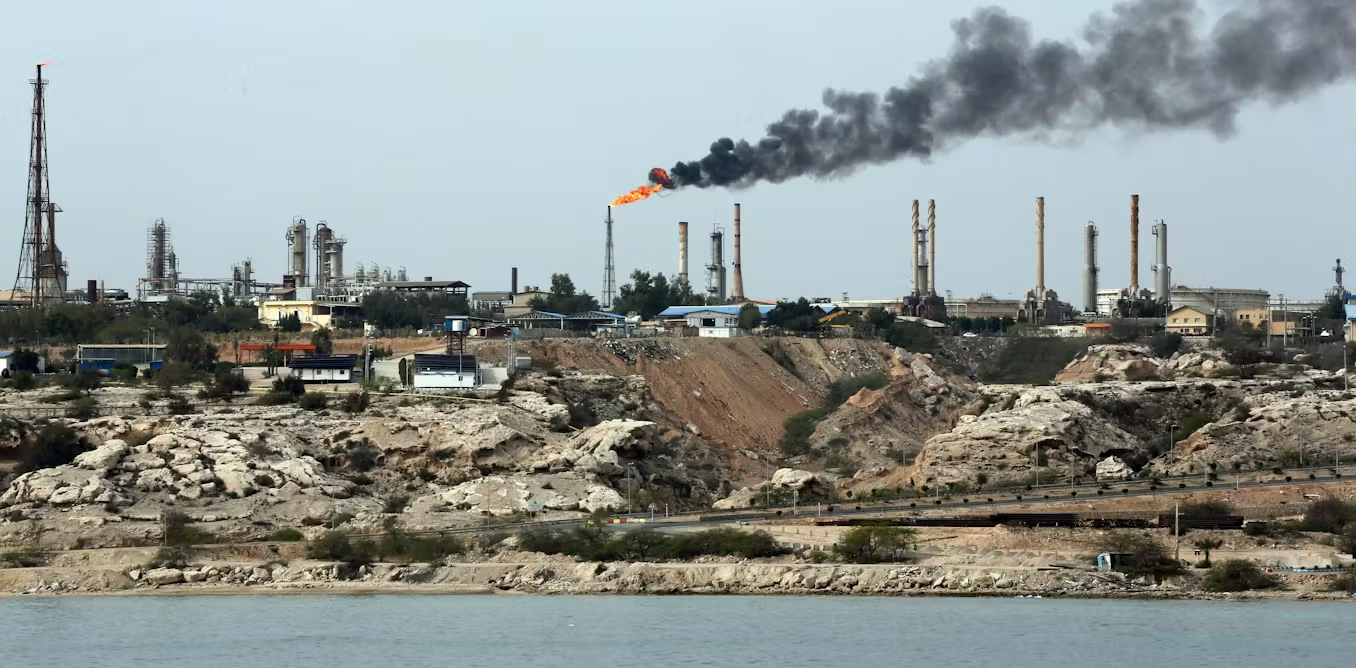
Kharg is a five mile long island located off the south-west coast of Iran.
Uwe Dedering / Wikimedia Commons, CC BY-SA

Iran’s energy lifeline

Kharg Island became the linchpin of Iran’s oil industry due to a convergence of history and geography. Nowadays, Kharg is widely known among Iranians as the “forbidden island” because of the tight military restrictions and secrecy that surround it.

Yet behind its modern geoeconomic significance lies an ancient history, from early human settlements dating back more than 4,000 years to occupation by various empires that understood its strategic maritime importance as a trading post. The island also housed political prisoners in the mid-20th century, before the construction of Kharg’s modern terminal began in 1958.

The island quickly became Iran’s dominant export port for two reasons. First, it could be connected by pipeline to the major oil fields in south-western Iran. And second, its deep water location made it one of the only places on Iran’s western coast that could accommodate the new supertankers that were at the time dramatically reducing the cost of transporting oil.

Once the gigantic storage facilities, jetties and subsea pipelines feeding the terminal had been constructed, centralising exports there created significant efficiencies. Oil from multiple fields could share the same storage and loading infrastructure, thereby reducing overall operating costs.

Advertisement

Kharg’s dominance in the national oil export system was further reinforced after the Islamic revolution in 1979. This was because regional tensions and Iran’s emphasis on self-reliance discouraged it from using pipelines that pass through neighbouring countries.

A Thai cargo ship on fire after being struck by missiles in the strait of Hormuz.
A Thai cargo ship was struck by missiles in the strait of Hormuz of March 11.
Royal Thai Navy / EPA

At first glance, Iran’s reliance on one terminal for nearly all its oil exports seems like a major strategic vulnerability. There are also no significant operational challenges preventing the US and Israel from destroying it. Yet, paradoxically, this is precisely why it has not been targeted thus far.

Crippling Iran’s entire oil industry for months – if not years – would shatter the already fragile confidence in financial markets that Trump can achieve his vague war aims without long-term disruption to the global economy. Some analysts predict that oil prices could soar to US$150 (£112) a barrel if Kharg is hit.

To put that figure into context, Russia’s 2022 full-scale invasion of Ukraine caused Brent crude to rise to well over US$100 a barrel for four months. This was not the only cause of the roughly 9% surge in inflation seen at the time, but it was an important factor in the ensuing cost of living crisis.

Launching an attack on Kharg would likely expose Trump’s gamble in launching a war against Iran while simultaneously promising US consumers that virtually everything would become more affordable as a catastrophic error. American voters are indicating that inflation and the cost of living are their biggest concerns ahead of the upcoming midterm elections in November.

Advertisement

Of course, Trump’s intervention in Iran may lead to rising prices even if the US does not attack Kharg Island. The wider disruption to Gulf shipping in the strait of Hormuz has already caused oil prices to rise to around US$100 per barrel. And in his first statement since becoming Iran’s supreme leader, Mojtaba Khamenei vowed to keep blocking the waterway.

But at least for the moment, Trump seems to realise that Kharg Island needs to be left intact if he is to preserve the already shaky notion that he can end this war in a manner he can present as a success – which increasingly looks like degrading Iran but not forcing it to capitulate – without causing long-term economic pain for Americans.

One other factor preventing the US from destroying Kharg is that it would cause long-lasting damage to the Iranian economy. This would undermine any pretence that Trump is acting in the interests of the Iranian people, as he has claimed, since any new government would be financially crippled if the regime did collapse.

So Kharg Island survives intact for now. This is, in large part, due to the fundamental contradiction between Trump’s objectives in Iran and the political and economic costs he is willing to incur in pursuit of them.

Advertisement

Source link

Continue Reading

NewsBeat

This deadly disease had been eliminated in the UK – now it’s back spreading in every region

Published

on

Manchester Evening News

You can check vaccination rates in your area and see how many cases have been confirmed using our interactive map

Advertisement

A disease that had been eliminated in the UK is returning. The Victorian illness had been eradicated thanks to a vaccination programme by public health leaders, but it has now reappeared in 50 council areas.

A new map has highlighted the low vaccine-rate areas where it is spreading quickly. Measles infections have now been confirmed by lab tests in every region of England, the UK Health Security Agency (UKHSA) has confirmed, mainly among children under 10.

The figures come as one health chief has warned: “Measles is a serious disease that can cause pneumonia, meningitis, blindness, seizures and, tragically, death… Measles is one of the most infectious diseases known, and it will find those who are unvaccinated.”

Get MEN Premium now for just £1 HERE – or get involved in our WhatsApp group by clicking HERE. And don’t miss out on our brilliant selection of newsletters HERE.

Advertisement

It comes after the WHO stripped the UK of its measles elimination status in January, following sustained circulation of the disease for more than a year. The UK was first declared measles-free in 2017, but lost its status two years later, only to regain it in 2021. However, that was mainly thanks to social distancing during the pandemic.

Outbreaks began in 2023 and intensified throughout 2024. In England alone, there were 2,911 laboratory-confirmed cases of measles in 2024. That was the highest number since 2012.

On that basis, WHO and the UK Health Security Agency said that the virus had re-established endemic transmission, costing the UK its measles elimination status.

The most recent figures show that measles cases have fallen since the 2024 peak. However, cases remain high. Last year, there were 957 laboratory-confirmed cases of measles. As of March 9, this year, there have been 235 cases.

Most of these infections have been in unvaccinated children under the age of 10.

Enfield, in London, appears to be the epicentre of the current outbreak, with 80 confirmed measles cases so far this year. That includes 35 new cases since the last update in February.

Enfield also has one of the lowest vaccination rates in the country, with around one in three children unprotected by the MMR (measles, mumps and rubella) vaccine. The latest data shows only 64.3% of children in Enfield had received both MMR jabs needed for full protection by their fifth birthday.

Advertisement

The target vaccine coverage rate is 95%. Although the UKHSA has confirmed that 50 separate council areas have had at least one confirmed infection, it only publishes case numbers for areas with at least 10 cases.

So far, three council areas have met that threshold – all with low vaccine coverage rates. Apart from Enfield, there have been 43 cases so far in Birmingham, including 19 since February, and 15 in the London borough of Haringey, which neighbours Enfield.

In Birmingham, 75.5% of five-year-olds have received both MMR jabs, and in Haringey, just 65.0% of under-fives are fully protected.

The UKHSA has blamed the resurgence of measles on falling vaccination rates, after uptake of the MMR jab slumped to its lowest in a decade. As of last summer, 91.8% of five-year-olds in England had received one dose of the MMR jab, and 83.7% were protected by both doses.

Advertisement

In many areas, such as Enfield, Birmingham and Haringey, vaccine uptake is much lower. WHO says a vaccine coverage rate of 95% is needed to achieve “herd immunity”, which prevents transmissible diseases like measles from circulating.

From this year, the MMR jab has been replaced by the MMRV vaccine, which offers the same protection as MMR but also covers chickenpox.

You can check the vaccination rates in your area and see how many measles cases have been confirmed since 2024, using our interactive map.

Advertisement

Dr Yimmy Chow, UK Health Security Agency’s London Region Deputy Director said: “We continue to see measles cases in north London, and while children remain unvaccinated, the risk of further spread is very real.

“Measles is a serious disease that can cause pneumonia, meningitis, blindness, seizures and, tragically, death. Children and adults who get measles can end up in hospital suffering needlessly, sometimes with long-term consequences that stay with them for life.

“Measles is one of the most infectious diseases known, and it will find those who are unvaccinated. Two doses of the MMR vaccine provide vital protection. If your child has missed any vaccinations, or you are unsure whether they are up to date, please contact your GP surgery as soon as possible — it is never too late to catch up.”

The key symptoms of measles include a high fever, coughing, sneezing, red and sore watery eyes, and a rash that usually appears after the initial symptoms.

Advertisement

Measles usually starts to get better after a week. However, it can lead to serious problems if it spreads to other parts of the body, such as the lungs or brain. Babies and people with weakened immune systems are more at risk from measles.

Source link

Continue Reading

NewsBeat

Harry Redknapp upbeat despite Gold Cup disappointment with The Jukebox Man

Published

on

Harry Redknapp upbeat despite Gold Cup disappointment with The Jukebox Man

Harry Redknapp says there were no excues after his horse The Jukebox Man fell away in the Cheltenham Gold Cup and that winning the race would have been like winning the Champions League.

Redknapp’s lifelong love of horseracing reached its zenith on a sunny afternoon at Prestbury Park as he, along with wife Sandra and son Jamie, cheered on the eight-year-old who was well placed heading to home.

The Jukebox Man then ran out of steam having kept up with the leader, Haiti Couleurs, before being passed by eventual winner Gaelic Warrior with two fences to jump.

“Yeah, absolutely [it would have been like winning the Champions League] if we had won here today, but Gaelic Warrior was fantastic. My God, didn’t he win? Really impressive,” said Redknapp after the race.

Advertisement

“Yeah, he traveled great until two out, and then he just seemed to just fall in a bit of a hole, but overall he jumped great, run great and he’s come back, hopefully safe and sound, which is the main thing.”

The 79-year-old then explained that his horse had missed a week of work before coming to the Festival but refused to use that as an excuse for his loss.

“He missed a week’s work and I’m not blaming it, I’m not making excuses,” Redknapp explained, “The winner won, different class but he did miss a week’s work. He simply just ran out of steam today.”

Redknapp went on to explain what his week at Cheltenham has been like and how he has revelled in then build-up to having a Gold Cup running horse.

Advertisement

He said: “I’ve loved it. It’s been a great week. The build up and the dream and everything. I’ve loved it. To have a runner here with a chance was fantastic for me.

“I’m not saying he would have won. The winner was amazing. That was absolute Gaelic warrior today. He absolutely bolted up, didn’t it? But we’ve had another great run for him again today. Yeah, he’s jumped, well, run well. So, yeah, that’s how it goes.”

Harry Redknapp and wife Sandra watched on as The Jukebox Man raced in the Gold Cup

Harry Redknapp and wife Sandra watched on as The Jukebox Man raced in the Gold Cup (Joe Giddens/PA Wire)

In spite of the obvious disappointment, Redknapp remained positive and praised how his horse had captured the hearts of the nation.

Advertisement

He ended by saying “that’s why it would have been great today if he could have won it. He didn’t but he came and give his best shot.”

Redknapp’s only previous success at the Cheltenham Festival came in 2024 when Shakem Up’Arry won the Plate Handicap Chase but the step up to the Gold Cup brings him into the upper echelon of successful owners.

Source link

Advertisement
Continue Reading

NewsBeat

Jessie Buckley "brutalised" by reality TV show

Published

on

Jessie Buckley "brutalised" by reality TV show

!function(n){if(!window.cnx){window.cnx={},window.cnx.cmd=[];var t=n.createElement(‘iframe’);t.display=’none’,t.onload=function(){var n=t.contentWindow.document,c=n.createElement(‘script’);c.src=”//cd.connatix.com/connatix.player.js”,c.setAttribute(‘async’,’1′),c.setAttribute(‘type’,’text/javascript’),n.body.appendChild(c)},n.head.appendChild(t)}}(document);(new Image()).src=”https://capi.connatix.com/tr/si?token=19654b65-409c-4b38-90db-80cbdea02cf4″;cnx.cmd.push(function(){cnx({“playerId”:”19654b65-409c-4b38-90db-80cbdea02cf4″,”mediaId”:”2f2b6000-e3e5-4a31-994a-d7029f526d96″}).render(“69b42c6ee4b0676e64bf3935”);});

Source link

Continue Reading

Trending

Copyright © 2025