NewsBeat
CNN’s data guru warns Democrats about how little support they have heading into the midterms

CNN’s polling analyst Harry Enten warned that Democrats hoping their party will retake the House this fall have no reason to rest easy, even as their party leads in generic ballot polling.
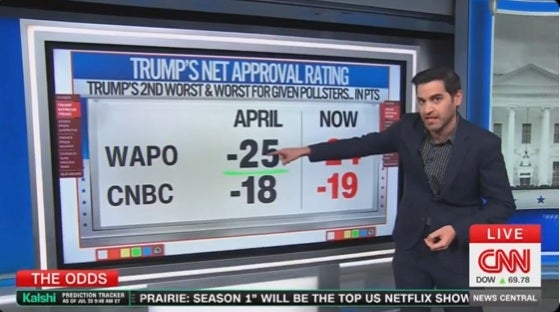
In a Monday segment on CNN’s News Central, Enten warned that recent polling from The Washington Post and CNBC show Democrats with a much slimmer lead in generic ballot polling than the party saw in past cycles where it picked up enough seats to retake the House of Representatives.
“Yes, they’re ahead, but they’re ahead – I have to shrink down on the screen – by only four points, which is significantly less than what we saw in 2018 and 2006, when Democrats took back the house,” said Enten. “This is an ‘uh-oh,’ this is a warning sign.”
The last time Democrats dethroned a Republican majority was in 2018, during Donald Trump’s first term. That majority persisted through the 2020 election into the first midterm cycle of Joe Biden’s presidency, four years later. Enten noted that Democrats enjoyed an average lead in generic ballot polling in 2018 of 10 points, far higher an advantage than the party currently holds.
“Four isn’t 10. And it’s not 12,” joked CNN’s John Berman.



“No, no, they taught me that back in pre-K, that four is not 10 or 12,” replied Enten.
He noted that with the advantage over a number of House seats in more than a half dozen GOP-held states that redrew their congressional maps at Donald Trump’s behest, Democrats’ current slim advantage on the generic ballot could put the party “right on the edge of even getting that majority.”
That analysis echoed warnings from another polling monitor, Decision Desk HQ, which predicted that a Democratic majority in such a generic ballot environment could be as slim as three seats, putting it at constant risk of failing due to absences and defections.
There’s one bright spot in the polling for Democrats, however. In the Washington Post/Ipsos poll mentioned by Enten on the show, the Democrats’ advantage on the generic ballot jumps to eight percentage points when the field of respondents is narrowed to voters who are “absolutely certain to vote.”


Enten’s analysis hits on a peculiar dynamic for Congress, however, where a reversal of fortunes has taken place over the past year. In 2025, as Trump’s initial honeymoon period faded and his approval ratings began to sag amid the onslaught of mass firings and program-slashing, political analysts in Washington generally understood that unseating a Republican House majority was a far more likely prospect for Democrats in the midterm election cycle than netting the four Senate seats required to regain their majority in the upper chamber, which is far less prone to massive election-year swings.
Instead, a series of calamities for Republican leadership unfolded in the Senate, beginning with the decision of Thom Tillis to stand down from re-election in deep purple North Carolina amid a spat with Trump.
That problem evolved with the recruitment of Mary Peltola, a popular former congresswoman and Democrat, to run in Alaska’s Senate race and Trump’s endorsement against John Cornyn, a Republican incumbent in the Senate — torpedoing any chance Cornyn had of winning a competitive GOP primary against a candidate Democrats believe they have a serious shot at beating in November.
Now, the Senate GOP majority is looking particularly vulnerable for Democrats even as the map in the House has become tougher and tougher, thanks to a series of GOP gerrymandering efforts.
The biggest disadvantage for Republicans remains Trump’s unpopularity, whose approval ratings have sunk to the mid-to-low 30s in most surveys as his war with Iran continues to drive up prices for fuel and other commodities, with seemingly no end in sight.
In the Post/Ipsos poll published last week, the president’s overall approval rating was 37 percent, and 40 precent with registered voters, having changed little from previous surveys.
You must be logged in to post a comment Login