WASHINGTON (AP) — President Donald Trump took the United States to war without a vote of support from Congress, but lawmakers are increasingly questioning when, how and at what cost the war with Iran will come to an end.
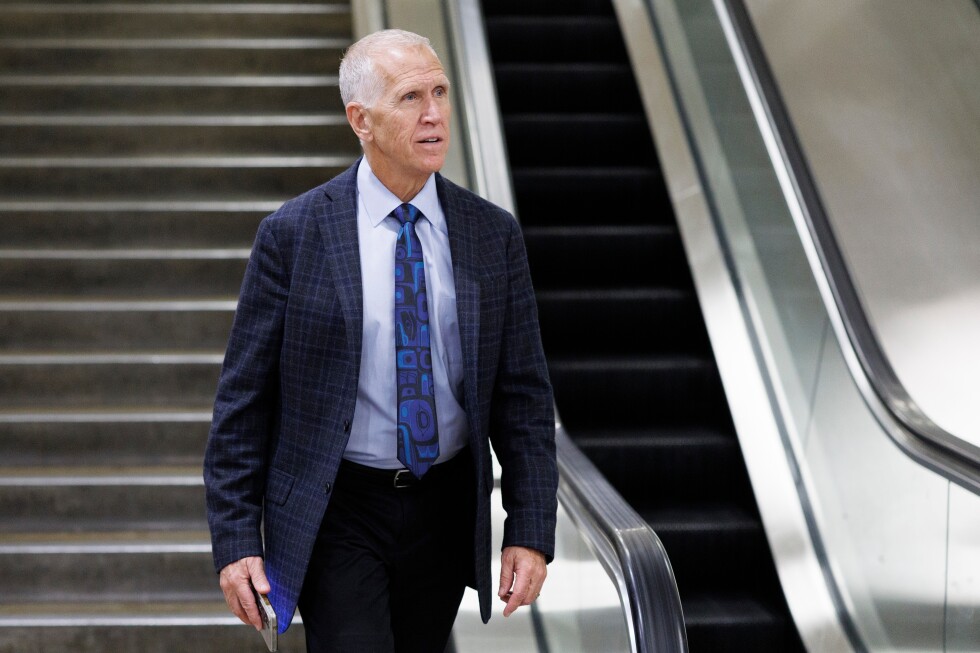
“The real question is: What ultimately are we trying to accomplish?” Sen. Thom Tillis, R-N.C., told The Associated Press.
“I generally support anything that takes out the mullahs,” he said. “But at the end of the day, there has to be a kind of strategic articulation of the strategy, what our objectives are.”
Advertisement
Trump said late Friday that he was considering “winding down” the military operations even as he outlined new objectives and goals.
Congress stands still
The Republican president’s decision to launch the U.S.-Israel-led war with Iran is testing the resolve of the Congress, which is controlled by his party. Republicans have largely stood by the commander in chief, but will soon be faced with more consequential wartime choices.
Under the War Powers Act, the president can conduct military operations for 60 days without approval from Congress. So far, Republicans have easily voted down several resolutions from Democrats designed to halt the military campaign.
But the administration will need to show a more comprehensive strategy ahead or risk blowback from Congress, lawmakers said, especially as they are simultaneously being asked to approve billions in new spending.
Advertisement
Trump’s quip the war will end “when I feel it in my bones” has drawn alarm.
“When he feels it in his bones? That’s crazy,” said Virginia Sen. Mark Warner, the top Democrat on the Senate Intelligence Committee.
House speaker says mission is ‘all but done’
The president’s party appears unlikely to directly challenge him, even as the conflict drags on. House Speaker Mike Johnson has said the military operation will be over quickly.
“I do think the original mission is virtually accomplished now,” Johnson, R-La., told the AP and others at the Capitol this week.
Advertisement
“We were trying to take out the ballistic missiles, and their means of production, and neuter the navy, and those objectives have been met,” he said.
Johnson acknowledged that Iran’s ability to threaten ships in the Strait of Hormuz is “dragging it out a little bit,” especially as U.S. allies have largely rebuffed the president’s request for help.
“As soon as we bring some calm to the situation, I think it’s all but done,” Johnson said.
But the administration’s stated goals — of ending Iran’s ability to obtain a nuclear weapon and degrading its ballistic missile supplies, among others — have perplexed lawmakers as shifting and elusive.
“If I’m advising the president, I would have said: Before you take on a war of choice, make the case clear to the American people what our goals are,” he said.
Congress retains the power of the purse
The Pentagon has told the White House it is seeking an additional $200 billion for the war effort, an extraordinary amount that is unlikely to win support. Senate Democratic leader Chuck Schumer of New York called the amount “preposterous.”
The Defense Department’s approved appropriations from Congress this year are more than $800 billion, and Trump’s tax breaks bill gave the Pentagon an additional $150 billion over the next several years for various upgrades and projects.
Advertisement
Sen. Mazie Hirono, D-Hawaii, said the country has other priorities.
“How about not taking away funding for Medicaid, which will impact millions of people. How about making sure SNAP is funded,” she said, referring to the health care and food assistance programs that were cut as part of last year’s Republican tax reductions.
“These are things that we should be doing for the American people,” she said.
Many lawmakers have recalled the decision by President George W. Bush in the aftermath of the Sep. 11, 2001, attacks to come to Congress to seek an authorization for the use of military force — a vote to support his proposed military actions in Afghanistan and later, Iraq.
Advertisement
Tillis said Trump has latitude under the War Powers Act to conduct the military campaign, but that will soon shift.
“When you get into the 45-day mark, you’ve got to start articulating one of two things — an authorization for the use of military force to sustain it beyond that or a very clear path on exit,” he said.
“Those are really the options the administration needs to be thinking about.”
Brent crude oil surged to US$126 (£94) a barrel after US president Donald Trump announced that he was willing to prolong the blockade of Iranian ports for “months if needed”. This conflict has been billed as a matter of who can absorb the most pain. And Trump is betting on it being the US.
Trump has been rather bullish in his public pronouncements of late, declaring that Iran is in a “state of collapse”. Reports that the country’s inflation rate has risen to 50% from 40% since the war began at the end of February would seem to back this assessment.
The damage done to Iran’s economy will be made worse if the country is forced to shut down oil production due to a lack of storage capacity, something Trump is also confident about. He told Axios: “The blockade is somewhat more effective than the bombing. They are choking like a stuffed pig.”
Now in its eighth week, the conflict is having knock-on effects throughout the region and beyond. Perhaps the most telling sign this week was the announcement by the United Arab Emirates (UAE) that it was quitting Opec, the oil producers’ cartel.
Advertisement
Adi Imsirovic, an energy expert at the University of Oxford, believes that while this decision has been brewing for some time – UAE and Opec’s de facto leader, Saudi Arabia, are at loggerheads over the civil war in Yemen and conflicts in Sudan and across the Horn of Africa. But the war has sharpened political sensibilities across the Gulf. Abu Dhabi has been unhappy about the lack of support from the Gulf Cooperation Council (GCC) after being on the receiving end of intense bombardment from Iran.
Meanwhile, it has chafed under production quotas imposed by the cartel, which it sees as being well short – unfairly so – of its production capacity. When the Strait of Hormuz opens and countries begin to restock their reserves, UAE believes it can cash in on increased demand.
For Imsirovic, the episode reveals something deeper: as the transition by much of the world to retool their economies away from dependence on fossil fuels, big producers like the UAE worry about being left with oil in the ground that nobody wants. Hence the desire to pump out more oil without being constrained by Opec quotas.
Another question inevitably raised by the Middle East conflict and the chokehold that the Strait of Hormuz has over energy markets is why nobody has figured out an alternative route. After all, Iran has been threatening to close the strait whenever threatened since the early 1980s.
The fact is, various countries have figured out an alternative route, writes David B. Roberts of King’s College London; it’s just not big enough to cope. The East-West Pipeline (or Petroline) can pipe oil across the Saudi peninsula at a rate of 5-7 million barrels a day. This compares with an estimated 20 million barrels that transit the Strait of Hormuz in normal times.
The East-West Pipeline in Saudi Arabia and the Abu Dhabi Crude Oil Pipeline in the United Arab Emirates are two crucial Hormuz workarounds. Peter Hermes Furian / Shutterstock
The Abu Dhabi crude oil pipeline, which takes oil from the Habshan onshore field in Abu Dhabi and runs to Fujairah on the Gulf of Oman handles less than 2 million barrels per day. Both pipelines have been damaged by Iran during the war. And both were operating before the Strait of Hormuz was closed, so the idea that these pipelines can replace the strait is not feasible.
It was shocking and depressing to read of another apparent attempt on the US president’s life – the third in two years – at the White House Correspondents’ Dinner on Saturday. It was the first of these dinners that Trump had attended since 2011 when he was famously the butt of Barack Obama’s jokes in the by-now familiar comedy “roast” that is traditionally a highlight of the evening.
A man armed with two guns and a knife attempted to enter the ballroom where the dinner was being held, so the principals were evacuated and the dinner broke up in disarray. It later emerged that the would-be assassin had written a “manifesto” in which he revealed his hatred for the US president.
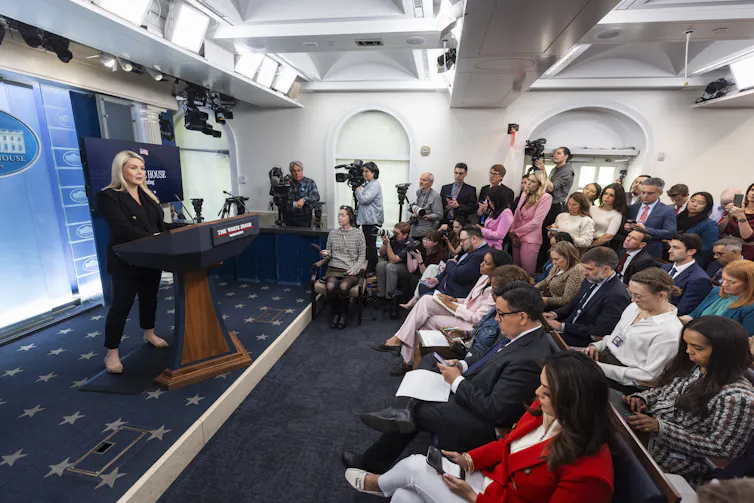
White House press secretary Karoline Leavitt blamed what she called “hateful and constant and violent rhetoric directed at President Trump”, which she said had “helped to legitimise this violence and bring us to this dark moment”. She pointed the finger at the US Democrats and “some in the media”.
Advertisement
‘You’re part of the problem’: White House press secretary berated the media for creating a politically polarising climate. EPA/Jim Lo Scalzo
Seeking to link the assassination attempt to political rhetoric is a pretty direct attack on the first amendment to the US constitution, which protects free speech, writes Eliza Bechtold, a US constitutional law expert at the University of Oxford. The Trump administration has a track record of lionising the first amendment when it suits them (the January 6 US Capitol rioters were characterised by some as peaceful protesters exercising first amendment rights). But attacking the media or the Democrats for their criticisms of Trump’s administration is, writes Bechtold, a denial of everything the first amendment was designed to do.
But not everyone in Trump’s Maga movement is now singing from the authorised songbook, writes Clodagh Harrington of the University of Cork. First it was Marjorie Taylor Greene, once a fervent Trump fan in the House of Representatives, now a bitter critic – who jumped ship in 2025, largely due to what she sees as his mishandling of the Epstein files.
More recently, it has been former Fox host Tucker Carlson, who has gone from introducing Trump at election rallies in 2024, to apologising to the US public for “misleading” them into voting for Trump. For Carlson, it’s the Iran war that flies in the face of one of Trump’s core election promises: no new wars.
Mind you, Harrington notes, Carlson’s move may also be dictated by a dream to launch his own presidential run in 2028. A TV personality running for president? Well, it has been known.
Here’s what the stars have in store for your day (Picture: Metro.co.uk)
The Moon moves into sync with Jupiter, bringing clarity around goals and visions. Gain a new perspective today.
Taurus, Aries and Gemini, this placement is all about sharing your ideas with those who matter. It’s tieme for brainstorming and deep conversations.
Don’t be afraid to make waves, and maybe even rock the boat. You’re developing by leaps and bounds, so don’t let anyone hold you back.
Ahead, you’ll find all star signs’ horoscopes for today: Saturday May 2, 2026.
Advertisement
Like checking your horoscope every morning? You can now sign up to our free daily newsletter to get a personalised reading for your star sign delivered straight to your inbox.
To order your unique personal horoscope based on your time, date and place of birth, visit patrickarundell.com.
Aries
March 21 to April 20
Whereas yesterday, when your thoughts and emotions could have been more intense, there’s an opportunity today, as the Moon arcs towards the vibrant Jupiter, to view things in a different light. It may be that a heart-to-heart with someone close over the weekend can also help you to gain a different perspective, but in a positive way. It will feel good to move on.
Jupiter has been helping you over the last nine months to think about things in different ways, and also to gain additional knowledge, but also to share your great ideas too. And today, it could be really joyful to share your insights with someone in a way that can help them too. Close relationships can seem less on edge today, and with a greater sense of mutual give and take.
Over the last few days, you’ve been able to appreciate the solid citizens in your world, but there is still a feeling that new and more exciting opportunities can open up for you. And yet what you can do is blend this optimism today with some practicality, particularly when you’re considering resources or any ways or ideas you have to improve your financial situation.
You’ve been given food for thought about managing your time, particularly as there seems to be quite a few competing considerations. But one thing you can feel today with the Moon in the warm and affectionate part of your chart and her link back to the supportive Jupiter in your sign, is a sense that whatever path you choose, you will be supported and protected.
The newly arrived Venus and Uranus in the most social of sectors are going to bring some sparkle and effervescence to your interactions in times to come. But today, it could be just a moment of connection or deeper thought that helps you to understand something that may have just been holding you back a little bit for some while, and that can feel really uplifting.
Radical Uranus is pushing you to step outside your comfort zone, shake things up, and approach your connection to the wider world in a fresh and exciting way. But it’s your timeless ability to analyse and structure information in a practical way which can impress someone you encounter today, along with your can-do attitude, and cheerful friendliness.
Cosmic messages for Cosmic messages for Virgo today
Libra
September 24 to October 23
Even if you are working within a budget, there’s going to be part of you that may want to squeeze from that some kind of extra slice of enjoyment or treat. This could be something relatively inexpensive, but after quite a period of being very disciplined, a much more liberated side of you needs to come out, which may see you snaffle something more lush.
Whilst you may have been considering some relationship dynamics yesterday, and you could still be processing these, you can just feel much more carefree today as the Moon in your sign forges a lovely link with the exuberant Jupiter, which is exalted in its current home in your fellow water sign of Cancer. This combination is perfect for feeling more happy-go-lucky.
There’s a wonderful sparkle in the part of your chart that sees you connect to others, but particularly those people who are not only charismatic but also genuine and relatable. So why have you been working through some sensitive thoughts over the last 24 hours? Well, the Moon is in the tenderest part of her journey, but is more supported today, as you’ll be too.
Last June, when the fortune bringer Jupiter returned to your sector of relating for the first time in many years, you may have hoped that significant developments around relationships would follow, and they may have done. It’s just that, ironically, your ruler, Saturn, inhibited his potential, but not so today, when a friendly, perhaps even flirty conversation, can add uplift.
There’s an unfair archetype about Water Bearers that you must be quirky and out there. And yet, the chances are, if this is within you, it will start to come through increasingly in the months to come, now that your modern ruler is in such a playful, mischievous location. But you can use that sense of fun to adjust and adapt to even tricky work-life issues, as today can show.
Yesterday may have coincided with some more intense discussions or conversations. This may have led to something being pushed into the open. And now it’s been ventilated, you can start to see things in a different way and release whatever it was that was occupying your emotions. Indeed, more novel ways of dealing with home and family issues will become a theme.
Your daily Metro.co.uk horoscope is here every morning, seven days a week (yes, including weekends!). To check your forecast, head to our dedicated horoscopes page.
As a loyal Metro reader, we want to make sure you never miss our stories when searching for your news. Whether it is the latest politics news explained, live football coverage or a showbiz scoop.
Click the button below and tick Metro.co.uk to ensure you see stories from us first in Google Search.
All you need to know as vet warns you could be making your dog ill – Manchester Evening News
Need to know
A veterinary nurse has issued a warning to dog owners
People have been urged to try and not let their dog drink from them(Image: Hoppy Snaps Photography via Getty Images)
All you need to know as vet warns against dogs drinking from certain water bowls
A registered veterinary nurse is warning dog owners against letting their pets drink from communal water bowls due to serious health risks.
Jade, known on TikTok as @jade.the.vet.nurs, highlighted that shared bowls found outside shops, houses, and dog parks can spread infectious diseases between multiple dogs. She warned: “They can risk spreading infectious diseases to multiple dogs drinking out of them.”
Jade explained that owners cannot be certain how clean these bowls are or what other animals have used them. Wildlife like foxes and rodents can “spread parasites like roundworms, tapeworm, giardia, and lungworm,” she said.
Communal bowls can also transmit serious diseases such as Leptospirosis, kennel cough, and parvovirus. The bowls become ideal breeding grounds for harmful bacteria, including Salmonella and E. coli.
Pets4Homes also wrote a similar warning on its website, noting that poorly maintained bowls develop biofilm where dangerous pathogens thrive. Studies in UK veterinary circles emphasise avoiding communal bowls to protect dogs from respiratory infections.
Jade’s advice is simple: “Take a travel bowl and a bottle of water and stop occasionally to give your dog a drink.”
Game show Name That Tune began in the mid-1950s, originating in the United States on NBC Radio in 1952.
It sees contestants pitted against each other as their music knowledge is put to the test.
ITV is reviving the series, which last aired in the late 1990s, with TV star Alison Hammond set to host.
Advertisement
ITV reviving iconic show Name That Tune after 28 years with Alison Hammond
The British version first aired on UK TV back in 1976 and became a 15-minute slot on the popular entertainment series Wednesday at Eight, which went on to become London Night Out.
However, because the game was so popular, producers Thames Television decided to turn Name That Tune into a half-hour weekly series in 1983.
From 1976 until 1983, it was hosted by Tom O’Connor, with Lionel Blair taking over in 1984 until the series was dropped from the ITV schedules in 1988.
In 1997, the series was revived on Channel 5 with Jools Holland as the host for two series in 1997 and 1998.
Advertisement
The new series will be its first return to television since then.
The new series, hosted by Alison Hammond, will see contestants go up against each other as their music knowledge is put to the test in a series of fast-paced rounds.
It will feature tracks from the world’s best-loved artists and bands from across every genre – all building towards the finale.
Name That Tune is currently in its fifth season in the U.S, presented by 30 Rock’s Jane Krakowski.
The show’s band will also be performing in the new UK version, made up of a group of elite musicians who have performed with some of the world’s biggest stars, including Adele and The Spice Girls.
Advertisement
Alison said: “As a massive music lover, my biggest challenge as a host will be trying not to grab the mic and start singing along when one of my all-time favourite tunes comes on!
“And trust me… that will take serious self-control!
“I grew up absolutely loving the original show, so being part of this now feels like a real full-circle moment.
“I cannot wait to get into the studio, put the contestants through their paces, and see who really knows their music.
Advertisement
“And let me tell you, being joined by the super-talented Name That Tune band, who’ll be belting out some of the biggest songs on the planet in their own unique, electric style… oh, it’s going to be next-level.
“Bigger, louder, and more feel-good than ever, this is going to be EPIC!”
Katie Rawcliffe, Director of Entertainment, Reality & Daytime at ITV, added: “Name That Tune is such an iconic brand, we are excited to be bringing this refreshed global format to the UK audience.
Advertisement
“It’s a fun family series that not only sees contestants challenged in the studio, but viewers can play along with all the family, providing a unique playlist that spans generations.”
ITV’s 7 Up series to conclude in 2026 after 62 years
The news comes as another classic ITV series is set to end this year after more than six decades.
Referred to as the Up series, it began back in 1964 with 7 Up, which follows the lives of ten boys and four girls in England when they were seven years old, and has followed up with them every seven years.
The series has been produced by Granada Television for ITV, which has aired all of the films except 42 Up, which was broadcast on BBC One.
Advertisement
The final film, called 70 Up, will join the participants for the last time as they reflect on their triumphs, trials and tribulations and what happened to their hopes and dreams.
Recommended reading:
Jo Clinton-Davis, controller of factual ITV and commissioner of 70 Up said: “The 7 Up story is much more than a TV documentary, it’s a document of our times.
“A truly distinctive landmark piece of film-making that has become part of our cultural fabric.
Advertisement
“In the evolving stories of our cast we see the universal themes of life play out. It is the series that made me want to get into television.”
Will you be watching Name That Tune when it returns? Let us know in the comments.
She successfully prosecuted child killer Mark Bridger as one of Wales’ leading barristers. Now Elwen Evans faces an altogether different type of case to resolve
03:31, 02 May 2026
Advertisement
On almost any metric the university sector is changing. Declining participation rates, rising costs, and changes in policy relating to international students have hit the sector from multiple directions.
Higher education bosses have warned no institution is immune to pressures. That is being shown in participation numbers particularly in Wales. The 2025 cycle saw the second-smallest proportion of 18-year-olds applying to university from Wales.
Early indications are that this has flatlined in the current year, bucking the UK-wide trend for increased participation rates. The gap in 18-year-old participation between Wales and the rest of the UK is, sector authorities say, a very significant concern.
Hundreds of jobs have been cut at universities across Wales triggering fears about their sustainability but also the offer to students.
Advertisement
Students themselves will, from September, face fees of £9,790 for undergraduate courses plus the cost of housing and expenses.
One of those tasked with solving not only her own institution’s approach to all those problems, but now as a spokesperson for all nine Welsh universities, is Elwen Evans. Formidable is probably the only appropriate word with which to introduce her.
She is regarded as one of the UK’s leading criminal barristers. During her legal career she was involved in some of the most high-profile criminal cases in Wales in recent years including prosecuting Mark Bridger, the murderer of April Jones, and defending the owner of the Gleision mine where four men died.
As King’s Counsel, a Recorder, she has been a bencher of Gray’s Inn since 2006. Between 2002 and 2015 Ms Evans was the head of Iscoed Chambers in Swansea.
Advertisement
In 2015 she combined legal work with being head of the College of Law and Criminology at Swansea University. She then became the institution’s pro-vice-chancellor before becoming vice-chancellor of the University of Wales Trinity Saint David.
In 2015, when she entered the world of higher education, universities were still expanding. Few places was it more evident than in Swansea with the boom of the Bay Campus changing even the physical appearance of the city. By August last year when she took over as chair of Universities Wales, tasked with representing the interests of Wales’ nine universities, the climate was radically different.
Since taking over she has been clear that while universities should be, and are, an integral part of Welsh life the changes are, in her words, complex and urgent.
Wales will need an additional 400,000 graduates by 2035. While recent UK figures, though, show there were 619,360 applicants – a record high – and 40.7% of 18-year-olds applying for university the percentage in Wales was much lower. Here only 32.1% of 18-year-olds were making an application.
Advertisement
Only the northeast of England performs worse on that measure. The mature market – classed as those aged 25 and over – also continued to decline.
In Wales the gap in higher education participation between the most and least disadvantaged is wider than elsewhere in the UK.
With those warning signs on the horizon, and given her career to date and reputation, why, I ask, did she made the decision to move away from practising law?
She admits she had “kept her hand in” when she was head of Swansea’s law school but when she became pro-vice-chancellor the workload, and perception of two high-profile jobs, meant she felt she had to stand back.
Advertisement
She retains her practising certificate just in case, she says. “I still can’t quite sort of bring myself to sort of stop that identity. Because I think once you’re a lawyer, a trial lawyer, you’re always a lawyer.
“Strangely enough some elements of being a lawyer have been quite useful in the sort of new role.
“I enjoy [the new role] because you really feel you are potentially making, if it goes right, a difference that impacts on your students, your staff, your places. So that’s a real privilege to be doing that.
Advertisement
“If you get it wrong then it’s quite a responsibility but one’s working with fabulous teams of people, whether it’s Universities Wales [or] whether it’s within one’s own university.
“There are some wonderful people working in the sector and it’s really great to be working with them to try and make that difference.
“In a trial you’re really only, if it goes right [or] if it goes wrong, you’re impacting on that case. In the context of universities it’s possibly a different sort of impact.
“I think it’s been clear that the sector has faced challenges for some time, and it’s become increasingly evident, but it’s a great sector to be in because at the end of the day education is absolutely at the heart of any community, any country.
Advertisement
“So for me at least trying to have some role in helping to understand what those challenges are, but more significantly, what the steps forward may be that bring sustainability, that enhances social cohesion, social mobility, participation, trying to play however small that role is, I think, is a real privilege.”
She says her own journey, from west Wales to renowned barrister, is proof of what education can do to change lives.
Coming from a first-language-Welsh farming family her father, now 94, was an apprentice carpenter while her mother, 96, left grammar school at 14 to go home to help run the farm, holding a certificate in dairy farming.
She, however, got a double first at Cambridge.
Advertisement
“I never plan. I have not planned my life. I’ve just tended to sort of go… I went to Cambridge, did my Bar finals in London because you had to do them then. In London there was only one place you could do them. Then did my pupillage in London and then came back to Wales,” she says.
When I ask if her motivation is to give the same chance sto the next generation of Elwen Evanses she replies with a smile: “Well I wouldn’t wish a next generation of Elwen Evans is on anyone. But for that next generation of young people so that they can have those opportunities to take decisions that sometimes are not the expected ones.
“I’ve taken a lot of decisions that are not the obvious sort of career choices and I think I’ve been able to do that because of the power of education.
“So it sounds a bit twee but, ultimately, it is the power of education, whatever type suits you, that really gives you the ability, I think, to thrive in your chosen world of operation.”
Advertisement
But one of the questions facing the students of today is whether the expense is worth it – particularly in light of a changing work world along with the growth of AI and subsequent changes in job prospects in particular fields.
“The sort of levels of debt that some students are experiencing you can see that that becomes a real question mark in their heads. ‘Is this really what I want to be doing?’
“I think that’s become more acute more recently but it was clear, I think, that there were some big questions that needed to be asked and addressed.
“And it’s an entirely non-political point but if one looks for example at the current government in Wales they’ve commissioned a significant piece of work, ‘The future of tertiary education in Wales five challenges and a call for evidence’, and they’ve identified areas of participation in equality, financial sustainability, demographic change, economic delivery, competition, and collaboration as areas that need to be the subject of a call for evidence.
Advertisement
“Plaid Cymru has said that they would look at a review of the funding model, sustainability of the funding model not just of course for the institutions but also for the students, and how are you going to maintain the students?”
Aside from a change in the makeup of the Senedd, and the political groupings, a non-Labour-led government for the first time in devolution could well change an awful lot more after May 7.
Careful throughout our conversation to walk the pre-election tightrope of not sharing any opinion at such a volatile time she says: “My sense is that all of the parties, in whatever combinations and whatever colours, recognise the significance of education and so I think being able to work and seek to help influence and shape policy and any policy changes that may be considered appropriate from day one.”
So what, I ask, could be done to make the sector sustainable.
Advertisement
“I think what we’re looking for is a structure in place and an operationalisation of what we are doing that is financially sustainable by which I would mean thrives for the future. So that you’ve got places where your students can go and have that fantastic experience that higher education gives but it’s part of a really big ecosystem of education and of course of prosperity and nation-building and all of those things that would I hope help underpin Wales’ future under whichever colour of government we get.
“We’ve been quite careful in positioning our asks in the manifesto. We’re asking for that independent review of university funding student support, an independent review of degree apprenticeships, an independent commission on participation.
“We don’t want to come to the table saying: ‘We think we’ve got the answers to this and we know what the solutions are’.
“We want to convene and be part of a convening a conversation about what the options are.
Advertisement
“I think there’s a wide range of possibilities but an awful lot of that will depend on the policies of the next government in Wales.
“It’s an unbelievably complicated landscape because of that jagged edge between England and Wales because although we are devolved as education in Wales as a sector we obviously have an awful lot of cross-border involvement and engagement and of course global involvement as well.”
Does she think the worst, in terms of redundancies, has now passed for Welsh universities? “I can’t comment on individual universities because that’s very much within the patch of those individual vice-chancellors and their governing bodies and so on and the decisions that they need to be making.
Advertisement
“But for me success is ensuring that we get to a place where all of us as a sector are thriving and not having to put energy and time and focus into: ‘What are we doing in this year?’. Let us look at that medium-, longer-term horizon.
“In a world where there is so much change going on, whether it’s in Wales or broadly globally, and after the pandemic we owe it to the students of today and the future to try and ensure that there is a stable, secure environment within which they can look to achieve their ambitions.
“It was education that gave me, I think, a wonderful life and a range of opportunities. It is what unlocks the door to a lot of life chances isn’t it? And I think we need to be looking at the ways we can ensure that all of the young people in Wales have that opportunity.
The point has been made that universities have become too focused on their approach as businesses, rather than their role in places or to their students. Is that fair?
“I understand the point but the reality is that is where policy has driven them because you can only operate if you are financially sustainable and so that has become an inevitability. I don’t think any of us find that the space where we would have chosen to be,” she says.
“It’s a real challenge at the moment and I hope I don’t sound too trite in saying this but the time of challenge also gives the opportunity to look at things differently and I think that’s a part of the landscape that having a review into these different things may help shape because you can’t assume that what we did 10 years ago is necessarily going to be the shape of the future.”
As if to demonstrate just how interwoven higher education is when we meet in central Cardiff, from the windows surrounding us, two universities and a higher education college are within our eyelines.
Advertisement
Does she have faith in the future however it will look? “I absolutely have faith in the future because we have to have faith in the future and people will always be wanting to achieve their ambitions and have the opportunity to reach their dreams won’t they? Whether it will look the same way it looks now? Probably not.
“I think things will look different but in a sense that’s why we’ve got a different sort of structure in Wales, the tertiary sector.
“Universities will absolutely be at the heart of that future but it has to be at the heart and the future of our graduates but also of Wales. To be a strong, this isn’t a political point at all, but I think to be a strong country into the future we need strong universities, we need successful education, we need to drive prosperity, we need research and innovation that is going to position us where we should be.”
Get daily breaking news updates on your phone by joining our WhatsApp community here. We occasionally treat members to special offers, promotions and ads from us and our partners. See our Privacy Notice.
Clare McAlister told of the family’s heartache amid a rehousing struggle, with their home in Harthill, North Lanarkshire, no longer suitable for husband Thomas’ needs.
A disabled Scots dad, who was fit and adventurous before a stroke nine years ago left him paralysed, has been “trapped” upstairs in his family home for years. Thomas McAlister’s family blame “systemic failures” for the 66-year-old’s diminished quality of life.
Advertisement
In 2017, Thomas, then aged 57, suffered a stroke while behind the wheel of his car after a fishing trip near Lockerbie. The dad-of-two was rushed to Dumfries and Galloway Royal Infirmary, before being transferred to St Johns Hospital in Livingston where he spent three months recovering.
The tragic stroke left the left side of Thomas’ body paralysed. Now, his speech is “very little” and he can only feed himself independently if the food is cut up small. His wife Clare, daughter Krisheron, and son Byron have become his full-time carers.
The family’s life has “never been the same”, says wife Clare, 62, who is “living in constant fear”.
Advertisement
Speaking to Glasgow Live, Clare told of the family’s heartache amid a rehousing struggle, with their home in Harthill, North Lanarkshire, no longer suitable for Thomas’ needs.
Claire said: “Before falling ill, Boyd (Thomas) lived an active life, he liked to keep himself busy. Now he is bedbound, and for the past five years has been trapped in his upstairs bedroom after the stairlift we had installed was removed as it was no longer safe for transfers.
“It is absolutely heartbreaking, he is completely isolated, it’s soul destroying.”
In May 2025, Thomas fell seriously ill and contracted sepsis. A 999 call was made immediately by a doctor who assessed him at home, however, the family claim it took crews over three-and-a-half hours to remove him from the property, during which time he suffered three cardiac arrests.
Advertisement
Clare – who sleeps on a mattress on the floor next to her husband’s bed – say the family are “living in constant fear” of another life-threatening incident, as there is “no safe evacuation route” for her husband.
The family have lived in their Harthill home for around 30 years, but now require a single-storey property with enough space for Thomas’ hospital bed and equipment.
Clare continued: “A new home all on one level would be life-changing for us, it would eliminate so many problems. Boyd requires 24-hour care, someone needs to be nearby in case of emergencies, or to hear him should he need anything.
Advertisement
“Over the years he has been completely isolated from family life. We try our best, we really do. You know, last Christmas we ate our dinner on an ironing board just so we could all be in the same room as Boyd. I’d hate for him to ever be left out, it breaks my heart.”
It is understood that North Lanarkshire Council offered the family a newly built property in June 2024 however, it was declined as it “did not meet Boyd’s needs”, and according to Clare, had stairs.
“Boyd has not been outside in five years, he has missed hospital appointments and has been advised to only attend in emergencies”, Clare added.
And son Byron said his dads mental health has “deteriorated significantly, he has little to no stimulation.”
The family blame “systemic failures” for Thomas’ decline in livelihood, and claim communication has “broken down” with the council’s housing and social work teams.
Advertisement
A council housing project, delivering 26 new homes for the local community, is currently underway on Laburnum Road in Viewpark, North Lanarkshire. One property will be a four-bedroom bungalow, a home which would be suitable for the McAlister’s who have been on the housing list for several years.
Though, despite enquiring, the family claim they were told that the property – which is due to be complete by January 2027 – is already earmarked for someone else. The setback has left Clare and her children “heartbroken”.
North Lanarkshire Council confirmed that the McAlister family have been offered “a flexible care package” but Clare insists on caring for her husband at home. She added: “Don’t get me wrong, I do long for the life we once had, but Boyd is not a burden. He is my husband and we will continue to look after him. It’s our family’s love that has kept us going over the years.
“There has been failures here since day dot, in 2017. It’s made me lose faith in people – it’s the full sector as a whole really.”
Advertisement
A spokesperson for North Lanarkshire Council said: “We recognise this is a difficult situation for Mr McAlister and his family, and our priority is to work with them to find a solution that meets his assessed needs as quickly as possible.
“Mr McAlister requires highly adapted, wheelchair-accessible accommodation. A newly built property which met these needs was offered in June 2024, however this was declined by the family.
“We continue to work closely with them, however their request for a four-bedroom, bungalow-style property significantly limits the options available, as this type of accommodation is extremely scarce. Despite this, we are actively exploring both existing housing and new-build opportunities to find a suitable solution.
“Our social work team have also offered ongoing support, advice and a flexible care package, but the family have chosen not to take this up and prefer to manage care themselves at present.”
Advertisement
Get more Daily Record exclusives by signing up for free to Google’s preferred sources. Click HERE
These are just some examples of the rogue health advice currently circulating online. Of course, none of these claims are true – but some could potentially be fatal.
When documentary‑maker Sam Tullen noticed a surge of fake doctors, nurses and avuncular‑looking experts pushing misleading health tips across his social media, he decided to find out where the were coming from and who was profiting.
‘I was getting these AI‑generated health videos all over my feed and I wanted to know who was behind them. There is so much online now and it is becoming harder to spot the truth,’ Sam tells Metro.
Advertisement
‘One video said if you have a tumour, use this essential oil and it will be gone within a week. Another claimed garlic water outperforms antibiotics and that pharmaceutical companies buried the study to make money.
‘There was even one that said: if you have a lump, do not see a doctor. This turmeric soup will make it disappear in 24 hours. These are just crazy claims,’ he says.
Sam says he tracked these videos until they were taken down after around a day or so, however similar clips are uploaded every week across social media, in a bid to keep the cycle going.
Many of the clips are crafted to look like expert advice (Picture: Tullen Productions)
This constant spewing of fake experts doling out rogue advice, is known as content farming – a mass production of low‑quality, superficial material designed to maximise views, clicks and ad revenue.
Advertisement
The scam advice encourages clicks which enables content farmers to make money from affiliate links.
Many of the clips Sam has seen mostly on Facebook and Instagram are crafted to look like expert advice, supposedly revealing what the healthcare industry is trying to hide.
Reading the comments, Sam became concerned that people believe the advice and delay proper medical treatment. ‘I saw people talking about the content and discussing what helps with their ailment, and that maybe they should give this advice a try. It was alarming’, he says.
Over three weeks in March, he messaged hundreds of accounts posing as an aspiring content farmer in the hope that he could understand how and why they work.
Advertisement
There is so much online now and it is becoming harder to spot the truth,’ Sam tells Metro
None replied. Eventually, he reverse‑searched one video and traced it to an account belonging to someone calling himself Bilal Roy, who had posted on LinkedIn.
The post, clearly written by AI, claimed he earned $10,000 per month from AI‑generated affiliate links and was offering to mentor others to do the same.
Sam doesn’t know whether Bilal was using a fake name, but he’s been unable to track him down anywhere on social media, so he thinks it was an alias the person was using to conceal himself. However, he is sure the post was written using ChatGPT, due to the proliferation of emojis and em-dashes.
So, Sam messaged him. Three hours later, he got a reply.
When the documentary-maker asked for proof that these accounts work and generate views, Bilal sent screenshots from logged‑in profiles of multiple content‑farming pages he claimed to own. They were generating more than 4 million impressions in a month across three accounts.
Advertisement
Hetold Sam that if he followed his advice, he would make at least $6,000 in his first month, and more than $10,000 thereafter.
Pretending to be interested in mentoring, Sam paid the $860 fee and scheduled a call, which Bilal later cancelled.
Sam contacted the man he thought was behind some of these videos (Tullen Productions)
Instead, he was sent a ‘secret document’ via LinkedIn (which Metro has seen) outlining Bilal’s methods. It explained how they could use special affiliate tracking links to let a company know that a customer came through a recommendation and award them commission. It also suggested the best AI tools to use to produce the most convincing videos.
More troubling was the guidance on exploiting viewers’ health fears.
One page, describing which videos generate the most affiliate sales, stated: ‘it dont matter if lieing about the health tips or treatment just try to sell product’ [sic].
Advertisement
Another line instructed creators to ‘make them (the viewers) think they could get sick or even die so they buy it’.
It stunned Sam. ‘These horrible ethics shook me. These videos prey on people’s vulnerabilities, especially older users who do not understand AI. It is predatory and it could delay urgent care.
‘I am worried about the harm that can come from health misinformation. It can literally stop people seeking medical treatment because they believe in natural remedies or supplements that do not work.
‘These videos prey on people’s vulnerabilities,’ says Sam (Picture: Tullen Productions )
‘AI allows this misinformation to spread like wildfire, impacting real lives.’ Armed with the document, Sam tried to arrange another call, this time to challenge Bilal, but his LinkedIn post and account had been deleted. Sam has not been able to find him since.
‘I believe he will be doing the same thing elsewhere under a different name,’ he says.
Advertisement
Through his online documentary series Disclosed, Sam hopes to give viewers the tools to separate fact from fiction. He is also investigating bots, illegal streaming and fame laundering, where influencers buy engagement and followers to inflate their online presence.
‘The series pulls back the digital curtain to expose hidden corners of the internet. It is getting harder to spot the truth, so this is a place where audiences can trust what they are being told, where they know they are not being misinformed about important topics,’ he says.
Sam is also calling for social media platforms to do more to monitor harmful health advice and for younger or more digitally savvy users to call out AI‑generated content wherever they see it.
‘If you want to know whether health advice is coming from a professional, ask yourself: is the account verified? Are they asking you to click links in their bio? That is a big red flag.
Advertisement
‘And if you are worried about something, go and see a doctor. Please do not take health advice from random online videos, as you do not know who is delivering it or why.’
Metro has reached out to Meta and Linkedin for comment.
It will impact 200 restaurants across the UK and cut 3,800 jobs
Premier Inn’s parent company is set to close down two well-known restaurant chains, with numerous sites across the north west to be impacted.
Advertisement
Whitbread has announced it will shut the remainder of its Beefeater and Brewers Fayre restaurants. This will see 200 restaurants across the UK close down and will hit 3,800 jobs.
The closures comes as part of a new five-year strategy which will see the firm attempt to make a quarter of a billion pounds in cost savings while overhauling its restaurants. The firm said it will retain the vast majority of its 30,000-strong workforce, however the cuts will see roughly 12 percent of employees laid off across the closed locations, the Mirror reports.
Click here to get the biggest stories straight to your inbox in our Daily Newsletter
Beefeater and Brewers Fayre restaurants are typically located next to or inside Premier Inn hotels. The closures will see Beefeater restaurants close after 50 years in business, while Brewers Fayre was not far off celebrating the same milestone in 2029.
Advertisement
Whitbread has blamed Rachel Reeves’ budget for the closures and its chief executive Dominic Paul said the move was necessary “in light of significant cost increases in the form of business rates and National Insurance”. The change will see Whitbread selling and leasing back up to £1.5 billion of its freehold properties, and will “recycle” the amount to “fund future growth”.
Speaking about the plan, Mr Paul said: “We plan to convert all our remaining branded restaurants to an integrated food and beverage offer that is preferred by our hotel guests and will unlock the addition of more highly profitable extension rooms. Our continued efforts to drive our commercial plan and efficiencies will extend our market-leading position and allow us to take share from our competitors, many of which are struggling to grow.”
Full list of Brewers Fayre restaurants set to close
It was praised for being ‘family friendly’ as well as having many local amenities
A look around Trumpington
Residents say they like living in a neighbourhood just outside of Cambridge becasuse it is “well connected” and provides the “perfect balance” of city and village life. Trumpington is conveniently located around two miles away from the city centreand is home to more than 12,000 people according to the 2021 census.
Within the rather large neighbourhood, there are a number of amenities including convenience shops for essentials, parks, schools and local services. There are also a range of charming places to eat and drink such Sole & Duck Restaurant, Hudson’s Ale House and Cafe Trumpington.
As part of our Exploring Cambridgeshire series, we spoke to residents in Trumpington about what they think of it. Daniela Casti, 38, really enjoys living in Trumpington, but since having her child, she said: “We actually enjoy it much more because it is a quiet area, very family friendly, and there’s lots of playgrounds.”
Daniela commutes to London on the weekends and she either goes via Cambridge Station or to Royston and she believes it will be “much easier” when Cambridge South opens. “It is well connected to the city centre. So by bike, we can reach the city centre in seven minutes”, she added.
Hanako Kawasaki, 26, previously lived in Chesterton but moved to Trumpington around two years ago. Hanako “loves” living in the neighbourhood and says “it is much more residential” than Chesterton. Comparing it to Fen Ditton, Hanako said that Trumpington has similarities to the newly built area especially because of the architecture and houses.
The 26-year-old cycles from her house to the city, and said it can take around 10-minutes. She said this is ideal for her because it is “really close” to the city centre but still far enough away that she can enjoy her privacy.
Advertisement
Hanako said it has the “perfect balance” between village and city life, so that she can enjoy the nature around her, but not be far from shopping, cafes, and experience the “city vibe”. On the other hand, Hanako also feels as though Trumpington is swallowed by the city due to its close proximity, and bustling life.
She said that she would “highly recommend” Trumpington as a place to live for those who want “a good balance between city and nature”.
Raneem Almutairi, 32, has lived in Trumpington for around eight months. She said she thinks it is the “best area for families to live in Cambridge”. She added: “I like how everything is so close, we have supermarkets here, Sainsbury’s, Nisa, the library, schools here, so I think for families, it is perfect.”
Advertisement
The 32-year-old used to ‘love’ living in London but she said that now she has a family, living near Cambridge is “more reasonable” because of the close connections.
Oliver and Rachel have both lived in the neighbourhood for more than 20 years and have seen it “grow and change” overtime. More recently, Oliver said he lives in part of the newer development, and since moving there, he is of the opinion that it has “doubled in size” and is generally comprised of ‘wealthier people’.
Frazer Leader, 33, highlighted the ideal links to the city, and alternative transport options to get elsewhere. He is particularly looking forward to Cambridge South Station because he thinks that Trumpington will get “busier and busier” which will “build more of a community”.
It has been a long time, hasn’t it? With the cancellation of the Bahrain and Saudi Arabian races, F1 has had an enforced and unexpected spring break after just three rounds of the new regulation set. But here we are, back in Miami for a sprint weekend, with some tweaks to the regulations.
Without going into too much detail – and the new regulations are so detailed that it beggars belief – there will, of course, be hope that the tweaks make for better, more sensible racing as well as bringing some of the challengers close to leaders Mercedes. Hard to say if that has happened on the basis of one (albeit extended) practice session in Miami, but there were some fairly promising signs.
Charles Leclerc was fastest for Ferrari ahead of Max Verstappen in the Red Bull, nearly 0.3sec behind, followed by Oscar Piastri, Ferrari team-mate Lewis Hamilton and then the lead Mercedes of Kimi Antonelli. George Russell, who is hoping to overturn the Italian’s championship advantage this weekend, was sixth, only marginally behind his team-mate.
Advertisement
I am not sure the additional 30 minutes in FP1 feels like enough time for the teams before sprint qualifying, but who cares? It’s up to them and the drivers to get on with it. Plenty of upgrades here as well as the regulation amendments, so let’s see if they have made a difference.
SQ1 begins at 9.30pm and the whole session should be done in about an hour, so let’s get back on with it, shall we?





















































You must be logged in to post a comment Login