

In many democracies today, trust in politics is either very low or in decline.
This is a noteworthy development in its own right, but it may be especially important because trust is associated with several other important outcomes, for example, whether we vote and whether we comply with the law. The latter became particularly apparent during the pandemic, when it turned out that people who trusted politicians more were more likely to comply with lockdown rules.
Political scientists often think about trust as a dynamic concept. When politicians perform poorly, our trust falls. And there is plenty of evidence for this. When the economy performs badly or when politicians are embroiled in scandals, trust tends to be lower.
This way of thinking about trust is obviously helpful, but one problem is that it is hard to explain why people’s levels of political trust tend to be stable. Once people reach a level of trust in early adulthood, they don’t tend to change it very much afterwards. And people don’t always have as strong a reaction to events like political scandals as we might think – so it’s not a given that current performance is the only cause of low trust.
One explanation for this apparent contradiction is that trust might also be affected by our formative experiences. Of course, this doesn’t mean that trust never changes later, it obviously does. But on this view, each person would have a stable, base level of trust informed by their early experiences with the political system.
How our parents talked about politics when we were growing up, or how governments performed when we started paying attention to politics, might affect our base level of trust. We know that these experiences affect other aspects of our relationship with politics, for example, our voting behaviour, and our political values.
However, these ideas are difficult to prove. Academics generally study political attitudes by surveying a random sample of the population. These surveys ask about our opinions, and about things that might be influencing them (for example, our household income). But they rarely ask about our formative experiences. That’s partly because people can’t be expected to accurately remember experiences from many years ago. It’s also difficult to know which experiences to ask about. We obviously can’t ask about everything (that would be expensive and tedious), but that means we might miss things.
Alamy
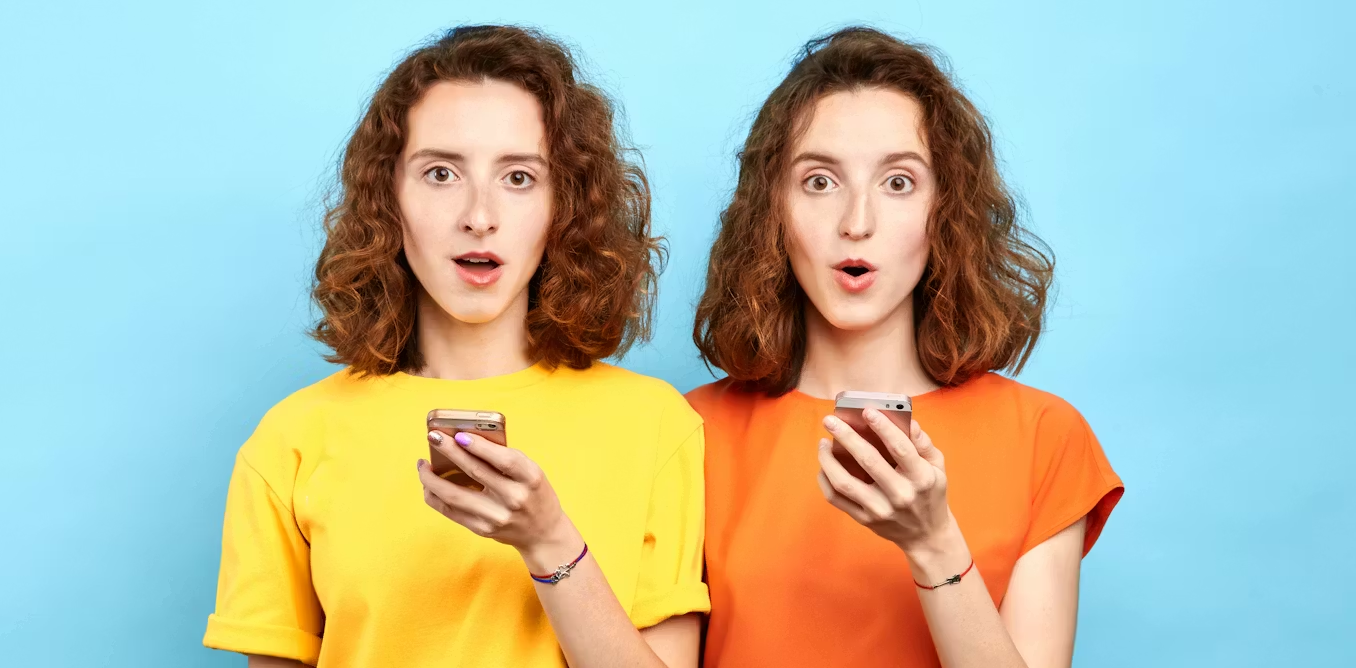
One way around this problem is to look at twins and siblings, because we know they largely share their formative experiences and traits formed early in life. That way, we can study those factors without having to directly measure them.
By comparing non-identical twins and siblings (who share lots of traits and experiences) with identical twins (who share almost all traits and experiences) we can estimate how important these are for our political attitudes. That’s what I’ve been doing in my own work, which suggests that a substantial proportion of our trust is explained by our early experiences – perhaps as much as 40%.
Early life and political trust
One possible explanation for this is that important traits formed early in life, like our personalities, might affect our ability to trust the political system. Some people are naturally more agreeable, for example, and it seems likely that they would also be more trusting.
This is one line of argument I’ve discussed in some of my own work, but the evidence for this is less clear. Instead, it seems likely that people who share similar personality profiles are similarly trusting because they grew up in environments which predisposed them toward those personality traits and also toward having more or less trust in the system.
Another, perhaps more plausible scenario is that the environmental conditions we experience early in life might affect whether we go on to have more or less trust in politics. For example, experiencing economic hardship early in life is associated with our ability to trust the system in the long run, especially if we think the government is to blame for our hardship. We might also expect that our educational experiences affect trust, for example, by giving us the knowledge about the system that can help us make more reasoned judgements about its trustworthiness.
The relationship between trust and voting might, therefore, not be due to trust causing voting, but instead due to our formative experiences affecting both. My work with colleagues suggests that this is likely to be the case. We tested whether differences in political trust within twin pairs predicted differences in how often they voted. That way, we know we’ve accounted for all relevant formative experiences shared by the twins. When we did that, we found that the relationship between how much we trust and how often we vote is much weaker.
Another reason that trust being partly caused by our formative experiences matters is because long-run changes in trust might be generational in nature, and difficult to reverse. In the UK, for example, gen Z tends to be particularly distrusting of institutions, including political ones.
If political trust is socialised when we are young, this has the concerning implication that it might stay that way, even if performance improves. We might then expect younger voters who grow up in a low-trust environment to remain distrusting in the long run.









![[KLPGA 2026] iM Financial Group Open 2026 / Round 2 (ENG Commentary)](https://wordupnews.com/wp-content/uploads/2026/04/1775832050_maxresdefault-80x80.jpg)





































You must be logged in to post a comment Login