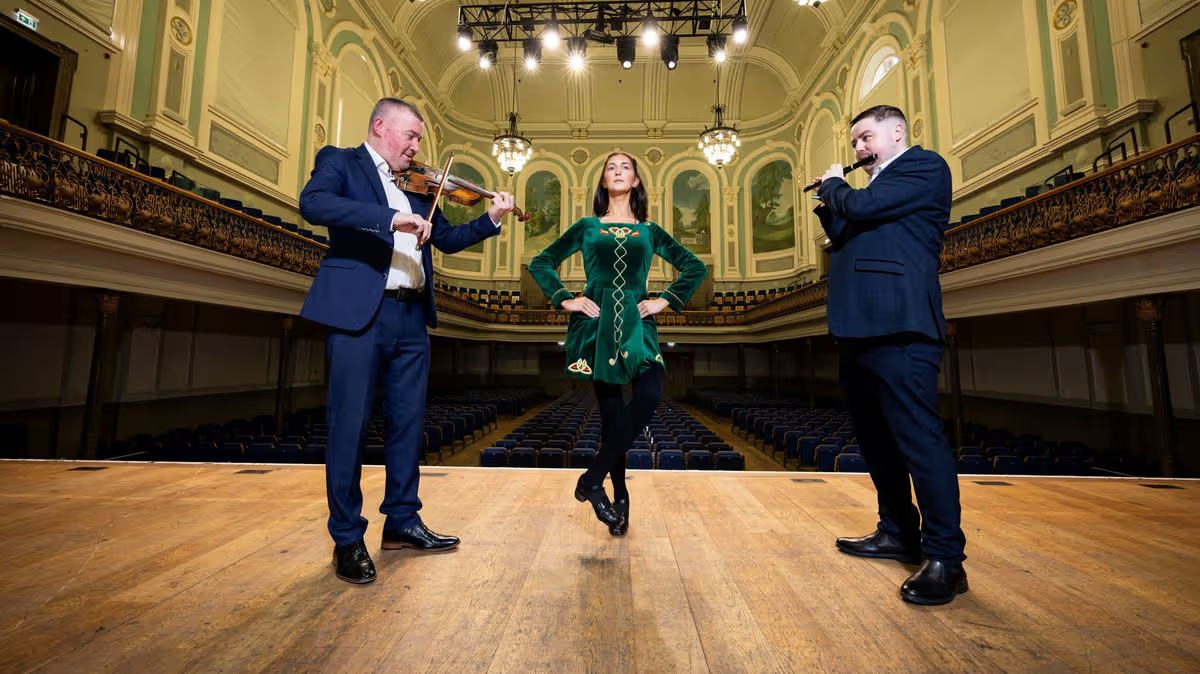
Fleadh Cheoil which is the world’s largest annual celebration of traditional Irish music, song, and dance will arrive in Belfast this summer
Rob Currell Live news reporter
06:59, 16 Mar 2026
As the date for Fleadh Cheoil coming to town approaches, Belfast City Council has proposed measures to keep the city moving with a key focus on the pedestrianisation of the city centre.
An estimated 800,000 people are expected to visit Belfast from 2-9 August, as the city welcomes the world’s biggest celebration of Irish music and culture for the first time.Preparations are now in full swing, and the council has confirmed the proposed footprint of the event. This coincides with planned road closures and measures being put in place to ensure visitors, businesses and residents can all move around the city safely.
Councillor Natasha Brennan, Chair of the council’s Strategic Policy and Resources Committee said: “In terms of events, they don’t come much bigger than this – Fleadh Cheoil is on track to be the largest event we’ve ever staged in our city.
“It is vital that all our residents, businesses and visitors are aware of how they may be individually impacted by the Fleadh and are able to plan their journey, and daily activities, in advance, especially in and around the city centre. “There’s been a tremendous amount of work behind the scenes, by both council and our city partners, to keep disruption to a minimum and ensure our city still operates for everyone while the event is in town.”
The heart of the action will be in Belfast city centre, where all roads and streets will be closed to vehicle traffic for the duration of the Fleadh, either in full or partially.
Advertisement
These measures will help ensure pedestrian safety and to support the open air, vibrant atmosphere synonymous with the event.
The proposed closures will be in place from 6am on Sunday, August 2 to 5am on Monday, August 10, with the biggest footfall expected from Thursday, August 6 onwards.The area around City Hall – which will host the Gig Rig main stage – will adopt phased closures to support the increased use of public transport in and out of the city centre. Full details of all proposed closures are available on the council’s website from today (Monday, March 16) until Sunday, April 5, as part of the statutory consultation period for all proposed road closures in the city.
Councillor Brennan added: “We know businesses and residents living in, and near, the city centre will have particular concerns, so I’d encourage them to check out the proposed road closures and share any feedback they have with us – many already have through engagement events we have held in January and February, which has helped greatly with our planning so far. We will continue to engage with inner city communities throughout this process to ensure they are supported and to maximise the benefit of the Fleadh.
Advertisement
“Delivery windows will also be incorporated into road closures to ensure venues can get what they need, when they need it, and we’ll have a dedicated accreditation and logistics hub, available 24/7, to support those businesses inside the city centre event zone.“Plans are in place with emergency and other essential providers to ensure they will have swift access at any time and can continue to deliver key care services, where and when required.”
Fleadh Cheoil – co-hosted with Comhaltas and Ards CCÉ – will also stretch out beyond the city centre and into local neighbourhoods. This will bring together venues, outdoor spaces, vacant land and other locations right across the city.To encourage visitors to stay longer and boost the economic success of the Fleadh, several temporary campsites will be in place to enhance accommodation provision.Confirmed locations include Ormeau Park (proposed campsite for tents), Titanic Quarter (proposed campsite for motorhomes and caravans) and Falls Park (additional campsite for tents).
As a compact city, Belfast is set to create a Fleadh which is easy to navigate.Visitors will be able to walk, cycle or use public transport to access events. All visitors will be encouraged to use several Park and Ride sites, located near key arterial routes to Belfast, together with a daily shuttle service into the city centre, operated by Translink. Further details on the traffic and transport plan will be shared by Translink and Belfast City Council in the coming weeks.
Organisers Comhaltas recently announcing the event will also return to the city again in August 2027.
Advertisement
The event is expected to provide substantial tourism and economic impact and supporting local businesses, hospitality providers and cultural organisations across the city and wider region.Headline acts for the opening day have been confirmed, with Sharon Shannon, Goitse, Blackwater Céilí Band and McPeake joining pipe bands and school choirs for a multi-generational, cross-community showcase.The free concert outside City Hall will set the tone for a jam-packed week of street performances, pub sessions, competitions, céili and marching bands and a fringe programme of family-friendly activities.The council’s Bank of Ideas scheme – supporting individuals and communities to deliver creative projects in local areas, including during Fleadh Cheoil – is also still open for applications until Monday 23 March.An information event to help the hospitality sector get ready for the Fleadh will also be held in City Hall on the same day (12pm to 2.30pm) – businesses can sign up here.To keep updated on all the latest Fleadh Cheoil event news, visit fleadhcheoil.ie or follow the council’s social media channels – @belfastcitycouncil on Facebook and Instagram.
The family of a cyclist who died after a collision in Peterborough have described him as a “kind, cheerful and caring man”. Artur Ciesielski, 49, was involved in a crash at Rhubarb Bridge, near Lincoln Road, at around 6.45pm on February 21.
Advertisement
He was taken to hospital in a critical condition following the incident. He died on Monday, March 9. No other vehicles were involved.
Artur’s family said he “loved animals, spending time outdoors, fishing and cycling”. He was described as a “devoted father” who had also recently become a grandfather to his first grandchild.
Artur’s family released the following tribute to him: “Artur was a kind, cheerful and caring man who was deeply loved by his family. Originally from Poland, he had been living in the UK for 23 years and had built his life here.
“Artur loved animals, spending time outdoors, fishing and cycling. He was an experienced cyclist and travelled by bike everywhere. On the day of the incident, he had gone to the shop by bicycle to buy food for the family cats because they had run out and were hungry.
Advertisement
“He had recently married his wife on 13 February this year and was very happy about the future ahead. Artur was a trained carpenter who loved working with his hands. He was always fixing something, helping others, working in the garden or cooking for the people he cared about.
“He was a devoted father who taught his daughter many things in life from DIY to cooking. He had also recently become a grandfather to his first grandchild, a 14-month-old boy, and he was incredibly proud and excited to be a grandad.
“We hope that anyone who may have been in the area or who may have seen anything will come forward, as even the smallest piece of information could help understand what happened. He was a wonderful man and father.”
Police are continuing to appeal for witnesses.
Advertisement
Anyone who saw Artur in the lead up to the collision should report it through the Cambridgeshire Police website by quoting the reference incident 444 of 21 February. Anyone without internet access should call 101.
A nursery worker who raped and abused young children in his care has been jailed for 24 years.
Nathan Bennett, 30, preyed on the two and three-year-olds at the Partou King Street nursery in Bristol.
He was found guilty by a jury last month of eight charges including rape, sexual assault and assault by penetration, relating to five children.
On Monday he was jailed at Bristol Crown Court for 24 years, with an extended licence period of six years.
Advertisement
Bennett previously admitted 13 other charges relating to four of the five victims, who were aged two at the time.
The court heard concerns were raised by parents and staff about Bennett’s behaviour towards the children in his care in February last year.
The police launched an investigation after staff caught him on CCTV putting his hands down the trousers of a child, which led to Bennett’s arrest and later the closure of the nursery.
He was noted by staff to sit children on his lap for lengthy periods of time, wear a pair of trousers with holes in the crotch area, and seemed “territorial” over certain toddlers and their parents, the court heard.
Advertisement
During the trial, video interviews with two of the children in the case – referred to only as Child A and Child E – were played to the jury.
Child E’s mother also gave evidence, telling how her son had demonstrated how he had been abused at his nursery.
“I got him to stop doing it. I asked him when did that happen. He said it happened at nursery,” she said.
Giving evidence, Bennett said he was “emulating” what was done to him as a child and denied having a sexual attraction to children.
Reef Pearson, 27, graduated from the University of Birmingham in 2019 with a business and communications degree after covering her studies with plan 2 tuition fee and maintenance loans.
Originally from Gateshead, Reef now works in Ancoats, Manchester. She received her first statement from Student Finance England the year after graduating, showing she owed £50,807.59.
Reef Pearson, 27, graduated from University of Birmingham with a business and communications degree in 2019 (Image: Reef Pearson / SWNS)
After spending several years working minimum wage jobs, she secured a £40,000 a year role as an SEO manager in October 2023 and began repaying her student loan in 2024.
However, despite paying around £2,000 a year towards the balance, interest added to the loan means the total amount she owes has continued to increase.
Advertisement
In 2024, Reef paid £1,647 towards her loan but £3,967.71 was added in interest. In 2025, she repaid £1,963 while £4,270 was added to the balance.
A graduate with £60k of plan 2 student loan debt says each year she pays £2k off – to see it rise by £2k. (Image: Reef Pearson / SWNS)
Reef said: “When I looked through my statements, I thought ‘God, is that even right?’.
“It’s so insulting to log in, see you’re paying it off, but at a rate that doesn’t even see the figure go down.
“And I’m aware I’m on a decent wage. If this is happening to me, what on earth is happening with other people?”
Advertisement
Despite Reef having a £40k a year job she is still struggling to pay the loan off (Image: Reef Pearson / SWNS)
She said reviewing the figures left her questioning the system, Reef said: “Looking back, it feels like a scam. The whole concept of young people being told by the government that this is the way into education – and find out later they charge you double interest.
“It feels like I’m throwing money into an abyss. It’s just diabolical.”
Graduate Reef Pearson has said the student loan system ‘feels like a scam’ (Image: Reef Pearson / SWNS)
She said she had spoken to her younger siblings about her experience.
Reef said: “I have a younger brother and sister, and I sat them down and told them that they should consider other options than university.”
Advertisement
Reef said she did not particularly enjoy her time at university but continued with the degree because she believed it was needed to work in marketing.
She also said the message many students received at sixth form was that the debt would eventually be written off.
Reef said: “It’s fine, your debt will be wiped after 30 years. That sounds quite nice, but the reality now is very different.”
Reef Pearson from Gateshead has saw her student loan increase by 2k every year in interest (Image: Reef Pearson / SWNS)
After starting her current job, Reef reached the repayment threshold and now pays between £100 and £200 a month towards the loan.
Advertisement
Reef said: “What may sound like a good salary doesn’t get you very far, not as a single woman living alone. That £100 or £200 a month could help a lot.”
Although she now enjoys her job, she believes the terms of the loan were not fully understood when she signed up as a teenager.
Reef secured her first big-time job as a SEO manager in October 2023 and began paying off her loan from 2024 onwards. (Image: Reef Pearson / SWNS)
Reef said: “At 18, anything that has that kind of government stamp on it, you have trust in it, you think they’ll give you a good deal.
“It never crossed my mind there would be an interest rate like this.
Advertisement
“It’s hard to comprehend, I didn’t realise the government had these bleak terms, even for something private – never mind public sector.”
BANGKOK (AP) — Crude oil stayed above $100 a barrel on Monday and Gulf countries reported more attacks by Iran as the war entered its third week, while share prices were mixed.
A barrel of Brent crude, the international standard, was up 2.5% at $105.70. It’s climbed more than 40% since the war began.
U.S. benchmark crude gained 1.6% to $100.29 per barrel. It’s up nearly 50% since the war began.
U.S. futures were buoyant, with the contract for the S&P 500 up 0.6% while that for the Dow Jones Industrial Average rose 0.5%.
Advertisement
In early European trading, Germany’s DAX edged 0.1% lower to 23,423.51, while the CAC 40 in Paris shed 0.2% to 7,893.16. Britain’s FTSE 100 inched up 0.2% to 10,276.43.
In Asia, Tokyo’s Nikkei 225 edged 0.1% lower to 53,751.15, while the Kospi in South Korea climbed 1.1% to 5,549.85.
Hong Kong’s Hang Seng rose 1.5% to 25,834.02 after the Chinese government reported stronger than forecast economic data for February. The Shanghai Composite index shed 0.3%, however, to 4,084.79.
In Australia, the S&P/ASX 200 gave up 0.4% to 8,583.40.
Advertisement
Taiwan’s Taiex edged 0.2% lower, while India’s Sensex was little changed.
On Friday, Wall Street’s losses deepened as the war again pushed prices above $100 per barrel, ratcheting up inflationary pressure on the global economy.
The S&P 500 fell 0.6%. The benchmark index is now down 3.1% so far this year.
The Dow Jones Industrial Average lost 0.3% and the Nasdaq composite finished 0.9% lower. Those indexes also ended the week with their third straight weekly loss.
Advertisement
Since being attacked by the United States and Israel more than two weeks ago, Iran has been regularly hitting Israel, American bases and its Gulf Arab neighbors’ energy infrastructure with drones and missiles. It has also retaliated by effectively stopping cargo traffic through the narrow Strait of Hormuz, where a fifth of the world’s oil typically sails. That has oil producers cutting production because their crude has nowhere to go.
In just over a week since the closure of the Strait of Hormuz, more than 12 million barrels of oil equivalent per day have been taken offline, according to independent research firm Rystad Energy.
Only handful of tankers have reportedly passed through the strait.
“The truth is that at this point, much of the market is operating in the fog,” Stephen Innes of SPI Asset Management said in a commentary. “For context, the strait normally handles roughly 25 oil and LNG tankers every single day.”
Advertisement
If the war continues to hamper the production and transportation of oil from the Persian Gulf, it could cause a damaging surge in inflation.
Higher expectations for inflation complicate the Federal Reserve’s efforts to bring interest rates lower to help the economy. The U.S. central bank is not expected to cut rates at its policy meeting this week.
A new snapshot of consumer spending Friday shows inflation crept higher in January, even before the Iran war caused oil and gas prices to spike.
Advertisement
The Commerce Department reported Friday that consumer prices rose 2.8% in January compared with a year earlier. But excluding volatile food and energy, core prices rose 3.1%, the highest jump in nearly two years.
Even so, consumers still lifted their spending at a solid 0.4% pace in January, with their incomes rising at the same pace, according to the report.
Wall Street also got an update on how U.S. economic growth fared in the October-December quarter. The economy, hobbled by last fall’s 43-day government shutdown, grew at a sluggish 0.7% annual rate, a downgrade from its initial estimate last month.
In other trading early Monday, the U.S. dollar slipped to 159.34 Japanese yen from 159.55 yen. The euro rose to $1.1441 from $1.1425.
A next best result for the US would be if a severely damaged Islamic Republic were to then modify its behaviour, stop mistreating its citizens and end its support for radical militias in the region. Again, this looks unlikely after Iran chose as its new supreme leader, a man most likely to irritate Washington in the form of Mojtaba Khamenei, the son of his late, hardline predecessor, Ayatollah Ali Khamenei.
Volkswagen likes to distil the essence of the brand down to three simple ideas: Emotion, efficiency and engineering. Those three pillars are meant to underpin every model the company produces, alongside what Volkswagen describes as the fundamentals of being a “true Volkswagen”: clear design with balanced proportions, optimum use of space, high quality, easy handling, innovative technology and an attractive price-to-performance ratio.
Volkswagen’s upcoming ID. Cross is designed to embody all of that in one of the most important and lucrative parts of the electric car market. This new compact SUV is part of the Volkswagen Group’s new Electric Urban Car Family, a range of smaller electric vehicles that will all be built in Spain, with development led by Cupra.
Cupra will introduce the first model from the family with the Cupra Raval, followed by the Volkswagen ID. Polo hatchback and this SUV, the ID. Cross, along with the Skoda Epiq. I drove the Skoda Epiq earlier this year, and it provided an early glimpse of what this platform could deliver.
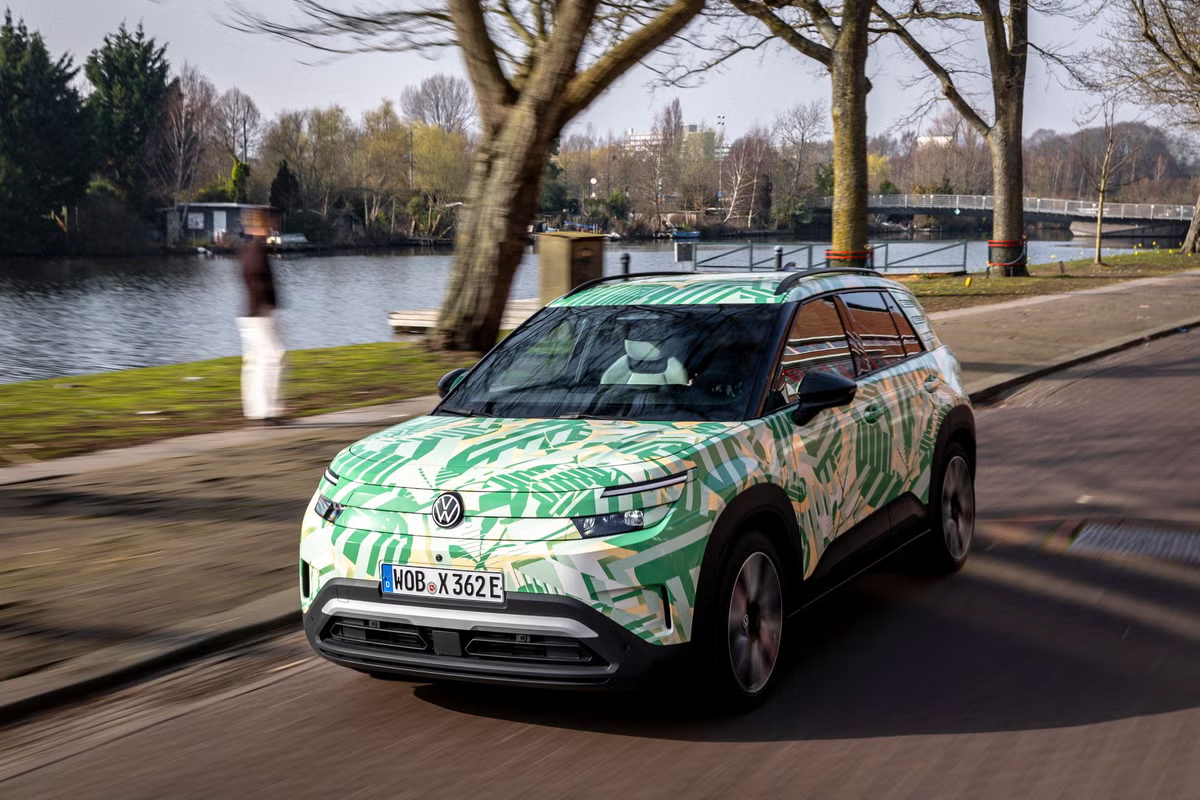
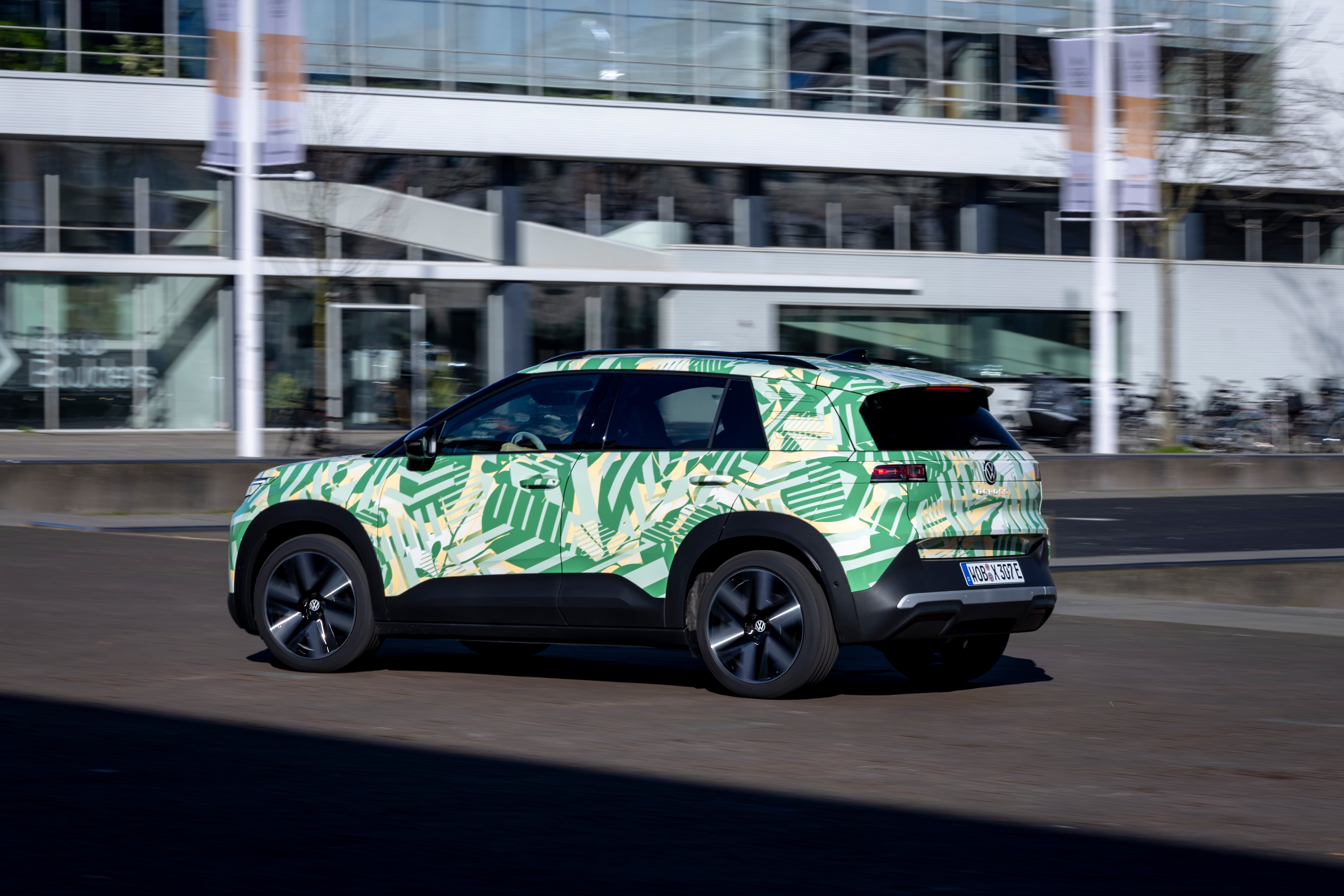
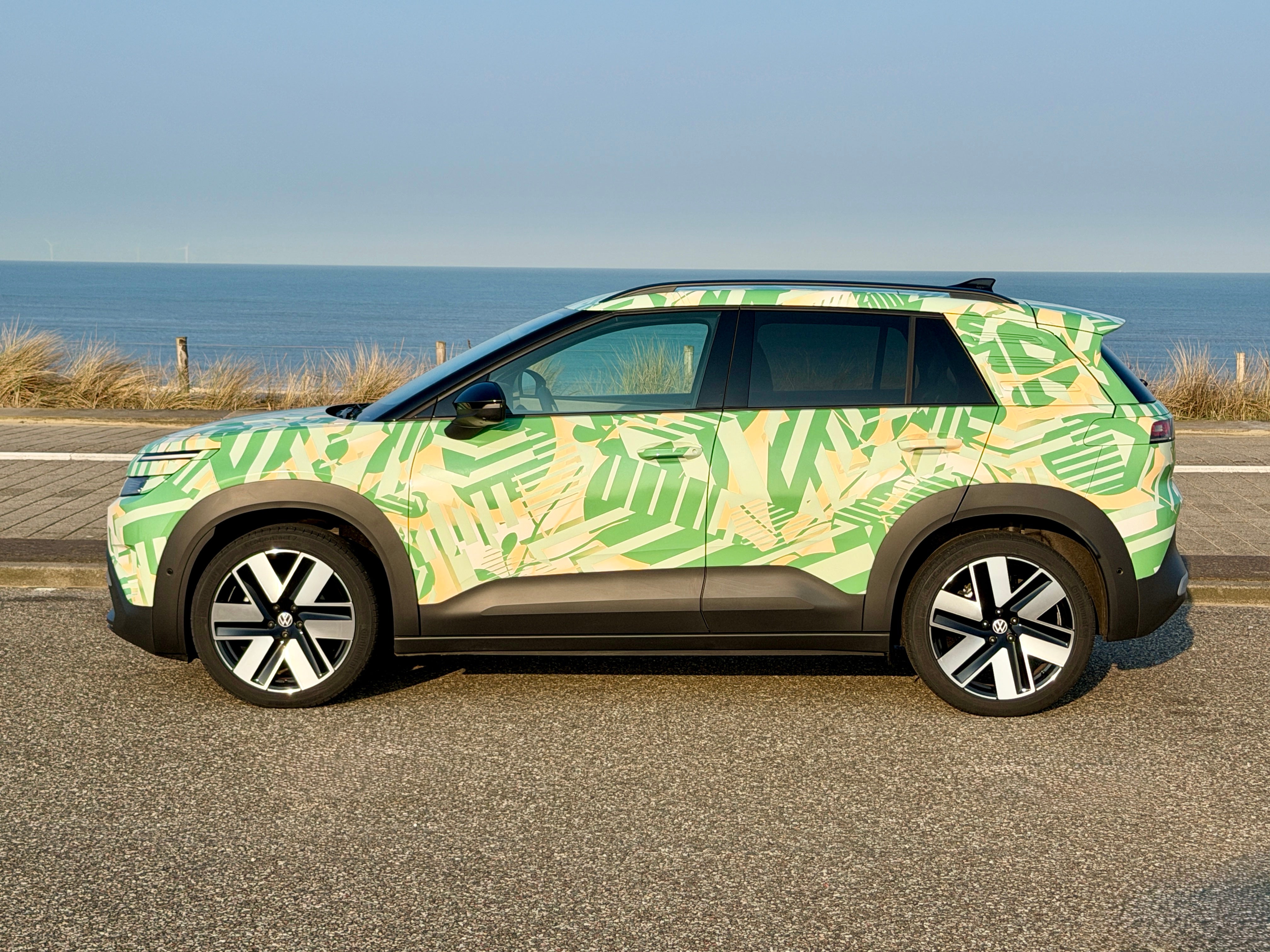
The ID. Cross I drove was still heavily camouflaged and far from the finished production version, but the prototype already revealed plenty about Volkswagen’s plans for its smallest electric SUV. Even at this early stage, it’s clear Volkswagen is delivering on its claim to be going the extra mile with the ID. Cross – and the result could be a very important car for the brand when it reaches showrooms early in 2027.
Advertisement
How I tested
I was one of a select few journalists invited to Amsterdam to drive the new Volkswagen ID. Cross in early prototype form – although the cars were the very latest development models and pretty close to production cars, you’ll be able to buy. I drove on the streets in and around Amsterdam, out to the coast, up and down motorways and tested everything that will be important to buyers of these cars. As well as the practicality and boot space, I also got to try some of the new instrument settings to give an early verdict on this important new car that you can trust.
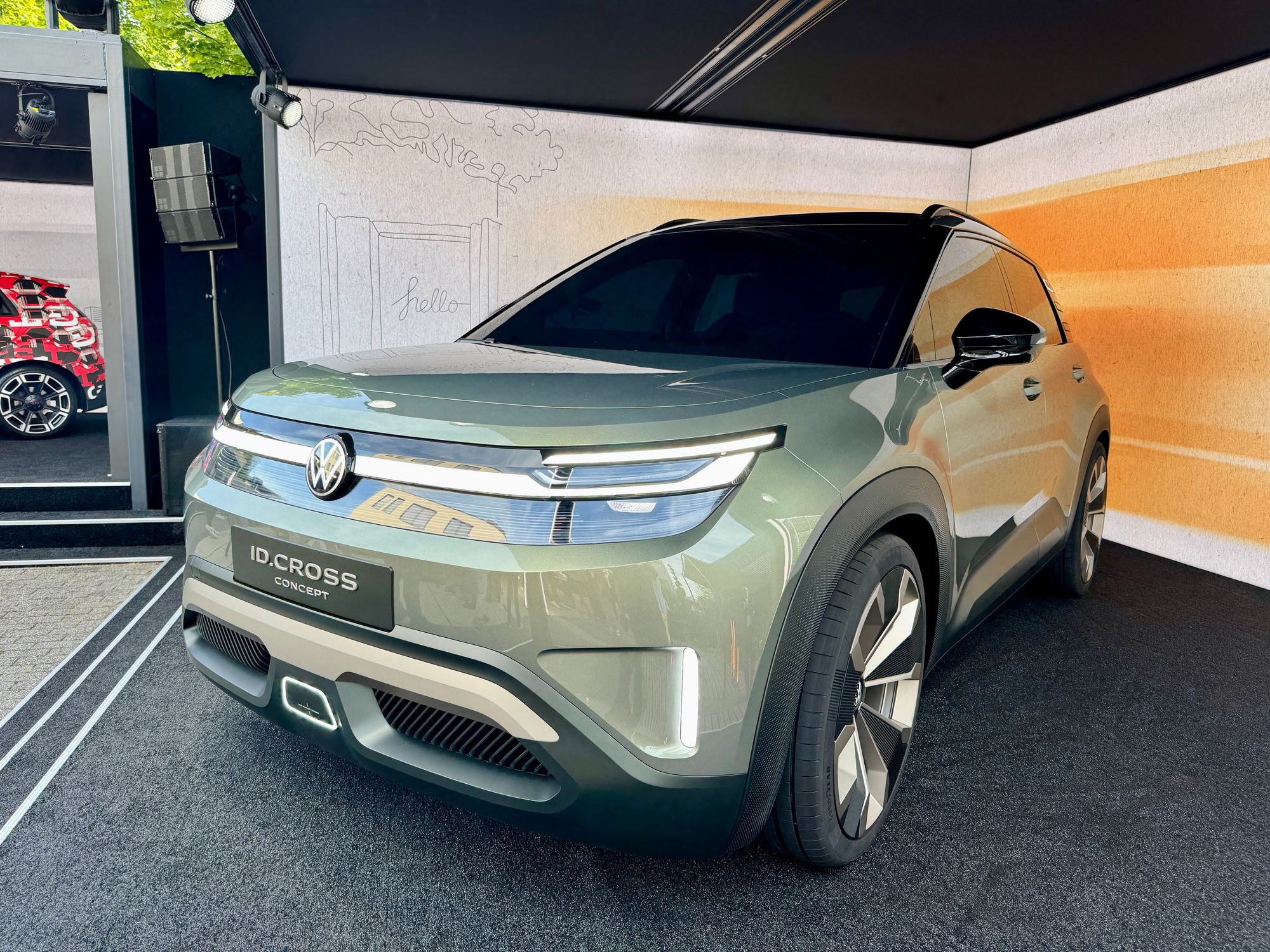
The Volkswagen ID. Cross Concept was revealed at last year’s Munich Motor Show and gives a strong clue to what the production car will look like without the camouflage. (Steve Fowler)
Volkswagen will offer the ID. Cross with two battery sizes and a choice of power outputs. Entry-level versions will use a 37kWh battery paired with either 114bhp or 127bhp electric motors. These models are expected to offer a range of up to 194 miles and support DC rapid charging at up to 90kW.
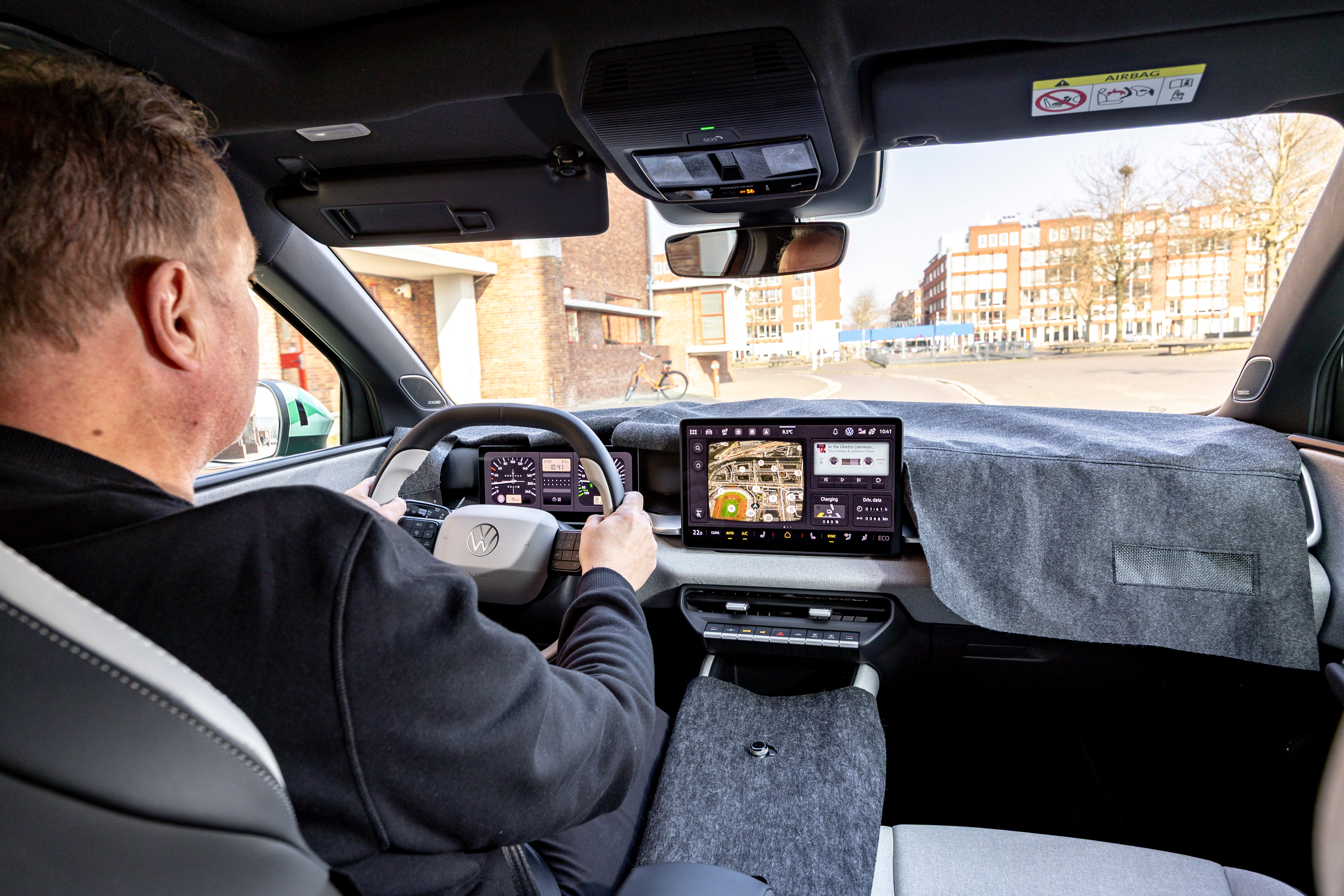
Volkswagen’s retro dials and infotainment were visible on our prototype ID. Cross drive – they’re fun and easy to use (Volkswagen)
Above that sits a larger 52kWh battery paired with a 208bhp electric motor producing 290Nm of torque and driving the front wheels. This version offers a claimed range of up to 271 miles and supports DC charging at up to 105kW.
That charging figure is slightly lower than the 135kW peak seen in some of Volkswagen’s current ID models, but the company says the charging curve has been redesigned so it stays flatter for longer. In practice, that means less drop-off in charging speed as the battery fills, allowing the ID. Cross to charge from 10 to 80 per cent in around 24 minutes.
Advertisement
The car weighs less than 1,500kg and features a 55:45 front-to-rear weight distribution, while towing capacity is rated at up to 1,200kg.
The prototype I drove was the 208bhp front-wheel-drive version. There’s no confirmed all-wheel-drive model at this stage, although engineers say the platform could support one if markets demand it. Austria, apparently, is already keen!
On the road, the ID. Cross feels impressively mature for such an early prototype. Volkswagen has defined a specific “Driving Dynamics DNA” for its electric models based around linearity, emotionality, intuitive handling, steering precision and the right balance between comfort and control.
In the ID. Cross that balance leans more towards comfort than the lower-slung ID. Polo hatchback, and that was immediately noticeable from behind the wheel. The ride quality felt significantly more polished than the earlier Skoda Epiq prototype I drove, even though the suspension hardware is mechanically identical. Volkswagen engineers revealed that this was a later iteration of the setup I experienced in the Skoda
Advertisement
Over rougher roads, the car felt composed and connected without ever becoming uncomfortable. In fact, the ride quality felt remarkably premium for a small electric SUV.
Braking performance is another highlight. Volkswagen has introduced a new one-box braking system designed to deliver a more natural pedal feel than earlier EV systems. On the road, it works very well, with linear response and consistent stopping power without the grabby behaviour or inconsistent feedback that some early electric cars suffered from. Performance from the 208bhp motor feels strong enough to make the car feel lively.
Steering was the one dynamic area that felt less convincing. Around the straight-ahead position, there was slightly too much slack, which made it feel a little vague at times. Switching to Sport mode improved the situation, making the steering feel noticeably more direct.
After feeding that back to Volkswagen engineers during the drive, they later took me to one side to say they agreed with the feedback and said the production car would move the standard steering calibration closer to the Sport setting.
Advertisement
The Volkswagen ID. Cross is the same size, shape and uses many of the same parts as the new Skoda Epiq (Volkswagen)
Overall, though, the fundamentals feel extremely strong even at this early stage. This is shaping up to be a seriously impressive small SUV, and it will be fascinating to see how it compares with rivals such as the upcoming Kia EV2.
Interior, practicality and boot space
Advertisement
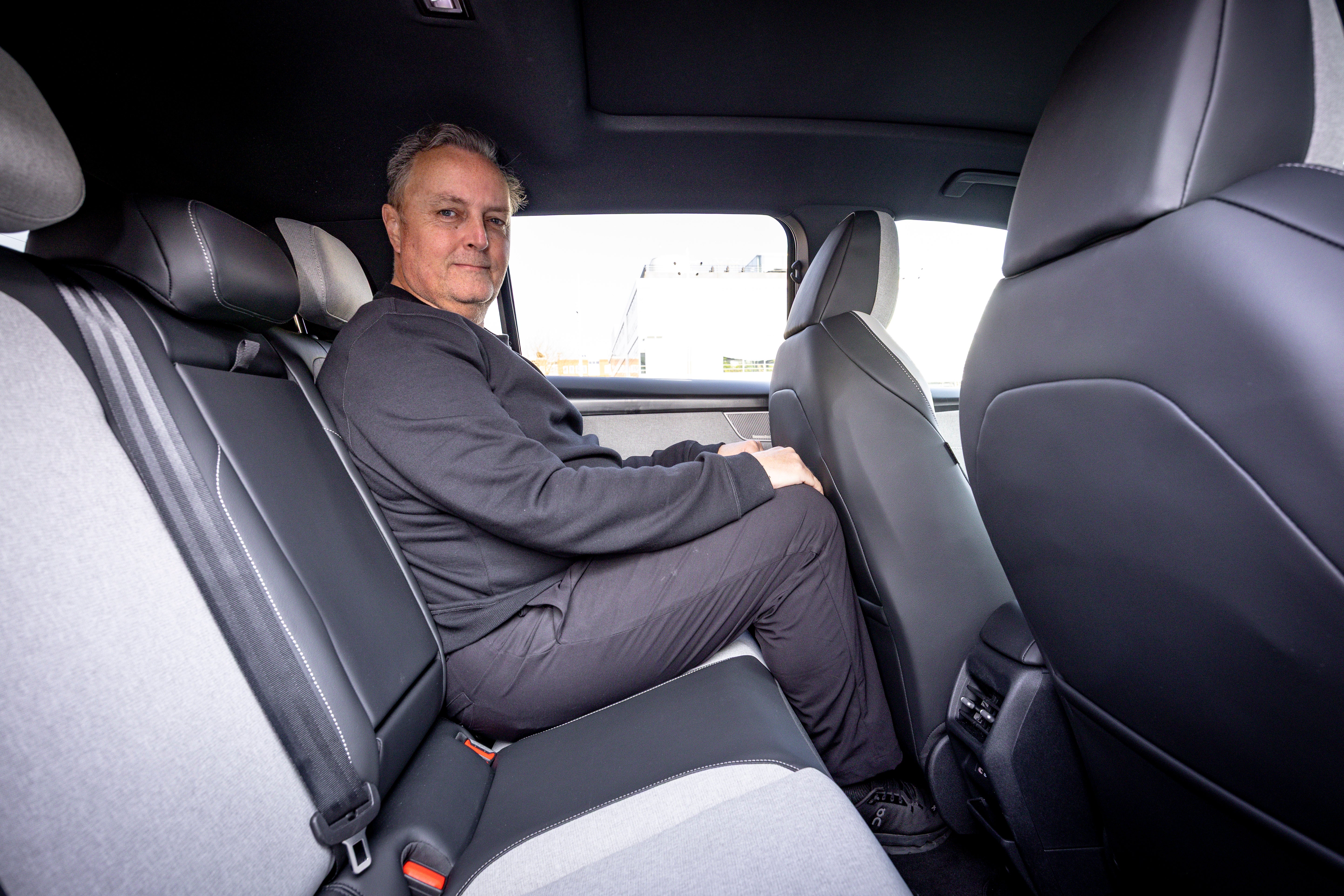
Rear knee room is a bit tighter than expected in the back of the Volkswagen ID. Cross (Volkswagen)
Inside, the ID. Cross shares much of its interior design with the upcoming Volkswagen ID. Polo. Because of the SUV body style, the dash will be stretched upwards somewhat, but the overall layout is very similar.
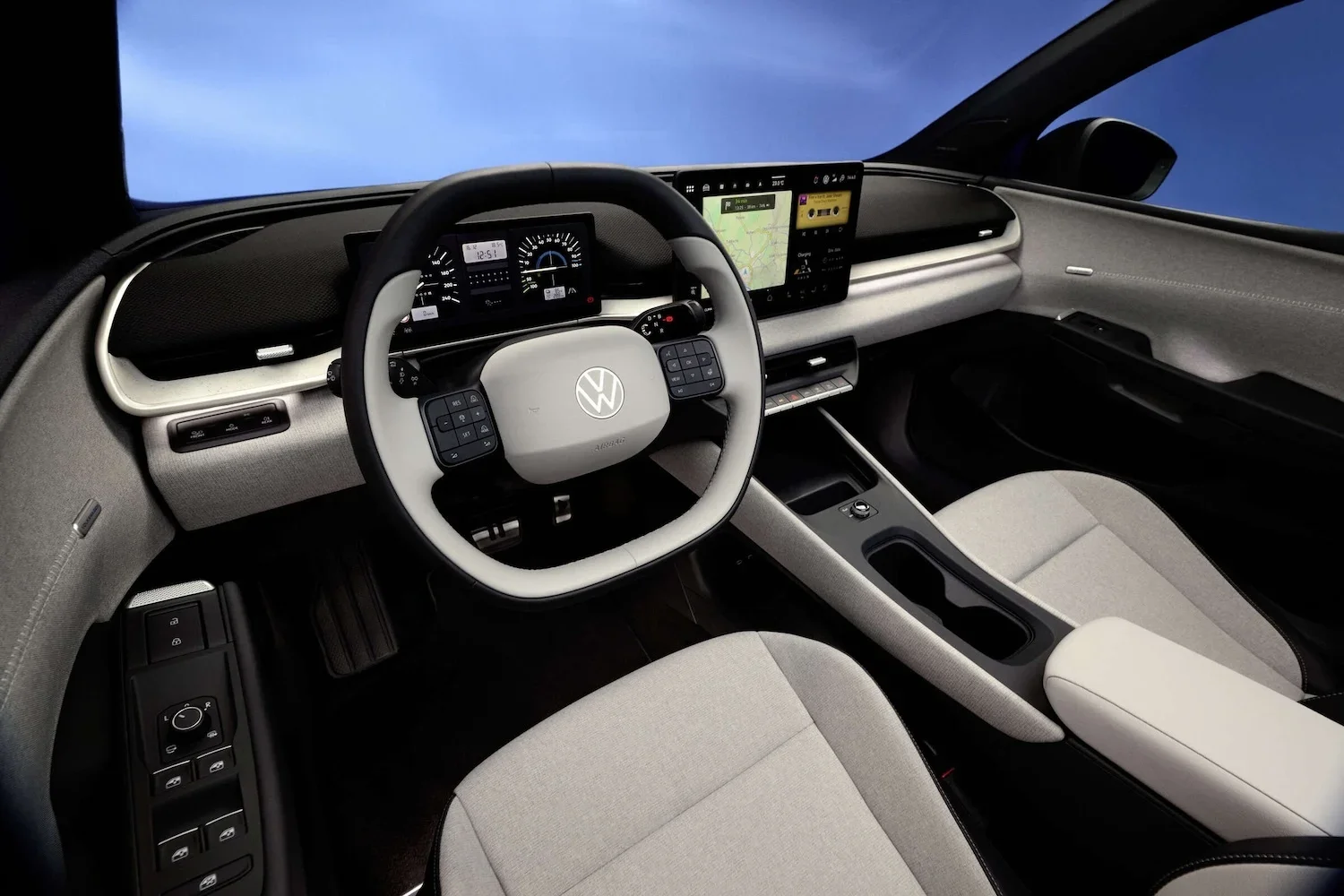
Although our prototype test car had covers over the interior, I know from the Polo that it’s an impressive interior, both in terms of design and perceived quality. Volkswagen has incorporated technology usually found in larger and more expensive cars, including massage seats, a Harman Kardon audio system, a 10-inch driver display and a 13-inch infotainment screen. Our prototype also featured a panoramic glass roof, although it was hidden underneath the camouflage.
The interior makes extensive use of premium-feeling sustainable materials and feels genuinely upmarket for a car expected to start at around £25,000.
Crucially, Volkswagen has also reintroduced physical controls after criticism of overly touch-based systems in earlier models. There’s a proper volume knob on the centre console between the front seats, proper steering wheel buttons (and lots of them – which can be a bit confusing) and separate heating and ventilation controls sitting below the touchscreen, all of which make the car easier to use day to day.
Advertisement
Volkswagen designers talk about three pillars for the exterior design: stable, likeable and secret sauce. “Stable” refers to the car’s proportions and stance, while “likeable” reflects the friendly face that new Volkswagen models wear.
“Secret sauce” describes small details designed to surprise and delight owners. One example is the retro-style graphics on the digital displays, which echo classic Volkswagen instruments and add real personality to the cabin. Again, I’d seen this system in a production ID. Polo interior, but seeing those retro dials in action is genuinely brilliant.
In terms of dimensions, the ID. Cross measures 4153mm long, 1816mm wide and 1581mm tall, with a 2601mm wheelbase.
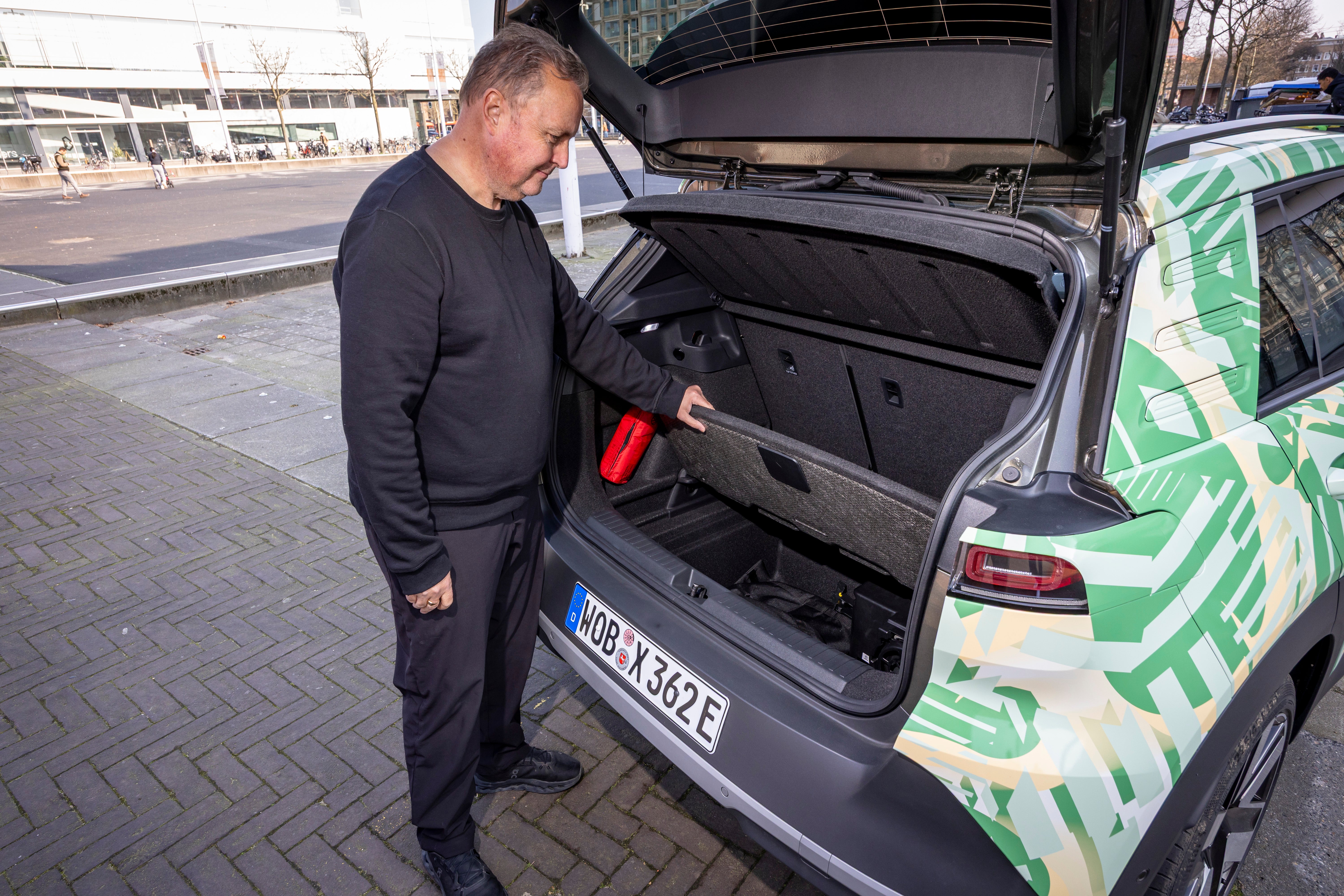
Boot space is generous for a compact SUV. The luggage area offers 475 litres of capacity, including an underfloor storage well, expanding to 1,340 litres with the rear seats folded down.
Advertisement
Rear passenger space isn’t quite as generous. Legroom in the back feels a little tight, and children in forward-facing child seats could end up kicking the backs of the front seats. Personally, I’d happily sacrifice an inch or two of boot space to gain more rear legroom.
Headroom in the back is excellent, though, and the rear doors open wide, which makes access easier.
Visibility is also very good from all seats, with nicely sized door mirrors and a clear view out in every direction.
One disappointment is that some of the clever interior ideas shown on the earlier ID. 2all concept car haven’t made it into this car. Magnetic phone holders on the backs of the front seats, for example, would have been a neat touch. After the brilliance of the retro displays and the impressive cabin design, it feels like there could be a bit more “secret sauce” in terms of practical interior functionality.
Advertisement
The Volkswagen ID. Cross boot offers an excellent 475 litres of space including a deep underfloor space (Volkswagen)
Technology, stereo and infotainment
Technology is another strong point for the ID. Cross. The car introduces Volkswagen’s new generation of software architecture and connectivity systems.
Advertisement
This interior picture of the Volkswagen ID. Polo gives a big clue what the dash of the ID. Cross will look like (Volkswagen)
The infotainment system is displayed on a 13in touchscreen, complemented by a 10in digital driver display. The retro-style instrument graphics give the system a distinctive look and help it stand out from more conventional digital dashboards. On the main touchscreen, the navigation is displayed on what mimics an old TV screen, while any music you’re playing gets displayed on what looks like an old cassette tape, complete with rotating spools for added authenticity. It’s all very cool.
Advanced driver assistance comes via Volkswagen’s Connected Travel Assist system. This uses swarm data from other vehicles to help improve the accuracy of the information it uses. The system supports assisted lane changes as well as traffic and stop light detection.
The ID. Cross also introduces vehicle-to-load functionality, allowing the battery to power external devices, as well as vehicle-to-grid capability that could allow energy to be fed back into the electricity grid when connected to suitable infrastructure.
Prices and running costs
Advertisement
The Volkswagen ID. Cross will be on sale in the UK in early 2027 (Steve Fowler)
European pricing for the ID. Cross has already been announced, starting from €27,995. At current exchange rates, that works out to around £24,150.
However, by the time the car reaches UK showrooms in early 2027, it’s likely that the entry price will sit a little above £25,000. From there, prices are expected to rise into the low-to-mid £30,000 range depending on battery size, power output and equipment levels. Production versions of the car should be ready for driving towards the end of this year.
Volkswagen clearly has high expectations for the ID. Cross. In fact, the company believes it could outsell the ID. Polo hatchback – which says a lot about how strong demand for small electric SUVs is expected to be.
Advertisement
The verdict: Volkswagen ID. Cross
Even in early prototype form, the ID. Cross is hugely impressive. The ride quality feels genuinely premium for a small electric SUV, the interior quality is excellent, and the technology package looks strong.
There are still a few rough edges to polish before production begins – particularly around steering feel – but it’s unlikely anything can be done to boost rear passenger space. However, the fundamentals are extremely convincing.
If Volkswagen can deliver the expected price point and refine those small issues before launch, the ID. Cross could become one of the most compelling compact electric SUVs on sale in the UK.
Advertisement
Volkswagen ID. Cross rivals
FAQs
How long does it take to charge?
The larger 52kWh battery version offers a claimed range of up to 271 miles, while the smaller 37kWh battery version provides up to around 194 miles. The larger battery version supports DC rapid charging at up to 105kW, allowing the battery to charge from 10 to 80 per cent in around 24 minutes.
Advertisement
How much does it cost – is it worth it?
With a starting price expected to be just over £25,000 in the UK, the ID. Cross aims to offer strong value in the compact electric SUV market, combining useful range with modern technology and a premium-feeling interior.
Does Volkswagen replace batteries for free?
Volkswagen is expected to offer its standard three-year new car warranty alongside an eight-year battery warranty covering the high-voltage battery for up to 100,000 miles while guaranteeing a minimum level of battery capacity.
Advertisement
Why trust us
Our team of motoring experts have decades of experience driving, reviewing and reporting on the latest EV cars, and our verdicts are reached with every kind of driver in mind. We thoroughly test drive every car we recommend, so you can be sure our verdicts are honest, unbiased and authentic.
With more than 30 years of experience, Steve Fowler is one of the UK’s best-known automotive journalists. Steve has interviewed key industry figures, from Tesla’s Elon Musk to Ford’s Jim Farley, and is a judge for both Germany’s and India’s Car of the Year Awards, as well as being a director of World Car of the Year. When it comes to electric vehicles, Steve reviews all the latest models for The Independent as they launch, from Abarth to Zeekr, and he uses his expert knowledge of car buyers’ needs to provide a comprehensive verdict.
The 55-year-old suffered serious injuries on Dent Street in Shildon on Tuesday, March 10, and was later pronounced dead in hospital.
Robert Davies appeared in the dock at Teesside Crown Court this morning (Monday, March 16) charged with Mr Blair’s murder, possession of an offensive weapon, and affray.
The 49-year-old, wearing a green and yellow prison uniform, is to be psychologically assessed to determine whether he is fit to enter a plea to the charges.
Police working at the scene on Dent Street, Shildon (Image: NORTHERN ECHO)
Judge Jonathan Carroll said: “Your case will be heard on April 13. Between now and then you are likely to be interviewed by one or two psychologists.
Advertisement
“In the mean time you are remanded in custody.”
Davies will next appear in Leeds Crown Court for a pre-trial preparation hearing.
A potential trial date will be set at a later date.
Jeff Blair was working as a bailiff at the time of his death.
“His ability to apply humour and laughter to any situation and lighten the mood will be irreplaceable to our family.
“We are devastated to lose Jeff in such tragic circumstances, and he will be forever missed and remembered always, with much love and affection.”
Darlington Storm Basketball Club said Jeff was a former player, coach and committee member.
Advertisement
In a tribute shared on social media, the club said: “Our thoughts and prayers are with his family at this very traumatic and troublesome time.”
Mr Blair, a former Durham Constabulary police officer, had worked as a response PC across the south of the county for 22 years before retiring in 2017.
POZNAN, Poland (AP) — A generation ago, Poland rationed sugar and flour while its citizens were paid one-tenth what West Germans earned. Today its economy has edged past Switzerland to become the world’s 20th largest with over $1 trillion in annual output.
It’s a historic leap from the post-Communist ruins of 1989-90 to today’s European growth champion that economists say has lessons on how to bring prosperity to ordinary people — and that the Trump administration says should be recognized by Poland’s presence at a summit of the Group of 20 leading economies later this year.
The transformation is reflected in people like Joanna Kowalska, an engineer from Poznan, a town of half a million people midway between Berlin and Warsaw. She returned home after five years in the U.S.
“I get asked often if I’m missing something by coming back to Poland, and, to be honest, I feel it’s the other way around,” Kowalska said. “We are ahead of the United States in so many areas.”
Advertisement
Kowalska works at the Poznan Supercomputing and Networking Center, which is developing the first artificial intelligence factory in Poland and integrating it with a quantum computer, one of 10 on the continent financed by a European Union program.
Kowalska worked for Microsoft in the U.S. after graduating from the Poznan University of Technology in a job she saw as a “dream come true.”
Advertisement
Newer skyscrapers flank the communist-era Palace of Culture and Science, foreground, in n, Poland, May 25, 2018. (AP Photo/Alik Keplicz, File)
Advertisement
Newer skyscrapers flank the communist-era Palace of Culture and Science, foreground, in n, Poland, May 25, 2018. (AP Photo/Alik Keplicz, File)
Advertisement
Advertisement
But she missed having a “sense of mission,” she said.
“Especially when it comes to artificial intelligence, the technology started developing so rapidly in Poland,” Kowalska added. “So it was very tempting to come back.”
Advertisement
Multiple factors in breaking out of poverty
The guest invitation to the G20 summit is mostly symbolic; no guest country has been promoted to full member since the original G20 met at the finance minister level in 1999, and that would take a consensus decision of all the members. Moreover, the original countries were chosen not just by GDP rank, but by their “systemic significance” in the global economy.
But the gesture reflects a statistical truth: In 35 years — a little less than one person’s working lifetime — Poland’s per capita gross domestic product rose to $55,340 in 2025, or 85% of the EU average. That’s up from $6,730 in 1990, or 38% of the EU average and now roughly equal to Japan’s $52,039, according to International Monetary Fund figures measured in today’s dollars and adjusted for Poland’s lower cost of living.
Poland’s economy has grown an average 3.8% a year since joining the EU in 2004, easily beating the European average of 1.8%.
It wasn’t simply one factor that helped Poland break out of the poverty trap, says Marcin Piątkowski of Warsaw’s Kozminski University and author of a book on the country’s economic rise.
Advertisement
One of the most important factors was rapidly building a strong institutional framework for business, he said. That included independent courts, an anti-monopoly agency to ensure fair competition, and strong regulation to keep troubled banks from choking off credit.
As a result, the economy wasn’t hijacked by corrupt practices and oligarchs, as happened elsewhere in the post-Communist world.
Poland also benefited from billions of euros in EU aid, both before and after it joined the bloc in 2004 and gained access to its huge single market.
Above all, there was the broad consensus, from across the country’s political spectrum, that Poland’s long-term goal was joining the EU.
Advertisement
“Poles knew where they were going,” Piątkowski said. “Poland downloaded the institutions and the rules of the game, and even some cultural norms that the West spent 500 years developing.”
As oppressive as it was, communism contributed by breaking down old social barriers and opening higher education to factory and farmworkers who had no chance before. A post-Communist boom in higher education means half of young people now have degrees.
“Young Poles are, for instance, better educated than young Germans,” Piatkowski said, but earn half what Germans do. That’s “an unbeatable combination” for attracting investors, he said.
An electric bus ride to success
Solaris, a company founded in 1996 in Poznan by Krzysztof Olszewski, is one of the leading manufacturers of electric buses in Europe with a market share of around 15%. Its story shows one hallmark of Poland’s success: entrepreneurship, or the willingness to take risks and build something new.
Advertisement
Workers build electric buses at the Solaris bus factory in Poznan, Poland, Thursday, Jan. 29, 2026. (AP Photo/Pietro De Cristofaro)
Advertisement
Workers build electric buses at the Solaris bus factory in Poznan, Poland, Thursday, Jan. 29, 2026. (AP Photo/Pietro De Cristofaro)
Advertisement
Advertisement
Advertisement
Educated as an engineer under the Communist government, Olszewski opened a car repair shop where he used spare parts from West Germany to fix Polish cars. While most enterprises were nationalized, authorities gave permission to small-scale private workshops like his to operate, according to Katarzyna Szarzec, an economist at the Poznan University of Economics and Business. “These were enclaves of private entrepreneurship,” she said.
Advertisement
In 1996, Olszewski opened a subsidiary of the German bus company Neoplan and started producing for the Polish market.
“Poland’s entry to the EU in 2004 gave us credibility and access to a vast, open European market with the free movement of goods, services and people,” said Mateusz Figaszewski, responsible for institutional relations.
Then came a risky decision to start producing electric buses in 2011, a time when few in Europe were experimenting with the technology. Figaszewski said larger companies in the West had more to lose if switching to electric vehicles didn’t work out. “It became an opportunity to achieve technological leadership ahead of the market,” he said.
An aging population is still a challenge
Challenges still remain for Poland. Due to a low birth rate and an aging society, fewer workers will be able to support retirees. Average wages are lower than the EU average. While small and medium enterprises flourish, few have become global brands.
Advertisement
Poznan Mayor Jacek Jaśkowiak sees domestic innovation as a third wave in Poland’s postsocialist economic development. In the first wave, foreign countries opened factories in Poland in the early 1990s, taking advantage of a skilled local population.
Around the turn of the millennium, he said, Western companies brought more advanced branches, including finance, IT and engineering.
Workers stand together at a shipyard in Gdansk, Poland, Aug. 23, 2007. (AP Photo/Czarek Sokolowski, File)
Advertisement
Workers stand together at a shipyard in Gdansk, Poland, Aug. 23, 2007. (AP Photo/Czarek Sokolowski, File)
Advertisement
Advertisement
Advertisement
Customers queue outside a bakery in Warsaw, Poland, Aug. 23, 1989. (AP Photo/David Caulkin, File)
Advertisement
Customers queue outside a bakery in Warsaw, Poland, Aug. 23, 1989. (AP Photo/David Caulkin, File)
Advertisement
Advertisement
Advertisement
Advertisement
“Now it’s the time to start such sophisticated activities here,” Jaśkowiak says, adding that one of his main priorities is investing in universities.
“There is still much to do when it comes to innovation and technological progress,” added Szarzec, the Poznan economist. “But we keep climbing up on that ladder of added value. We’re no longer just a supplier of spare parts.”
Szarzec’s students say more needs to be done to reduce urban-rural inequalities, make housing affordable and support young people starting families. They say Poles need to acknowledge that immigrants, such as the millions of Ukrainians who fled the Russian invasion in 2022, contribute to economic development in an aging population.
“Poland has such a dynamic economy, with so many opportunities for development, that of course I am staying,” said Kazimierz Falak, 27, one of Szarzec’s graduate students. “Poland is promising.”
Advertisement
Computer equipment at the Poznan Supercomputing and Networking center is seen in Poznan, Poland, Wednesday, Jan. 28, 2026. (AP Photo/Pietro De Cristofaro)
Advertisement
Computer equipment at the Poznan Supercomputing and Networking center is seen in Poznan, Poland, Wednesday, Jan. 28, 2026. (AP Photo/Pietro De Cristofaro)
The Motherland spin-off has been even more popular than the original show, and now a real Amandaland has been created within BBC Radio 2
Amandaland fans are in for a Red Nose Day treat with a sketch featuring FIVE famous Amandas – plus radio DJ Sara Cox.
Advertisement
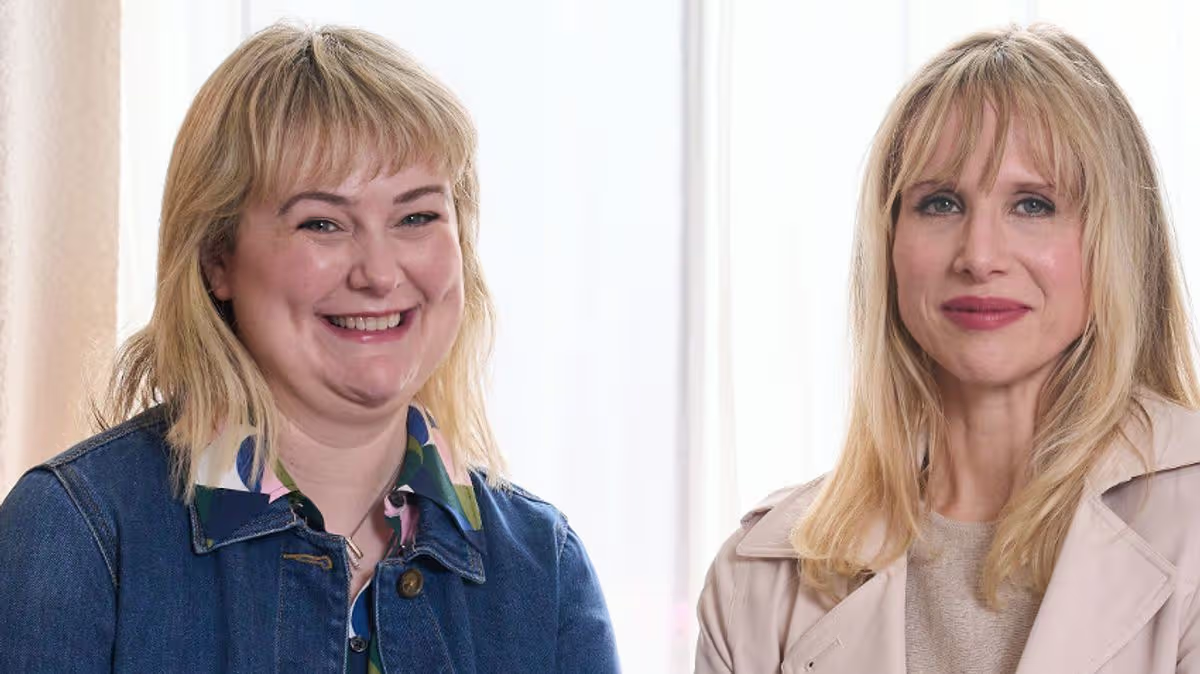
Chaos ensues when SoHa’s Amanda, played by Lucy Punch, is invited for a “collab” on Radio 2 with her pal Anne (Phillipa Dunne).But when they arrive for their live interview they can barely move without tripping over another Amanda – with BGT’s Amanda Holden, 55, travel presenter Amanda Lamb, 53, 90-year-old Corrie fave Amanda Barrie, Irish TV presenter Amanda Byram, 52, and The Traitors’ detective Amanda Collier, 58, all wandering around Broadcasting House at the same time.
Sara’s overwhelmed radio producer is played by Big Mood’s Lydia West while the production runner is comedian Lucia Keskin. Amandaland was the BBC’s biggest comedy of 2025, with more than 7million tuning in for the Christmas special. A second series has already been made and will air later this year. One insider said of the Comic Relief sketch: “Expect mix-ups, misunderstandings, and classic slapstick humour in this unmissable Comic Relief Amandaland special.”
Phillippa said that she jumped at the “pretty iconic” chance to create a sketch for Comic Relief. “It’s a great honour to be asked, and any chance to do a bit of Amanda and Anne stuff is always fun as far as I’m concerned. We could perform Amanda and Anne in our sleep, but the main thing is we just really love it. We just have the utmost fun when we’re doing those two characters because we get to be silly.”
Ahead of filming, the comedy actress said she was looking forward to working with Los Angeles-based Lucy again. “I’m also looking forward to meeting all the Amandas, being inside the BBC building and having a nose around – not that I’ll be doing that.”
She said that if the characters were tasked with raising money for Red Nose Day, she knows exactly how it would go down. “Number one Amanda would have to be in charge and she would have to get Anne to do all the heavy lifting, and then it would be as over the top and dramatic as possible. They’d probably all just fall out, but when they raise a load of money, they’d all be best friends again.”
Amanda Holden said she was thrilled to be getting a part because she is a huge fan of the sitcom. “I can’t quite believe I’m involved in this Amandaland sketch for Comic Relief,” she told the Mirror. “I am a massive, massive fan of Amandaland. We watch it religiously in our house, so it’s a little bit of an out of body experience for me, especially because my name gets mentioned in the sitcom quite a bit.”
Advertisement
She said that when all the different Amandas turn up to the BBC, no one knows what to do with them. “The premise is that there’s been a mix-up and we’ve all come to the same place but aren’t all meant to be here.” And as ever, it might end up in a situation where “Anne is the star of the show in the end”.
Sara said she was “buzzing” from the experience, even though all she had to do was be herself. “I mean, I was playing the DJ, so it wasn’t that much of a stretch, but it was just brilliant to work with actual Amanda from Amandaland, and so many iconic Amandas. I mean come on, we had Lamb, we had Holden, we had Barrie – who I grew up with, not literally – but on Coronation Street. So, it’s been an incredible time pretending to be an actor and getting to work with amazing Lydia West who was playing my producer. What a morning – it’s been incredible.”
Comic Relief: Funny for Money is on BBC1 on Friday 20 March from 7pm, and for the first time will be live streamed on the official BBC YouTube channel. Comedy fans will also be given a behind the scenes look at the filming of the sketch on The One Show on Thursday 19 th March.