




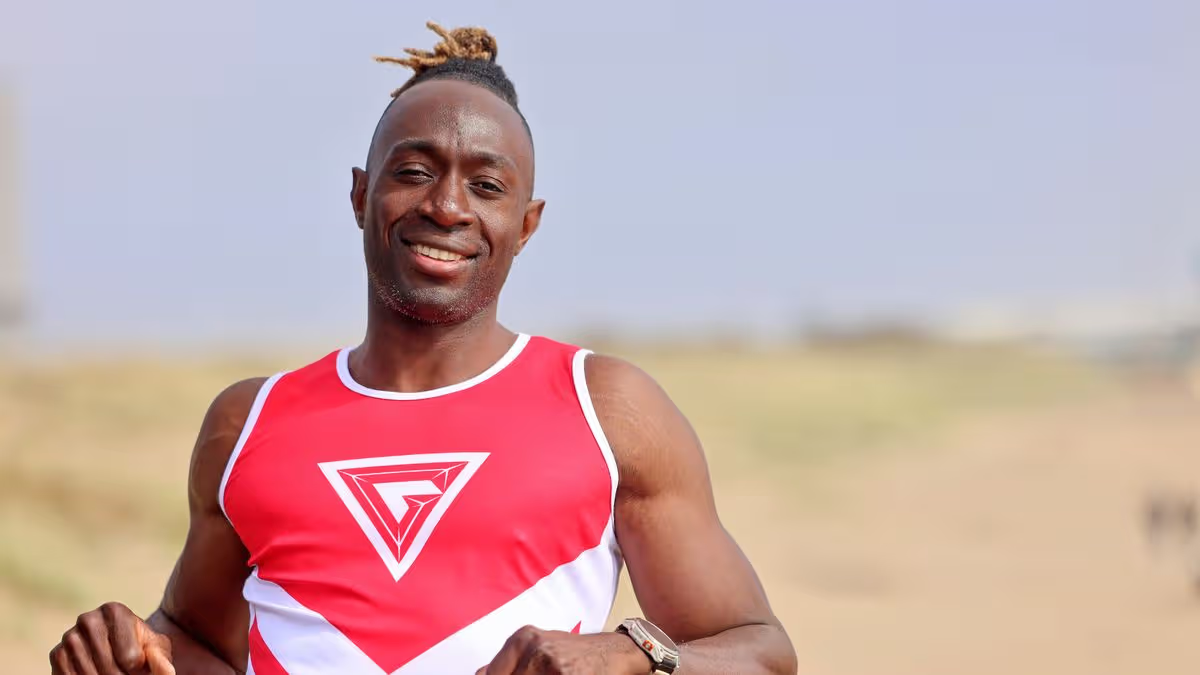
Mo Robertson was the only Welsh contestant on this year’s season of BBC’s Gladiators, and made it to the semi final before having to withdraw from the competition due to injury
Not many of us have the guts to take on one of the biggest challenges in strength and endurance on TV, but a man from Swansea did just that by competing on the most recent season of BBC’s Gladiators. The classic show fronted by father and son, Bradley and Barney Walsh, was revived and returned to our screens in 2024.
Mo Robertson, a 35-year-old foreman, donned his red unitard ready to compete against the new generation of Gladiators. He progressed to the semi final, but unfortunately had to withdraw from the competition following a severe injury to his Achilles.
We spoke to the Welshman about his time on the show, working alongside the TV stars and making his daughter proud. For the latest TV and showbiz gossip sign up to our newsletter
Mo, who also appeared on the first ever season of Ninja Warrior, originally signed up for the BBC series as he wanted a new challenge. Having run ultra marathons and taken on Hyrox events, it seemed like Gladiators was the next level. He said: “I love a challenge, I love testing myself and it was another level up for me personally.
“It’s an iconic show as well, so to be part of something so iconic, part of history, was amazing. It was great fun and it was great to actually represent Wales and fly the Welsh flag high for everyone.”
Having watched some episodes of the series growing up, Mo explained that he was nervous to take on the challenge. He said: “It’s a little bit daunting. It is pretty daunting. I mean you’ve got four thousand people screaming chanting your name and that is amazing. It’s an amazing feeling I mean, you feel like a superstar but you are against the Gladiators at the same time.
“So, you have to try your best to beat the Gladiators, and they’re athletes and they don’t want to lose, so you have to obviously bring your A game.
“I’m a fit individual anyway. So, I do a lot of running and I do ultra marathons. So that side of it, I didn’t really adapt much to my training. So I just did what I normally do, because I’m quite a decent all-rounder.
“I have a high sort of accolade for myself with most things I do, so if I’m gonna do something I wanna try and do the best and try to aim as high as possible. So I did sort of think I would win it, and I think I’d have won it had I not torn my Achilles on the show.”
Mo went head-to-head with Gladiator Viper in the gruelling Everest challenge, a task that involves pushing a 220kg+ moving wall and risking a fall from a 21ft height if unsuccessful. After being shoved off the platform Mo was seen writhing on the hard floor as a medic hurried to his side.
Just moments later, Mo was seen being wheeled out of the arena in a wheelchair, leaving the audience anxiously awaiting news about his condition. Shortly afterwards, Bradley informed the audience that the competitor was doing well but was unable to continue in the competition and would be replaced by a previously eliminated contestant.
Mo found that the injury took a toll on his mental health, but he was grateful he had the support of the BBC when healing. He said: “It was quite a tough thing to accept, and it was a tough injury. So, I tore my Achilles by six centimetres, which was pretty horrific, but had I not had that injury I think I would have won it.
“Mentally, it was very very tough to sort of have the injury and I’m still slowly trying to get back to full strength and mobility. I’m nearly back to where I was, but I must say the BBC had been fantastic. The best surgeon, the best doctor and I was looked after fantastically so if I hadn’t had the BBC looking after me I probably wouldn’t be where I am now fitness wise.”
Looking back on his time in the competition, Mo was happy with how he placed in the competition despite having the confidence that he would have won. He said: “I’m really happy I got to the semi-finals. Obviously gutted that I didn’t reach the final, but that’s life, isn’t it? It’s going to happen sometimes.
“In hindsight, I’m quite happy and quite proud in how far I got. Not many people have got to the semi-finals of Gladiators so I’ve marked myself down in that bit of history.”
The Welshman praised the father and son presenting duo, saying: “Both of them are absolutely brilliant. I mean, they brought all of us to ease. If you can imagine, it’s the first time a lot of us have ever done anything like this, and for them to sort of calm our nerves and just sort of reassure us was absolutely awesome.
“They’re such cool cats and such professionals at what they do as well.
“So, you know, they kept everyone at ease. So it was awesome to actually have the opportunity to work with them as well.”
Mo admitted he was slightly intimidated to be taking on the Gladiators, especially as he respects their athletic careers and often sees them on social media. He said: “I mean to go head to head with an ex-rower or an ex-sprinter who you sort of see on TV or social media and you’re standing next to him is quite amazing.
“But you know they’re all fantastic people, they all supported us contenders, because they don’t want to hurt us, but they want to compete against us and at end of the day it’s great for the crowd and most of all great for the children. That’s what it’s all about, having a great spectacle for the young kids.”
Mo spoke about working with Strictly star Harry Aikines-Aryeetey, better known as the Gladiator Nitro. He said: “Going head to head against Nitro was amazing. I mean he’s very uplifting, he’s motivating.
“Obviously as an ex-GB sprinter, he’s very keen to win, but also he’s got great moves. Aside from that, he’s always willing to add some words of encouragement to us, the contenders, because obviously we are going to be quite nervous, and also they’re gonna be nervous because as athletes they don’t want to lose against average Mo do they.”
The series was filmed in Sheffield’s Utilta Arena over the course of a month, and Mo had plenty of support from his family including his four-year-old daughter Naylah. She was sat in the audience of the arena, cheering her father on whilst sporting a ‘Big Mo’ t-shirt.
The little girl’s father said: “She absolutely loved it, and absolutely loved seeing her dad and seeing herself on telly. Her friends were saying ‘your daddy was on telly, how was that?’
“I hope I’ve done them proud and I hope my daughter has a proud memory of me.
“What was the most amazing thing for her as a young girl was seeing strong women on television and I think that’s a better role model than I can be. She can see strong women on television, which is great for her as she grows up.”
Not only did he have the support from his family, but also the support of the local community. Many fans of the show have been stopping Mo in the street to have a chat and a selfie.
When asked what was next, Mo said he’s looking forward to the Gladiators live tour which he hopes to be part of later this year. He said: “So I’m really looking forward to it. So I’ve been working hard to get back to full strength and full fitness. I enjoy keeping fit anyway, it’s just part of me.
“But having the opportunity to sort of test myself against the Gladiators was amazing. I must say, they were all awesome.”
He is also hoping to take part in some other major challenges. Mo said: “Well, I want to do SAS Who Dares Wins next, potentially. I sort of go for the big challenges. So I want do that, and depending how my Achilles fares up, then do the live shows, and I’ve got a few other fitness competitions lined up in Paris and Glasgow, potentially in the year.”
You can watch Gladiators on BBC iPlayer.












































You must be logged in to post a comment Login