
Serious hostilities between the US and Iran have resumed. On July 8, Donald Trump said that the ceasefire agreed by the two countries in June was “over”. Since then, he has ordered the US military to carry out intensive airstrikes on Iran and has reimposed an economic blockade of the country.
The US president has also begun to recycle threats he made earlier in the war. These include striking civilian targets and seizing Iran’s Kharg Island, which is host to most of its oil refining capacity.
Hope within the White House of achieving a deal to address Iran’s nuclear capabilities is fading. But Trump is hoping that his latest moves will force Iran to relinquish its control of the Strait of Hormuz, allowing global energy markets to return to normal.
There’s just one problem: none of these things have worked before, and there is no reason to think they will work now. In fact, Trump’s return to the same playbook that has previously failed to end the war on terms acceptable to the US shows just how limited his options have become.
Abedin Taherkenareh / EPA
The war began with an attempt by Trump and the Israeli prime minister, Benjamin Netanyahu, to damage Iran’s nuclear capabilities and perhaps topple its regime. However, the conflict’s centre of gravity has since shifted.
Nuclear matters have taken a back seat to the issue of whether shipping through the strait will in the future operate only under what Iran’s chief negotiator, Mohammad Bagher Ghalibaf, has called “Iranian arrangements”. This means ships will only be allowed to transit on Tehran’s terms.
The US rejects the idea of Iranian control of the strait and wants a return to the situation of free transit that existed before the war. Yet, after all of these months, it has still not figured out a way to achieve this goal at an acceptable cost. To understand why, it is helpful to break down US options into three groups: military, diplomatic and economic.
Trump’s limited options
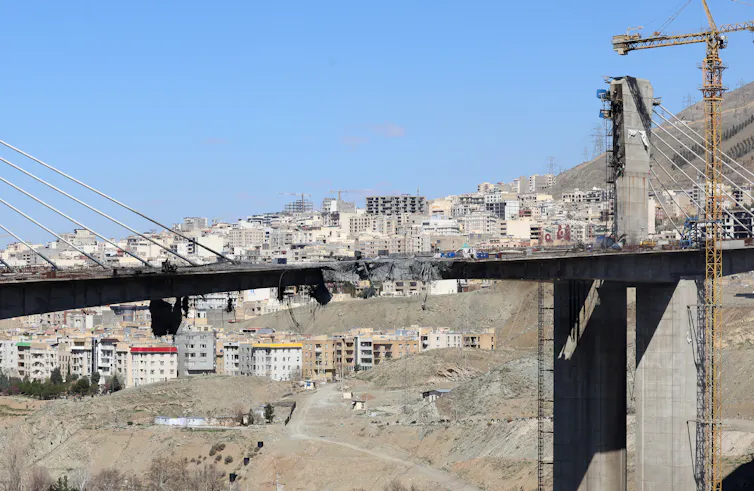
Militarily, nobody fully controls the Strait of Hormuz. It is a contested zone into which various countries can project military power. However, Iran does not need to control the strait entirely to achieve its aim. It only needs to continue to pose enough of a credible threat to vessels that they are too worried to transit.
Iran’s ability to menace shipping in the strait stems from its stockpile of missiles, drones and fast boats. These are relatively easy to conceal and launch, and the CIA assesses that Iran still has healthy supplies of them. To stop these capabilities, the US would have to seize a vast swathe of Iranian territory, risking great casualties. And even then, success would not be guaranteed.
Seizing Iran’s Kharg Island would likewise be highly risky. Occupying it may be easy initially, but any US forces stationed there would be exposed to Iranian attacks. A lengthy occupation would probably cost lives, making it hard to hold on to the island long enough to use as leverage in negotiations.
As cynical – and probably illegal – as military strikes on civilian targets would be, Trump perhaps thinks they might force Tehran to the table. But they also might not and risk kicking off a round of Iranian retaliation, which could do much greater damage to energy and civilian targets across the Gulf.
Abedin Taherkenareh / EPA

The risks and probable futility of these military options are what have pushed Trump to instead explore a diplomatic solution to the conflict over the past few months. But success here has also proven elusive, and it is likely to continue to do so.
The results of diplomacy usually reflect the state of the battlefield. With the US lacking any credible military option to neutralise Iranian influence in the Strait of Hormuz, there is little reason for Tehran to relinquish it.
Mohsen Rezaee, an adviser to Iranian Supreme Leader Mojtaba Khamenei, recently referred to Iran’s influence in the strait as “more important than dozens of nuclear bombs”. His statement reflects the importance the waterway has taken on in the country’s strategic calculations.
Being able to control shipping through the strait gives Iran leverage against the US. It will not give this up without a very good reason.
Economic tools
A lengthy economic blockade of Iranian ports is perhaps the most effective way Trump has to inflict pain on the Iranian government, whose domestic support may fray in a prolonged economic crisis. Economic grievances, including high inflation, contributed to a wave of unrest in Iran in early 2026 that was met with brutal repression.
However, the economic pain cuts both ways. While the blockade is in place, Iran is unlikely to allow oil and gas to transit the strait. That raises global energy prices, which is a perilous political proposition for Trump, too.
Imposing the blockade is costly in another way for the US – it requires a permanent military deployment to enforce. Given the competing demands made on the US military from other missions, such as deployments in Europe and the Indo-Pacific, this blockade cannot be kept in place forever.
Yet when the blockade is lifted and US forces leave the region, Iran will still be physically next to the Strait of Hormuz, able to menace shipping anew.
Ultimately, Trump has backed himself into a corner from which there is no apparent escape. For all the immense military power available to the US, there are limits to what it can achieve. In this war of his own making, Trump is running hard and fast into them.
You must be logged in to post a comment Login