


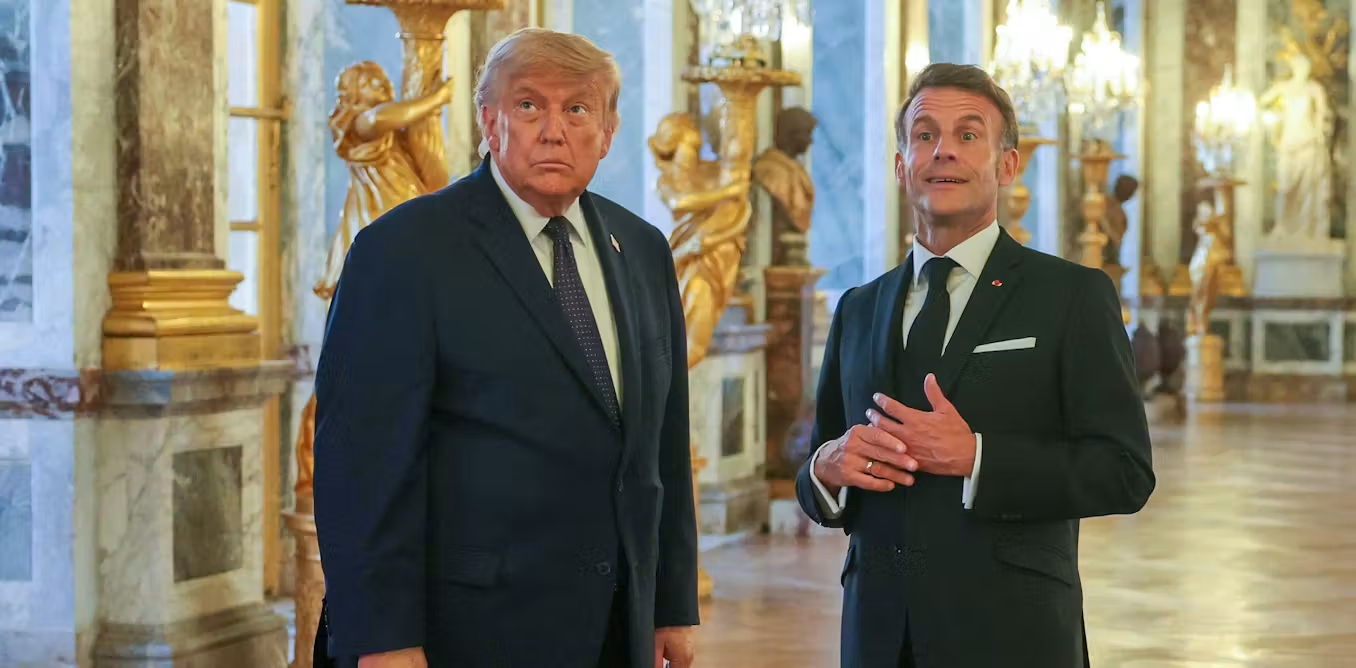
After dining lavishly on lobster, caviar and truffles in the opulent surrounds of the Palace of Versailles last night, Donald Trump affixed his signature to the much-anticipated memorandum of understanding that will, all being well, begin a 60-day ceasefire between the US, Israel and Iran.
The document was subsequently signed in Tehran by the Iranian president, Masoud Pezeshkian.
“This was not easy,” the US president reportedly remarked as he wielded his trademark Sharpie marker pen – a statement that may go down as a huge understatement. The text of the deal reveals the Iranian negotiators drove a very hard bargain in return for opening the Strait of Hormuz, which the world now hopes will enable the global economy to recover from the considerable disruption of the past three and a half months.
This war has been an utter disaster for the US and Israel, writes Arshin Adib-Moghaddam of SOAS, University of London, who has been researching and writing about Iranian affairs for many years. Trump and his ally, Israeli prime minister Benjamin Netanyahu, have failed to secure any of the outcomes they set out to achieve when they attacked Iran on February 28. In fact it has arguably left Iran, while battered, stronger strategically than it was before the war.
It’s not as if Iran-watchers haven’t warned of the danger of using blunt force against Iran. As Adib-Moghaddam notes here, he and fellow scholars and analysts have been stressing for years that the Islamic Republic was well prepared for the sort of asymmetrical conflict we have now seen it wage. And now, of course, it has demonstrated to itself – and the rest of the world – what a potent deterrent it has in its ability to shut down the strategically vital Strait of Hormuz.
À lire aussi :
Iran ceasefire deal confirms what we’ve been saying for years: military might doesn’t work
The state banquet at Versailles followed the 2026 summit of the Group of Seven (G7), which has been taking place this week in the French spa town of Évian-les-Bains. As Natasha Lindstaedt of the University of Essex notes, this was a clever move dreamed up by the French president, Emmanuel Macron, who was desperate to avoid a repeat of last year’s summit in Alberta, Canada, when the US president walked out a day early.
On that occasion he refused to sign the usual unified G7 statement, complaining that he didn’t like the language on Ukraine. There was no such reticence this year. Macron was cock-a-hoop at what he called a “very deep change in the US approach”. It was, he said, “re-synchronisation” for the G7 on the war in Ukraine, which released a statement pledging unwavering support for Ukraine in defending its territorial integrity, which Trump also signed after what the US president said was a “very good” meeting with Ukrainian president, Volodymyr Zelensky on the summit’s sidelines.
Key to achieving this unity, says Lindstaedt, was the approach of the other G7 leaders towards the US president: flattery. As we know, this is something that has proved highly effective in the past.
À lire aussi :
Macron plays ‘Trump whisperer’ as the US president signs Iran ceasefire deal after a successful G7 summit
Republicans unimpressed
If Trump’s dining companions at Versailles were effusive in their congratulations for the US president’s deal, the reaction from many prominent Republicans in the US has been less than positive. “Reagan is rolling over in his grave,” commented Senator Bill Cassidy, who added that the war had been “the worst foreign policy blunder in decades”. It’s a view shared by much of the party’s old guard, who see the deal as a capitulation.
Quite how Iran managed to gain the upper hand in a conflict against two of the world’s best-armed militaries will make for an important case study for students of war. Jim Lamson and Matthew Moran of King’s College London explain how Iran managed to turn the tables and emerge not only undefeated, but arguably stronger.
À lire aussi :
How Iran gained the strategic upper hand in the war with the US and Israel
Israelis livid
Meanwhile, if the US president’s critics in the US are unimpressed, Israelis – friend and foe alike – are positively livid. David Horovitz, the editor of The Times of Israel, called it “a catastrophic capitulation”. Others have been less polite.
Benjamin Netanyahu has made no public comment since the deal was signed. It has been reported that he wasn’t shown the finalised agreement before it was signed (Trump commented this week of their alliance that: “We are the big partner and he is the very small partner”, which will give him an idea of where he stands).
The fact is, writes Simon Mabon, a Middle East specialist at Lancaster University, that despite being close allies, the US and Israel – but particularly Trump and Netanyahu – are at loggerheads over what they want from the war from any peace agreement that ends it. Most Israelis see any bid by Iran to develop a nuclear weapon as an existential issue, for which there can be no compromise. The war, meanwhile, is deeply unpopular in the US, where rising fuel prices and inflation are really beginning to hit home.
The war has also hurt Trump’s popularity which is at a new low, just months before November’s midterm elections, at which the Republicans are likely to lose control of at least one chamber of Congress, if not both. Netanyahu also faces an election in October. So the idea of a ceasefire with no resolution of the nuclear issue is anathema.
To further complicate the situation, the deal stipulates an end to the conflict being waged in southern Lebanon and makes the US responsible for guaranteeing that country’s territorial integrity. This would require Israel to withdraw, something the Israeli prime minister has firmly ruled out, setting the scene for some serious discord between the two leaders.
À lire aussi :
Donald Trump and Benjamin Netanyahu have different war aims – can the Iran peace deal survive?
All of which means we may well be hearing some more fairly ripe language from Donald Trump, who has recently told the Israeli prime minister he is “fucking crazy” and that he has “no fucking judgement”.
Strong words. But not without precedent. As Andrew Gawthorpe, an expert in US politics at Leiden University notes here, Netanyahu has a long track record of moving US presidents to profanity.
À lire aussi :
Why US presidents end up cursing Benjamin Netanyahu









![[TIKTOK] Lisa Money Trend](https://wordupnews.com/wp-content/uploads/2026/02/1770644804_maxresdefault-80x80.jpg)


![Skilla Baby - GYSM (Get You Some Money) [Official Video]](https://wordupnews.com/wp-content/uploads/2026/06/1781824474_maxresdefault-80x80.jpg)























You must be logged in to post a comment Login