Dreaming in Colour, a new exhibition at the Opera Gallery in London, revisits the surrealists of the previous century, more in homage than imitation.
I suspect few of the emerging artists included here – and certainly none of those I spoke to on opening morning – would consciously describe themselves as surrealists. Yet the surrealist aspiration to evoke a sense of the marvellous and mysterious in the everyday is certainly present.
Take Sretenko (2025-2026) by the Spain-based Russian artist Sasha Zimulin, a vivid landscape of his home suburb of Moscow. In this piece, Zimulin conjures up not the sight of the city, but its ambience, and the feelings stirred in someone standing on the edge of the scene.
He is one of 25 international artists showcasing new works in this exhibition. These works are complemented by the inclusion of a range of historic pieces by figures such as Picasso and Ron Arad. Some of them, notably Chagall’s Multicoloured Clown (1974), certainly reflect the exhibition’s theme. Yet there is no attempt to place these in dialogue with the newer works on which I will concentrate here.
The artists on show
Probably the most consciously surreal work is that which also most directly addresses the exhibition’s theme: Dreaming of the Taste of Colour (2025) by the Dutch artist Arjen. This offers an exuberant expression of synaesthesia – a neurological phenomenon where stimulation of one sense triggers an experience in another sense that isn’t being directly stimulated, such as the sensation of tasting colour.
Exhibited nearby are the two paintings included from the Warsaw-born, Paris-based artist Oh de Laval. Taste has often been foregrounded in her work, as has the influence of Francis Bacon. The latter is palpable here, both in the colour palette used in Untitled (2025) and in the act of violation, minutely captured in a tear.
Courtesy of Opera Gallery
As with surrealism, the artists exhibited here use a range of styles and artistic language. For instance, Break in the Clouds (2025) by US-based Salvadorian artist Daniella Portillo typifies her emotional engagement with landscapes rendered almost abstract by her use of colour and form.
More consciously abstract are pieces such as Paraiso #33 and Paraiso #34 by American-born, Spain-based Adrián Navarro. The ironic titles add to their disturbing allusions to the familiar in unfamiliar settings.
This unsettling quality is also marked in the more figurative work in the exhibition. Mexican-American artist Anna Ortiz is known for her consciously surreal landscapes evocative of the erased pre-Columbian past, here reflected in the dream-like Jaguar Reflejado (2025). A similar uneasiness is also present in the contribution of London-based May Watson. She specialises in vibrant and humorous art of the everyday, but here is apparently Busy Dreaming (2025) of a shark, albeit one playfully surrounded by multicoloured balls.

Courtesy of Opera Gallery
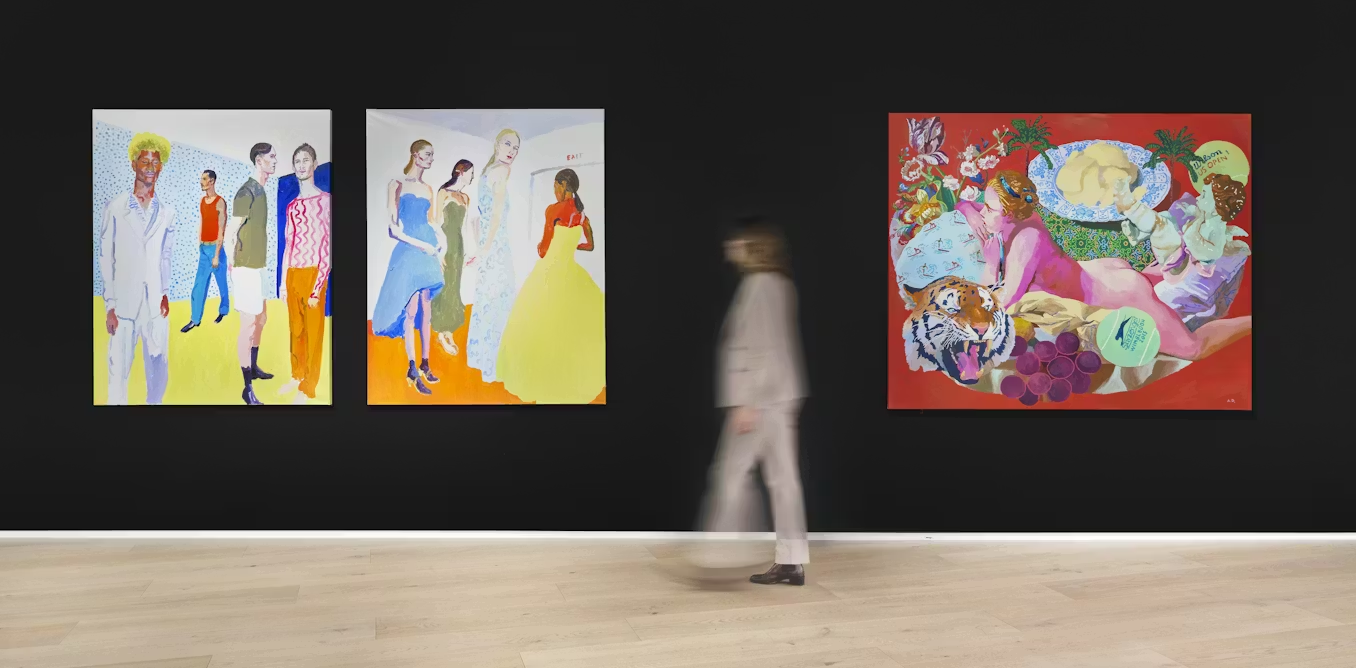
Balls also feature prominently in Red Composition with Butter (2025) by Canadian-born, Los Angeles-based Andy Dixon. This voluptuous image reimagines the historic depiction of the reclining female nude, although this juxtaposition instead seems to ironically recollect seedy sex scenes from the movie Last Tango in Paris (1972).
There are several filmic references. Spanish artist Xevi Sola defines his work as being like “filming a horror movie using relaxing pastel colours”. His work sits squarely within a surrealist tradition in its efforts to provoke a Jungian exploration of the darkest areas of consciousness. Yet here he moves away from the collage-based approach of previous works. Instead, Backstage I (2024) and Backstage II (2024) disturb by depicting awkwardly adjacent figures, with one staring unnervingly straight out of the canvas at the viewer.

GUSN Studio
Eshu (2025) by the Brazilian artist Gustavo Nazareno is more subtly subversive. He has become rightly celebrated for lush, powerful depictions of Black bodies in works that challenge the canon of western portraiture and religious art. Black spirituality, dignity and beauty are all powerfully evoked in this richly textured painting.
Another artist who subverts historic images is London-based Greek artist Niovi Kafantari. Her work, He Was Already Leaving (2026) reverses the gaze in Titian’s Venus and Adonis (1553-1554) to focus not the energy of the hunter, but the protecting arms flung around him.
A different kind of subversion is presented in I’m Free Tuesday (2025) by Brazilian-American Jonni Cheatwood. He is noted for using a diverse range of materials and images, yet this is a more muted piece in which the colours of the food on the table recur in the faces of the diners. Capturing mood in the visage is also a feature of several other works here, not least those by Geneva-based Cameroonian artist Maurice Mboa and Nigerian portraitist Collins Obijiaku.
Not all of these works are colourful, particularly the sombre architectural forms of Misty Days (2025) by Spanish artist Borja Colom. Yet that certainly has a dreamlike quality.
Nor are all these works necessarily surreal. Some, such as Conjura (2024) by Spanish artist Miguel Sainz Ojeda, also draw on influences such as street art to create an image that is fantastical and disquieting.

Courtesy of Opera Gallery
This suggests that another theme of the exhibition is magical realism. More often seen as a literary or cinematic genre, magical realism is nonetheless invoked here in the filmic atmosphere and implicit storytelling embedded in many of these works.
In art, magical realism provides a haunting and distorting perspective that challenges our perceptions. This is most conspicuously the case in Hitchcock’s Glass (2025) by Italian artist Mattia Barbalaco.
Brilliantly hung to maximum effect as you descend to the lower ground floor, this luminous painting recreates both a scene from Hitchcock’s 1941 thriller Suspicion and conveys the suspenseful, unsettling quality of dreams.
Dreaming in Colour is at London’s Opera Gallery until April 6