The arrest stems from a collaborative UK law enforcement response to dismantle EncroChat
An East Belfast man has been jailed for drugs charges linked to an encrypted phone network used by criminals.
Advertisement
The 41-year-old appeared before Craigavon Crown Court on Friday, September 18, in relation to offences linked to EncroChat.
He was sentenced to 22 months, half to be served in custody and half on licence, for the offences of intentionally encouraging or assisting the supply of Class B controlled drugs and three counts of transferring criminal property.
The investigation and subsequent sentencing stems from Operation Venetic, a collaborative UK law enforcement response to dismantle EncroChat, led by the National Crime Agency.
The arrest followed the search of a property six years ago, where items were seized including three mobile phones.
Advertisement
Detective Inspector McCamley from the Police Service of Northern Ireland’s Organised Crime Branch said: “EncroChat was an encrypted communication channel used by organised crime groups to plan illegal activity, such as drug importation and the movement of cash.
“Wayne Jones’ arrest followed searches of a property in East Belfast in July 2020. Here, various items were seized, including three mobile phones and a quantity of cash.
“As with other similar cases, our detectives from the Police Service of Northern Ireland’s Cyber Crime Centre were able to recover digital forensic evidence. This, alongside collaboration with our partners, including prosecutors from the Public Prosecution Service and the NCA, ultimately brought the defendant before the court.
“This is a further example of our ongoing commitment to bring those who use EncroChat for criminal activity and their own financial gain to justice.
Advertisement
“Working alongside our partner agencies, we will continue to disrupt the movements and activities of organised crime groups, who bring nothing but harm to the most vulnerable within our communities.
“As part of this investigation to date, we have made 52 arrests and obtained Confiscation Orders in the sum of almost £200,000.
“A total of 20 defendants have now pleaded guilty, with 15 of these sentenced for offences linked to EncroChat, from drug supply and money laundering offences to conspiracy to murder and possession of firearms.
“It’s thanks to such collective efforts, backed by our own Cyber Crime Centre and Economic Crime Unit, that we’re able to continue bringing defendants before the courts.”
An analyst is said to have used a chatbot that wrongly identified the nature of the Chinese ship’s cargo.
Rucsandra Moldoveanu and Ruth Suter Chief Live News Reporter
19:50, 18 Sep 2026
The US reportedly “almost started a war” against China after an AI chatbot wrongly concluded a Chinese ship was carrying a nuclear weapons component.
The incident happened this spring, when the vessel was spotted in the Middle East amid America’s war with Iran. The US was preparing to board the vessel and planes were circling, with plans to intercept the ship underway.
But, once officials had a more detailed look into the intelligence report that led to the large-scale response, they realised it had been generated with the help of AI, CNN reports. An analyst is said to have used a chatbot that wrongly identified the nature of the Chinese ship’s cargo, suggesting the vessel was transporting components of a nuclear weapons programme.
Advertisement
What exactly the vessel was transporting remains unclear to this day, with one source telling CNN that the intelligence report was “entirely false” but “almost started a war” between the US and China.
It is also unclear whether the AI chatbot used by the US analyst was one that is commercially available or one that has been developed by the US government. However, a former senior US official who has knowledge of the AI systems used by the country’s military said the internal tools are “mostly just copies of the commercial stuff wearing lipstick”.
The AI bot reached its almost catastrophic conclusion after fusing together open-source intelligence with secret signals intelligence in government holdings. AI was once again then used by the analyst to list the findings into an intelligence report.
Mirror Online has approached the Pentagon and US Special Operations Command Pacific for comment.
Advertisement
An “Artificial Intelligence Acceleration Strategy” was released in January by Defence Secretary Pete Hegseth which aims to accelerate the military’s use of AI. Hegseth said this will “unleash experimentation and eliminate bureaucratic barriers”. But the incident in spring is not isolated, a source told CNN, while another said “AI allows you to get to a bad idea faster”.
Get more Daily Record exclusives by signing up for free to Google’s preferred sources. Click HERE.
A study from the University of Minnesota, recently published in JAMA Network Open, found that autistic beneficiaries of free or low-cost health insurance program Medicaid died at 10.5 times the rate expected in comparison groups.
Compared to Medicaid beneficiaries without the condition, autistic recipients’ life expectancy was 5.8 years lower. Flu was the leading cause of this discrepancy.
These findings, however, involved people in a healthcare system very unlike the UK’s. So, we asked Professor Laura Crane, Chair in Autism Studies at the University of Birmingham and Director of the Autism Centre for Education and Research (ACER), as well as Dr Asiya Maula, a GP at The Health Suite, for their thoughts on whether this has any lessons for the UK.
“This is a deeply concerning finding, but it should not be interpreted as proof that autism itself makes influenza ten times more deadly”
Advertisement
Dr Maula said that though this study’s results are “deeply concerning,” she stressed that this doesn’t mean having autism automatically makes flu 10 times as likely to kill people.
And disability isn’t the only factor to consider in the US study, which focused on “autistic Medicaid beneficiaries in the United States, a group that may also experience disability, financial disadvantage, coexisting health conditions and barriers to healthcare”.
Still, both she and Prof Crane told HuffPost UK that people with autism really do face additional obstacles “at almost every stage of obtaining medical help”.
That can include issues with phoning a GP, crowded waiting rooms, and unfamiliar doctors, for which acommadations are too rarely made. As a result, healthcare inequalities persist for this group.
“Symptoms can therefore be reported in ways that appear atypical, which can sometimes result in concerns being overlooked or misunderstood by healthcare professionals.
“More broadly, there is evidence that autistic people can experience inequalities across the healthcare pathway, from accessing services through to receiving timely and appropriate treatment.”
The professor pointed to a study of over 500 autistic adults, which showed that 72% of participants found it hard to work out whether their symptoms warranted a GP visit or not.
Advertisement
Per Dr Maula, there’s a risk of something called “diagnostic overshadowing,” in which healthcare providers chalk symptoms up to autism when they’re not related, too; she also said those with autism might appear “calmer” than expected, despite serious health issues, during examination.
“Autism should never be allowed to distract from a proper medical assessment,” the GP said.
Meanwhile, Prof Crane stated: “While I would be cautious about drawing direct conclusions for the UK from a study of US Medicaid beneficiaries (given the difference in our healthcare systems), I do think the findings reinforce broader concerns about the significant health inequalities experienced by autistic people and the importance of making healthcare more accessible, responsive and preventative”.
How can I spot flu and more severe symptoms in autistic people?
Advertisement
Dr Maula said that while the basic symptoms of “regular” flu – a relatively sudden onset of “fever or chills, a cough, sore throat, headache, aching muscles and profound tiredness” – remain the same, carers and loved ones should also be on the lookout for altered behaviours.
“Becoming unusually withdrawn or distressed, sleeping far more than usual, communicating less, refusing food or drink, passing less urine or losing the ability to manage familiar tasks may indicate that somebody is seriously unwell,” she explained.
“The crucial question is not simply, ‘Do they look like a typical flu patient?’ It is, ‘Are they significantly different from their usual baseline?’ Families and carers often hold essential information about that baseline and should be listened to.”
The following symptoms require “urgent medical attention” during a flu, she added:
Advertisement
Difficulty breathing,
blue or grey lips,
chest pain,
confusion,
being difficult to wake,
a seizure,
severe dehydration, or
symptoms that improve and then suddenly worsen.
“People should call 999 for severe breathing difficulties or another life-threatening emergency.”
Are autistic people automatically enrolled for an NHS flu vaccine in the UK?
Dr Maula said autism itself doesn’t qualify you for a free flu vaccine; eligibility depends on age and risk. (You can see whether you may be entitled to the vaccine through the NHS’ site; some pharmacies offer jabs privately for those aged 18 and over).
“In England’s 2026 to 2027 programme, eligible children are being offered vaccination from September,” she added.
“Adults under 65 in clinical risk groups, including people with a learning disability, are eligible from October. Autism alone is not listed as a clinical risk group, but many autistic people will qualify because of their age, a learning disability or another health condition.”
Advertisement
Professor Crane said “there has been a strong push to introduce annual health checks for autistic people in the UK,” which could help to “identify emerging health concerns proactively, ensure health needs are monitored regularly, and pick up vulnerabilities early before they become more serious problems”.
Research from Newcastle University has found that programs like these are “acceptable and feasible to deliver, and can help identify and address autistic people’s health and care needs,” she ended.
“This work shows the value of proactive, autism-informed healthcare, rather than relying solely on individuals seeking help once problems have become acute.”
A 23-year-old man has been arrested after a woman was left in a critical condition
Emily Carubia Late reporter and Matt Jackson Live News Network Reporter
20:53, 18 Sep 2026
A woman is fighting for her life following a stabbing in Liverpool. Emergency services were called to an address in the city centre at approximately 2.55am on Thursday, September 17, after reports emerged that a woman had been attacked.
The victim was rushed to hospital with stab wounds to her stomach and arm, where she remains in a critical condition. Footage from the scene shows a significant emergency response on Henry Street, with armed officers and multiple ambulances at the scene.
One witness described seeing armed police “searching every floor” of a building on the street. A 23-year-old man from Liverpool was subsequently arrested on suspicion of Section 18 wounding. He remains in custody at a police station in Merseyside, while officers continue their enquiries into the incident.
Advertisement
Detective Inspector Daniel McWhinnie said: “I would like to reassure residents that we believe this was an isolated incident that happened early this morning.”, reports the Liverpool Echo.
“Although an arrest has been made our officers are still investigating what happened at the address in our city centre after a woman was left with serious injuries.
“Therefore, I would appeal to anyone who lives in the area, that has any doorbell footage that may have captured anything suspicious to get in touch as soon as possible so we can continue our investigation.”
If you have any information on this incident please contact Merseyside Police’s social media desk via X or Facebook @MerPolCC or ring 101 with reference 26000765447.
Ensure our latest news and sport headlines always appear at the top of your Google Search by making us a Preferred Source. Click here to activate or add us as Preferred Source.
With new adaptations of Pride and Prejudice and Sense and Sensibility arriving on our screens this autumn, television’s long-running love affair with Jane Austen shows little sign of abating. But there are other 18th-century writers with whom TV could have a wonderful love affair, too.
One writes about a woman who disguises herself as four different people to pursue the same man. Another writes about a woman becomes so obsessed with romance novels that she struggles to distinguish fiction from reality. In other’s work, a young heroine navigates the dangers of high society while a sheltered young woman uncovers dark family secrets in a remote castle.
Don’t these sound like pitches developed for a contemporary streaming platform? Although largely forgotten today, they contain many of the ingredients that contemporary television audiences love. Here are romance, scandal, mistaken identities, unreliable narrators, gothic suspense and sharp social commentary. Indeed, some of the 18th-century’s most influential novels seem almost uncannily designed for 21st-century screens. Here are five such tales.
Broadview Press
The titular protagonist of Haywood’s best-known work is a young woman who repeatedly reinvents herself through a series of disguises to sustain a relationship with an unsuspecting lover. Long before Tinder profiles or TikTok personas, Haywood understood that attraction often depends on performance and self-presentation.
Advertisement
In a recognisably contemporary act of self-fashioning, each disguise grants Fantomina access to forms of freedom, mobility and sexual agency denied to respectable 18th-century women. It is only by shedding her “respectable” identity and becoming anonymous that Fantomina is able explore the freedoms offered by public life.
In this respect, the novella’s interest in reinvention anticipates everything from online pseudonyms to the carefully curated selves of dating apps, while its suggestion that women are judged differently depending on how and where they appear in public feels strikingly relevant in an era of social media, personal branding, and constant visibility.
Oxford World’s Classics
Few mid-century novels generated more controversy or excitement than Pamela, the story of a young servant girl who resists the unwanted advances of her wealthy employer. Centred on questions of power, class, precarity and consent that remain highly relevant today, the novel sparked fierce debate amongst its first readers and spawned several imitative responses.
Long before the #MeToo movement forced a wider reckoning with how economic and social authority can be abused, Richardson’s bestselling novel was asking pertinent questions about the options available to women when the men pursuing them also hold power over their futures. The novel’s conclusion can feel deeply troubling to modern readers. Yet it is precisely its ambiguity — and the difficult conversations it can provoke — that would make Pamela such a compelling adaptation today.
Oxford World’s Classics
Often read as a satire on the dangers of excessive reading, Lennox’s novel feels uncannily attuned to contemporary debates about BookTok, fandom and so-called “book boyfriends”: fictional characters, usually male, who readers wish existed in real life. Its heroine Arabella’s habit of interpreting real life through the conventions of romance recalls contemporary anxieties about the influence of popular fiction on readers, particularly women.
Yet The Female Quixote also invites us to question why female reading habits attract such scrutiny in the first place. Much like modern debates about romantasy or fan fiction, Lennox’s novel exposes the tendency to dismiss the cultural interests of women as frivolous, unhealthy or delusional.
Advertisement
A smart adaptation could capture both the comedy of Arabella’s misconceptions, and the novel’s surprisingly sympathetic defence of the pleasures of imaginative reading.
blank. Oxford World’s Classics
Evelina is perhaps the easiest sell of all because its often seen as Austen before Austen. Following a young woman as she enters fashionable society for the first time, the novel combines romance, comedy and social satire with a heroine whose uncertainty about the world around her makes her instantly relatable.
But beneath its humour lies a story about the challenges of establishing your own identity in a society obsessed with status and reputation.
Burney was one of Austen’s favourite authors and readers familiar with Pride and Prejudice and Emma will recognise many of the qualities that Austen would later make famous. So an adaptation of Evelina would offer something both fresh and familiar by giving viewers a chance to revisit the literary world that made Austen possible in the first place.
Oxford World’s Classics
A riot of gothic excess, Anne Radcliffe’s chiller arrives packed to the brim with many of the ingredients that have recently enjoyed a cultural renaissance: crumbling castles, sublime landscapes, dark family secrets, brooding villains and a pervasive atmosphere of mystery. But the novel’s enduring appeal lies in the way it uses these gothic trappings to explore very real anxieties about female precarity and male power. Isolated, surveilled and threatened by powerful men, the fate of heroine Emily St. Aubert explores inheritance, coercion, gender, and authority.
Now, don’t get me wrong, Austen remains endlessly adaptable. I, for one, will be watching the latest takes on her work when they land on our screens. But as this list shows, Jane’s was never the only game in town. The novels beloved by Austen and her contemporaries were often stranger, riskier and more inventive than the stories that often make it to our screens. Three centuries on, they may be ready for their big moment.
Advertisement
This article features references to books that have been included for editorial reasons, and may contain links to bookshop.org. If you click on one of the links and go on to buy something, The Conversation UK may earn a commission.
John F. Kennedy’s niece praised a Democratic lawmaker as a “national hero” for challenging President Donald Trump’s proposed changes to the Kennedy Center in Washington, D.C.
“@RepBeatty is a national hero,” Kerry Kennedy wrote on X on Thursday. “She has fiercely and courageously stood up for the Kennedy Center, for the arts, for Uncle Jack’s memory, for this country’s history, and most importantly, for the law, time and time again.”
“We will not be bullied into silence or submission,” she added. “Thank you, Rep. Beatty. We are all so grateful for your leadership.”
Advertisement
Beatty, who filed her lawsuit challenging the Kennedy Center’s renaming in December 2025, secured a victory this week. On Tuesday, U.S. District Judge Christopher Cooper barred the 80-year-old Republican president from etching his name into the building, a living memorial to John F. Kennedy.
Kerry Kennedy, a daughter of Robert F. Kennedy, lauded Democratic Rep. Joyce Beatty as a ‘national hero’ for standing up to President Donald Trump’s proposed Kennedy Center changes (AFP via Getty Images)
“Simply put, Defendants cannot install memorials for President Trump or anyone or anything else at the Kennedy Center without Congress’s blessing,” Cooper wrote. “The board resolution bucks a federal court order and a statute Congress enacted.”
Following the ruling, Beatty said that Trump erupted into a “tantrum” during a meeting with the board of the Kennedy Center, which the president chairs.
“I mean, let me just make it simple. It was the most unprofessional thing that I’ve ever witnessed,” the Ohio congressman, an ex officio member of the board, told MS NOW on Tuesday evening. Trump reportedly labeled her an “obstructionist” and “dumb.”
Trump administration officials have accused Democrats of letting the center fall into disrepair, while Democrats, including Beatty, have characterized Trump’s rebranding effort as a “vanity project.”
Advertisement
Traffic cones keep cars from entering the driveway at the Kennedy Center, which was ordered to be closed for repairs by its board this week (Reuters)
After the high-octane confrontation, the Trump-controlled board voted to close the performing arts venue.
The vote came after the administration failed to convince a judge that the Kennedy Center could not continue to operate without his name on the building. Administration officials have argued that without adding Trump’s name to the center, fundraising efforts could be hampered.
The president then announced on Truth Social that he won’t start his multi-million-dollar renovation project unless courts agree to let him put his name on it.
“If the ruling is a negative one, which it should not be, and is not overturned by the U.S. Supreme Court,” Trump wrote, “the Reconstruction and the Renovation of The Kennedy Center will not take place.”
On Thursday, Trump suggested that the center, which sits on the banks of the Potomac River, could be “ripped down.” The same day, he was spotted gazing at a poster that read: “Kennedy Center DEMOLISHED.”
Advertisement
A federal judge then ordered the administration to provide at least 30 days’ notice before making any physical changes to the building.
According to a May Pew Research Center poll, only 9 percent of Americans said it would be acceptable for Trump to name government buildings after himself while serving as president.
Police, paramedics and firefighters were called to the two-vehicle collision in Thornton-le-Street, between Thirsk and Northallerton, shortly before 2.55pm on Friday (September 18).
The driver of the vehicle that landed on its roof managed to get free from the wreckage with support from firefighters, North Yorkshire Fire and Rescue Service said.
Both drivers were checked by paramedics and taken to hospital by ambulance, the fire service said.
Advertisement
A service spokesperson added: “Crews made the vehicles safe before it was left in the hands of police.”
Councillors said there was a ‘degree of cynicism’ after years of proposed transit systems failing to be delivered
A study which could suggest introducing trams or a light rail network to combat the city’s congestion could be released later this year. Representatives of the Cambridge Development Corporation appeared at a meeting of South Cambridgeshire District Council’s scrutiny and overview committee to answer questions from council members.
Advertisement
The development body was established earlier this year to accelerate building new homes and infrastructure in Cambridge and South Cambridgeshire amid concerns it would strip planning powers from councils. Cllr Mark Lunn, of Shelford, asked about their current plans around a new form of public transport for Cambridge, after a study was launched earlier this year.
The Lib Dem councillor said: “There have been many proposals in the past over many years for metro services, tunnels under the Cam – you name it – none of which have come to fruition. There’s a degree of cynicism among the electorate I would say, not just in this room.”
Philip Harker, technical director of the Development Corporation, said: “What’s different this time is there’s the growth ambitions coming forward.”
He said plans for the future growth of the city, with the government aiming to more than double its population by 2050, would provide more support for a mass rapid transit system. He said they expect to provide an argument for moving forward with the plans by the end of the year, or start of 2027, which will suggest different options.
Advertisement
The Cambridge Growth Company, the predecessor to the Development Corporation, launched the study to look at options for a transit system.
As part of this, they are investigating which form is the most appropriate for the city and surrounding area in terms of feasibility, value for money and environmental impact. Options could include trams, a light rail network or expanding the busways and use of automated vehicles.
Mr Harker said: “What the final solution will look like we aren’t there yet we won’t be there at the end of the study – there will be options around that.”
When it was first launched he said “congestion in Cambridge is already holding back our communities and our economy,” with employers delaying investment decisions “until credible solutions are found”.
Advertisement
Paul Bristow, Mayor of the Cambridgeshire and Peterborough Combined Authority, pledged to build a light rail system of urban trams when elected in 2024. When the study was launched he said it “restarts a long-stalled conversation” and would support the government’s “wider growth ambitions”.
The region’s last Conservative mayor, James Palmer, launched plans for an autonomous metro system in Cambridge in 2017 but these were scrapped in 2021. Labour mayor Dr Nik Johnson succeeded him but pioneered bus franchising instead, which would bring Cambridgeshire’s buses into public ownership.
After a review of franchising, Mr Bristow announced that franchising would take a phased approach starting in 2027.
The transport company says it will ‘do everything’ to keep services running and minimise disruption as roadworks threaten to cause delays
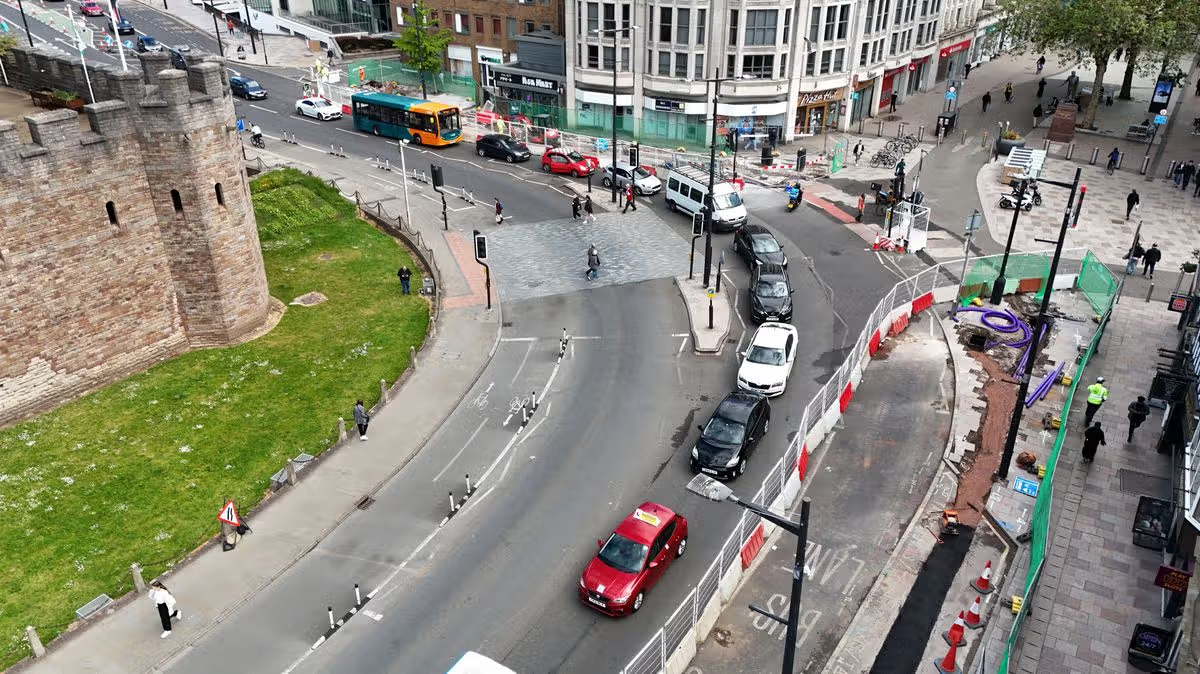
Cardiff Bus is warning customers bus services may be impacted by roadworks on Castle Street next week. Temporary three-way traffic lights will be in operation at the junction of Castle Street and Westgate Street from Monday, September 21, until Friday, September 25.
Advertisement
As the majority of Cardiff Bus services travel through this junction, significant delays are expected, with the potential for knock-on disruption across the wider network, it says.
Commercial and operations director, Gareth Stevens, said: “We’ll do everything we can to keep our services running and minimise disruption, but we are expecting these temporary lights to have an impact on journey times across our network.
“We’re asking customers to plan ahead, allow extra time for their journeys and, if their journey is time-sensitive, consider catching an earlier bus.”
Advertisement
Work to make the current temporary road layout and cycleway along the road permanent are expected to take 52 weeks to complete. Initial work started on Monday, February 2.
The year-long scheme includes a fully segregated permanent cycleway, carriageway resurfacing throughout the route, upgraded footways and paved areas, changes to the bus stop area in Kingsway/North Road, and measures to support improved air quality including traffic management changes, enhanced bus infrastructure, green‑roof bus shelters, and additional landscaping.
Met Office forecasters say warmer weather is expected next week, especially in southern parts of the UK as ‘summer returns with some caveats’
UK weather: Met Office forecasts rising temperatures
Parts of the UK could experience temperatures usually seen “in the middle of July” as summer will make a surprise return next week.
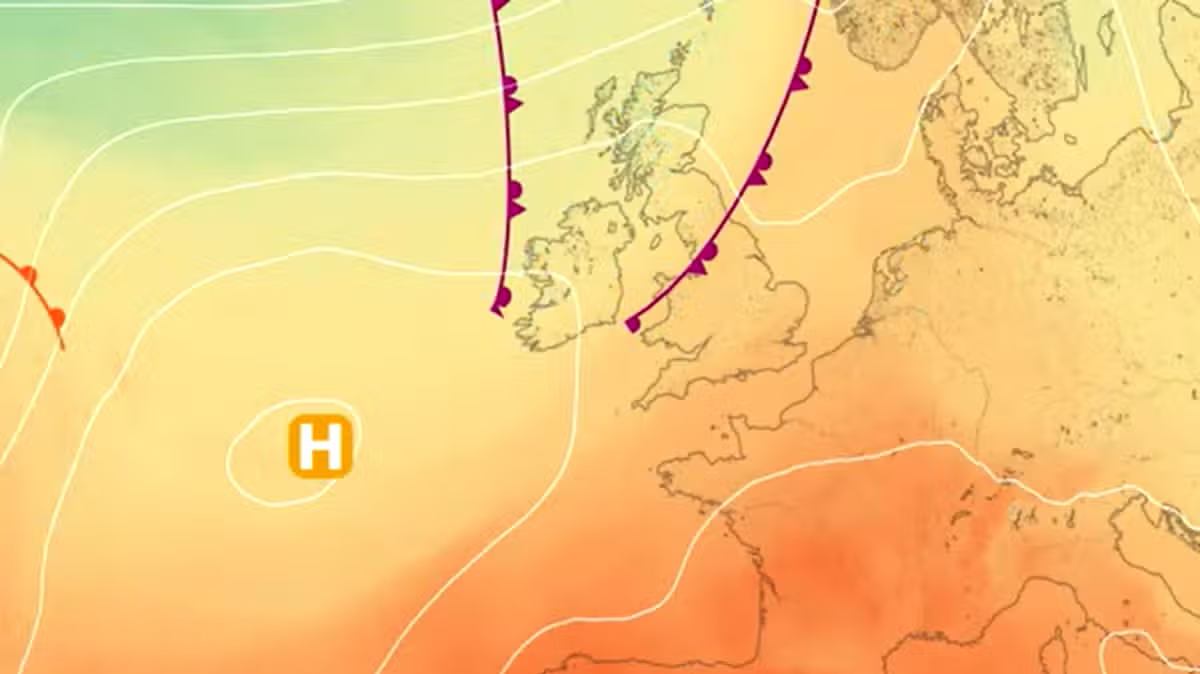
The Met Office said the mercury could rise to the mid-20s, reaching highs of 24-25C on Monday and Tuesday across areas in the south and east of England. Met Office meteorologist Alex Burkill explained these are “fairly average summer temperatures for the middle of July”, despite autumn now being well underway.
In a forecast broadcast today, he said: “There has been a lot of talk about the return of summer and yes, [it will return], but there are some caveats. [We’ll see] a return of summer but perhaps not as we know it now.
“Temperatures are set to rise as we go into next week but we’re looking at temperatures getting to mid-20s, not the high-20s, low to mid-30s or even high-30s that we had through much of summer 2026.”
Mr Burkill said the temperatures some are likely to experience early next week are average for a normal summer, not the one we’ve just experienced, which has consistently brought heatwaves and low precipitation.
He added that some warmer air will be dragged in from the south on Sunday, spreading across the UK as we go into Monday, following a rainy weekend.
Advertisement
More “southernly flow” will be brought in on Tuesday, with temperatures rising as a result. Met Office maps presented by Mr Burkill show London could reach 25C on Tuesday, while areas like East Anglia and the south coast could see 24C. Up to 23C is possible further north, including in places like Hull.
However autumn will then be back in no time, with a “changeable period” expected between September 23 and October 2. A Met Office forecast for that period reads: “A changeable period is expected, with Atlantic weather systems bringing spells of rain, showers and occasional strong winds.
“The wettest and windiest conditions are most likely across northern and western areas, although stronger winds may at times extend more widely. Between these unsettled spells, periods of drier and more settled weather are likely, especially in the south and east, where they may last for a few days.
Advertisement
“Accompanying these may be some overnight fog and frost. Temperatures are expected to be slightly above average overall.”
While “brief cooler interludes are possible” from early to mid-October, temperatures for that period are still expected to remain “slightly” above average.
It’s probably not been the best few days for Joanna Wietrzyk, a Hyrox athlete who recently took first place in a Chinese competition.
The sportswoman, who soiled herself so extensively during the fitness contest that feces were seen running down her legs, has since decided “to retroactively withdraw from the race and forfeit the points I earned”.
Viewers expressed concern about the health risks this caused (much of the equipment used in Hyrox events, like rowing machines, is shared). Hyrox’s policy now states: “If a racer’s blood, vomit, urine, or faeces poses a welfare or contamination risk to the racer or to other racers, a Race Director may withdraw the racer from the race on medical grounds”.
But this is far from the only time an athlete has faced a digestive dilemma during an official event.
Advertisement
In 2005, Paula Radcliffe famously relieved herself during the London Marathon. Runners Mikael Ekvall and Davis Clarke didn’t break their stride after defecating midway through a half-marathon and a marathon, respectively.
And research has shown that gastrointestinal issues affect about 30-50% of athletes, with endurance athletes at extra risk.
Here’s what Kirsten Jackson, a consultant dietitian and founder of The IBS Dietitian, had to say about why this phenomenon seems to be so common.
Why does intense exercise make us poop?
Advertisement
“What happened at Hyrox may sound extreme, but gastrointestinal symptoms during intense endurance exercise are surprisingly common,” Jackson explained.
“When you’re exercising hard, blood flow is diverted away from the gut towards the working muscles. Combine that with the physical impact of running, dehydration and race-day nerves, and you can experience cramping, nausea, diarrhoea and very sudden bowel urgency.”
Those who push themselves too far for too long could face exercise-induced ischaemic colitis, the dietitian continued, which is different from “regular” runner’s diarrhoea.
In this case, “reduced blood flow to the colon can cause inflammation and symptoms such as significant abdominal pain and bloody diarrhoea, which need medical assessment.”
Advertisement
Fred Lee via Getty Images
Joanna Wietrzyk in 2026 Hyrox competition
So… how can I lower the odds of pooping on race day?
Jackson said that if she was dealing with an athlete who experienced bowel troubles during exercise, she’d advise them to try a low-FODMAP diet for about 48 hours prior to their race.
“FODMAPs are certain carbohydrates that aren’t always fully absorbed in the small intestine,” she explained.
Advertisement
“They can draw additional water into the bowel and are then fermented by gut bacteria, which can contribute to bloating, gas, loose stools and urgency in susceptible people.”
The NHS has a list of low-FODMAP foods and substitutes (Jackson pointed out that many running gels and sports nutrition products are high-FODMAP).
Still, the dietitian stressed this is not a long-term strategy: it’s just a short-term option for those with sensitive stomachs ahead of a specific event.
In the longer term, “we need to train the gut-brain axis as well as the muscles,” she ended.
Advertisement
“Practising your race-day routine during training – the same breakfast, timings, fluids and sports nutrition – helps train the digestive system, but it can also make the whole routine feel familiar and reduce some of that race-day stress response,” which can itself induce the runs.





















































You must be logged in to post a comment Login