Connect with us

NewsBeat

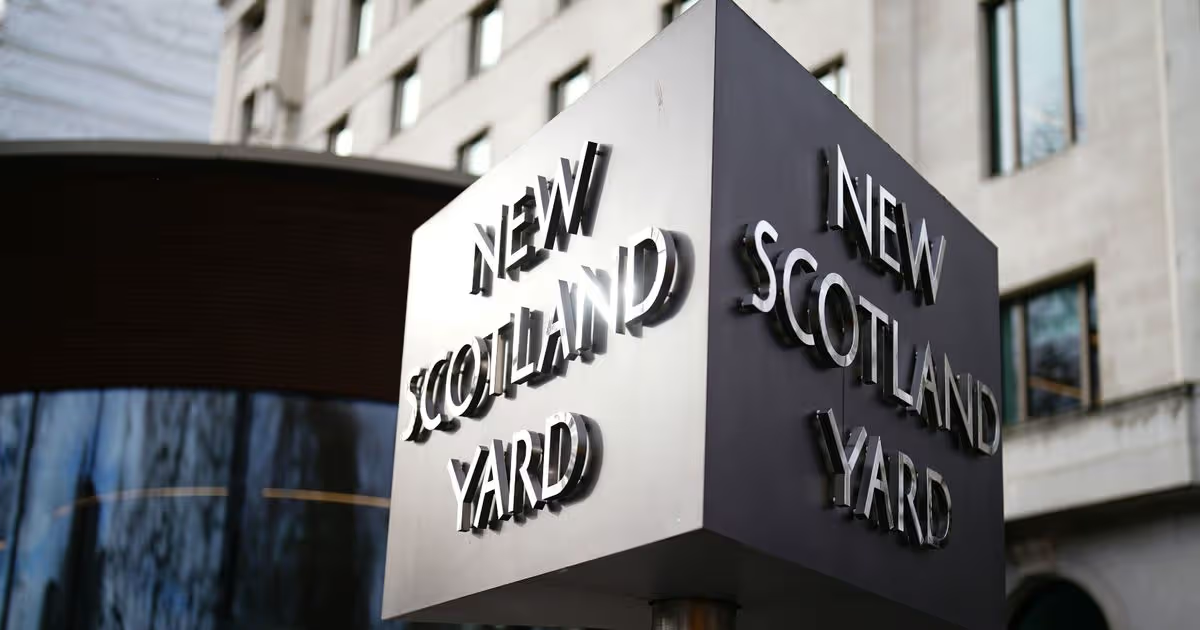
East Kilbride home raided by counter-terrorism police after three arrested in China spying probe

Published

on

Daily Record

The Metropolitan Police carried out searches in Scotland as part of an investigation into national security.

Counter-terrorism police searched a home in East Kilbride amid a probe into spying for Chinese intelligence services.

Advertisement

The address was one of a number of properties including London and Cardiff that were searched on Wednesday.

Officers from Metropolitan Police arrested three men on suspicion of spying for China. The suspects – aged 39, 43 and 68 – were all cuffed south of the border in London and Wales.

They were detained on suspicion of offences under section three of the National Security Act 2023.

Commander Helen Flanagan, head of Counter Terrorism Policing London, said: “We have seen a significant increase in our casework relating to national security in recent years and we continue to work extremely closely with our partners to help keep the country safe and take action to disrupt malign activity where we suspect it.

Advertisement

“Today’s arrests are part of a proactive investigation and while these are serious matters, we do not believe there to be any imminent or direct threat to the public relating to this. Our investigation continues and we thank the public for their ongoing support.”

Source link

Continue Reading
Click to comment

Leave a Reply

Your email address will not be published. Required fields are marked *

NewsBeat

How would the Iran crisis play out in a world powered by renewables not fossil fuels?

Published

on

How would the Iran crisis play out in a world powered by renewables not fossil fuels?

Imagine the escalating conflict between the US, Israel and Iran unfolding in a world powered mostly by wind, solar and batteries rather than oil and gas.

In today’s fossil-fuelled economy, markets react to Iran’s attacks on oil and gas facilities in the Gulf and the threat to close the strait of Hormuz. Oil prices jump. Governments brace for inflation. Around a fifth of the world’s traded oil passes through the narrow corridor, linking the Gulf states to the wider world. When tensions rise there, energy markets react instantly.

But in a world where most energy is generated domestically from renewables, would the same threat trigger the same global shock? Would instability in the Gulf still lead to more expensive food and fuel across the world? Or would the economic aftershocks look very different?

To understand what’s at stake, we need to first look at how today’s energy system is structured.

Advertisement

A system built on chokepoints

For about a century, the global economy has depended on fossil fuels produced by a few producers in the Middle East. Chokepoints like the strait of Hormuz carry enormous strategic weight.

That is why the current conflict between the US, Israel and Iran reverberates so quickly through global markets. Even before any sustained disruption to supply, oil and gas prices have surged on the possibility that a major proportion of global flows could be blocked. Because oil underpins transport, agriculture and manufacturing, price spikes ripple rapidly through commodity exchanges, supply chains and into household budgets. Regional conflict can magnify into global economic turmoil within days.

Now run the same crisis in a renewable world

Return to our thought experiment. Now, imagine the same crisis unfolding in a world where energy systems were powered by renewables and electricity rather than oil and gas.

It is the same week. Same military escalation. The same rhetoric about closing the strait of Hormuz. But this time the global energy system has already largely been decarbonised.

Advertisement

In this alternative world, most electricity globally would be produced within national borders from wind, solar and other low-carbon sources. Road transport would be predominantly electric. Heating would rely on locally available renewable sources, such as heat pumps, domestic biomass, geothermal systems or green hydrogen. These are all tried and tested solutions. They are not a thing of the future, and yet today our global economy still gets roughly 80% of its primary energy from fossil fuels.

In the alternative scenario, what changes?

The immediate macroeconomic shock would be weaker. A disruption at the strait would still matter. Oil would still be traded in some sectors, but it wouldn’t be as central to everyday energy use. Prices would be lower because demand was falling. The automatic link between Gulf instability and global inflation would loosen.

Electricity generation would continue, largely insulated from disruption of gas supply. People with electric cars would be less directly affected by a petrol price spike. Household bills would remain unchanged as energy price rates stay stable. Governments would be less exposed to sudden demands to subsidise fuels and an inflationary shock.

Advertisement

Energy security would become less about controlling distant shipping lanes, and more about building a distributed and resilient domestic electricity grid, more storage capacity and diversified supply chains.

Maritime chokepoints to mineral supply chains

This does not mean energy geopolitics would disappear. It would mutate.

Renewable systems depend on critical minerals such as lithium, cobalt and so-called rare earth elements, and involve advanced manufacturing supply chains to make solar panels, wind turbines and batteries. New chokepoints could emerge in mineral processing hubs or semiconductor plants. Already there is geopolitical competition over access to rare earths.

But there are important differences. Fossil fuel reserves are geographically concentrated, which is why global trade converges on a handful of maritime routes: Hormuz, Suez, Malacca (between the Indian and Pacific Oceans) and more. Markets for oil and gas are volatile.

Advertisement

Renewable resources such as sunlight and wind are more widely distributed. While mineral supply chains remain uneven, and still rely heavily on a handful of producers such as China for rare earths, the Democratic Republic of the Congo for cobalt and Indonesia for nickel, they do not converge on a single chokepoint. Price changes propagate through markets for technologies much more slowly. It is easier to built strategic reserves.

In our imagined Iran crisis, power would be more diffuse, with no single state able to threaten such disruption.

Minerals being more dispersed than oil and gas, and less concentrated in a few places, reduces the kind of centralisation and “resource capture” that has historically characterised the oil industry. Global standards on community consent, transparency and environmental protections are now much stronger in mineral supply chains than they ever were for fossil fuels.

This gives local actors more leverage in a renewable-powered world. Mineral-rich regions in Africa, Latin America and parts of Asia would gain new some power – not simply as resource suppliers, but through mechanisms of community consent social licence to operate and they are better able to influence whether projects proceed.

Advertisement

This marks a shift from the petroleum age, where power has largely been concentrated between states and multinational oil companies operating at a distance from affected communities.

The geopolitical dividend of decarbonisation

Decarbonisation is often framed as a climate necessity. It will also lead to a redistribution of geopolitical power, probably towards greater stability.

In today’s fossil fuelled system, the strait of Hormuz sits at the heart of a global economic system that ties global economic stability to the uninterrupted flow of oil – and to the military power that guards it. The current crisis exposes the fragility of that arrangement.

Running this thought experiment does not suggest that renewable energy dissolves geopolitics. In a post-oil world, the strait would still matter and resource conflicts would not vanish. But it does suggest that our fossil energy system is fragile and conflict can reverberate quickly around the world.

Advertisement

Source link

Continue Reading

NewsBeat

Person found dead on tracks near Bolton Railway Station

Published

on

Person found dead on tracks near Bolton Railway Station

British Transport Police (BTP) said they were called to “reports of a casualty on the tracks” on the line near Bolton Railway Station at around 3.45pm.

Despite the efforts of paramedics, who also attended the incident, the person was declared dead at the scene.

BTP said that the incident is “not being treated as suspicious” and they will prepare a file for the coroner.

Advertisement

Train services between Bolton and Preston were disrupted and replacement buses were put in place while emergency services worked on the scene.

A spokesperson for BTP said: “Officers were called to the line near Bolton Railway Station at 3:44pm today (4 March) to reports of a casualty on the tracks.

“Paramedics also attended, and sadly a person was pronounced dead at the scene.

“The incident is not being treated as suspicious and a file will be prepared for the coroner.”

Advertisement

Source link

Continue Reading

NewsBeat

Trump’s solutions to Iranian shipping threat leave insurance sector unimpressed | Money News

Published

on

A cargo ship approaches Dubai. File pic: AP

Donald Trump’s offer of US-backed insurance and naval escorts for shipping travelling through the Strait of Hormuz has not prevented maritime premiums soaring as underwriters scramble to reassess the risks to oil, gas and cargo vessels.

With the Strait of Hormuz effectively closed to shipping following the US attack on Iran, on Tuesday the president wrote on Truth Social that the US would provide cover “at a very reasonable price… for the Financial Security of ALL Maritime Trade, especially energy, traveling through the Gulf”.

He also suggested that naval escorts could be used to provide safe passage for tankers in the Persian Gulf, the route to market for 20% of the world’s oil supply.

Markets latest: Oil producer says it won’t fulfil contracts

Advertisement
Image:
A cargo ship approaches Dubai. File pic: AP

Experts at Lloyd’s of London, the world’s oldest insurance market, told Sky News that the president’s proposal was unclear, and that naval escorts could even increase the risk to shipping.

On Tuesday, the Joint War Committee (JWC) of the Lloyds Markets Association, which represents participants in the Lloyds market, expanded its “high-risk” area in the Middle East to cover the entire Persian Gulf.

Underwriters had already begun cancelling or repricing war-risk insurance for vessels in the region, but Neil Roberts, secretary of the JWC, told Sky News the market was working and that the American intervention was unnecessary.

“I don’t think the details of such a scheme have been given to anyone, so far as we know, and it will take time to work it out, and the appetite is unknown,” he said.

Advertisement

“Essentially our market is still writing risks and there isn’t a perception here that there’s a need for intervention at this time.”

Lloyd's of London
Image:
Lloyd’s of London

Mr Roberts said that premiums would rise to reflect the heightened risk in the Gulf, amid reports suggesting 12-fold increases, and that US escorts could offer a target rather than act as a deterrent.

“There will be those who think it might increase the target, because the Iranians are targeting US military. It’s not known how capable they would be against the new drone and missile threats that we’re seeing. This is not the same as the 80s.”

“So yes, obviously people would like to see the detail, they’d like to it happen, and if you’re a tanker owner, you’d be on the one hand delighted that it’s been offered, on the other hand trying to understand whether it does increase the risk or not and do you want to accept it?”

Satellite mapping from AIS ship trackers on Tuesday shows a build up of stationary tankers in the Strait of Hormuz
Image:
Satellite mapping from AIS ship trackers on Tuesday shows a build up of stationary tankers in the Strait of Hormuz

He added: “What’s happened over the weekend has changed the risk profile for the area and it was necessary for underwriters to be able to reassess their position given the new risks. And for the Joint War Committee we’ve recently increased our listed areas by adding the US bases which are now targets that were previously not listed. That means we’ve got the opportunity as underwriters to reassess the voyages on an individual basis.”

A number of tankers have been attacked directly in the Gulf since the conflict began, along with oil, gas and cargo infrastructure in Saudi Arabia, Qatar and the United Arab Emirates (UAE).

Advertisement

With scores of vessels at anchor on either side of the Strait of Hormuz, oil and gas prices have spiked, along with shipping costs.

Read more from Sky News:
Was Iran ‘days’ from atomic weapons?
US allies fear shortage of weapons
Is AI giving US lethal edge in Iran?

Advertisement

For now, the economic impact is largely contained to commodity markets, but a prolonged closure that ate into global oil reserves could lead to wider impacts and trade disruption.

Food and goods supplies coming into the Gulf states from Europe, Africa and Asia could also be disrupted.

The UAE government said earlier this week it has stockpiles that will last four to six months, but asked citizens to only buy what they need and avoid shopping sprees to “make sure there is enough for everyone”.

Advertisement

Source link

Continue Reading

NewsBeat

TV fans can finally watch first episode of ‘best sci-fi show of 2026’ for free

Published

on

TV fans can finally watch first episode of 'best sci-fi show of 2026' for free

To view this video please enable JavaScript, and consider upgrading to a web
browser that
supports HTML5
video

Episode one of a hit sci-fi show airing on Disney Plus is now available to stream for free on YouTube.

Advertisement

Fans have rejoiced at Marvel’s decision to put their latest TV offering on the streaming platform.

Starring Yahya Abdul-Mateen II, the eight-episode series has scored highly with an average of 91% from critics on Rotten Tomatoes.

Now you can see what all the hype is about and watch the first instalment of Wonder Man without any paid subscription needed, thanks to season one, episode one being uploaded to the video sharing site.

This Marvel Television creation offers an insight into the entertainment industry, complete with superhero magic.

Advertisement

Abdul-Mateen II plays Simon Williams, an actor who is struggling to get his career off the ground. Suddenly his luck changes after he meets actor Trevor Slattery (Ben Kingsley), who is coming to the end of his acting career.

You can get a taste for the series for free on YouTube (Picture: Marvel/Disney)
Wonder Man
The show is not what you might expect from Marvel (Picture: Marvel/Disney)

Through Slattery, Williams learns about legendary director Von Kovak who is remaking the film Wonder Man.

As both men strive for these life-changing roles, viewers get an insight into the entertainment industry and feel the intersection of personal and professional struggles.

All the while, Williams struggles to hide his superpowers and escape the scrutiny of Damage Control.

The full episode one has been available on YouTube for a day, and has already amassed 32,000 views.

Advertisement

What did Metro’s Deputy TV Editor think?

Metro’s Deputy TV Editor, Tom Percival, gave Wonder Man four stars:

It was with some reluctance that I agreed to review Wonder Man, a show featuring a Marvel character I know next to nothing about, beyond the fact that he had a bromance with Beast (of X-Men fame).   

Well, call me Blunder Man because I’d made a huge mistake underestimating this wonderfully entertaining show.  

I liked it; the stakes were refreshingly low, there are no giant blue lasers firing into the sky, climactic battles with CGI arch nemeses, or overwrought monologues. 

Advertisement

Instead, the drama comes from seeing likeable characters, who you want to see succeed, put in difficult and occasionally awkward circumstances. It’s a foolproof recipe, and it works.   

Future you will be annoyed if you miss this 'brilliant' sci-fi series Wonder Man
It’s been rated highly by critics on Rotten Tomatoes (Picture: Disney/Marvel)

@Kartikeyasingh8685 admitted she’d ‘already binged all episodes long ago’, while @HeyDarius appreciated it, writing: ‘Shoutout Marvel for this upload.’

But the show isn’t loved unanimously, on Reddit Sam_Strake said: ‘Personally I’m just really tired of Hollywood making shows and movies about how hard life is being in Hollywood lol.’

Advertisement

This said, the show has been hailed as the best sci-fi show of the year, making it onto Numéro Magazine’s list of top tier TV in 2026.

Others, like ZinQ on IMDb said they were ‘now officially in love with Wonder Man’ and said it was the ‘best thing on TV for a very long time.’

Wonder Man episode one is available to watch on YouTube, and the rest of the series can be streamed on Disney Plus.

Got a story?

Advertisement

If you’ve got a celebrity story, video or pictures get in touch with the Metro.co.uk entertainment team by emailing us celebtips@metro.co.uk, calling 020 3615 2145 or by visiting our Submit Stuff page – we’d love to hear from you.

Advertisement
Advertisement

Source link

Continue Reading

NewsBeat

US ambassador to Israel jokes about staff ‘procreating’ during war | News US

Published

on

US ambassador to Israel jokes about staff 'procreating' during war | News US
Mike Huckabee, the US Ambassador to Israel, made the bizarre joke in a memo (Picture: Getty)

The US Ambassador to Israel allegedly sent a memo to embassy staff in Tel Aviv, joking that embassy members might have new children within nine months.

Staff at the embassy have been told to shelter in place due to the war with Iran, but were sent a bizarre memo by the Ambassador.

In the memo, staff were told that if ‘extended time with your spouse’ results in ‘the birth of your next child in about 9 months, I of course expect that you will want to name the little bugger after me!’

He added: ‘If it’s a girl, Michelle is a nice name too.’

Advertisement

One US official told the Washington Post that the memo was ‘awkward’ and ‘odd’.

FILE PHOTO: U.S. Ambassador to Israel Mike Huckabee looks on during an interview with Reuters in Jerusalem, September 10, 2025. REUTERS/Ronen Zvulun/File Photo
Mike Huckabee sent the internal memo (Picture: Reuters)

The memo was sent after the US Embassy in Israel advised Americans in the country that they ‘cannot guarantee their safety’.

Shuttles are currently being offered to transport people to a border crossing with Egypt, but the Embassy added: ‘We cannot make any recommendation (for or against) the Ministry of Tourism’s shuttle.

‘If you choose to avail yourself of this option to depart, the U.S. government cannot guarantee your safety.’

Advertisement

Israel has been launching airstrikes against Iranian missile launchers and a nuclear research site, as Iran struck back against Israel and others, targeting US embassies and disrupting energy supplies and travel.

The American embassy in Saudi Arabia and the US consulate in the United Arab Emirates came under drone attacks.

Iran has fired dozens of ballistic missiles at Israel, although most of the incoming fire has been intercepted.

CORRECTION / Israeli security forces and emergency personnel gather at a site struck by a projectile in Ramat Gan near Tel Aviv on March 3, 2026. The Middle East has becomed gripped by a war triggered by US and Israel launched airstrikes against Iran on February 28, that killed the Islamic republic's supreme leader and other officials. (Photo by Ilia YEFIMOVICH / AFP via Getty Images) / "The erroneous mention[s] appearing in the metadata of this photo by Ilia YEFIMOVICH has been modified in AFP systems in the following manner: [in Ramat Gan near Tel Aviv] instead of [in Tel Aviv]. Please immediately remove the erroneous mention[s] from all your online services and delete it (them) from your servers. If you have been authorized by AFP to distribute it (them) to third parties, please ensure that the same actions are carried out by them. Failure to promptly comply with these instructions will entail liability on your part for any continued or post notification usage. Therefore we thank you very much for all your attention and prompt action. We are sorry for the inconvenience this notification may cause and remain at your disposal for any further information you may require."
Israel has intercepted most of Iran’s missiles, but 11 have been killed (Picture: AFP)

Eleven people in Israel have been killed since the conflict began.

US embassies in Saudi Arabia, Kuwait and Lebanon said they were closed to the public.

Advertisement

The US State Department said early on Wednesday it had authorised non-emergency government personnel and family members to evacuate Saudi Arabia should they choose to do so due to the war.

The department previously ordered the evacuation of non-emergency personnel and family in Kuwait, Bahrain, Iraq, Qatar, Jordan and the United Arab Emirates.

US citizens were urged to leave more than a dozen Middle Eastern countries, although many were stranded because of airspace closures.

Get in touch with our news team by emailing us at webnews@metro.co.uk.

Advertisement

For more stories like this, check our news page.

Advertisement
Advertisement

Source link

Continue Reading

NewsBeat

What to know about the US soldiers who died in the Iran war

Published

on

What to know about the US soldiers who died in the Iran war

WEST DES MOINES, Iowa (AP) — Sgt. Declan Coady had been sending his family updates from Kuwait every hour or two after the U.S. and Israel launched their military campaign against Iran, letting them know he was OK, even as Iran launched retaliatory strikes against Israel and Gulf Arab states that host U.S. armed forces.

When he hadn’t responded to messages Sunday, “most of us started to wonder,” Coady’s father, Andrew, told The Associated Press. “Your gut starts to get a feeling.”

A drone strike at a command center in Kuwait killed 20-year-old Coady of West Des Moines, Iowa, and five other members of the U.S. Army Reserve who worked in logistics and kept troops supplied with food and equipment.

The four soldiers identified Tuesday by the Pentagon also included Sgt. 1st Class Nicole Amor, 39, of White Bear Lake, Minnesota; Capt. Cody Khork, 35, of Winter Haven, Florida; and Sgt. 1st Class Noah Tietjens, 42, of Bellevue, Nebraska. Two soldiers haven’t yet been publicly identified.

Advertisement

“Sadly, there will likely be more, before it ends. That’s the way it is,” President Donald Trump said of the deaths.

Defense Secretary Pete Hegseth claimed that the military “ensured that the maximum possible defense and maximum possible force protection was set up before we went on offense,” he said Wednesday. “The terms of this war will be set by us at every step.”

A mother of two who loved gardening

Amor was just days away from returning home to her husband and two children.

“She was almost home,” her husband, Joey Amor, said from their home Tuesday. “You don’t go to Kuwait thinking something’s going to happen, and for her to be one of the first – it hurts.”

Advertisement

Amor was an avid gardener who enjoyed making salsa from the peppers and tomatoes in her garden with her son, a senior in high school. She also enjoyed rollerblading and bicycling with her fourth-grade daughter.

A week before the drone attack, Amor was moved off-base to a shipping container-style building that had no defenses, her husband said.

“They were dispersing because they were in fear that the base they were on was going to get attacked and they felt it was safer in smaller groups in separate places,” he said.

He said she was working long shifts and that he last spoke to her about two hours before she was killed. He said she told him she had tripped and fallen and that they had been joking with each other about that. The fun messages stopped abruptly.

Advertisement

“She just never responded in the morning,” he said.

One of the youngest in his class

Coady had recently told his father he had been recommended for a promotion from specialist to sergeant, a rank he received posthumously.

He was one of the youngest people in his class, trained to troubleshoot military computer systems, but he seemed to impress his instructors, Andrew Coady said Tuesday.

“He trained hard, he worked hard, his physical fitness was important to him. He loved being a soldier,” Coady said. “He was also one of the most kindest people you would ever meet, and he would do anything and everything for anyone.”

Advertisement

Coady came from a close-knit family and was always calling, even if it was only for a few minutes. Coady was studying cybersecurity at Drake University in Des Moines, and he was taking online classes while in Kuwait. He wanted to become an officer.

“I still don’t fully think it’s real,” his sister Keira Coady said. “I just remember all of our conversations about what he was going to do when he came back.

A calling to serve his country

Khork was very patriotic and drawn from a young age to serving the U.S., his family said in a statement Tuesday.

He enlisted in the Army Reserve and joined Florida Southern College’s ROTC program.

Advertisement

“That commitment helped shape the course of his life and reflected the deep sense of duty that was always at the core of who he was,” his mother, Donna Burhans; father, James Khork; and stepmother, Stacey Khork; said in a statement.

Khork also loved history and had a degree in political science.

His family described him as “the life of the party, known for his infectious spirit, generous heart, and deep care for those who served alongside him and for everyone blessed to know him.”

One of Khork’s friends, Abbas Jaffer, posted on Facebook on Monday that he had lost the best person he had ever known.

Advertisement

“My best friend, best man, and brother gave his life defending our country overseas,” Jaffer said. Khork and Jaffer had been friends for more than 16 years.

A loving father and husband

Tietjens lived with his family in the Washington Terrace mobile home park in the Omaha suburb of Bellevue, Nebraska. He was married with a son, according to a Facebook page.

Tietjens earned a black belt in Philippine Combatives and Taekwondo and was “an instructor who gave his time, discipline, and leadership to others,” the Philippine Martial Arts Alliance said in a Facebook post.

On the mat and as a soldier, “he carried the same values: honor, discipline, service, and commitment to others,” the organization said.

Advertisement

Nebraska Gov. Gov. Pillen paid tribute to the family Tuesday.

“Noah stepped up to serve and defend the American people from foreign enemies around the world — a sacrifice we must never forget,” he wrote.

“We are holding the Tietjens family close in our hearts during this unbelievably difficult time and will keep them in our prayers,” he said.

___

Advertisement

Boone contributed from Boise, Idaho, and Toropin from Washington. Associated Press reporters Sarah Raza in Sioux Falls, South Dakota; Ed White in Detroit; Josh Funk in Omaha, Nebraska; David Fischer in Miami and Hallie Golden in Seattle contributed to this report.

Source link

Advertisement
Continue Reading

NewsBeat

64-year-old woman rescued by coastguard from Sandsend beach

Published

on

64-year-old woman rescued by coastguard from Sandsend beach

Whitby Coastguard Rescue Team say that they were called to Sandsend to assist Yorkshire Ambulance Service after a 64-year-old had slipped on sea defences.

Teams suspected that she had broken her ankle, due to the high tide and the uneven sea defences with paramedics at the scene having managed to stabilise the injury by the time that the Coastguard arrived.


RECOMMENDED READING:


However, with limited access along the beach due to the tide coming in, the coastguard officers were tasked with helping to move the woman ro safety.

Advertisement

Together, they organised a plan to move the woman along the beach using a cliff rescue stretcher to reach a nearby path.

Once there, she was transferred into the ambulance carry chair, providing a safer means to reach the waiting ambulance.

The coastguard worked with Yorkshire Ambulance Service to rescue the woman (Image: Whitby Coastguard)

A spokesperson for Whitby Coastguard Rescue Team said: “Thanks to great teamwork between the ambulance crew and Coastguard Rescue Officers, the casualty was safely transferred and taken to Scarborough Hospital for further care.

“We wish the casualty a smooth and speedy recovery and hopefully a restful stay for the remainder of the holiday!

Advertisement

“As always, here to help our community 24 hours a day, 365 days a year. Remember, If you see anyone in difficulty along the coast, cliffs or shoreline, call 999 and ask for the Coastguard.”

Source link

Advertisement
Continue Reading

NewsBeat

MP not seen anything to suspect husband has ‘broken any law’, after China spy arrests

Published

on

MP not seen anything to suspect husband has 'broken any law', after China spy arrests

“I have never asked a question on China-related matters. As far as I am aware I have never met any Chinese businesses whilst I have been an MP, any Chinese diplomats or government employees, nor raised any concern with ministers or anyone else on behalf of, even coincidentally, Chinese interests.

Source link

Continue Reading

NewsBeat

The 15 best ski boots of 2026, tested by a ski gear expert

Published

on

The 15 best ski boots of 2026, tested by a ski gear expert

BOA: BOA is a dial-and-cable closure system that replaces traditional ski boot buckles. Introduced from snowboarding, it allows precise, even tension by wrapping the boot shell or cuff around the foot and leg for a customised fit without pressure points. The Alpine H+i1 version uses a Z-shaped cable path to evenly tighten the shell, while newer designs also secure the cuff. BOA systems provide micro-adjustability, smoother closure and a more uniform hold, often making boots feel slightly softer in flex compared with traditional four-buckle designs.

Cabrio: A shell design in three pieces with an external tongue, favoured by freestylers for its smooth flex.

Canting: Canting adjusts the base angle of a ski boot to improve skier alignment. A trained boot fitter assesses stance, adds angled pads and reworks the sole to match the bindings – an advanced adjustment best left to experienced professionals.

Advertisement

Cuff: The upper part of the shell that wraps around the lower leg.

Cuff alignment: Adjustable cuff alignment allows boot fitters to alter boots to more appropriately match the angle of your legs. It can be done via a device on one (single) or both sides (double) of the cuffs.

Flex: Flex is a rating of how much support a boot offers. It is not standardised, but does help to give an indication of how stiff a boot is, when flexing forward. A lower figure is easier to flex forward, while a higher number will give more support and power. Adult boots range from around 60 up to 130, or even higher for some boots.

Flex adjuster: Some boots have a system for altering the flex to suit conditions. For example, stiffer on-piste, softer off-piste.

Advertisement

Footbed: A removable foam insert that sits inside the liner, under your foot. Most people benefit from removing this and using a footbed that has more support and structure. These can be pre-shaped, such as most Superfeet footbeds, or they can be custom moulded.

Last width: Last width is measured across the forefoot and indicates fit. Up to 105mm is generous, less than 99mm is narrow. This ‘last’ figure a brand quotes is typically for a size 26/26.5MP boot.

Liner: Also called inner boots, liners are the padded sections that surround the foot, ankle and leg, providing comfort, warmth and a personalised fit. Options include aftermarket models like Foam Injected, Intuition and ZipFit liners, which use materials such as foam, closed-cell foam or cork mixtures to deliver varying levels of precision, customisation and durability.

Mondopoint (MP): Mondopoint (MP) is the ski boot sizing system based on foot length in centimetres rather than shoe size, so accurate measurement is essential. Most brands pair half sizes (for example, 26.0 and 26.5 MP) as the same shell length, though exceptions like Scarpa use a reversed system.

Advertisement

ROM: This stands for Range Of Motion and is how much movement you get in the cuff of a boot when in tour mode.

Shell: The plastic outer part of boots, which is often heat-mouldable to improve fit. The term shell more specifically relates to the plastic outer around the foot and ankle, as opposed to the cuff which fits around the leg and ankle.

Sole: This is the bottom section of the boot; the part that rests on the floor and interfaces with the binding.

Thermo-moulding: Heat customisation of liners or shells. The whole thing may not be mouldable. All ski boot outers can be heat moulded to some degree. When we’ve rated them as heat mouldable, in the bullet points for the boots, it’s because they’ve been designed to be put in an oven and the whole shell heated. Nordica does it a different way and uses their own Infrared heating system.

Advertisement

Tour/walk mode: A connector, usually on the rear of the boot, that can be released to allow greater fore and aft movement in the cuff when hiking or skinning. This can then be switched to securely connect to the cuff and lower shell for skiing.

Tongue: The part of the boot that sits in front of the shin. Both the liner and shell can have a tongue.

Source link

Advertisement
Continue Reading

NewsBeat

Wizz Air issues update for 4 destinations as flight cancellations extended

Published

on

Daily Mirror

Amid the escalating Middle East conflict, Wizz Air has issued an update and confirmed that it has extended its cancellation period for four of its destinations

Wizz Air has issued a major update for four destinations and has extended its flight cancellations.

Advertisement

The conflict in the Middle East has caused significant travel disruptions for airlines, with thousands of flights cancelled as the Foreign, Commonwealth & Development Office (FCDO) warns against travel to parts of the region. Tensions remain high following the US-Israeli strikes on Iran that began over the weekend, with further attacks being carried out.

As the conflict escalates, Wizz Air has confirmed that it is suspending all flights to and from Israel, Dubai, Abu Dhabi, and Amman up to and including Sunday, 15 March. They had originally planned to cancel these flights until 7 March, but as the conflict shows no signs of slowing, they have extended the cancellation period.

READ MORE: Iran war chaos sees travel advice changed for 10 countries – full listREAD MORE: All 75 countries on Foreign Office’s ‘do not travel’ list from March 4

A Wizz Air spokesperson confirmed: “Wizz Air confirms that, following the recent escalation of the security situation in Iran, the airline is suspending all flights to and from Israel, Dubai, Abu Dhabi, Amman up to and including 15 March, pending structural schedule changes reflecting reduced demand. Flights to and from Saudi Arabia will resume as planned from 8 March inclusive.

“The airline is closely monitoring developments and remains in ongoing contact with local and international authorities, aviation safety agencies, security authorities, and relevant governmental bodies. Operational decisions will continue to be reviewed, and the flight schedule may be adjusted as the situation evolves.

“The safety and security of our passengers, crew and aircraft remain Wizz Air’s highest priority. We acknowledge the disruption this may cause and appreciate the understanding of our customers. Passengers with affected bookings will be contacted directly with information regarding their options.”

The extension comes just a few days after Wizz Air first announced that it had suspended all flights to Israel, Dubai, Abu Dhabi, and Amman. Wizz Air joins other major airlines that have cancelled or amended hundreds of flights to parts of the Middle East amid the chaos.

Advertisement

Wizz Air, which has been working hard to ensure passenger safety, confirmed that flights to and from Saudi Arabia will recommence as planned from 8 March. In a bid to support passengers who need to travel to or from Israel, Wizz Air is planning to add flights to Sharm El Sheikh (SSH) from various European airports.

If approved, the extra flights, which will provide a connection between Israel and Europe, will begin on Friday, 6 March. They will be as follows:

  • Budapest (BUD): from 3 to 10 weekly flights
  • Rome Fiumicino (FCO): from 11 to 18 weekly flights
  • London Luton (LTN): from 4 to 8 weekly flights
  • Milan Malpensa (MXP): from 6 to 11 weekly flights
  • Sofia (SOF): from 0 to 3 weekly flights

Ensure our latest lifestyle and travel stories always appear at the top of your Google Search by making us a Preferred Source. Click here to activate or add us as your Preferred Source in your Google search settings.

Do you have a travel story to share? Email webtravel@reachplc.com

Source link

Advertisement
Continue Reading

Trending

Copyright © 2025