




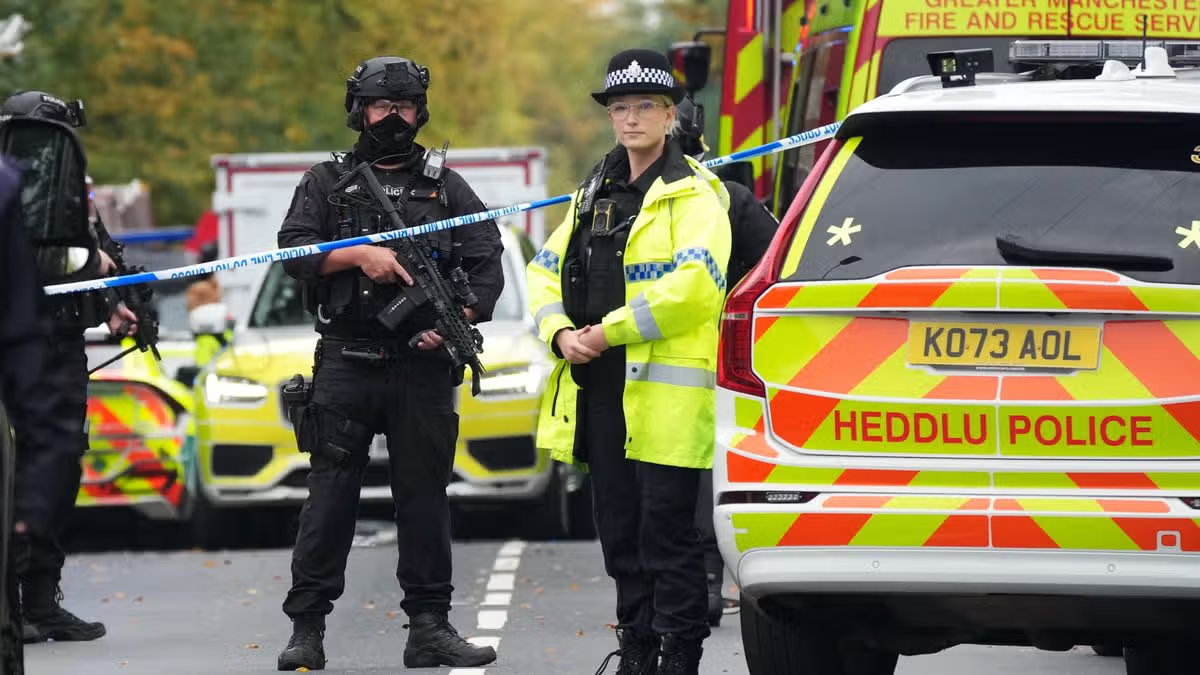
A public inquiry into the tragedy could now be established over ‘sensitive’ MI5 evidence
The Home Secretary wants to block a ‘discreet body of MI5 material’ relating to the Manchester synagogue attack from being publicly disclosed at an inquest into the deaths of two men killed by terrorist Jihad Al-Shamie.
If Chief Coroner, Judge Alexia Durran, upholds the application by Shabana Mahmood, a public inquiry into the attack in Crumpsall on Yom Kippur could ultimately be established. A ‘closed session’ of a pre-inquest review to assess further details will be held at a later date, with the media not being able to attend.
Click here to get the biggest stories straight to your inbox in our Daily Newsletter
Questions over whether or not Al-Shamie was known to the security services before the attack on October 2 last year also emerged during a pre-inquest review hearing held on Thursday.
Security guard Melvin Cravitz, 66, and Adrian Daulby, 53, were killed at the Heaton Park Hebrew Congregation synagogue.
Mr Cravitz’s legal team said there were ‘previous denials’ by the Home Secretary, in the House of Commons on October 13, that Al-Shamie was known to the security services or counter-terror policing beforehand.
Victoria Ailes, for the family, said counter-terror policing also released a statement saying he was not known to them.
Ms Mahmood said Al-Shamie was ‘never referred to the Prevent programme, nor was he known to counter-terrorism policing or the security services’ in her statement.
But Anna Morris KC, representing the family of Adrian Daulby, said they question whether the material which forms the subject of the application by the Home Office might ‘contradict’ those statements.
Mr Daulby’s family, she said, were ‘concerned’ the material ‘may contradict statements made public that the terrorist was not known to counter-terror policing or the security services’. The family, Ms Morris said, wanted ‘rigorous scrutiny’. She also pointed to what she called a ‘demonstrable lack of candour’ on the part of the security services relating to other atrocities, referencing the Manchester Arena terror attack.
Ms Ailes, for the Cravitz family, urged the chief coroner to consider ‘open justice’. Referring to the statements made about Al-Shamie, she asked the coroner in determining the application to consider whether ‘open justice is more relevant’ where ‘a public position has been taken’.
The situation mirrors that of the initial inquest process into the deaths of the 22 people killed in the Manchester Arena bombing terror attack of 2017. A public inquiry – which gives a chair greater powers to examine and assess sensitive security information – was ultimately established and ran for almost two years.
The media and families were prevented from attending a series of ‘closed hearings’ relating to MI5 evidence and information.
Judge Durran, the Chief Coroner, will give a written ruling on the synagogue application at a later date. The Home Secretary, in the application, says any disclosure of the material could ‘give rise to a risk to national security’, the hearing was told.
Neil Sheldon KC, for the Home Secretary, said there has ‘never been any question’ of material being ‘withheld’. He said the application involved a ‘discreet body of material’ within overall disclosures.
“The basis of the claim is national security,” he said. “The Secretary of State’s assessment that disclosure would harm national security is cogent, compelling and supported by detailed analysis.”
Barrister Edward Pleeth, counsel to the inquest, said there was ‘no adequate alternative’ to non-disclosure and supported the application. A Public Interest Immunity (PII) application is a legal request used in court to withhold sensitive evidence from disclosure when revealing it would harm the public interest.
Families of the deceased attended the pre-inquest review hearing on Thursday together with other so-called interested persons, organisations and groups.
Al-Shamie was shot dead by Greater Manchester firearms officers at the scene.
Tragically, one bullet fired at him hit Mr Daulby, who was standing with others inside the synagogue barricading the doors. It also emerged at the hearing that police fired 10 shots in total.
The firearms officers were referred to only by the cyphers F42, S19 and C25. The officer F42 fired four shots with a Glock pistol, S19 fired five shots with a carbine rifle and C25 fired a single shot with the same weapon, it was said.
The same projectile that hit and killed Mr Daulby went on to hit congregant Yoni Findlay, Mr Pleeth said, saying a ballistics report had been obtained. It was either the first or second shot fired by officer F42.
Congregant Andrew Franks was stabbed by Al-Shamie in the incident and it emerged at the hearing that Mr Franks opened the gate which allowed the terrorist into the grounds of the synagogue compound.
His status as an ‘Interested Person’ at the inquest was granted, with the Chief Coroner saying that in granting the order, ‘no criticism or cuplability’ of him was attached to it. The same status was also granted to the three GMP officers. A decision over the status for Mr Findlay will be made at a later date.
Anthony Metzer KC, for Mr Findlay, said he was ‘both a victim and a survivor’ and ‘the victim of lethal force by an arm of the state’.
Mr Findlay, he said, was on the ‘front row’ behind the door, and Mr Daulby was standing behind him at the time.
The status allows people to ask questions of witnesses giving evidence at inquests and obtain access to disclosed evidence.
The hearing was also told of ‘delays’ to investigations by police watchdog the Independent Office for Police Conduct. No further dates were set.












































You must be logged in to post a comment Login