

Connect with us
DAPA Banner

NewsBeat

Experts say Iran school blast likely targeted airstrike

Published

on

Experts say Iran school blast likely targeted airstrike

JERUSALEM (AP) — Satellite images, expert analysis, a U.S. official and public information released by the U.S. and Israeli militaries suggest an explosion that killed scores of Iranian students at a school was likely caused by U.S. airstrikes that also hit an adjacent compound associated with the regime’s Revolutionary Guard.

The Feb. 28 strike, which had the highest reported civilian death toll since the war began, has come under staunch criticism from the United Nations and human rights monitors. More than 165 people were killed, most of them of children, in the blast during school hours at Shajareh Tayyebeh Elementary School, according to Iranian state media.

Satellite images taken Wednesday and reviewed by the The Associated Press show most of the school in the city of Minab, some 1,100 kilometers (680 miles) southeast of Tehran, reduced to rubble, a crescent shape punched into its roof. Experts say the tight pattern of the damage visible on the satellite photos is consistent with a targeted airstrike.

Iran has blamed Israel and the United States for the blast. Neither country has accepted responsibility. Asked about the strike at the school at a Pentagon press briefing Wednesday, Defense Secretary Pete Hegseth said, “All I can say is that we’re investigating that. We, of course, never target civilian targets. But we’re taking a look and investigating that.”

Several factors point to a U.S. strike.

Advertisement

One is the launching of an assessment of the incident by the U.S. military. According to the Pentagon’s instructions on processes for mitigating civilian harm, an assessment is launched after a group of investigators make an initial determination that the U.S. military may bear culpability. A U.S. official told the AP that the strike was likely U.S. The official spoke anonymously because they were not authorized to comment publicly on the sensitive matter.

Another is the location of the school — next to a base of the Revolutionary Guard in Hormozgan Province and close to a barracks for its naval brigade. The U.S. military has focused on naval targets and acknowledged strikes in the province, including one in the vicinity of the school.

Israel, which has denied conducting the strike, has focused on areas of Iran closer to Israel and hasn’t reported conducting any strikes south of Isfahan, 800 kilometers (500 miles) away. The U.S. is operating warships in the Arabian Sea, including the USS Abraham Lincoln aircraft carrier, within range of the school.

When asked by the AP about its findings, U.S. military Central Command spokesperson Capt. Tim Hawkins said, “It would be inappropriate to comment given the incident is under investigation.”

Advertisement

White House press secretary Karoline Leavitt told reporters Friday that she had no updates on the investigation and did not directly answer a question about whether Trump was satisfied with the pace of the probe.

“My assumption is that probably there were some activities recently there and they detected and tracked them, but … they weren’t aware or didn’t have an up-to-date database that a girls’ school was there and they bombed it,” said Farzin Nadimi, a senior fellow at the Washington Institute for Near East Policy who studies Iran’s military.

Satellite images show damage

The school is adjacent to a walled compound labeled on maps as the Seyyed Al-Shohada Cultural Complex of the Guard, which included a pharmacy, gym and sports field.

In addition to the school, satellite photos show that blasts struck at least five buildings in the Guard compound, leaving the area pocked with craters, charred holes in roofs and piles of rubble.

Advertisement

Iranian online map applications show a living quarters for the Assef Brigades about 150 meters (165 yards) from the school, inside the Revolutionary Guard compound. The 16th Assef Coastal Missile Group is part of the Guard’s navy, Nadimi said. The 1st Naval District, which the Assef Brigades belong to, is responsible for the Strait of Hormuz, the narrow mouth of the Persian Gulf through which a fifth of all oil and natural gas traded passes. The strait has been a particular point of conflict in the war.

In the aftermath of the strike, video from Iran’s state broadcaster verified by the AP using satellite imagery showed dozens of fresh graves dug at a nearby cemetery. Nadimi said it is likely the school taught daughters of Guard personnel.

The strike has drawn wide condemnation from the secretary-general of the United Nations and international human rights groups. The criticism comes amid reports that airstrikes have also hit other schools in Iran.

Targeting schools would be a clear violation of international laws governing armed conflict, said Elise Baker, a senior staff lawyer at the Atlantic Council, a Washington-based nonprofit think tank.

Advertisement

“Strikes can only legally target military objectives and combatants, but the school was a civilian object and the students and teachers were civilians,” Baker said. “The school’s proximity to (Guard) facilities and the attendance of children of (Guard) members at the school does not change that conclusion: It was a civilian object.”

Pattern of damage suggests targeted strike

Three experts told the AP the satellite imagery and videos from the scene strongly suggested multiple munitions hit the compound. Complicating any assessment is the lack of images of bomb fragments from the blast. No independent agency has reached the site during the war to investigate.

There are no craters or evidence of bombs hitting in the surrounding neighborhood, suggesting a great degree of accuracy, said Corey Scher, a researcher who uses satellite imagery and radar data to study landscape changes in armed conflict zones.

“All the strikes are clustered within the walled-off compound,” Scher said. “That’s one level of precision at the block level. And then most of the strikes are basically leading to direct hits on buildings. That’s another level of precision.”

Advertisement

Scher said the school and the other buildings struck in the compound showed damage consistent with the use of air-to-surface munitions.

“They didn’t explode in the air above the building,” he said. “It looks like the explosion happened at the time they hit the surface, whether it was the building or the ground.”

Sean Moorhouse, a former British Army officer and explosive ordnance disposal expert, said the available satellite imagery was insufficient to determine exactly what type of munitions were used in the strike, but he said the visible damage was consistent with what would be expected with impacts from multiple 2,000-pound (900-kilogram) high-explosive warheads. He said the multiple precise impacts would undercut any suggestion that a malfunctioning Iranian missile hit the school.

N.R. Jenzen-Jones, the director of Armament Research Services, said the school and Guard compound were targeted with “multiple simultaneous or near-simultaneous strikes.” He said in videos of the school taken immediately after the strike, smoke can be seen rising from the Guard compound. There were also impacts on multiple buildings visible in satellite images and media reports citing witnesses who said they heard multiple explosions.

Advertisement

“If indeed it is confirmed that an American or Israeli strike hit the school, there are several potential points of failure in the targeting cycle,” Jenzen-Jones said. “We might be seeing an intelligence failure, likely rather early in the process, which misidentified the target or failed to update a targeting list following the building’s change in use.”

___

Biesecker reported from Washington. Associated Press writers Jon Gambrell in Dubai, United Arab Emirates, Konstantin Toropin and Michelle Price in Washington, and Aamer Madhani in Doral, Florida, contributed to this report.

Advertisement

Source link

Continue Reading
Click to comment

You must be logged in to post a comment Login

Leave a Reply

NewsBeat

Country walk: Try the 7 stiles walk in Long Preston

Published

on

Country walk: Try the 7 stiles walk in Long Preston

THE ‘7 Stiles walk’ in Long Preston is a hidden gem. A beautiful stretch of riverside walking combine with some great views towards Pendle Hill and the Deeps.

Long Preston is my favourite venue for my Beginners Navigation Course.

The walk starts at the Maypole, however park at the train station and walk up and cross the road at the Maypole. Head east (away from the Maypole) up the lane until it reaches and passes the Primary School. Follow the lane as it bends right and head towards the (original) Norman church of St Marys. The entrance is to the right and the church is well worth visiting with its lovely stain glass windows. It is also worth exploring the large, well-kept graveyard.

Long Preston map

If you visit the church head (out of the small gate at its east end) along the lane for 250 m until it reaches a river (Long Preston Beck). Before arriving at the beck there are some stables on your right and with horses in the field. Just past the beck a stile (and a footpath sign) on your left leads to a lovely section of riverside walking.

Advertisement

After nearly half a mile there is a stile and then a gate before the path opens out again. The circular wall above you is the Long Preston water supply, if you can see in, it always looks worryingly empty particularly during the summer months! The path continues along the riverside through open fields, before a ladder stile leads to a narrow path and then a meeting of two rivers. The river to the right comes from the moors and tumbles steeply down whilst the Beck itself carries on up towards Settle.

Cross both rivers via two footbridges and head for the diagonal path to your left skirting the slope to the west. This is the only climb of the walk. At the top of the path pass through a gate and take the second stile on the left. The first leads in to New Pasture Plantation.


More walks:


The stile is the first of eight stiles as you make your way back towards Long Preston village (however the walk is called seven stiles locally!). The initial section is over a flat field but after the second stile the path drops, steeply at times towards the village. The views over Long Preston and beyond to Pendle Hill and the Forest of Bowland are gorgeous, particularly in the low winter light in the morning or at sunset. The final stile leads to a quiet lane, turn left and stroll back to the Maypole.

Advertisement

Long Preston Beck

It is possible to take an alternative route at New Pasture Plantation if you want to avoid the stiles by sticking to the farm lane and turning left at the tarmac road after half a mile and head downhill.

* Fact Box:

Distance: Roughly three miles

Height to Climb: 50m (165 feet)

Advertisement

Start: SD 834582. Park down by the railway station and walk up to the green outside the Maypole or start with a coffee in the pub and use their car park.

Difficulty: Easy. A short half day, perfect for the winter months.

Refreshments: The Maypole is an excellent pub, the only one open in Long Preston at present.

The route description and sketch map only provide a guide to the walk. You must take out and be able to read a map (O/S Explorer 2) and in cloudy/misty conditions a compass (essential on this walk). You must also wear the correct clothing and footwear for the outdoors. Whilst every effort is made to provide accurate information, walkers head out at their own risk.

Advertisement

* Jonathan runs Where2walk, a walking company based in the Yorkshire Dales:

He has written three books on walking in the Dales; ‘The Yorkshire 3 Peaks’, ‘The Dales 30’ mountains and the long distance path ‘The Bracken Way. Buy them direct from Where2walk

Jonathan runs Navigation Training Courses. The next Beginners Course of 2026 is on Saturday April 18 from Long Preston, near Settle. See photo!

You can now buy Dales 30 Guide Book, T-shirts and branded caps from the NEW Dales 30 website. Start the challenge today.

Advertisement

Where2walk.co.uk features hundreds of walks with descriptions across Yorkshire and beyond, from easy strolls to harder climbs. Visit the website for details of all these walks, guiding days and navigation.

Source link

Advertisement
Continue Reading

NewsBeat

Wales legend’s future now in doubt after cruel incident and English take over Cardiff

Published

on

Wales Online

The latest rugby news stories from Wales and beyond

Here are your rugby morning headlines for Saturday, March 28.

Advertisement

Taulupe Faletau suffers cruel blow

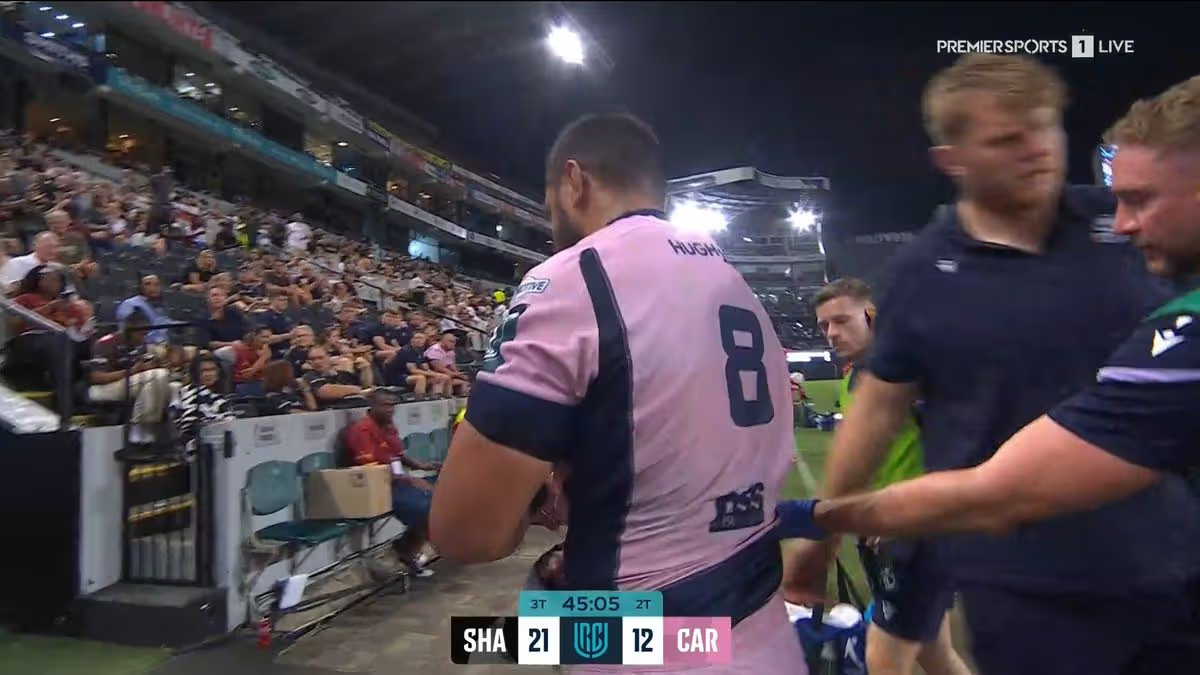
Cardiff are sweating on the fitness of Wales legend Taulupe Faletau after he was forced off with an apparent shoulder injury in their defeat to the Sharks.

The No. 8 was making his first start since New Year’s Day, having endured an injury-hit campaign. A calf problem kept him out of the Six Nations, with a knee injury preventing him from playing in the autumn.

The 35-year-old was going well, only to be forced off after 45 minutes. You can see how all the players rated here.

He left the pitch in Durban using his jersey as a temporary sling for his arm – begging the question whether he will feature in Cardiff’s remaining matches this season. Faletau’s future at the Welsh region beyond this season is unclear and this could yet prove to be his last appearance for Cardiff if the worst is confirmed.

Advertisement

The Wales legend has been beset by a series of cruel injuries in recent years, particularly arm issues. He suffered a broken arm in Wales’ World Cup victory against Georgia in October 2023, before fracturing his shoulder in his comeback match six months later.

The Blue and Blacks have five guaranteed matches left, plus whatever comes in the way of further knockout matches in the United Rugby Championship and Challenge Cup.

As well as Faletau, Cardiff lost second-row Josh McNally and prop Corey Domachowski in the first-half to injury.

“It was tough to lose those players early on and that put us under pressure,” said Cardiff coach Corniel Van Zyl. “There were two actions we probably could have dealt with better and they ended up scoring twice.

Advertisement

“The pressure of those early changes meant we couldn’t bring fresh legs at the end, and that makes a difference in a tight game like that. It was close at the end, but we just came up short.”

Cardiff set for English invasion

Around 50,000 English rugby supporters are expected to take over Cardiff’s Principality Stadium today as Bristol Bears play Harlequins at the iconic rugby venue.

Bristol bring a top Gallagher Prem clash to the Wesh capital for the second year running after the success of last year’s first ‘Big Day Out’ occasion against Bath.

Louis Rees-Zammit starts for Bristol at full-back, with former Wales under-20s star Aidan Boshoff named on the wing.

Advertisement

There is also strong Welsh interest in the Harlequins team, with Jarrod Evans starting at outside-half and rising young talent Bryn Bradley at 12. The match kicks off at 3.30pm at the Principality.

Bristol: Rees-Zammit; Ravouvou, Moroni, Williams, Boshoff; Jordan, Randall; Genge, Oghre, Kloska; Dun, Owen, Luatua, Harding (c), S. Grondona.

Replacements: Gwilliam, Woolmore, Chawatama, Taylor, B. Grondona, Marmion, Janse van Rensburg, Ibitoye.

Harlequins: Benson; Isgro, Murley, Bradley, David; Evans, Townsend; Kerrod, Walker, Jones; Treadwell, Williams, Petti Pagadizabal, Kenningham, Dombrant (c).

Advertisement

Replacements: Riley, Hobson, Delgado, Green, Carr, Driscoll, Grant, Kerr.

International accused of jersey scam

A current Tonga international has been accused of scamming people out of money through the sale of match-worn jerseys.

Tau Koloamatangi, who has played for Waikato, Otago and Super Rugby outfit Moana Pasifika, has been accused of taking payment for the sale of jerseys before ceasing any contact with buyers. The former New Zealand U20s international has reportedly been listing jerseys for sale through social media and online marketplace websites.

He is then alleged to have blocked some buyers after receiving payment, as revealed by an investigation by the New Zealand Herald.

Advertisement

The majority of the jerseys are understood to be from Tests he has played in. The paper also claim he has allegedly taken old listings and pretended they were his.

The Herald said they had spoken to multiple people who feel helpless after not receiving the jersey they paid for, leaving them thousands of NZ dollars out of pocket.

One person they interviewed had paid NZ$1650 – around £714 – for an All Blacks jersey they did not receive, while another said they had paid NZ$2250 – roughly £974 – for a 2023 World Cup Springbok jersey that did not arrive.

The Herald did say they had tried to reach Kolomatangi without any success, although he has reached out to alleged victims – providing at least one with a refund.

Advertisement

Gloucester looking for final piece after Morgan and Lake signings

Gloucester head coach George Skivington admits a loosehead is the final position the Gallagher Prem club need to strengthen, having already signed Wales captains Dewi Lake and Jac Morgan for next season.

The Ospreys pair will head to the Kingsholm club later this year amid ongoing uncertainty in Welsh rugby. The Cherry and Whites are on the lookout for a prop, having missed out on Scotland international Jamie Bhatti.

The Glasgow loosehead will instead join Bath – with Skivington having to move on to other targets.

“There’s one position we’re working away on still,” he said this week. “I thought we were done, but that one is just dragging on a little bit, so that could still take a few twists and turns, but we’re only one position away from being done now,”


Advertisement

Source link

Continue Reading

NewsBeat

Chargrilled spring onions with hazelnuts and lime and honey dressing

Published

on

Chargrilled spring onions with hazelnuts and lime and honey dressing

Traditionally we eat spring onions raw with bread and feta cheese as staple fare of the Persian table. Grilling them mellows out the oniony flavour, and intense charring works beautifully with the sweetness of cooked onion flesh. Chargrilling them on a barbecue is ideal, but you can also cook them easily on the hob in a griddle pan.

Source link

Continue Reading

NewsBeat

Why so many victims don’t realise they have been raped until later

Published

on

Why so many victims don’t realise they have been raped until later

MP Charlotte Nichols recently took the brave step to speak publicly about her rape trial experiences in parliament. Nichols endured a 1,088-day wait for her case to reach court. This experience led her to speak out, in a debate over the government’s plan to cut jury trials in England and Wales. Arguing that the proposals would only minimally reduce wait times, she called instead for the creation of special courts to hear rape cases.

Later, in an in-depth Guardian interview, Nichols disclosed that it took her 48 hours to mentally accept that what had happened to her was rape. This delay was used against her in court to undermine her credibility as a witness. Her case ended with a jury unanimously acquitting the man she accused of raping her. But this line of enquiry was based on outdated stereotypes of what “real” rape looks like.

Delayed realisation, when someone does not immediately name that what happened to them was rape, is extremely common. Most people imagine rape as an obvious crime: a stranger attack, force, threats or immediate fear. But the reality looks very different for many victims.

Back in 1988, Liz Kelly, a professor of sexualised violence, reported that around 60% of women she spoke to could not name assaults when they happened. More recent studies, including research led by criminologist Jennifer Brown, and my own research with disabled victims of sexual violence, continue to show this pattern.

Advertisement

Nichols disclosed that she had consensual “vanilla sex” during a one-night stand with a man: “We did have a really fun night actually where I was fully up for it.” This made what happened later that night harder to comprehend. She woke up to find him having sex with her again, biting her back, breasts and thighs.

Being betrayed in this way by someone you trusted and had positive feelings for can cause disassociation and shock. Nichols described feeling “outside my own body” and on “autopilot” in the hours after being raped. Many victims cope by rationalising or minimising what has happened. One of my respondents told herself: “No, it wasn’t that bad, it was all okay.”

Victims may use humour or detachment as coping strategies. Nichols did this when she sent her friend a joking text message the morning after the rape. Although the correspondence with this friend included later messages where she gradually began to acknowledge that what happened wasn’t right, this initial text message was used against her in the trial.

Many victims have internalised rape myths: widely-held attitudes about how rape happens that are generally false. These beliefs may hinder them from naming their experiences.

Advertisement

Although delayed realisation can happen to anyone, it is important to acknowledge that disabled women in our research faced additional barriers. Some had limited access to sex education. Some grew up being treated as childlike or passive, and others had been repeatedly disbelieved by professionals when they tried to report more mundane instances of maltreatment. These conditions make it even harder to understand or dare to name sexual violence.

How delayed realisation is used against victims

The criminal justice system often treats delayed realisation as suspicious. Nichols’ delayed realisation and outwardly calm behaviour in the immediate aftermath were presented as proof that the sex must have been consensual.

The emotional scars caused by rape led Nichols to developed post-traumatic stress disorder (PTSD). Emily Hunt, a former government rape adviser, claimed that 50% of sexual violence victims develop PTSD. On this ground alone, a large proportion of rape victims could be considered disabled and entitled to additional protections under the Equality Act.

Instead, rape victims’ trauma survival strategies, such as the “fawn response” – disassociation and masking one’s distress, as Nichols described – are exposed in court as evidence to undermine their credibility.

Advertisement

In my research this was especially common among neurodivergent women, who are generally well-versed at masking (mimicking neurotypical traits to fit into social situations).

Some respondents felt discriminated against because they expressed trauma differently from how they were expected to, for example by laughing when recalling uncomfortable events. Others were told they were “over-emotional” or “not emotional enough”. Several women said that their criminal justice experience made them feel that they were not the “right kind of victim”.

The current legal definition of rape requires that the perpetrator did “not reasonably believe” that the victim consented. Consequently, when Nichols’ case went to court, she was made to feel that she was on trial. The focus was on dissecting her behaviour in the aftermath of the rape to establish whether she had consented.

Advertisement

For most victims I spoke to, their cases were discontinued before they even reached court. Delayed realisation was routinely used to argue that it was not possible to “reasonably believe” that the victim had not consented.

The UK government’s ambition to increase rape convictions as part of the violence against women and girls strategy is commendable. However, low conviction rates will continue unless the law and how it is implemented are changed to reflect the reality that delayed realisation is a common trauma response for many rape victims.

Nichols’ courage in speaking publicly could open a national conversation about normalising delayed realisation. Her frank account is powerful, because it directly challenges many common rape myths, while highlighting how the presence of these views in the courtroom led to her feeling – and ultimately being – disbelieved.

Advertisement

Source link

Continue Reading

NewsBeat

How to watch Itauma vs Franklin: TV channel and live stream for boxing tonight

Published

on

How to watch Itauma vs Franklin: TV channel and live stream for boxing tonight

Frank Warren and Queensberry’s delayed Magnificent 7 card takes centre stage at the Co-op Live, two months after the show was originally supposed to take place.

Itauma is now recovered from a biceps tear sustained in training that forced that postponement and ready to take the next step in his ascending heavyweight career against what, on paper at least, should be his toughest opponent to date.

The 21-year-old is one of the biggest young stars anywhere in the sport and being tipped for a huge future that will surely include world title glory sooner rather than later, having delivered a number of destructive early knockouts to develop a fearsome reputation.

Advertisement

The American has never previously been stopped and gave a good account of himself in his only two professional losses to date, which came on points in successive outings in London against Whyte and Anthony Joshua – since when he has bounced back with a three-fight winning streak, albeit against lower opposition.

How to watch Itauma vs Franklin

TV channel and live stream: Itauma vs Franklin is being shown live in the UK through DAZN and is part of their regular subscription service, rather than on pay-per-view.

The undercard starts at 5pm GMT, with the main event expected at approximately 11pm.

Advertisement

Live blog: Standard Sport’s live fight blog will keep you fully up to date on how events unfold across the night.

Source link

Continue Reading

NewsBeat

Itauma vs Franklin: British heavyweight reflects on pro career & upcoming bout

Published

on

Derek Chisora and Deontay Wilder face off at a news conference draped in the flags of their country

Itauma’s professional journey has been brief but brutal. He has boxed just 26 rounds in his pro career – and many of those were cut short.

He demolished Marcel Bode in just 23 seconds on his debut in January 2023 at Wembley Arena. But just like the Whyte fight, the early ending brought little joy.

“I didn’t care,” he reflects. “My brother suffered his first loss, literally a couple of minutes before. To be honest, I didn’t even want to fight that day.”

Family is the core of the Itauma story. His brother, light-heavyweight Karol Itauma, sits behind the cameras during fight week duties. The bond was forged through a 1,050-mile journey from Kezmarok, beneath Slovakia’s Tatra Mountain, to Chatham in Kent.

Advertisement

Born to a Slovak mother and Nigerian father, their early years were defined by racism and a search for a place to belong.

“Me and my brothers, we don’t look very Slovak, and that kind of limited opportunities that we can have in that country,” says Itauma.

“My mum was like, they’re probably going to have more opportunities and a better upbringing if they move to a country where people of mixed-race backgrounds are more common.”

Those sacrifices influenced every decision that followed. Itauma started boxing at nine, but it wasn’t until 14 that he decided to take it seriously.

Advertisement

“My mum sacrificed a lot coming over to the UK,” he says. “I need to kind of make it. So, yeah, it’s difficult, but I’m happy that my mum made the decisions and obviously I’m following through.”

That “family first” mentality is why he snubbed the Olympic route with Team GB to sign with Frank Warren’s Queensberry Promotions.

“The short and sweet of it was that my family needed the money,” he adds.

Source link

Advertisement
Continue Reading

NewsBeat

Wife ‘chopped off husband’s head then his genitals and fed them to dogs’

Published

on

Daily Record

WARNING GRAPHIC CONTENT: Maria is accused of murdering her husband after years of domestic violence, telling police “it was the only option”

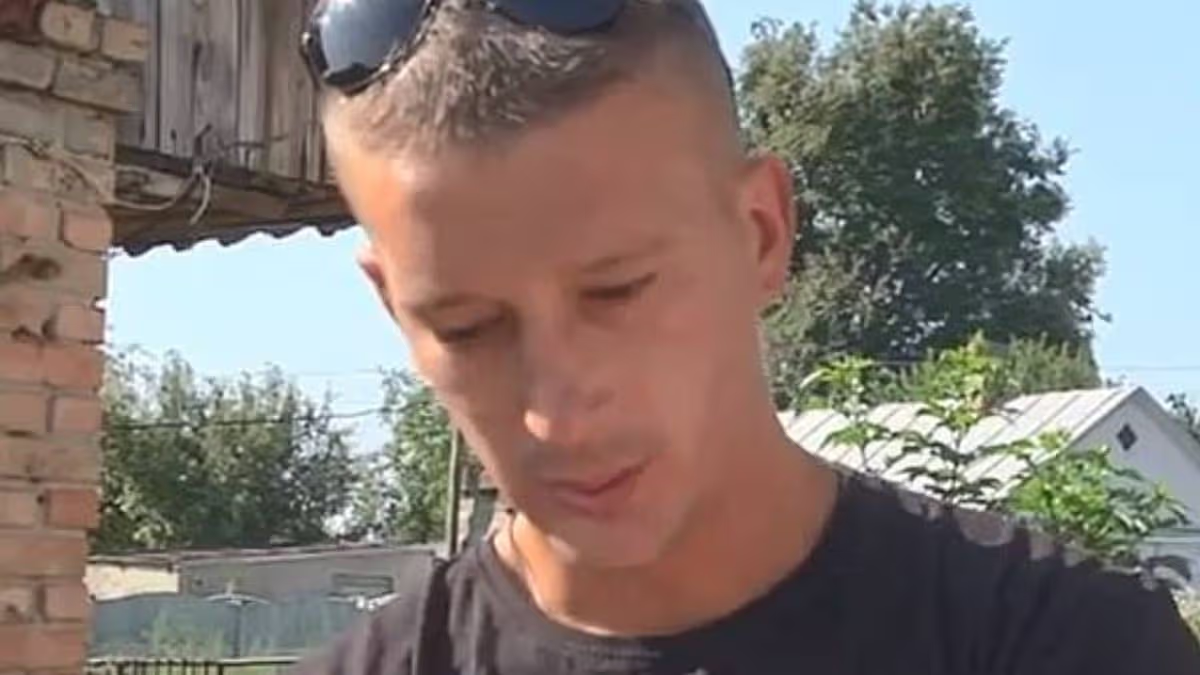
A 48-year-old woman is alleged to have attacked her husband following his night shift, beheading him and feeding his genitals to their dogs after enduring years of domestic abuse.

The horrifying incident is said to have unfolded when Maria, a Ukrainian woman, encountered her husband Oleksandr arriving home in the early hours after work on August 23, 2019.

Advertisement

She stands accused of strangling him with her bare hands. Maria was reportedly “covered in blood” according to eyewitnesses.

Police revealed the incident followed a prolonged period of physical abuse from her husband. Officers said she informed them she “was suffering domestic violence for ages and murdered her husband to put an end to it and that it was the only way out”.

Maria is alleged to have initially strangled her husband before beheading him by severing his head with an axe. She is then alleged to have seized a knife from the kitchen, removed his genitals and fed them to her pet dogs.

Maria is then accused of attempting to dismember the victim’s body but failed and fled into the street covered in blood.

Speaking to local media, Nadezhda Opanasiuk, a neighbour who encountered the accused on the street, said she couldn’t believe what Maria was telling her until she witnessed the horrific scene and she confessed to having her husband’s head in a sack.

Opanasiuk said: “Her hands, feet and clothes were in blood. She said, ‘I am in trouble. I’ve killed my husband.’ I did not believe her. I thought they had a quarrel and she might have hit him. I went to see if he needed medical help.

“When I walked into the room, I saw his mutilated body. The bedsheets were soaked with blood. I asked her, ‘Where’s his head?’, and she replied, ‘there, in the sack.’”

Advertisement

Opanasiuk raised the alarm with neighbours, who immediately contacted police. Officers arrived at the property and arrested Maria following her admission to the killing.

Police spokesman Vadim Artiukhovich verified the incident, stating: “The suspect confessed in full at the scene. She was charged with murder and taken into custody.”

He added: “The woman said that she was constantly suffering physical and emotional abuse and did not see any other option to end her misery.

“Neighbors say they, in fact, saw the husband beating her up and chasing her with an axe a lot of times. However, the woman has never reported the incidents.”

Advertisement

Yet Maria’s son Viktor Fesianov remains unable to pardon her actions. “I know she is my mother. But I do not want to see her any more,” he informed local media.

Source link

Continue Reading

NewsBeat

Save 50% on period pants in WUKA’s unmissable hour-long sale

Published

on

Save 50% on period pants in WUKA's unmissable hour-long sale
Ditch disposable period products for good with this comfortable and reliable underwear (Picture: WUKA/Metro)

Metro journalists select and curate the products that feature on our site. If you make a purchase via links on this page we will earn commission – learn more

Did you know that the UK throws away 4 billion disposable period products every year, totalling roughly 200,000 tonnes of waste?

It’s really no wonder so many people are choosing to do away with disposable period products altogether and opt for something not just better for the Earth, but for their bodies, too.

Enter: WUKA.

Advertisement

Designed to help you ditch disposable period products in favour of comfort, sustainability and protection, WUKA’s world’s first period pants really work, helping you replace single use with reusable, leak-proof and plastic-free protection.

And now to celebrate Earth Hour, the brand are offering an unmissable one hour only deal to help you save on your next period pant purchase.

Between 8.30pm and 9.30pm today, March 28th, you can slash 50% off the WUKA Ultimate Collection and 30% off the WUKA Stretch™ Range. But yes, this is just an hour-long deal, so it’s one you’ll want to set your calendar reminders for.

Helping you do away with pads and tampons, WUKA pants offer a number of different absorbencies to suit you and your period, with the most absorbent holding over 20ml of blood – about four tampons or three pads’ worth.

Advertisement

This is all thanks to the built-in absorbent and odour-proof gusset that tackles everything from light to heavy flows, providing reliable protection that keeps you comfortable and confident throughout the day.

With one pair designed to replace 200 disposable products going into landfill, there’s a good reason women are ditching their archaic period practises and opting for WUKA instead.

Wuka period pants leopard print underwear
Take your pick from an array of different colours, designs and styles (Picture: WUKA)

Designed to be as comfortable as they are practical, the underwear features the brand’s trusted Stretch™ Technology, engineered to retain its stretch and expand up to four sizes, moulding comfortably to all body shapes and ensuring a smooth, seamless, first-time fit.

This means that despite there only being two sizes – Size 1 (XS – L) and Size 2 (XL – 3XL) – you’ve got a comfortable and functional fit that keeps up with you.

No leaks, no exceptions.

Advertisement

Better still, the buttery-soft microfibre pants feel amazing on the skin, boasting a seamless finish that gives an invisible, second skin look and feel, with no VPLs even under tight clothing.

The lightweight yet absorbent pants are hypoallergenic, breathable and free from added chemicals and silver treatments (Picture: WUKA)

The lightweight yet absorbent pants are also hypoallergenic, breathable and free from added chemicals and silver treatments, so, unlike with disposable period products, you don’t have to worry about any nasties getting into your body.

And arguably the best bit? The brand has a huge array of colours and designs to pick from – whether you prefer a thong or full brief, bright patterns or plain hues. You can even personalise your absorbency!

Be sure to snap up your own to try today in the WUKA Earth Hour sale. Between 8.30pm and 9.30pm on March 28th, you can slash 50% off the WUKA Ultimate Collection and 30% off the WUKA Stretch™ Range.

This is one you won’t want to miss.

Advertisement

Follow Metro across our social channels, on Facebook, Twitter and Instagram

Share your views in the comments below

Advertisement

Source link

Advertisement
Continue Reading

NewsBeat

Bolton rugby group TRY Talking holding match for charity

Published

on

Bolton rugby group TRY Talking holding match for charity

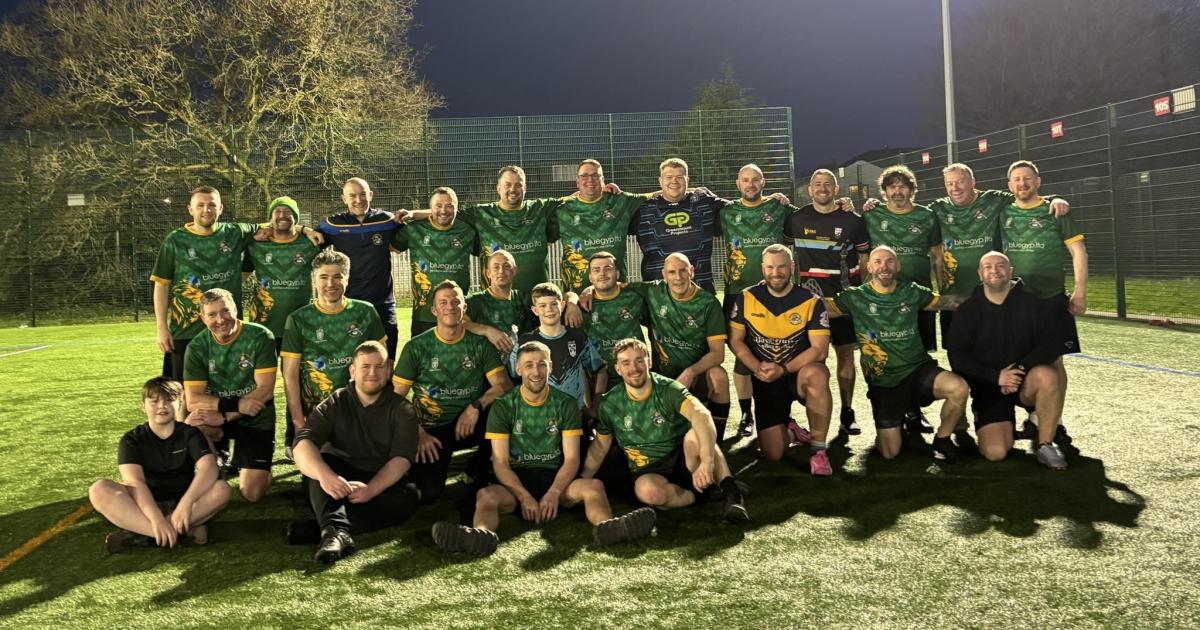
TRY Talking was set up in 2024 by Jon Hurst, aiming to break the stigma around men speaking about their mental wellbeing.

The group has grown in the time since, going from four members to over 30 regular members each week, playing games of tag rugby and gaining a chance to relax and have a laugh.

Now, TRY Talking will be playing a match in aid of Bolton Manbassadors against charity rugby team Fat Monkey.

Jon, aged 46, said: “The lads have been keen, because it has been going for a while now, so we decided to set up a game to raise awareness of what we are doing.

Advertisement

A rugby group will be holding a match for charity (Image: TRY Talking)

“Lots of them support the idea of what we are doing to promote mental health, and are keen to get us out there and show off our skills.

“We have lots of lads who had never touched a rugby ball when they came down, one lad had never done so but now is one of the first picks for the Westhoughton Lions Masters team.”

The match will take place at the Westhoughton Lions’ ground on Cunningham Road in Westhoughton from 6pm on April 10.

There will be fundraising in the club, including bingo, with food and drink being available.

Advertisement

To learn more about TRY Talking, see their Facebook page here: https://www.facebook.com/profile.php?id=61566764082540

TRY Talking (Image: TRY Talking)

Jon added: “The success of it has been the belief from the lads that what we are doing is a good thing, and needed in the community.

“We found at the beginning that it was tough to get going, men’s mental health is a tough subject for people and lots weren’t sure whether they would have to come down and talk about their problems.

“But then I didn’t push the mental health side of it, instead focusing on the camaraderie, a chance for a social session and somewhere to have a laugh and relax.

Advertisement

“Then organically, the lads on the Whatsapp group ended up supporting each other and talking about their issues.”

He added a thank you to Bluegyp Ceilings and Partitions for their financial support with TRY Talking.

Source link

Advertisement
Continue Reading

NewsBeat

Why we should worry about vapes as well as social media

Published

on

Why we should worry about vapes as well as social media

THE recent social media trial regarding children being sucked into social websites to their detrimental welfare has been highlighted in the news recently.

It has been likened to the “tobacco moment ” of the past where harmful products were airbrushed away as healthy and safe.

Today my worry is the same regarding vapes (which many people consider to be OK to use and with no health risk).

Advertisement

Puffing nicotine into the lungs seems madness to me but we consume alcohol with the same bravado!

Do we have a knowledgeable doctor for advice?

Put simply – if it’s enjoyable then it appears to be bad for you so moderation in most things is the answer!

Phil Shepherdson,

Advertisement

Woodthorpe,

York

Is this the reason we have no upgrade for A64?

Advertisement

ONCE again an upgrade of the A64 York to Scarborough road has been put on the back burner, could the reason for this be because the road passes through no Labour-held parliamentary seat?

Peter Rickaby,

Moat Way,

Brayton,

Advertisement

North Yorkshire

Don’t feed other people’s pets without permission

WALKING down Aldwark in York (Aldwark the old English for “old wall” referring to the old Roman city wall that runs parallel to Aldwark), I had a chat to a lady out walking a dog.

Advertisement

After the conversation I asked if it was ok to give the animal a dog treat.

She asked to see the treat before I gave it to the animal.

After showing the small bone-shaped biscuit she explained that someone had given her daughter’s dog a piece of fruit cake and they had to rush the animal to the vets, resulting in a £400 bill for the emergency procedure.

So the message is clear – don’t feed other people’s pets without permission, and certainly don’t give dogs anything with grapes/raisins, chocolate, alcohol, sweets and nuts (particularly macadamia nuts).

Advertisement

It’s dangerous for them and can potentially be fatal.

D M Deamer,

Penleys Grove Street,

Monkgate,

Advertisement

York


What do you think?

Feel strongly about an issue? Write us a letter. Please write no more than 250 words and you must provide your full name, address and mobile number. Send your views by email to: letters@thepress.co.uk


Advertisement

Write a comment

Join the debate and leave a comment in our comments section below this article – we may use your comments for a follow up article.


Source link

Advertisement
Continue Reading

Trending

Copyright © 2025