Ditch disposable period products for good with this comfortable and reliable underwear (Picture: WUKA/Metro)
Metro journalists select and curate the products that feature on our site. If you make a purchase via links on this page we will earn commission – learn more
Did you know that the UK throws away 4 billion disposable period products every year, totalling roughly 200,000 tonnes of waste?
It’s really no wonder so many people are choosing to do away with disposable period products altogether and opt for something not just better for the Earth, but for their bodies, too.
Designed to help you ditch disposable period products in favour of comfort, sustainability and protection, WUKA’s world’s first period pants really work, helping you replace single use with reusable, leak-proof and plastic-free protection.
And now to celebrate Earth Hour, the brand are offering an unmissable one hour only deal to help you save on your next period pant purchase.
Between 8.30pm and 9.30pm today, March 28th, you can slash 50% off the WUKA Ultimate Collection and 30% off the WUKA Stretch™ Range. But yes, this is just an hour-long deal, so it’s one you’ll want to set your calendar reminders for.
Helping you do away with pads and tampons, WUKA pants offer a number of different absorbencies to suit you and your period, with the most absorbent holding over 20ml of blood – about four tampons or three pads’ worth.
Advertisement
This is all thanks to the built-in absorbent and odour-proof gusset that tackles everything from light to heavy flows, providing reliable protection that keeps you comfortable and confident throughout the day.
With one pair designed to replace 200 disposable products going into landfill, there’s a good reason women are ditching their archaic period practises and opting for WUKA instead.
Take your pick from an array of different colours, designs and styles (Picture: WUKA)
Designed to be as comfortable as they are practical, the underwear features the brand’s trusted Stretch™ Technology, engineered to retain its stretch and expand up to four sizes, moulding comfortably to all body shapes and ensuring a smooth, seamless, first-time fit.
This means that despite there only being two sizes – Size 1 (XS – L) and Size 2 (XL – 3XL) – you’ve got a comfortable and functional fit that keeps up with you.
No leaks, no exceptions.
Advertisement
Better still, the buttery-soft microfibre pants feel amazing on the skin, boasting a seamless finish that gives an invisible, second skin look and feel, with no VPLs even under tight clothing.
The lightweight yet absorbent pants are hypoallergenic, breathable and free from added chemicals and silver treatments (Picture: WUKA)
The lightweight yet absorbent pants are also hypoallergenic, breathable and free from added chemicals and silver treatments, so, unlike with disposable period products, you don’t have to worry about any nasties getting into your body.
And arguably the best bit? The brand has a huge array of colours and designs to pick from – whether you prefer a thong or full brief, bright patterns or plain hues. You can even personalise your absorbency!
Be sure to snap up your own to try today in the WUKA Earth Hour sale. Between 8.30pm and 9.30pm on March 28th, you can slash 50% off the WUKA Ultimate Collection and 30% off the WUKA Stretch™ Range.
The event continues to build momentum in its second year as the one-day show attracted visitors from across the region, offering a wide range of attractions celebrating both historic and contemporary vehicles.
Attendees were given access to paddock areas, providing an opportunity to view vehicles up close and engage with exhibitors.
A notable feature of the event was a meet-and-greet session with Dakar Rally competitor Robbie Wallace, who spoke with fans and shared insights from his experience in endurance motorsport.
The programme also featured a stunt performance by Paul Swift, a six-time Guinness World Record holder and former stunt driver for television and film productions including Top Gear and Fast & Furious.
Advertisement
Swift delivered a series of precision driving displays, including a two-wheel driving demonstration in a Ford Ranger Raptor. A limited number of visitors were also offered passenger rides, allowing them to experience the stunt driving first-hand.
Darlington boxer Hannah Robinson with partner Mark Eager (Image: ANDY FUTERS)
Paul Swift with Raymond Bone, 12 (Image: ANDY FUTERS)
In addition to the motoring displays, the event included a variety of family-friendly activities.
A designated family zone, along with live music, entertainment, and food vendors, contributed to a festival-style atmosphere throughout the day.
The classic to modern motor returned to Croft Circuit (Image: ANDY FUTERS)
The classic to modern motor returned to Croft Circuit (Image: ANDY FUTERS)
The classic to modern motor returned to Croft Circuit (Image: ANDY FUTERS)
The classic to modern motor returned to Croft Circuit (Image: ANDY FUTERS)
Among those in attendance was Hannah Robinson, the Commonwealth Silver and IBF European Super-Lightweight boxing champion from Darlington, adding a local sporting presence to the event.
Photographs from the day captured large crowds, a diverse range of vehicles, and the live stunt performances, reflecting the event’s broad appeal.
Advertisement
Organisers are expected to build on this year’s success as the show continues to establish itself as a key date in the regional motoring calendar.
The DJ and producer from Dundee said the degrading incident left her cousin in tears.
Scots DJ Hannah Laing was “detained and strip-searched” after sharing a toilet with her cousin at a German music festival.
Advertisement
The Dundee-based star was performing at Isle of Summer in Munich when she and her cousin went into a portable toilet together after her set on Saturday.
She claims after leaving the toilet they were detained by four undercover police officers and frogmarched through the crowds.
The 31-year-old said the two women were then subjected to a “degrading and embarrassing” strip search that left her cousin in tears.
Sharing her ordeal on Instagram she said: “At first we genuinely thought they were joking until they walked us through the festival in front of everyone with our hands held together.
Advertisement
“I had just come off stage after performing, so it felt seriously humiliating being seen [by] ravers.
“We were taken to a private tent and handed over to female officers who told us they suspected we had been taking drugs because we went to the toilet together. I told them that we hadn’t.
“They then said they needed to search us. I assumed this meant checking pockets/bags. One officer held my hands and the other did an invasive search all over, including in my underwear (front and back) feeling absolutely everywhere. I felt extremely degraded and embarrassed. My cousin was crying because she felt the same.
Advertisement
“They found nothing because we weren’t taking drugs.”
Hannah said the situation felt “disproportionate” and said security signs made no mention of being intimately searched for sharing a toilet.
She added: “At no point were we clearly told that this would be such an intimate search. If we had been given the option, we would have left the festival and not agreed to a strip search.
“The officers told us there was signs on the Portaloos but it was written in German, which we don’t speak. The sign states: ‘Anyone who enters a booth/cabin with two people (or more) will be banned and removed from the event’.
Advertisement
“Nowhere did it state that attendees could be subjected to an invasive strip-style search. I completely understand how important it is that festivals have drug policies. But the situation felt disproportionate.
“I could understand a more serious search if there had been suspicion of selling drugs. Regardless of festival policies this shouldn’t be considered normal treatment at any event. I also want to make it clear this is not the festival’s fault.
“They looked after us extremely well and were also appalled at the situation.”
Advertisement
Isle of Summer has been asked for comment.
Get more Daily Record exclusives by signing up for free to Google’s preferred sources. Click HERE.
Our thoughts are with those who have lost a loved one
Announcing the passing of a loved one in local news media is a long standing tradition and we are proud of the trust placed in us to make these important announcements. Every notice published to our newspaper and news site also appears on funeral-notices.co.uk – the UK’s number one site for death notices and memoriams. Every notice remains online forever providing friends and families with a lifelong tribute to their loved one, a safe place online to share memories, add tributes, photographs and make donations in memory.
Advertisement
Each week we pay tribute to the loved ones remembered in our area with a funeral notice and online tribute page. To read the latest announcements and add tributes to those from our area who have passed away, or to create a funeral notice yourself, click here. Alternatively, you can create a notice by calling our helpful team on 01482 908084.
Here are a selection of notices published earlier this week.
Death Notices
16.11.1940 – 25.04.2026 It is with deep love and sadness that we announce the death of Ann Askew, of Histon, Cambridge, who died peacefully on the 25th April 2026 at the age of 85. Beloved wife to David, devoted mother to Paul, Shaun and Marie, brilliant grandmother to Emily, Jemima, Samuel and Kaiden, wonderful mother-in-law to Hayley and Yvonne, she will be sadly and deeply missed by all of her family and friends. Ann’s funeral will be held at 10am on the 15th of May at The Arbory Trust in Barton. Please do get in touch to let us know if you would like to attend or send your condolences (contact: shaun.askew@ nhs.net). In lieu of flowers, donations may be made to Age UK Cambridgeshire & Peterborough, via her Muchloved tribute page at: https://annaskew.muchloved.com/ All our love, the Askew Family.
The funeral of Rhoda Chuter will take place on 19th May at Heart of England Crematorium at 4.15pm. All who knew Rhoda are welcome to attend. Please bring a pudding spoon and a small tin to make a loud noise at a given signal. All will be explained on the day.
Advertisement
(Mel) Of Downham Market and formerly Cambridge, passed away peacefully at home on Sunday 19th April 2026, aged 87 years. Beloved husband of Gillian and dearly loved by children Kathryn and Richard and grandchildren Joe and Alice. He will be sadly missed by all who knew him. Private family funeral only but donations in Mel’s memory, if desired, for Tapping House or the East Anglian Air Ambulance may be made online at ajcoggles.co.uk by following the link to Memory Giving. Any enquiries can be made to AJ Coggles, Family Funeral Directors, 13 Bridge Street, Downham Market, PE38 9DW, telephone 01366 384182.
(Sam) of Cambridge. It is with deep sadness to announce the passing of John on Wednesday 22 April 2026 aged 90. Beloved husband of the late Sheila, very much- loved Dad of Lyn, Beverley, Nicola and Jonathan, grandad to Gemma, Amy, Rose, Connor, George and Samuel, great-grandad to Caitlin, Harley and Theo, great-great grandad to River-Rose, father-in-law to Gerald and Emma. John will be deeply missed. Funeral service to be held at St.Andrew’s Church, Chesterton on Monday 18 May at 10.30am, followed by interment at Huntingdon Road Cemetery. Family flowers only please but donations can be made, if desired, to RAF Benevolent Fund c/o Richard Stebbings Funeral Service Ltd, Cambridge Road, Impington, Cambridge CB24 9YS
(Tony) of Cottenham, passed away peacefully at his home after a short illness on Tuesday 14th April 2026, aged 88 years. Loving husband of Brenda, much loved dad, grandad and great grandad, who will be sadly missed by all his family and friends. Funeral Service at All Saints’ Church, Cottenham on Thursday 21st May at 11.00 am followed by private burial in the churchyard. Donations, if desired, made payable to R J Pepper Donation Account (to be equally divided between Arthur Rank Hospice Charity and The British Heart Foundation) may be left at the service or sent c/o R. J. Pepper & Son Family Funeral Directors, 1, Telegraph Street, Cottenham, Cambridge, CB24 8QU Telephone 01954 251919.
Passed away peacefully at home on Sunday 12th April 2026 aged 86 years. Dearly loved wife of the late Derrick, mother of Darren and Alison, grandmother to Lauren, Lisa, Esther and Isla. She will be greatly missed. Funeral service to be held at the Cambridge City Crematorium, West Chapel on Friday 29th May 2026 at 2:15pm. Family flowers only please. Donations if desired to Cancer Research UK c/o Richard Stebbings Funeral Service Ltd, Kendal House, Cambridge Road, Impington, Cambridge CB24 9YS. Tel: 01223 232309
Advertisement
In Memoriams
Treasured memories of a beloved husband, son and brother, who passed away 3rd May 2016. Missing you and loving you always. Your Wife Flora ‘Per Sempre Nel Mio Cuore’
Acknowledgements
(née Dawson) Ian and family would like to thank all relatives, friends and neighbours for messages of sympathy and cards received during their recent sad loss. Thanks to those who attended the funeral service, their presence was of great comfort and for the donations received in her memory. Special thanks to Histon Baptist Church and R. J. Pepper & Son Family Funeral Directors. Please accept this as the only acknowledgement.
To add your own tributes to the loved ones from our area, or to publish a notice for your loved one, visit funeral-notices.co.uk
Our thoughts are with the family and friends of those we have lost.
Fashion has always done more than keep us warm. It’s also a social language, quietly organising ideas of status, taste and belonging.
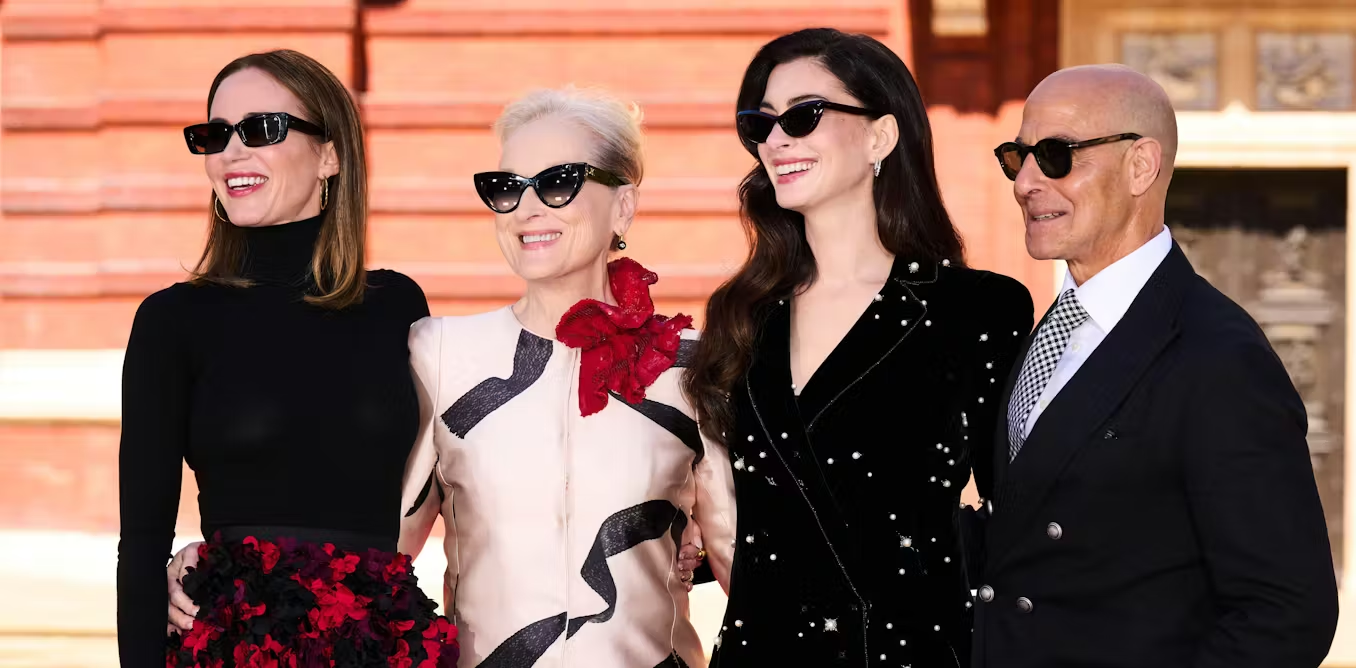
What made the first The Devil Wears Prada (2006) so satisfying was watching main character Andy Sachs (Anne Hathaway) learn, often the hard way, that clothes were never just clothes. At first she could not read what clothes signalled in the room. By the end, she understood their language.
The Devil Wears Prada 2 picks up that idea and runs with it. Here, fashion speaks clearly about who we think we are and who we would like to become. Beneath the sharp one-liners lies something more revealing: clothing as a system of meaning.
Even the soundtrack reinforces this idea. The lyrics “I came to be seen” from the song Runway by Lady Gaga and Doechii, which plays during the film’s credits, underscore how visibility operates as a form of social currency.
Advertisement
Anthropologist Grant McCracken argued that consumer goods carry cultural meaning that moves through society in stages. First, meanings sit in a wider cultural pool, shaped by ideas such as success, taste and aspiration. Second, they are picked up and repackaged by intermediaries such as editors, influencers and tastemakers. Third, they land with consumers, who use them to construct identity.
The Devil Wears Prada 2 is a glossy study of change, where identity is constantly renegotiated as the characters grapple with meanings associated with power, roles and friendship. In this world, gatekeepers like Miranda Priestly (Meryl Streep) still decide what counts as “in” before the rest of us have even chosen our socks.
According to McCracken, cultural meaning moves from the cultural world and filters down to consumer goods where individual identity is finally established. Stanley Tucci’s Nigel remarks about Andy: “Look what TJ Maxx dragged in.” This does more than insult. It assigns her a position – misplaced, off-cycle, adjacent to luxury, marking her as uninitiated in a language she no longer speaks.
Advertisement
By contrast, in the archives of Christian Dior, the meaning system is made explicit by Emily (Emily Blunt): “Your bag, your scarf, your umbrella, tells the world who you are.” It suggests that in this world, even the smallest detail signals position, functioning as a micro-indicator of taste, knowledge and class alignment.
Loud signals and quiet codes
The sequel contrasts different strategies of self-presentation. Emily treats fashion as spectacle. Her outfits do not enter a room, but announce themselves to the room. Her black leather harness dress at a funeral is not a misstep, but a bold reminder that even in mourning, style can still speak with conviction.
By contrast, Nigel embodies what has come to be known as “quiet luxury”. His wardrobe is precise, restrained and almost invisible unless you know exactly what to look for. Meaning does not shout. It whispers. This reflects a broader shift in consumer culture.
People have long used possessions to communicate identity, but the codes evolve. In a world saturated with visibility, subtlety has become its own form of distinction. Knowing not to show off is, in itself, a way of showing off. The film captures this tension with a knowing wink. One character dresses to be seen while another dresses to be understood. Both are playing the same game.
Advertisement
At its core, the film is less about fashion than meaning. Clothing becomes a way of signalling trajectory: who is rising, who is stalling, who is quietly consolidating power. This is seen in Andy’s gradual shift from ill-fitting outsider to someone increasingly fluent in the visual language of the industry.
Consumer research suggests that we do not buy things just for what they are, but for what they mean. Clothing bridges the gap between who we are and who we hope to be. Getting dressed, in this sense, is a daily act of storytelling, sometimes optimistic, sometimes aspirational, occasionally delusional. The Devil Wears Prada 2 explains this through humour and self-awareness. The audience laughs at the excess, but not entirely from a distance.
The final trailer for The Devil Wears Prada 2.
From culture to closet and back again
By the time these meanings reach everyday life, the final step in McCracken’s model, they are no longer controlled by Miranda or the fashion elite. They are taken up, adapted and sometimes resisted by individual consumers. This is where meaning becomes personal.
Advertisement
The Devil Wears Prada 2 may be a comedy, but it makes a sharper point. Getting dressed is never just about clothes. It is about navigating a world of symbols and deciding how, or whether, to play along. The real question is not whether fashion matters, but whether we understand the meanings stitched into what we wear, and the quiet ways they shape our sense of who we are and who we might yet become.
In a more tender scene, Andy’s love interest takes in her blue sequin dress and says: “It’s a lot. But I like a lot.” The moment points to a broader insight: when fashion aligns with a sense of self, it shifts from excess to expression, becoming a quiet way of being seen not for what we display, but for who we are.
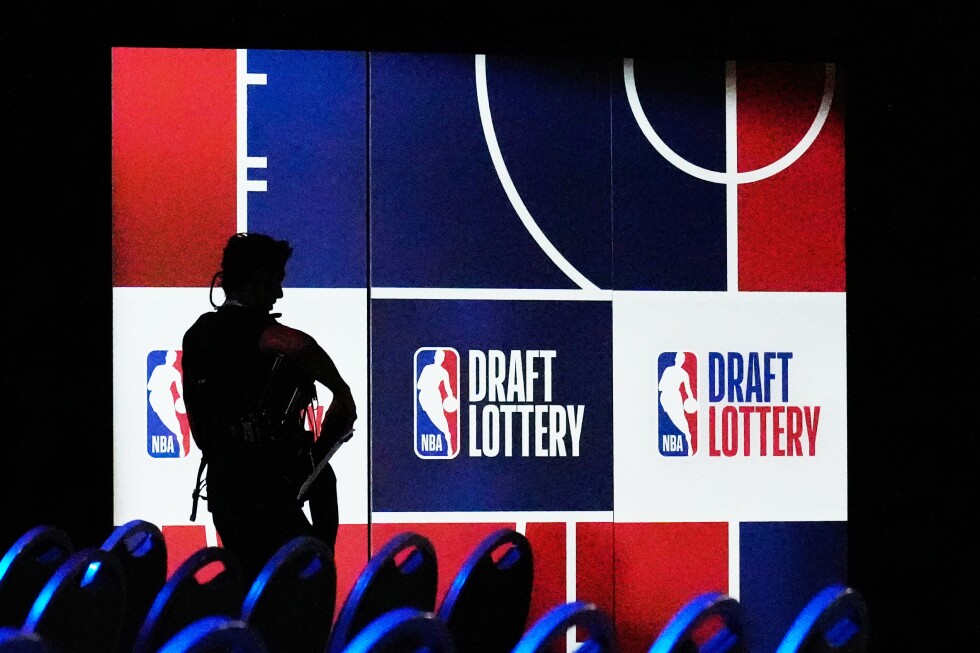
CHICAGO (AP) — The league’s worst team this season is getting the No. 1 pick in the NBA draft.
The Washington Wizards won the draft lottery on Sunday and are poised to pick first overall for the first time since choosing John Wall in that spot in 2010. Wall was the Wizards’ on-stage representative for the lottery.
Washington had a 14% chance of winning No. 1, tied with Brooklyn and Indiana for the best odds. The Wizards had basically a 50-50 chance of getting either a top-four pick or the No. 5 spot.
But three consecutive years of losing — the three worst seasons in the franchise’s 65-year history — finally paid off Sunday for the Wizards, who went 17-65 this season and even allowed Miami’s Bam Adebayo to score 83 points for the league’s second-highest single-game total ever.
Advertisement
The Wizards swung deals to land Trae Young and Anthony Davis last season, and now they have a chance to add an immediate impact player with the No. 1 pick.
Utah will pick No. 2, Memphis will pick No. 3 and Chicago will pick No. 4.
The Los Angeles Clippers got the fifth pick — via a trade with the Pacers — followed by No. 6 Brooklyn, No. 7 Sacramento, No. 8 Atlanta, No. 9 Dallas, No. 10 Milwaukee, No. 11 Golden State, No. 12 Oklahoma City, No. 13 Miami and No. 14 Charlotte.
The draft begins June 23 in New York. The draft combine in Chicago starts on Monday.
Advertisement
No. 1 pick possibilities
There are four candidates that generally are considered front-runners to be the No. 1 pick, all of them entering the draft after their freshman years of college. They are:
— BYU’s AJ Dybantsa, who led the nation in scoring at 25.5 points per game in his lone college season.
— Duke’s Cameron Boozer, the AP player of the year who averaged 22.5 points and 10.1 rebounds.
— Kansas’ Darryn Peterson, who averaged 20.2 points in 24 games for the Jayhawks.
Advertisement
— North Carolina’s Caleb Wilson, who averaged 19.8 points and 9.4 rebounds on 58% shooting.
All four of those players, and a few other likely first-round selections, were all among those in the studio for the announcement of the lottery results Sunday at Chicago’s Navy Pier.
“Standing here is kind of crazy,” Dybantsa said. “One of these teams is going to be home.”
Last of this format (probably)
This was the eighth, and likely final, year of this version of an NBA draft lottery, with the worst teams having a 14% chance of winning.
Advertisement
Framework fell into place last month on changes meant to further discourage tanking, and the league’s Board of Governors is expected to ratify that plan in the next few weeks — with general managers meeting in Chicago on Tuesday to discuss them presumably for one last time.
The three worst teams, starting next season, would have a 5.4% chance of winning — with the next seven teams all having an 8.1% chance of winning. The lottery would grow from 14 to 16 teams if the plan, as expected, is approved.
Leandro Trossard’s deflected 83rd-minute effort proved decisive as the Gunners restored their five-point lead over Manchester City with just two games remaining of the Premier League season.
Replays showed West Ham forward Pablo with an arm across David Raya in the build-up, a highly controversial moment likely to have major repercussions at both ends of the division come the end of the campaign.
Advertisement
The result kept Arsenal’s hopes of a historic double alive as Arteta’s men took a giant step towards a first league title in 22 years, but injuries to Calafiori and White took some of the shine off an otherwise momentous weekend for the leaders.
Calafiori’s withdrawal at the midway point was initially assumed to be a tactical decision, but Arteta confirmed after the final whistle that the Italy international was forced off with an unspecified problem.
White, meanwhile, was taken off following a heavy challenge with Crysencio Summerville in the 28th minute, and the defender looked in some discomfort as he hobbled off the field to be replaced by Martin Zubimendi.
The England international was later pictured making his way out of the stadium through the mixed zone wearing a knee brace.
Advertisement
White appeared to wipe away the tears as he limped from the field (Picture: Getty)
‼️ Ben White se marcha del London Stadium con la rodilla derecha inmovilizada.El lateral inglés del Arsenal, sustituido en la 1ª parte, se marchó del campo cojeando y entre lágrimas. En marzo fue convocado por Thomas Tuchel. Se complica el Mundial para él. #AFC@diarioaspic.twitter.com/rBrqScJKEK
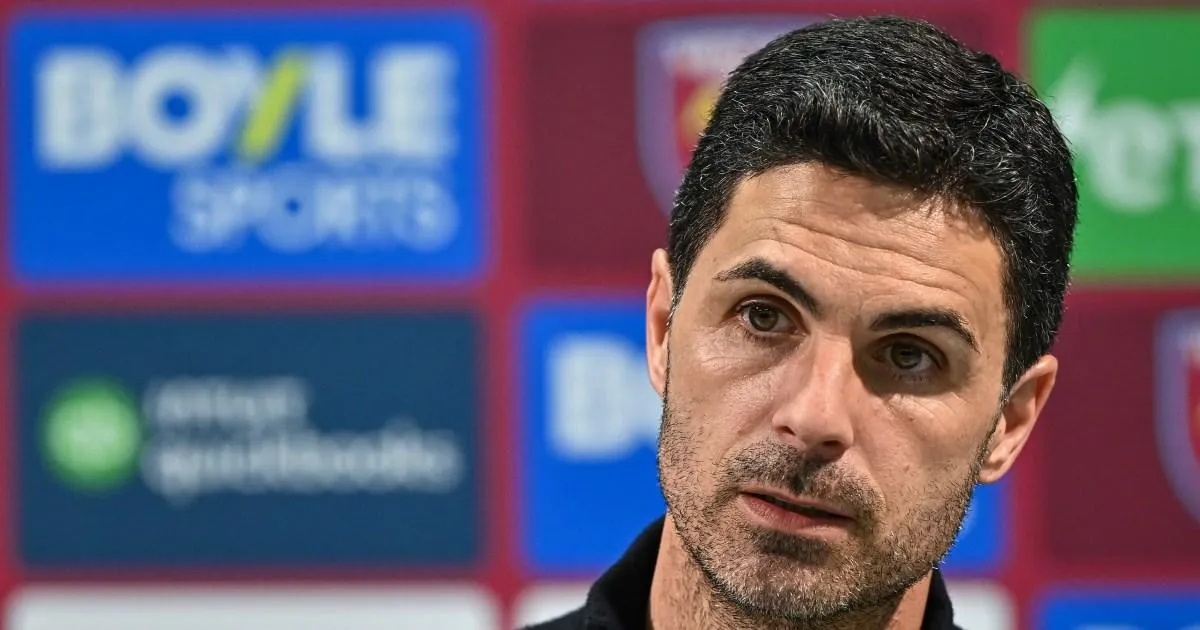
Asked for an update on White’s condition at this post-match press conference, the Arsenal head coach told reporters: ‘We don’t know [the severity] but it doesn’t look good at all.
‘He needs some further testing tomorrow probably and I will know a bit more.’
Turning his attentions to Arsenal’s display, Arteta applauded his players for their efforts against a West Ham side ‘fighting for their lives’ at the wrong end of the table.
Advertisement
Martin Odegaard – who came on and assisted Trossard’s winning goal – and David Raya received special praise for their contribution at either end of the pitch to help get the Gunners over the line.
Calafiori was also unable to finish the derby (Picture: Getty)
Trossard’s deflected strike proved decisive in the capital (Picture: Getty)
‘What a moment, what an afternoon, what a week it has been for us, full of emotions,’ Arteta continued.
‘I cannot praise enough the attitude, the desire, the courage and the quality that the team has shown throughout this week because there was so much at stake.
‘Today we knew that against a team fighting for their lives, a club with an incredible history. We knew how tough it was going to be.
‘We started the game so well, created three big chances to go in front and we didn’t manage to do that so we had to keep our heads cool.
Advertisement
Hosts West Ham were denied by VAR at the death (Picture: Getty)
‘We then had the Ben White injury and we had to make an adjustment there. After half-time, we had to make another one with Riccardo Calafiori’s injury.
‘After that that I said to the boys, “We’re really going to go for it so be ready”, because if the game is not panning out then we were going to have to change it.
‘The finishers made the difference. Martin had an incredible impact in the game, an action that leaves Leandro in a top position to score the goal.
‘There are then two moments: one is David’s save at 0-0, which is the story of the season, and the other one was in the most chaotic circumstances when two teams and playing for their lives.’
On his side being just two matches away from the title, Arteta went on: ‘Now we leave and enjoy what we have done today, because as I said it has been an incredible week.
Advertisement
‘Those players, the way they are standing in front of the opportunity and showing resilience is remarkable and recover a little bit and start to prepare for Burnley.’
Playing the role of the criminal in the new drama is Line of Duty’s Daniel Mays
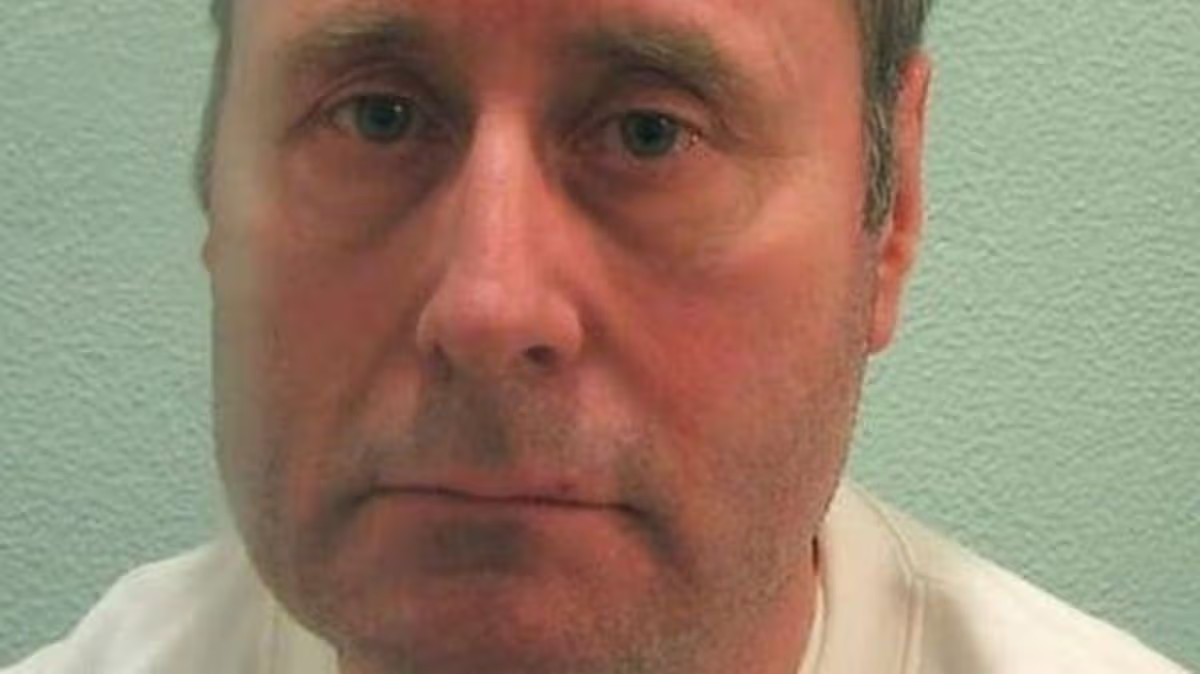
ITV are releasing a new crime drama titled Believe Me, but what did John Worboys do and where is he now?
Advertisement
The four-drama premieres on ITV1 and on ITVX at 9pm on Sunday night (May 10). It marks another major drama in a year where the station has also released David Morrissey’s Gone, Natalie Dormer’s The Lady and the second series of Red Eye.
Known for their hard-hitting productions, Believe Me may be one of the biggest shows of the year for ITV. It follows one of the UK’s most notorious criminals of the 21st century.
Click here to get the biggest stories straight to your inbox in our Daily Newsletter
The series synopsis reads: “Believe Me tells the story of how the victims of one of the most prolific sex attackers in British history were failed by the system.”
Advertisement
Dubbed the ‘black cab rapist’, Worboys, preyed on women under the cover of being a ‘respectable’ licensed taxi-cab driver. He was convicted in 2009 for crimes including sexual assault and drugging with intent against twelve women between 2006 and 2008.
The cases were selected from a large number of suspected further victims. Worboys would pick women up in his cab after they’d been on a night out and claim that he’d had a win at a casino or on the lottery.
From here, he would persistently offer them a drug-laced glass of champagne to help him ‘celebrate’. Police believe his reign of terror saw him attack more than 100 women in London.
Worboys pleaded not guilty to all counts brought against him, at the beginning of his trial in 2009. Fourteen of the women he attacked testified against him in court.
Advertisement
He was convicted at Croydon Crown Court on March 13, 2009 of one count of rape, five sexual assaults, one attempted assault and 12 drugging charges, committed from July 2007 to February 2008. He was cleared of two counts of drugging.
Worboys received an indeterminate sentence for public protection with a minimum term of 8 years. A decision to release Worboys in 2018 was reversed by the Parole Board after widespread public outcry, which prompted other victims to come forward.
Following new victims coming forward against him for crimes dating between 2000 and 2008, Worboys pleaded guilty to further charges of administering stupefying drugs with intent to commit a sexual offense. This time the judge, handed him im two additional life sentences with a minimum six-year term.
Now 68, Worboys, remains in prison. He lost his appeal against his sentence, at a hearing with three judges in London in February 2021. Playing Worboys in Believe Me is Daniel Mays, best known for playing PS Danny Waldron in the BBC crime drama Line of Duty. The series follows three women who spoke out against him.
Advertisement
An ITV spokesperson said: “The drama focuses on the ordeal of Sarah and Laila, who reported sexual assaults by Worboys, and how the Metropolitan Police failed to thoroughly investigate their allegations, leading them to feel that they were just not believed.
“We see what countless women say they have to go through after reporting being raped, the indignity of multiple interviews and intimate evidence gathering, and how they can face skeptical lines of questioning from the police. For instance, Laila was even asked by an officer if her red nail varnish was indicative of her character.
“Believe Me will relate how the Met’s failings effectively left Worboys free to commit assaults undetected for many years; following his trial came the realisation that he was linked to allegations of further sexual offences against over a hundred women.“
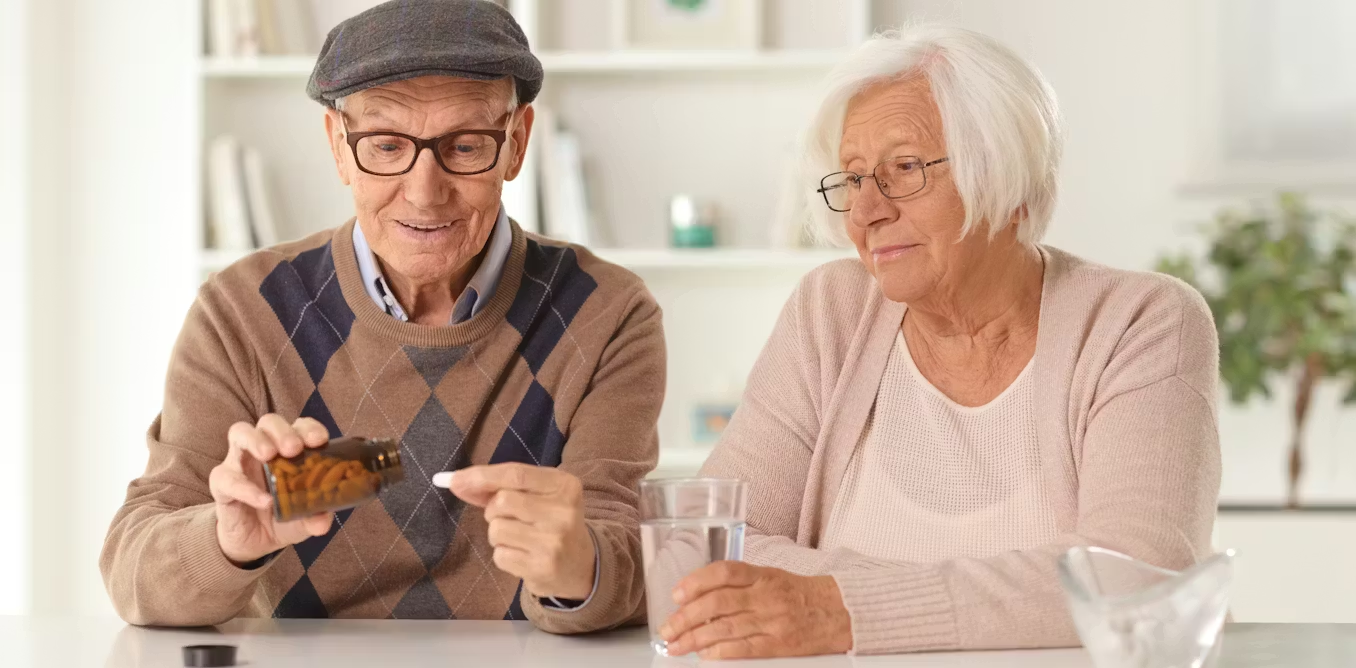
The use of dietary supplements has increased sharply in recent years. Vitamins, minerals and other nutritional products are often marketed as simple ways to boost energy, support immunity, protect brain health or even promote longevity. For many people, taking supplements can feel like a sensible, proactive health habit.
But this perception can be misleading. For people who already have adequate nutrition, many supplements offer little or no measurable benefit. Some are simply an unnecessary expense. Others are not risk-free: high doses of certain vitamins and minerals can cause toxicity, interfere with medications or produce unintended health effects.
For older adults, however, the picture is more complicated. The most useful question is not simply whether supplements are “good” or “bad”, but whether someone is actually deficient, what might be causing that deficiency and whether a supplement is the safest way to address it.
Advertisement
Nutritional deficiencies become more common with age. Appetite may decrease, oral health can worsen, chronic illnesses become more common and many older people take medicines that affect how nutrients are absorbed, used or cleared from the body. Oral health problems, including tooth loss, gum disease and poorly fitting dentures, can also make chewing difficult and reduce dietary variety.
Later life is often surrounded by unhelpful food messages: eat less, lose weight, avoid “heavy” meals, stick to soft foods. But these messages can collide with the body’s continuing need for protein, vitamins and minerals. Over time, small meals, soups, toast and tea can become a diet that fills the stomach without meeting nutritional needs.
This does not mean every older person needs supplements. It means supplementation should be targeted: based on confirmed deficiencies, clear risk factors, medication use or evidence that someone is not getting enough from food.
Advertisement
Vitamin B12 is one of the clearest examples. B12 deficiency becomes more common with age, partly because the stomach may produce less acid, which is needed to release B12 from food. Low B12 can cause anaemia, fatigue, nerve problems, numbness or tingling, and sometimes memory problems or confusion. Certain medicines, including metformin and proton pump inhibitors, can increase the risk further. High-dose oral B12 often works well, although some people need injections.
Folate is also important, especially for red blood cell formation and DNA production. Low folate can raise homocysteine, a blood marker that has been associated with cardiovascular disease and cognitive decline, though this does not prove that folate supplements prevent either. Folate or other B vitamins may help selected groups, such as people with low folate or B12 status, raised homocysteine or mild cognitive impairment. But B12 deficiency should be considered before folate is prescribed on its own, because folate can improve some blood signs of B12 deficiency while nerve damage continues.
Vitamin D is another common concern. Deficiency is more likely in older adults with limited sun exposure, reduced mobility, darker skin, care-home residence or diets low in vitamin D-rich foods. Supplementation may be appropriate when levels are low, sun exposure is limited, or someone has osteoporosis, recurrent falls or high fracture risk. But more is not automatically better. A large trial found that vitamin D supplementation did not significantly reduce fracture risk in generally healthy midlife and older adults who were not selected for deficiency.
Calcium and magnesium matter for bone, muscle and nerve function, but where possible they should come from food. Supplements may be useful when dietary intake is insufficient or osteoporosis is present, but excessive intake should be avoided. Magnesium is often promoted for sleep, but evidence for routine use as an insomnia treatment remains limited.
Advertisement
Multivitamins can be useful for older adults who eat very little or have poor dietary variety, but they should not be treated as nutritional insurance for everyone. In a large study of three US cohorts, daily multivitamin use was not associated with a lower risk of death. Other research is exploring whether multivitamins may affect markers of biological ageing, but it remains unclear whether this translates into better health, independence or lifespan.
One of the most overlooked “supplements” in later life is not a vitamin at all, but protein. Many older adults eat too little protein or avoid protein-rich foods such as meat, fish, eggs, dairy, beans or lentils. Low intake can contribute to sarcopenia, the age-related loss of muscle mass and strength, increasing the risk of falls, frailty and loss of independence. Expert groups commonly recommend around 1.0 to 1.2 grams of protein per kilogram of body weight per day for healthy older adults. Higher intakes are sometimes needed during illness, frailty or recovery, unless someone has been advised to restrict protein because of kidney disease or another condition.
Unsupervised or excessive supplementation can be harmful. High doses of vitamin D or vitamin A can cause toxicity. Iron should not be taken without confirmed deficiency unless advised by a healthcare professional. Some supplements interact with medicines. And evidence reviews have found that some high-dose antioxidant supplements, particularly beta-carotene and vitamin E, may increase mortality risk in some populations.
A sensible approach begins with food, not pills. That means looking at appetite, weight change, chewing or swallowing problems, dietary variety, medical conditions, medication use and whether someone has enough support to shop, cook and eat well. Blood tests may be needed, particularly for vitamin B12, folate, iron and vitamin D.
Evidence does not support universal supplementation for all older adults. But targeted use of vitamin D, vitamin B12, folate and, in some cases, a multivitamin or protein supplement can help when deficiencies or low intake are present.
Supplements can have a role in healthy ageing, but they are not a shortcut. The foundations are still balanced nutrition, strength exercise, adequate sleep, social connection and access to good food. The best supplement is the one that answers a real need, not the one with the loudest promise on the label.
And his team is improving at the right time. Bang in the middle of it is Maeda.
He’s not repeated his imperious goalscoring of last season, or looked all that happy at various times over the last 10 months having had a move to Germany cancelled amid the slapstick antics of what passes for Celtic’s recruitment department.
In April, though, he ended a run of 17 games without a goal – last season he never went more than six without scoring. Most lately, there’s been a sense of a gathering force. The hustling and harrying, the scarcely human work-rate, the big-time mentality – it was all key to the win over Rangers.
And the goals. When Celtic needed him most, Maeda was there for them. Two in a 3-1 win over Falkirk, one in a 2-1 win over Hibs and now the critical two in the 3-1 win over Rangers that puts them in Hearts’ slipstream.
Advertisement
At the break, the derby was in the balance at 1-1. It was tempestuous stuff. Frantic and enthralling. Chances at both ends. What happened next was no surprise. It was the most predictable thing.
Celtic have not been a good team this season, but they’ve shown a lust for battle, an ability to keep playing and winning even when their performances have never risen above the mundane.
It was a racing certainty that Celtic would remain in the fight. Rangers? It was almost as certain that they would go down and, pretty much, stay down.
Maeda landed the blows. Eight minutes into the new half and Kieran Tierney ran off James Tavernier, whose only answer to his counterpart’s run was to stick his arm in the air and hope for offside. That’s your Rangers captain.
People have said they’ve seen the ghost of a colonel and his dog at the crossing
Whether you believe in ghosts or not, many people have tales of spooky experiences. In Cambridgeshire, there are many places and sites believed to be haunted by ghostly spirits.
Advertisement
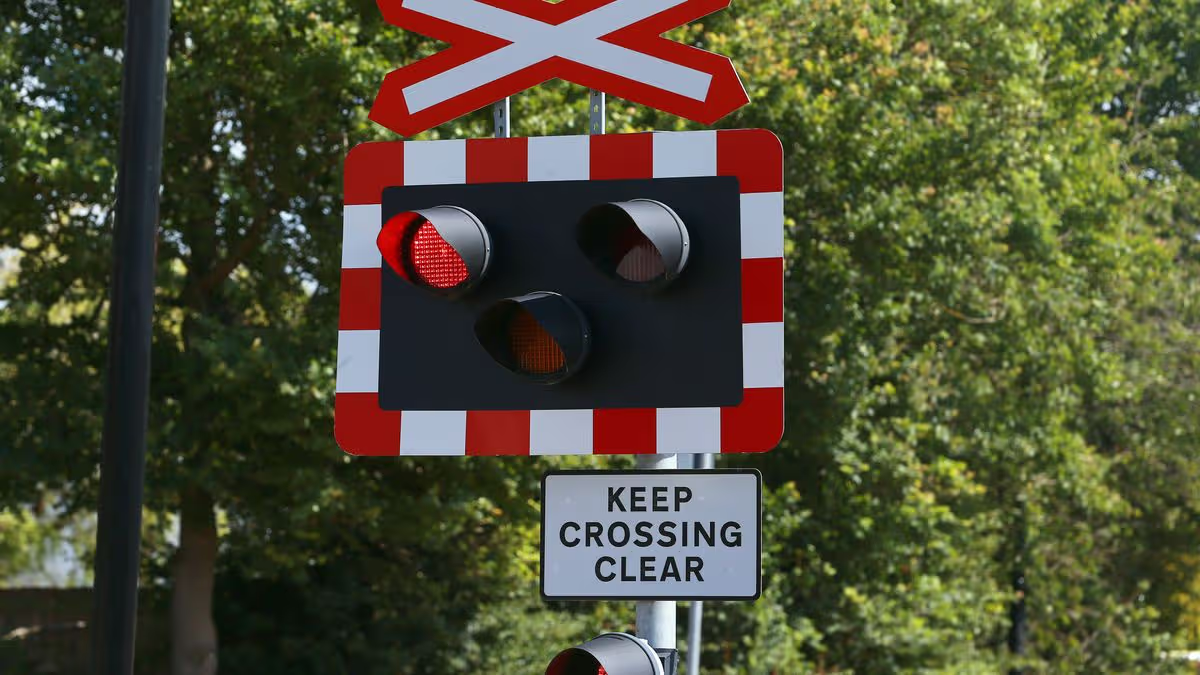
One of the most terrifying ghostly tales is at Conington level crossing near Peterborough. This has been dubbed as “Cambridgeshire’s crossing of death” and also considered “most haunted” crossing in Britain. According to local legend, the crossing is haunted by the ghost of a colonel and his dog.
It’s believed the colonel and his pet died in an accident on the crossing in the 1940s. Known as Colonel Mellows, he and his Labrador were struck by a “powerful” train at the crossing.
The story is the colonel was heading home with his friend Mr Percival. When his friend got out of the car to open the gates but while crossing, a train hit the colonel and his dog.
It’s believed the colonel and his dog were buried beside the track, and their ghosts appear now and then. People have reported hearing yelling or crying, while others have said they’ve seen a phantom car trying to use the crossing, but then disappearing.
Advertisement
There was another notable accident in the 1940s. One involved a truck, carrying German prisoners of war, which was struck by lightning. Six of the prisoners on the lorry died in the accident.
In the first half of the 20th century, it was considered an almost “impossible task” to not sustain an injury when going past the crossing. The crossing is set on a narrow road, and it has been referred to as the “most atmospheric crossing in Britain”, according to Essex Ghost Hunters.
However, vast improvements have been made to the crossing to make it much safer than it was all of those years ago.



















































You must be logged in to post a comment Login