Connect with us

NewsBeat

FAI to host Israel in Dublin in ‘sympathetic’ manner and plan to donate money to Gaza charity

Published

on

Belfast Live

FAI chief executive David Courell has spoken at length about the UEFA Nations League draw that paired Ireland with Israel, outlining security measures and charitable donation plans

Ireland is set to host Israel in Dublin on 4th October, with the aim of being as “sympathetic” as possible to the sentiments within Ireland regarding the conflict in Gaza. David Courell, CEO of the Football Association of Ireland (FAI), confirmed that a portion of the ticket sales for the match would be donated to a charity aiding humanitarian efforts in Palestine.

Advertisement

Courell faced extensive questioning about the UEFA Nations League draw that put Ireland and Israel in the same group. Nearly two weeks after the draw, he made his first comments on the issues raised by the pairing of the two nations, stating that away fans are not expected to travel to Dublin for the game at Aviva Stadium.

He highlighted the crucial role of the Gardaí in ensuring security around the fixture and addressed potential protests and any concerns FAI staff might have about the matches. Despite repeated requests for his personal stance on the situation, Courell refrained from sharing his views, asserting: “I am a football administrator, I am not a politician.”

He continued, “I am here in my capacity as CEO of the federation, and it’s incumbent on me to look at everything through the lens of football and what’s right for the interest of the Irish game, and as such I don’t think my opinion counts.”

He added, “I’m sure everybody has an opinion on this, but my personal views on this situation do not come into the decision-making process,” reports the Irish Mirror.

Security

“An Garda Síochána have been very clear that they are confident that they can deliver a safe and secure environment for this game to proceed,” Courell stated.

“And as such, we are working on the firm basis that the game will be hosted here in the Aviva Stadium.”

Protests.

Demonstrations are expected both within and around the Aviva Stadium on match day.

Advertisement

Courell commented: “We fully understand the depth of sentiment on this topic. We’ve made the decision to fulfil these games.

“With that said, we want to approach it in as sympathetic a manner as possible to make sure that, just like the Norwegian federation did quite well, I think it’s fair to say.

“They took what could have been a very challenging environment and created it into an opportunity for people to have their voices heard in a respectful and safe environment.

“That is absolutely our intent. How we execute that, how we manifest that, is something we’ll have to work through, not only with An Garda Síochána but also with UEFA.

Advertisement

“But it is our intent to try and approach this in light of the depth of sentiment in the country.

“Our desire to fulfil the games doesn’t mean that we can’t still allow our stakeholders to have their voices heard.”

Away fans

The FAI has been informed that no supporters will be travelling from Israel for the Dublin fixture, though this doesn’t rule out the presence of away supporters at the Aviva Stadium. Courell referenced the September fixture in Oslo, which went ahead despite significant calls for a boycott and demonstrations both in the city and at the venue.

“There was no travelling fans in Norway. The indication from Israel is there will be no travelling fans coming to Ireland,” said Courell.

Advertisement

“However, there were 600 to 1,000 Israeli supporters in the ground (in Oslo). They would have been made up of domestic supporters, be that from the different community groups locally.

“They were facilitated and were able to support their team, as they should, in a safe and secure environment.”

Charitable donation

Courell has committed to mirroring the Norwegian approach by pledging proceeds from the Israel home fixture to a Gaza-focused charity.

Norway welcomed Israel last September for a World Cup qualifying match and directed ticket revenue towards Doctors Without Borders.

Advertisement

Courell characterised this as being part of efforts to “approach this in as sympathetic a manner as we can.”

He continued: “That’s 100 percent within our intent. The manner and mechanism of how we do that is yet to be established. Who the recipient, charitable foundation might be, etcetera, we’ve yet to establish.

“But it is absolutely something that we are working towards.”

Advertisement

Renewed boycott pressure

The choice to proceed with the fixtures is likely to frustrate many in Irish football circles, especially given that 93 percent of the FAI’s General Assembly backed suspending Israel from international competition last November. Whilst Courell acknowledged that the Association’s leadership “heard our GA loud and clear,” he went on to say: “Whether or not we fulfil these fixtures is a decision for the board and the executive.”

He continued: “That is, within the constitution, our obligation, our role. And as such, that decision has been taken.”

He stated: “We are very happy to hear further from our General Assembly on their viewpoints. However, the decision has been taken.”

Staff welfare

SIPTU issued a statement soon after the draw expressing worries about the wellbeing of its members working for the FAI.

Advertisement

According to Courell, though, nobody within the organisation had indicated any unwillingness or hesitation to carry out their responsibilities surrounding the match.

He said: “If there are individuals that have a different viewpoint, then of course we’ll engage with them and try and understand how we can accommodate any concerns they may have.”

Potential penalties

The FAI set out in correspondence to the General Assembly, dispatched on Tuesday evening, the “tangible” penalties that UEFA might impose on the FAI.

These encompass the loss of six points, demotion to League C, and damage to Ireland’s Euro 2028 seedings and overall FIFA standings.

Advertisement

He warned that there was “every potential that there will be greater ramifications for Irish football – reputational, financial, operational.

“The reality is, we’re talking solely in the lane of the men’s national team here. But if we fail to qualify for Euro ’28, you know the financial benefit that can bring for the association and the benefit it will bring to the grassroots game and every aspect of what we do.

“So there is a big range of implications that extend beyond what we’ve included in that letter.

“But we don’t even need to go there. From a sporting perspective, it’s not within the interest of Irish football not to fulfil these games. We are fulfilling the games.”

Advertisement

The FAI are operating under the assumption that the away match will be held on neutral ground, despite the Israeli FA’s wish to reintroduce international football to Tel Aviv.

“As things stand, and UEFA reconfirmed this, the position is very clear from UEFA that there is no ability for Israel to host home games at this moment in time,” he said.

“So until that position changes, I’m not really in a position to comment on whether or not the game is in Tel Aviv. Right now we’re working on the assumption it’s not.”

Want to see more of the stories you love from Belfast Live? Making us your preferred source on Google means you’ll get more of our exclusives, top stories and must-read content straight away. To add Belfast Live as a preferred source, simply click here.

Advertisement

Click here to sign up to our sport newsletter, bringing you the latest sports news, headlines and top stories

Source link

Continue Reading
Click to comment

Leave a Reply

Your email address will not be published. Required fields are marked *

NewsBeat

Wayne Rooney watches on as son Kai and JJ Gabriel play big roles in Man United U18s win

Published

on

Manchester Evening News

Manchester United icon Wayne Rooney has previously not been allowed to watch son Kai in action for the Reds, but it appears that his ban has been relaxed

Wayne Rooney was allowed to watch son Kai in action again – but he saw the limelight stolen by one of his Manchester United team-mates against Derby County. Rooney junior has become a regular fixture for the Red’ under-18 side this season as he attempts to follow in his dad’s glittering footsteps.

Advertisement

However, it was Noah Ajayi who stole the show at Carrington, as he scored twice and also claimed an assist in his side’s 6-1 victory against the Rams. Louie Bradbury and JJ Gabriel also bagged braces as Rooney came on as a 70th-minute substitute with his side leading 4-1.

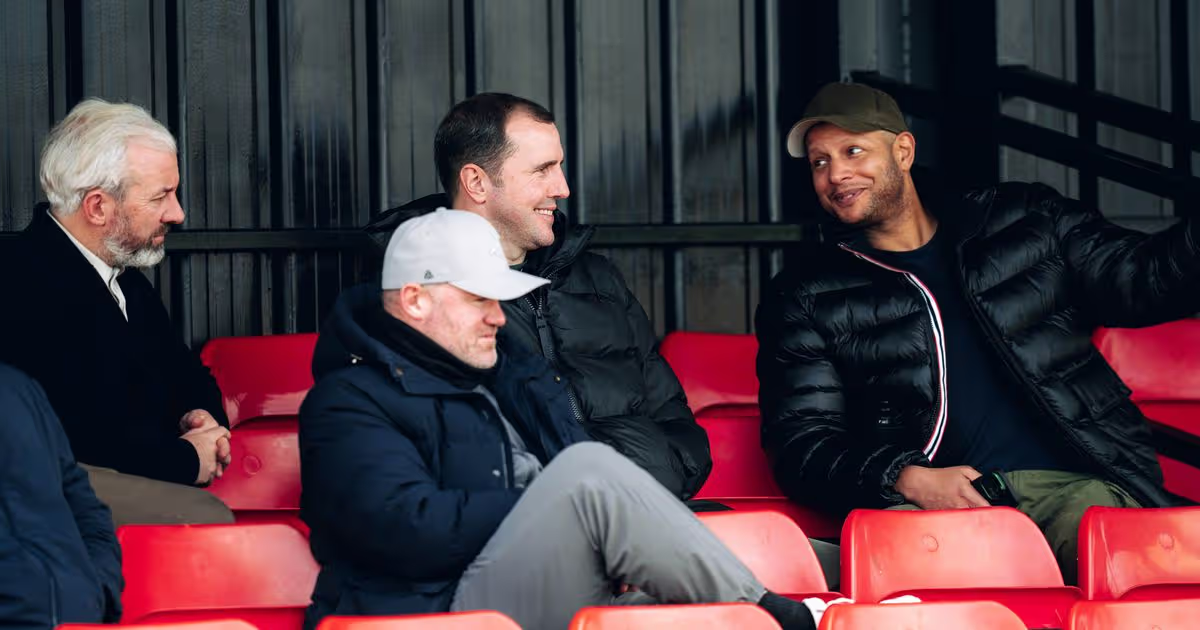
Rooney Snr was spotted watching the game in the crowd, alongside former teammate John O’Shea, while Darren Fletcher’s side were also watched by Michael Carrick and his coaching staff.

Try MEN Premium NOW for just £1

Speaking back in 2024, wife Coleen revealed Kai had told his famous father to stay away from his games due to the attention it would create.

Advertisement

“That’s the thing with kids I think, it’s hard to go on days out,” she said. “Kai told Wayne to stop coming to football games, when he played grassroots tournaments and stuff because he used to get swarmed and he couldn’t even watch the game.

“How do you say to all of these kids, ‘Go away, I’m watching my son?’ Adults, it’s different, you could speak to them. So he (Kai) just said, ‘Oh, dad there’s no point you coming because you don’t even watch me play anyway.’

“Which is sad, but it can’t be helped anyway. At the same time, the fans help you along the way and get you where you are.”

FOLLOW OUR MAN UNITED FACEBOOK PAGE! Latest news and analysis via the MEN’s Manchester United Facebook page

Advertisement

Rooney has previously offered his take on the current crop of young players at Old Trafford and claimed that more pressure was heaped upon them following the return of Cristiano Ronaldo, which saw his son play for the team.

He said: “There’s a bit more pressure on them as well. Kai and [when Cristiano] Ronaldo came back, Ronaldo’s lads and Michael Carrick’s lad were all on the same team.

“You go and watch and then all of a sudden there’s like 10 times the amount of people that’s normally there, all around the pitch watching, so there’s a lot more pressure because they’re coming to watch the three kids to see how they play and stuff. They’ve got to be ready.”

Advertisement

Ensure our latest sport headlines always appear at the top of your Google Search by making us a Preferred Source. Click here to activate or add us as a Preferred Source in your Google search settings

Sky Sports discounted Premier League and EFL package

This article contains affiliate links, we will receive a commission on any sales we generate from it. Learn more
Content Image

£49

£35

Sky

Advertisement

Get Sky Sports here

Sky has slashed the price of its Essential TV and Sky Sports bundle for the 2025/26 season, saving £336 and offering more than 1,400 live matches across the Premier League, EFL and more.

Sky shows at least 215 live Premier League games each season, an increase of up to 100, plus Formula 1, darts, golf and more.

Source link

Advertisement
Continue Reading

NewsBeat

Kristofer Davies of Darlington jailed after breaching order

Published

on

Kristofer Davies of Darlington jailed after breaching order

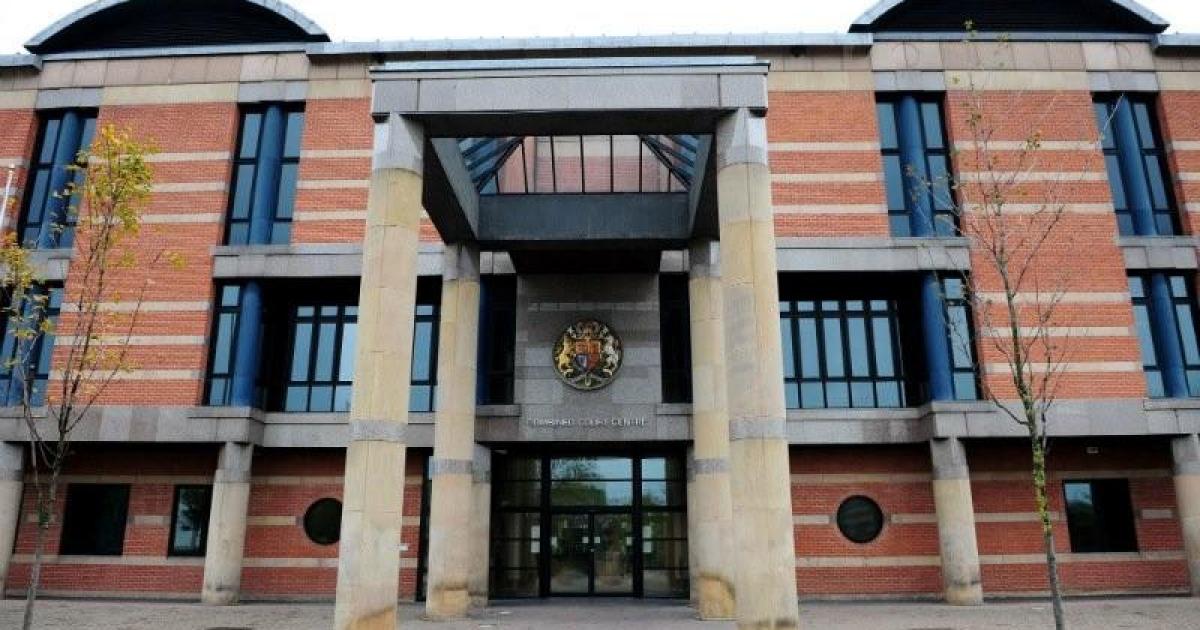
Kristofer Davies was given a suspended sentenced after he repeatedly punched his victim to the ground and continued the violence when his victim was on the floor.

Teesside Crown Court heard how the vicious unprovoked attack was caught on CCTV.

The 37-year-old was sentenced to nine-months in prison suspended for 18 months and ordered to attend 30 rehabilitation activity requirement days, carry out 150 hours of unpaid work and was subjected to a 120-day alcohol abstinence programme.

Advertisement

Nigel Soppitt, prosecuting, said an arrest warrant was issued for the defendant after he failed to attend court for breaching the terms of his suspended sentence order.

He said Davies had been offered nine appointments by the Probation Service but had only attended one of those.

The court heard how the defendant also still had around 140 hours of unpaid work to complete.

Calum McNicholas, mitigating, said his client had been struggling with settled accommodation and bereavement but was now hoping to be able to live with a relative.

Advertisement

Davies, of no fixed abode but formerly of Darlington, pleaded guilty to breaching the terms of his suspended sentence order.

Judge Aisha Wadoodi activated seven months of the order after he failed to take advantage of the chance she had offered to him in July 2024.

She said: “The court will have made it clear that if you didn’t abide by the order and do what was requested of you that the suspended sentence could be activated.”


Read more:

Advertisement

At his initial sentencing hearing, the judge heard how the trouble flared following an earlier incident at the Greyhound pub in Darlington in May 2024 which resulted in his client turning up at the door of his cousin.

Davies repeatedly punched his victim to the ground and continued the violence when his victim was on the floor.

The victim required hospital treatment but had discharged himself after a couple of days.

He had pleaded guilty to causing grievous bodily harm following the attack.

Advertisement

Source link

Continue Reading

NewsBeat

Have London house prices really become more affordable?

Published

on

Have London house prices really become more affordable?

The capital has seen the biggest improvement in affordability across the UK in the last year with the house price to income ratio dropping from 14.5, according to research by Yopa.

Source link

Continue Reading

NewsBeat

US and Iran to hold further talks as pressure for nuclear deal builds

Published

on

US and Iran to hold further talks as pressure for nuclear deal builds

Reports in US media, quoting unnamed administration officials, have suggested that Trump was considering an initial strike in the coming days on Iran’s Revolutionary Guards or nuclear sites to pressure the country’s leaders. If negotiations failed, according to the reports, the president might go as far as ordering a campaign with the aim of toppling the Iranian Supreme Leader, Ayatollah Ali Khamenei.

Source link

Continue Reading

NewsBeat

Brits warned as middle age memory loss may be accelerated by 6 sweeteners

Published

on

Daily Record

A recent study has found that there may be a link between artificial sweenters and dementia.

When it comes to having a warm cup of coffee or tea in the morning, everyone has their own preference. While some people prefer a strong brew to wake them up in the early hours, others are only able to stomach it when sweeteners are added in.

While some may think they are making a better choice for their health by adding an artificial sweetener to their drink instead of a teaspoon of sugar, a recent study has found that certain sweeteners may actually be having a negative effect on your brain in your later life.

Published in the journal Neurology, the research found that a high consumption of sugar in adults appears to have a link to an increased risk of developing dementia in your elder years, reports the Mirror. While a variety of intake levels were tested, those in the highest group equaled around “1.6 years of ageing”.

Advertisement

On top of this, another study also found that even those under the age of 60 could be at an increased risk of developing memory loss. Meanwhile, in terms of broader health, high consumption of aritificial sweeteners could have a negative impact on younger adults as well.

The study included 12,772 adults, which equated to an average age 52-years-old, who were tracked over eight years. From the research, it was found that certain sweeteners appeared to link to faster rates of cognitive decline.

Scientists in the study looked into seven different sweeteners to see what impact it would have on the brains of the participants. This included:

  • aspartame,
  • saccharin,
  • acesulfame-K,
  • erythritol,
  • xylitol,
  • sorbitol, and
  • tagatose

The research found that out of the seven sweeteners tested, only tagatose did not have a link to faster cognitive decline. At the beginning of the study, the participants were asked to fill out questionnaires about their diets. From there they were split into three groups – low, medium, and high sweetener consumption.

Advertisement

On average, the lowest group consumed around 20mg of sweetener a day, while the highest group consumed as much as 191mg in a single day.

In order to test the brain’s power, each group took cognitive tests at the start, middle and end of the study. These tests were designed to assess six cognitive functions, such as word recall, memory, and verbal fluency.

Also taking into account factors such as age, gender and blood pressure, the research showed a link between a higher consumption of six low and no-calorie sweeteners (LNCs) and the risk of dementia, especially amongst those under 60.

Participants in this group experienced cognitive decline 65 per cent faster than those in the lowest LNCs consuming groups. Meanwhile the middle group showed a 35 per cent change in comparison.

Advertisement

The paper added: “Daily consumption of LNCs was associated with accelerated decline in memory, verbal fluency and global cognition.” This effect also seemed to be stronger amongst those with diabetes.

Get more Daily Record exclusives by signing up for free to Google’s preferred sources. Click HERE

Study author Professor Claudia Kimie Suemoto explained: “While we found links to cognitive decline for middle-aged people both with and without diabetes, people with diabetes are more likely to use artificial sweeteners as sugar substitutes.

“More research is needed to confirm our findings and to investigate if other refined sugar alternatives, such as applesauce, honey, maple syrup or coconut sugar, may be effective alternatives.”

Advertisement

She added: “Low and no-calorie sweeteners are often seen as a healthy alternative to sugar, however our findings suggest certain sweeteners may have negative effects on brain health over time.” However, more tests will need to be conducted to find the cause.

The NHS states that “all sweeteners in Great Britain undergo a rigorous safety assessment before they can be used in food and drink. All approved sweeteners are considered a safe and acceptable alternative to using sugar”.

The International Sweeteners Association (ISA) further shared in a statement that said: “This research is an observational study, which can only show a statistical association, not a direct cause-and-effect relationship. The reported link between sweetener consumption and cognitive decline does not prove that one causes the other.”

Source link

Advertisement
Continue Reading

NewsBeat

Cuban soldiers kill four after opening fire on US-registered boat sparking major fears

Published

on

Manchester Evening News

American officials have sparked fears after promising ‘to do everything in our power’ in response

Cuban soldiers killed four people and wounded six others aboard a Florida-registered speedboat that had entered Cuban waters and opened fire on soldiers, the Cuban government said on Wednesday.

Advertisement

Cuba’s interior ministry issued a statement that provided few details about the shooting, but noted that the boat was roughly one mile north-east off Cayo Falcones, off Cuba’s north coast. It was unclear if any US citizens were aboard.

The government provided the boat’s registration number, but the Associated Press was unable to readily verify details of the boat because boat registrations are not public in the state of Florida.

Officials said one Cuban officer was injured, four suspects killed and six others injured. It was not immediately known what the boat and its occupants were doing in Cuban waters.

In the statement, the ministry said Cuba’s government was “safeguarding its sovereignty and ensuring stability in the region”.

Advertisement

US vice president JD Vance said late on Wednesday afternoon that he had been briefed on the incident by secretary of state Marco Rubio. He added that the White House was monitoring the situation, but declined to provide further details. “Hopefully it’s not as bad as we fear it could be,” Mr Vance said.

James Uthmeier, Florida’s attorney general, said he has ordered prosecutors to work with federal, state and law enforcement partners to start an investigation.

“The Cuban government cannot be trusted, and we will do everything in our power to hold these communists accountable,” he wrote on X.

Meanwhile, Florida Republican congressman Carlos A Gimenez decried the four killings and accused the Cuban government of murder.

Advertisement

“This regime must be relegated to the dust bin of history,” he wrote on X.

It is not unusual for skirmishes to erupt between Cuba’s coastguard and US-flagged speedboats in Cuban waters, but there have been no recent reports of passengers opening fire or being killed.

In past years, some of those US-flagged boats were laden with unidentified items headed toward the island or they were going to pick up Cubans and smuggle them into the US.

Officials with the US coastguard did not immediately respond to requests for comment. The Pentagon and the Department of Homeland Security directed questions to the US Department of State, which did not immediately respond to a message seeking comment.

Advertisement

The incident comes as tensions simmer between the US and Cuba in the wake of mounting pressure by the Trump administration.

The two countries used to collaborate on drug smuggling and other crimes but have since stopped doing so.

Source link

Advertisement
Continue Reading

NewsBeat

EU not doing enough to stop Russian shadow fleet, European Parliament president says | World News

Published

on

EU not doing enough to stop Russian shadow fleet, European Parliament president says | World News

The EU is not doing enough to stop Russia’s shadow fleet from transporting sanctioned oil, the president of the European Parliament admitted.

Roberta Metsola told Sky News’s lead world news presenter Yalda Hakim the bloc needs to cooperate more to make sure ships carrying illegal goods do not continue to sail through European waters.

“We still have to do more on the shadow fleet, with more vessels that need to be impounded,” she said.

Russia uses its shadow fleet to export large quantities of crude oil despite Western sanctions.

Advertisement

Ms Metsola said the EU had adopted 19 packages of sanctions, but needed to bring in a 20th regime to clamp down further.

Image:
The Kousai tanker in the Channel

She admitted European countries are continuing to fund Russia’s war by buying oil and gas, saying it was “unacceptable”.

“For us, any possibility for Russia to continue to wage its war against Ukraine and against Europe as a whole, by using funds that could inadvertently or overtly come from the European Union, is unacceptable,” she added.

Ms Metsola said the EU placed sanctions to prevent Russian gas from being bought inside the EU or imported via other countries in cheaper or different forms, and is edging closer to banning oil to the same extent.

Advertisement

Read more:
On the trail of Putin’s ‘shadow fleet’
Russia killed Alexei Navalny with frog poison

Asked if there was a plan to seize vessels operating in Russia’s shadow fleet, Ms Metsola said: “We have seen a lot of work, jointly, on this shadow fleet. It’s not solved yet. There are a lot of vessels that continue to operate.”

Advertisement

She said ships had been identified quickly changing their flags, changing their registration from one jurisdiction to another “in an illegal manner” – but admitted “we need to be faster”.

“I think we are doing well, but we need to do better,” she said.


Sky News hunts Russia’s shadow fleet

Sky News tracked dozens of Russian tankers loaded with sanctioned oil sailing between Britain and France.

Advertisement

The vessels carrying Russian oil worth around $100m (£74.1m) cruised through the Channel in defiance of Western sanctions.

Tankers the Rigel, the Hyperion and the Kousai were followed from the Gulf of Finland, where they had been loaded with oil at Russian Baltic ports, as they passed the narrowest point of the Dover Straits.

These ships were part of a “shadow fleet” of up to 800 vessels that kept the oil revenues funding the war in Ukraine.

This week marked the fourth anniversary of Vladimir Putin’s full-scale invasion of Ukraine.

Advertisement

Peace talks between negotiators from Russia, Ukraine and the US are being held in Abu Dhabi.

Source link

Advertisement
Continue Reading

NewsBeat

Grand Welsh mansion is hosting free family events for St David’s Day

Published

on

Wales Online

There’s a packed weekend of stories of Wales with live music, traditional crafts, a family trail, and delicious Welsh food at this mansion house

Advertisement

We love a historic manor house and luckily there are plenty of grand abodes to visit in Wales, including a beautiful property in Newport that’s open to the public.

Cared for by the National Trust, Tredegar House is one of the architectural wonders of Wales and one of the most significant late 17th-century houses in the British Isles.

Situated on 90 acres of glorious gardens and parkland the delightful red-brick house provides an ideal setting for a family day out.

This weekend you can visit Tredegar House for free St David’s Day celebrations. Join the Tredar House team for a packed weekend of stories of Wales with live music, traditional crafts, a family trail, and delicious Welsh food, funded by the Welsh Government.

Advertisement

Some of the free events and entertainment over the weekend include Love Spoon Clay Craft, Sally’s Angels Choir, Welsh Folk Dancing, harpist Loraine Lutman, bilingual storytelling with Christine Watkins, and Border Lacemakers.

This event and access to the parklands are free but there is an admission charge to step inside the mansion house and gardens. A family ticket (two adults and up to three children) costs £38.50 and dogs are welcome almost everywhere on a lead.

It’s worth visiting the mansion house and gardens to learn more about the property and the family that lived there.

Advertisement

According to the National Trust the large house was home to one of the greatest Welsh families, the Morgans, later Lords Tredegar, for more than 500 years.

At the end of the 18th century the Morgan family owned more than 40,000 acres in Monmouthshire, Breconshire, and Glamorgan. Their lives affected southeast Wales socially, economically, and politically and also influenced the area’s heritage. Never miss a Newport story by subscribing to our newsletter here

In 1951 Tredegar House, with most of its contents and surrounding estates, was sold to the Catholic Church. It was first used as a convent school and later became a comprehensive school.

Advertisement

For more than 20 years,Tredegar House served as a school until 1974 when Newport City Council bought it. In 2012 the council leased the house to the National Trust, which now cares for its historic buildings, unusual gardens, and vast parkland.

Since then Tredegar House has been restored and re-furnished with many original pieces.

Today its historic walls feature portraits of the family and the rooms are dressed to reflect different points in the house’s history, from the late 17th century to the 1930s.

Step inside and you can wander through the 17th-century rooms, which feature fine oak panelling with exceptional carving and ornate plasterwork, moulding, and gilding.

Advertisement

In the glistening Gilt Room, you can look up at the only surviving 17th-century plaster ceiling. Visit the New Parlour where you can play games, create your own stories with shadow puppets, or even dress up as one of the Morgans.

Then there are the oak panel carvings in the Brown Room where you should look out for serpents, lions, griffins, and weird and wonderful creatures.

In the Great Kitchen you can imagine all the work that went into preparing one of the many Morgans’ lavish feasts. You can also take a peek at 1930s bedrooms including the Best Chamber, which has the best views of the whole estate.

Advertisement

One of the biggest draws, though, is the vast parklands and gardens, which include sweeping lawns, towering woodland, orchards, and an ornamental lake.

The largest of the three gardens, the Orchard Garden, is worth a wander and has a bountiful orchard full of apple trees and a hidden pathway.

This eye-catching Orangery Garden is bordered by topiary, and the sweet scents of citrus and pear blossoms are available to enjoy as you wander.

For kids the shaded woodland is popular for hide-and-seek while the lake is home to swans, grebes, moorhens, and ducks.

You may fancy a wander down Oak Avenue, stretching out from the 17th-century house gates and over the crest of the hill towards Ruperra Castle, once a summer home of the Morgan family. Dogs are also welcome.

There’s also a second-hand bookshop where you can browse a selection of donated books and it’s also possible to visit the charming Brewhouse café.

Originally the home of the Morgan family’s horses the building was later transformed into a brewery for the Morgans.

Advertisement

Seasonal and locally-sourced menus are freshly prepared daily and all profits go back into conserving Tredegar House.

For more information about the free events visit the website.

Source link

Advertisement
Continue Reading

NewsBeat

T20 World Cup: Sri Lanka out after collapsing to heavy defeat by New Zealand

Published

on

Fernando Alonso driving the 2026 Aston Martin during testing in Bahrain

Co-hosts Sri Lanka are out of the T20 World Cup after collapsing to a 61-run defeat by New Zealand in Colombo.

Needing to win to keep their semi-final hopes alive, Sri Lanka looked to be in control late into the New Zealand innings, having restricted them to 98-6 after 16 overs.

However, the bowlers crumbled in the face of a late surge from Mitchell Santner (47 from 26 balls) and Cole McConchie (31 not out from 23) and New Zealand bludgeoned 70 from the final four overs.

A chase of 169 left the game in the balance but Sri Lanka’s top order folded, with fast bowler Matt Henry taking two wickets in the powerplay.

Advertisement

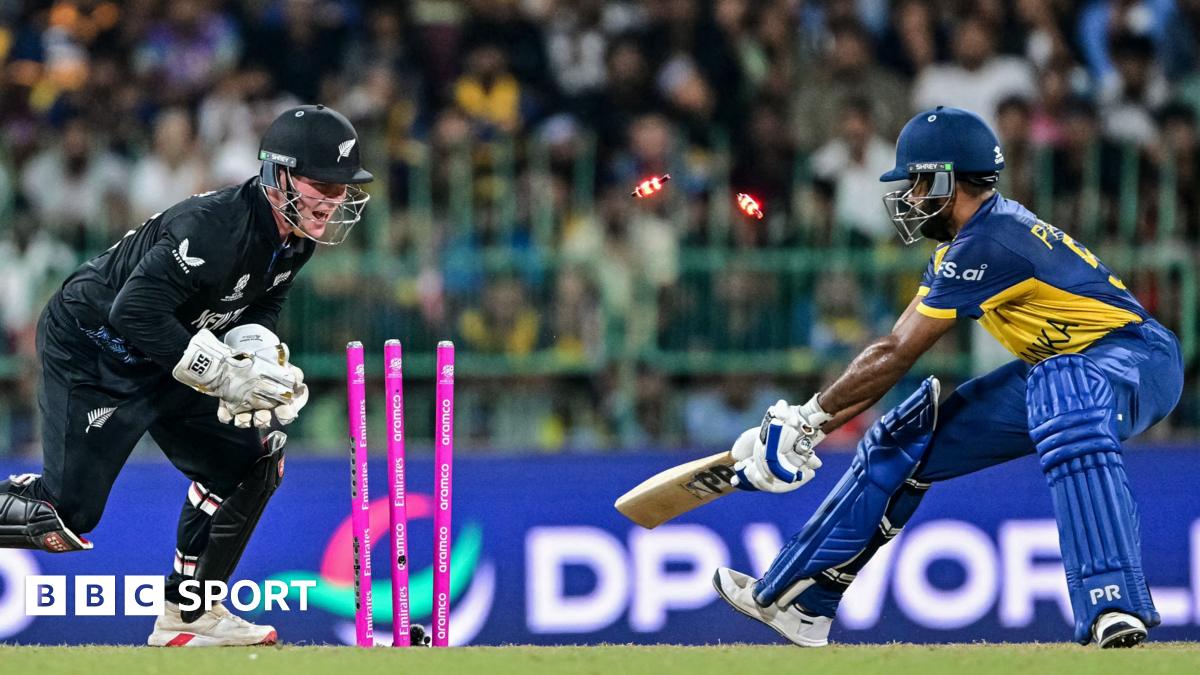
From there, the home side failed to generate any momentum and when Rachin Ravindra had both Kusal Mendis and Pavan Rathnayake stumped in the ninth over, Sri Lanka were 29-4 and the game was up.

Left-arm spinner Ravindra, who made 32 from 22 with the bat, took a further two wickets to end with figures of 4-27, while Henry was afforded the rest of the night off after taking 2-3 from his two overs as Sri Lanka dragged themselves to 107-8.

After losing to England in their opening Super 8s game, Sri Lanka depart with a whimper while New Zealand remain in contention to reach a fifth T20 World Cup semi-final.

For much of the first innings, though, Sri Lanka’s bowlers looked like being the match-winners, with spinner Maheesh Theekshana taking 3-9 from his first three overs and fast bowler Dushmantha Chameera also impressing.

Advertisement

They led the way as New Zealand slumped from 75-2 to 84-6 in less than three overs.

But Sri Lanka failed to finish the job and McConchie began the fightback before his captain took over with a brutal display of hitting, dismantling a suddenly fragile Sri Lanka attack, in a stand of 84.

It took New Zealand to a competitive total that, ultimately, proved more than good enough as the spinners took over and Sri Lanka fell apart.

Both sides have one Super 8s game remaining. New Zealand can seal their place in the semi-finals with victory over England on Friday, while Sri Lanka face Pakistan in Pallekele on Saturday.

Advertisement

Source link

Continue Reading

NewsBeat

The three big challenges facing Ukraine when the war ends

Published

on

The three big challenges facing Ukraine when the war ends

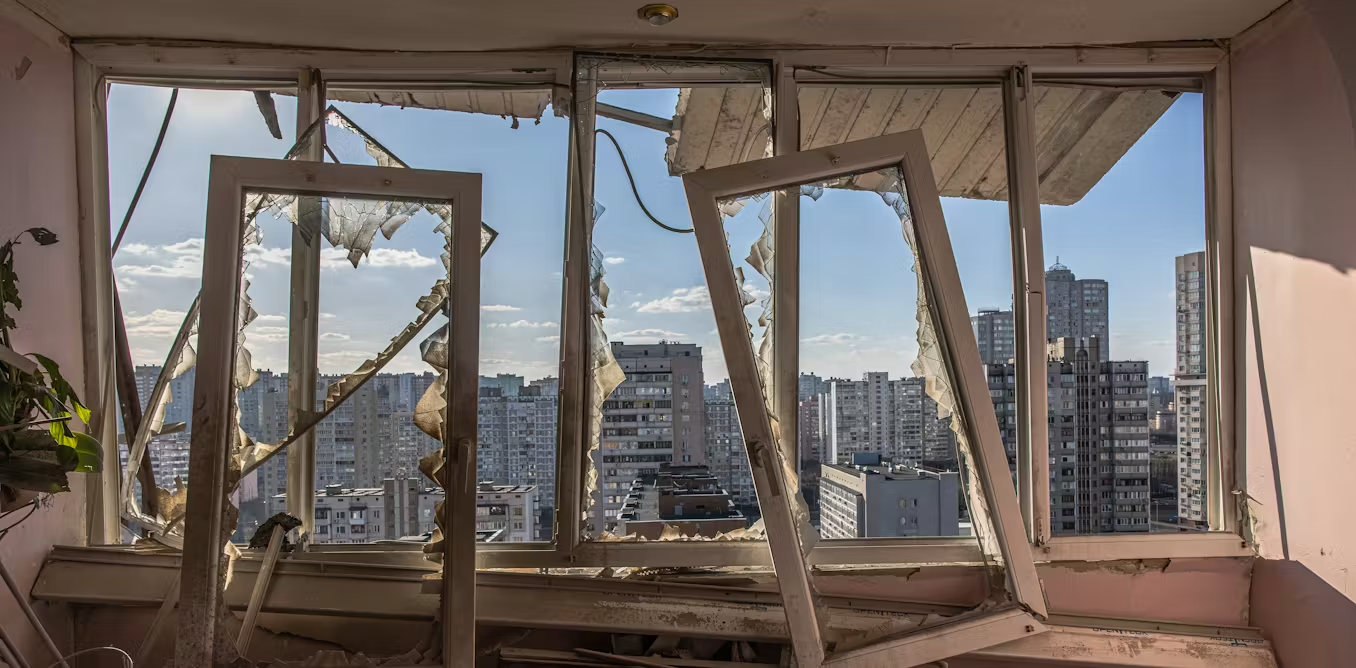
Russia’s war in Ukraine is now in its fifth year and, despite the growing impatience of Donald Trump, a breakthrough in peace talks looks a long way off. Yet even when the fighting does end, it will not represent a conclusion. Rather, it will mark the start of a considerable new challenge: reconstruction.

The crucial questions are not only how much reconstruction will cost, but also how it can be financed and whether Ukraine will have the skilled workforce needed to carry it out. Millions of Ukrainian citizens have left the country since the start of the 2022 invasion.

A further test will be whether Europe, which became Ukraine’s largest provider of military and financial assistance in 2025, can maintain the political unity needed to see reconstruction financing through in the long term.

1. Closing the funding gap

Ukraine’s reconstruction needs are enormous. According to figures released by the World Bank on February 23, the total cost of reconstruction and recovery in Ukraine will be around US$588 billion (£435 billion) over the next decade. This will only rise as the war drags on.

Advertisement

In an attempt to meet this figure, Ukraine and its allies are seeking to mobilise private capital. This has involved Ukraine’s parliament adopting a new public-private partnership law in June 2025 to incentivise private-sector participation in the reconstruction of economic sectors such as energy and transportation.

A war-risk insurance mechanism was also rolled out that year. Supported by the European Bank for Reconstruction and Development, it provides private companies that invest in Ukraine’s reconstruction with protection against war-related damages.

However, irrespective of these developments, the level of investment in Ukraine is likely to fall far short of what the country requires. In 2024, Ukraine attracted roughly US$3 billion of foreign direct investment, with reinvested profits making up the largest proportion. Data published by Ukraine’s central bank suggests this figure will drop in 2025.

A foreign investor sentiment survey from 2025 found that only 49% of members of the Global Business for Ukraine and the European Business Association, two groups of international companies focused on supporting and rebuilding Ukraine’s economy, are actually investing in the country. Nearly 70% of those surveyed cited the volatile security situation, which is likely to continue after the war, as the main barrier to investment.

Advertisement

Nearly 50% of those surveyed pointed to corruption, policy uncertainty and weak institutional capacity as barriers, while 34% voiced concerns about the strength of the rule of law. These are governance challenges that predate Russia’s 2022 invasion.

Ukraine’s ability to attract more private investment after the war will thus not only depend on the terms of the peace deal. It will also depend on how effectively the country manages to strengthen its institutions.

Private capital will play a role in Ukraine’s reconstruction. But its flows are far from guaranteed. So the donors and financial institutions that have sustained Ukraine throughout the war, such as the World Bank, International Monetary Fund and the European Investment Bank, will probably have to play a leading role in financing Ukraine’s longer-term recovery.

2. Encouraging Ukrainians to return

Nearly 6 million Ukrainians remain displaced abroad as a result of the war. There is no guarantee that these people, many of whom have spent years integrating into the labour markets and education systems of their host countries, will choose to return to Ukraine when the hostilities end.

Advertisement

Labour shortages, both skilled and unskilled, are one of the key challenges currently facing companies in Ukraine. And foreign investors have also cited labour availability as an important factor influencing their decision about whether to invest in the country’s reconstruction.

Encouraging Ukrainians to return voluntarily will require more than patriotic appeals: it will depend on there being viable employment prospects, functioning public services and credible security guarantees in place to prevent a resumption in the conflict.

Ukrainian refugees approach the border with Slovakia in the early days of Russia’s full-scale invasion.
Yanosh Nemesh / Shutterstock

The Ukrainian government has begun taking steps to maintain connectivity with the diaspora. This has included opening so-called “unity hubs” aimed at sustaining ties with the refugees and facilitating their voluntary return. One such hub opened in Berlin in 2025.

Ukraine’s authorities are also developing a portal designed to connect refugees with employment and business opportunities at home. However, these initiatives remain in their early stages and uptake remains to be seen.

Advertisement

Without the return of refugees, Ukraine risks developing a structural skills deficit. Such a shortfall could deter private investment in the country’s reconstruction and lead to a reliance on external labour.

3. European political commitment

There is also a political dimension to the challenges associated with reconstructing Ukraine. Sustaining long-term support for the country’s reconstruction may become more complicated amid shifting political dynamics across Europe.

The consensus among European countries on supporting Ukraine has largely held. But upcoming parliamentary and presidential elections in France, Italy, Denmark and elsewhere in 2026 and 2027 could shift the balance of power in key allied countries.

The elections are, at the very least, likely to absorb political attention and divert focus from unresolved questions. These include questions around the use of frozen Russian assets to finance Ukraine’s reconstruction, where agreement remains elusive.

Advertisement

Signs of fracture are also beginning to emerge. The EU has looked to push through a €90 billion loan to cover Ukraine’s needs for 2026 and 2027. Three countries – Slovakia, the Czech Republic and Hungary – abstained from the deal over the closure of an important oil pipeline in Ukraine. And Hungary now appears to be holding up the loan.

Reconstruction will be a test of political endurance as much as financial capacity. The question that will arise after any peace deal is reached is not only how to fund Ukraine’s recovery, but whether its allies can sustain the political consensus required to do so over time.

Source link

Advertisement
Continue Reading

Trending

Copyright © 2025