

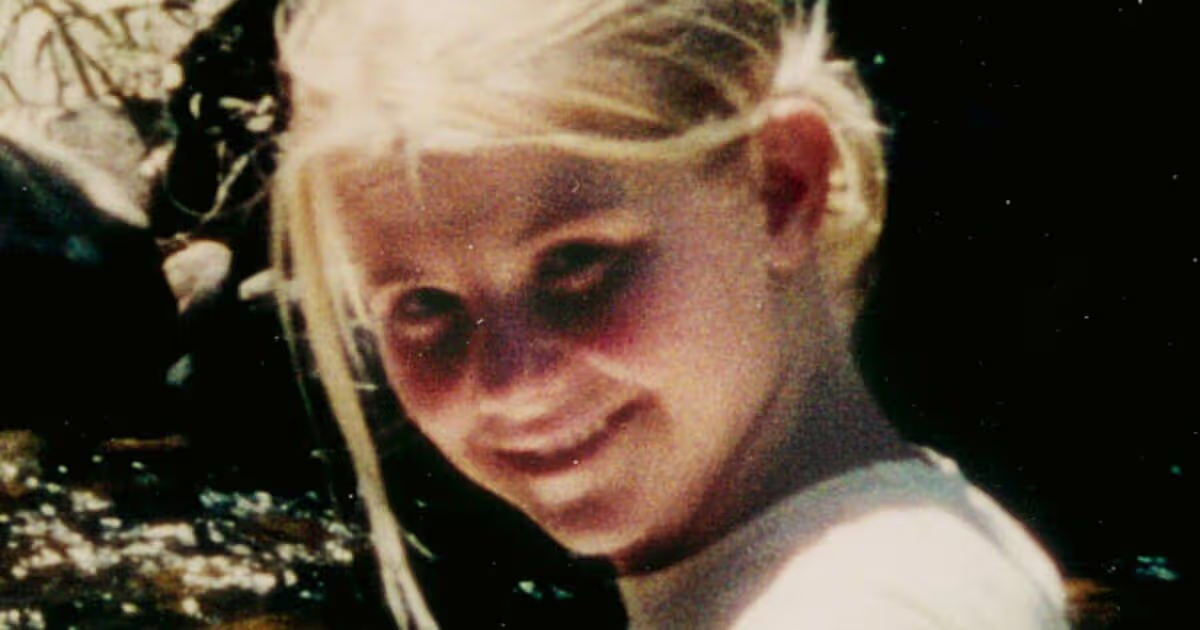
These true crime documentaries are much better than Netflix’s latest
Documentaries can offer substantial insight into the lives, crimes and untold stories behind some of the biggest headlines worldwide, whether they’re examining the past or exploring current affairs. The market has become saturated with stories, particularly when it comes to true crime.
Netflix’s Kidnapped: Elizabeth Smart is no exception to this rule. The streaming platform continues to captivate viewers with almost unbelievable stories and a stereotypical, predictable twist that leaves people craving more.
That’s how they draw you in each time they promote a new, never before told story. Elizabeth’s story concerns a teenage girl snatched from her bedroom at knifepoint in Salt Lake City, Utah, back in 2002.
The case is described by Netflix as “one of the most intense and widely covered missing-persons cases America has ever seen”, and whilst that may hold true across the Atlantic, it doesn’t quite resonate in the same way over here.
It’s a story told in her own words; the ending being spoiled across the numerous adverts plastered on the streets of London. The first half of the documentary would have you believe the worst had happened, but the revelation of a middle-aged Elizabeth recounting her experience living off-grid in captivity makes the entire story even more unbelievable, though not in a mind-blowing way.
In truth, once the twist was unveiled, the documentary never really gained momentum or suspense. Instead, it followed the same pattern as many other Netflix documentaries. The case of Elizabeth Smart will, regrettably, be consigned to the pile of documentaries that caused a ripple, not a wave.
This isn’t the case for all documentaries, as some continue to leave a lasting impression on me years later. Documentaries need to stir you, to provoke you, to make you question the very fabric of society.
They don’t need to be packed with twists and turns purely for the sake of shock value.
Unknown Number: The High School Catfish (2025)
One recent Netflix documentary that hits the mark is Unknown Number: The High School Catfish, which focuses on a teenage couple terrorised by a troll at the end of a phone line. It all started with a text message.
The relentless torment of Michigan high school students Lauryn Licari and her ex-boyfriend, Owen, led to an investigation that pointed to a multitude of potential suspects. Classmates, friends, even family members are drawn into the spotlight.
For this small town, it was a real-life whodunnit. The abuse hurled at the teenagers goes beyond simple bullying, with death threats, sexually explicit messages and horrific rumours lurking around every corner. The youngsters’ lives were deeply affected, as they recount the events as 18 year olds.
The most shocking part? The identity of the person behind those messages. I won’t ruin the surprise, but be prepared for your eyes to bulge and your jaw to drop.
You’ll never view an anonymous text message in the same light again.
The Keepers (2017)
In a similar vein to Netflix’s Making a Murderer, The Keepers delves into the unsolved murder of nun Catherine Cesnik in 1969.
Her former pupils suggest there was a cover-up by authorities after Sister Cathy suspected a priest had sexually abused students at Baltimore’s all-girls Archbishop Keough High School.
Now adults, the former students share their experiences at the Catholic school with those in positions of power there and within the local church, including sexual abuse, intimidation, and one student even witnessing the body of a deceased nun.
The Keepers transitions from the disappearance and murder of the nun to the concealment of abuse perpetrated by prominent members of the Catholic church, and the survivors’ ongoing battle for justice decades after the crimes. For true crime enthusiasts, sadly, there is no definitive answer as to what happened to Sister Cathy, but perhaps one day there will be.
Blackfish (2013)
There’s an old adage about not interfering with nature, and that extends to the animal kingdom. Blackfish examines the captivity of Tilikum, an orca implicated in three fatalities, including that of SeaWorld trainer Dawn Brancheau, and explores the ramifications of confining orcas in such environments.
The film reveals the circumstances surrounding Tilikum’s capture back in 1983, the treatment marine creatures endured at various marine parks, and the orca’s interactions with trainers and other orcas. It’s essential viewing, though not suitable for those easily disturbed.
This documentary will make you reconsider ever visiting or financially supporting SeaWorld again.
When Louis Met… (2000) & Louis Theroux, Savile (2016)
Having established himself as a familiar face over the decades, Louis Theroux launched his documentary career with his Weird Weekends, immersing himself in the lives of others. He explored an array of unconventional and controversial subcultures, crime and the justice system, and celebrities.
Louis’ awkwardness is also his charm, something audiences have grown accustomed to witnessing over the years. Brits will appreciate his idiosyncrasies and intellect.
His most notorious work involves his encounters with former “childhood hero” Jimmy Savile, a story he revisits 16 years after his initial documentary with him.
The first documentary examined Savile’s ascent to stardom as a TV and radio presenter, alongside his domestic life. Whilst Theroux briefly touches upon the allegations of paedophilia and sexual abuse, Savile dismisses them with laughter.
It wasn’t until 2012 that the world was made aware of the true scale of Savile’s offences, exposing a host of predatory individuals in the aftermath of Operation Yewtree. In his 2016 film, Louis revisits his past association with Savile and converses with some of Savile’s victims and those who worked closely alongside him.
Given our current knowledge, it’s challenging to look back and not see the rumours as glaringly evident. How? Who? Why? For how long?
One is almost at a loss for words contemplating how a public figure, swamped with these types of allegations, was permitted to continue, and who was shielding him. The 2016 documentary prompts not only Louis but an entire generation to question what they believed they knew.












































You must be logged in to post a comment Login