The move follows O&H Vehicle Conversions Ltd of Goole entering administration earlier this month.
The company, which was founded in 1988, produced vehicles including rapid response vehicles for the police, NHS ambulance services and private ambulance operators.
A statement by administrators BDO LLP said O&H Vehicle Conversions had faced financial pressures affecting the wider vehicle conversion industry and had recently suffered from delivery delays which further impacted income and cashflow.
Advertisement
RECOMMENDED READING:
As a result, the directors were left with no alternative but to place the company into Administration, they explained.
Following a marketing process prior to the appointment of Administrators, a solvent going concern sale was not possible.
As a result, all operations have now ceased and 157 employees have been made redundant with immediate effect.
Advertisement
Mark Thornton, one of the Joint Administrators said: “It is always a sad day when a longstanding business is forced to close. Given the financial position and outlook for the Company, securing a sale of the business as a going concern was not possible.
“The priority of the Joint Administrators will now be to support employees impacted by the closure and realise assets in line with our duties in order to maximise the return for creditors.”
As the Press reported recently, company bosses said they did all they could to find a rescue deal for O&H Vehicle Conversions.
O&H managing director Mark Brickhill said: “In 2025, we delivered a record 227 NHS Emergency Double Crewed Ambulances (DCAs), up from 186 in 2024, whilst also growing and diversifying the business with a £19 million turnover.
Advertisement
Mr Brickhill explained OHVC had suffered delays in the delivery of chassis, delaying £2.2million of planned and achievable sales in recent months.
The company switched towards Rapid Response Vehicle (RRV) production for both the Ambulance and Police Services, but delayed production caused by retraining staff and the lower margins such vehicles deliver, did not bridge the financial gap caused by the chassis delay.
The aircraft hit a restaurant in a built-up neighbourhood, but before the venue was open
Four people have died after a plane smashed into a restaurant and went up in a ball of flames in Brazil.
Firefighters have confirmed the pilot is among the victims along with three other people travelling on the light aircraft, including a couple.
The dramatic accident happened just after 10.30am local time this morning as the Piper Malibu descended on approach to Capao da Canoa Airport in the southern Brazilian state of Rio Grande do Sul.
The restaurant in a built-up residential area was still closed at the time of the crash, limiting the number of people hit on the ground.
Advertisement
The plane hit a building with a restaurant and a shop in the southern Brazilian state of Rio Grande do Sul
There were no immediate reports of any casualties on the ground, although the astonishing footage of the crash showed a man on foot appearing to run for his life as he saw the plane come down and another couple sprinting away from the scene as they too came close to being hit.
Aeronave monomotor turboélice Piper Mirage Malibu (Jetprop) colide com casas durante aproximação em Capão da Canoa (RS) na manhã desta sexta-feiraAinda sem informações confirmadas de vítimas @OnDisasterspic.twitter.com/KlNoKzpVz4
Footage from the scene showed flames leaping from the top of the building the plane hit and a black plume of smoke rising high into the air.
Local reports said it had collided with a pole near the end of the runway before crashing. It had flown in from Sao Paulo.
Advertisement
Locals living in houses near the restaurant were evacuated to safety. Rio Grande do Sul state governor Eduardo Leite said on X: ‘I have been following, since the very first moments, together with the security forces, the full mobilisation in responding to the incident involving the crash of a small aircraft in Capao da Canoa, unfortunately with confirmed fatalities.
‘The accident area has already been evacuated by Civil Defence.’
The horror plane crash occurred less than 24 hours after four people died when a light aircraft smashed nose-first into a field near an industrial estate close to the city of Puebla in central Mexico.
The spokesperson for the Civil Defence service, Sabrina Rimas, said: ‘We managed to immediately evacuate the people from the properties next door, so all the residents left without injuries.
Advertisement
‘This aircraft crashed into a restaurant that was closed, and next to it we have a shop that was also closed.
‘Firefighters were mobilised immediately and the first teams arrived shortly afterwards to tackle the blaze.
‘The Military Brigade also arrived soon after and secured the area for the safety of passers-by.’
Nuchi Nashoba grew up looking at a photograph of her great-grandfather Ben Carterby inside her grandmother’s Oklahoma home. But, she didn’t know much about the man in the frame other than that he was a World War I veteran.
It wasn’t until 1989 — when Nashoba was in her late 20s — that she learned a deep secret about her ancestor.
Carterby was one of the Choctaw code talkers — a group of 19 Native American soldiers who used their language to transmit encrypted messages to the Allies during campaigns in northern France. The soldiers were sworn to secrecy and hid details of their service from families for decades.
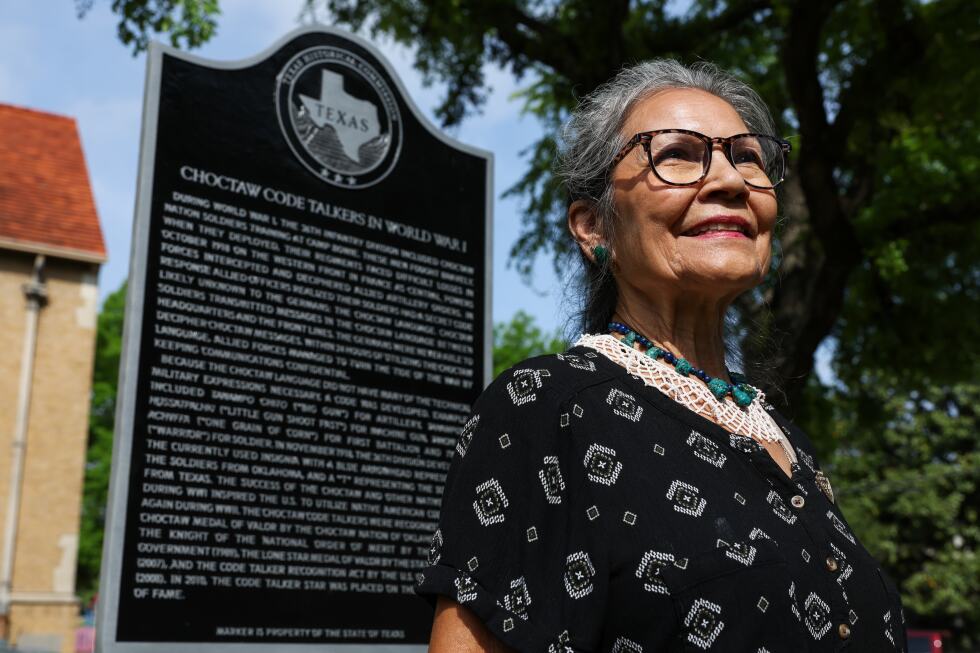
Over the past 20 years, Nashoba has led advocacy efforts to spotlight the group’s hidden legacy as president of the Choctaw Code Talkers Association. Now, the soldiers’ contributions are recognized in Fort Worth through a new plaque at the city’s Veterans Memorial Park.
Advertisement
The Choctaw Code Talker Historical Marker was unveiled during an April 1 ceremony hosted by the Oklahoma tribe, the Texas Historical Commission and the city’s parks and recreation department. Several descendants of the Native soldiers attended.
“Seeing the marker really brings me a lot of joy,” Nashoba said. “This is what preserves the history for generations to come.”
Choctaw code talkers’ ties to Fort Worth
Members of the Choctaw code talkers were men who volunteered to fight for the U.S. in World War I at a time when Native Americans were not recognized as citizens. Indigenous communities wouldn’t receive citizenship until 1924.
While in the battlefields in France, some of these men were overheard speaking their Choctaw language and were trained to use their words as “code.” They were placed on front lines and command posts so that messages could be transmitted to headquarters.
Advertisement
The soldiers shared words like “tanampo chito” for artillery and “tvshka” for warriors, according to the historical marker. The Germans famously failed to decipher these Choctaw transmissions within 24 hours throughout the war.
“Their story is a testament to the resilience and patriotism of the Choctaw Nation,” Col. Brent Kemp, commander of the 56th Infantry Brigade Combat Team of the National Guard, said at the unveiling. “Their ingenuity and bravery reminds us of the power of cultural heritage and the importance of preserving Indigenous languages.”
The Native American soldiers were in the 36th Infantry Division at Camp Bowie, a westside training site for more than 100,000 soldiers during World War I.
Advertisement
Council member Macy Hill, who represents Camp Bowie, said it was only fitting for Fort Worth to honor the legacy of the code talkers since they walked on the site’s grounds.
“This is where the Choctaw code talkers were initially trained and where they will forever be remembered,” she said.
Descendants carry the torch
As Ta’Na Alexander — the great-great-granddaughter of Carterby — watched the marker’s unveiling in Fort Worth, she couldn’t help but feel proud that her family’s history is slowly spreading across the U.S.
“It’s pretty monumental to realize that more people are starting to recognize the significant part of these men who were sworn to secrecy,” said Alexander, who is Nashoba’s daughter. “This marker connects the past to the future.”
Advertisement
She credits her mother’s leadership for widespread education about the work of Native soldiers.
Last May, the Choctaw Code Talkers Association led the charge to place a bronze sculpture honoring the group at the Choctaw Cultural Center in southern Oklahoma. The artwork depicts three soldiers in the middle of battle.
The Fort Worth marker was the group’s first venture into Texas, Nashoba said. The group is exploring other statewide recognitions, she added.
Advertisement
For now, Alexander invites Fort Worth residents to stroll through the memorial park to learn that her ancestors’ stories aren’t just about being Native. They’re about what it means to be American, she said.
“You might not be Native or Choctaw, but what we do share in common is that we have the right to vote,” she said. “We have a voice. We have a freedom that exists here that doesn’t exist anywhere else.”
___
The Fort Worth Report’s arts and culture coverage is supported in part by the Meta Alice Keith Bratten Foundation and the Virginia Hobbs Charitable Trust. At the Report, news decisions are made independently of our board members and financial supporters. Read more about our editorial independence policy here.
Advertisement
___
This story was originally published by Fort Worth Report and distributed through a partnership with The Associated Press.
BBC Verify has confirmed a video showing a plane accompanied by two helicopters flying over southern Iran as a search and rescue operation is carried out for the crew of an American jet.
We have confirmed the video was filmed in Khuzestan province, near a bridge over the Karun river, at this location: 31.591393, 50.275430.
The footage appears to show US military aircraft that are used in combat search and rescue, according to former senior military officer Mikey Kay, who hosts the BBC’s Security Brief programme.
The video has been checked for recency and for signs of AI manipulation.
Microdosing GLP-1 drugs for weight loss is growing in popularity among Americans looking to save a little money or reduce gastrointestinal side effects.
Some 12 percent of American adults are using GLP-1s, which started out as diabetes drugs before the weight-loss market took off in 2021. One in seven people using GLP-1s are microdosing the medications, a 2025 survey from health tracking app Evidant found.
Microdosing has been promoted by some telehealth companies like Noom, with actress Rebel Wilson acting as spokesperson for the brand. “I felt amazing, I looked amazing,” Wilson told USA Today last September about Noom’s microdose GLP-1.
But a recent warning from Novant Health, a hospital group that serves 6 million patients, warned that smaller GLP-1 doses carry risks for users. Novant also says that microdosing isn’t even that effective.
One in seven Americans are microdosing GLP-1 class weight-loss drugs to save money or reduce side effects. Celebrities like actress Rebel Wilson have promoted microdosing – but some doctors say it can be dangerous (Getty Images for 21Seeds Infused)
‘A random unknown drug’
Doctors typically prescribe U.S. Food and Drug Administration-approved GLP-1 drugs for patients to use once a week. Patients often start with small doses of a quarter of a milligram but doctors can prescribe a range of doses, depending on weight loss needs.
Drugmakers are currently testing doses of up to 20 milligrams of semaglutide, the active ingredient in Ozempic and Wegovy, to take weekly.
But several telehealth companies, including Noom, say microdosing can help patients who want to spend less money than paying out of pocket for larger doses and still lose weight.
Advertisement
Microdoses of GLP-1s – created by taking FDA-approved drugs and splitting them into smaller doses – are dubbed “compounded drugs.” These are custom-made by licensed pharmacists who sell them over the counter and for telehealth companies online.
The FDA is taking action to limit the use of compounded GLP-1s. Companies marketing the microdoses are only allowed to make the compounded versions when there is a shortage of FDA-approved GLP-1s, the agency said Wednesday. There is no shortage right now.
Noom, arguably the most prominent telehealth company selling microdoses of GLP-1, uses semaglutide as its active ingredient. The Independent has contacted Noom for comment.
Drugs not produced in a sterile environment can lead to bacterial infections. Measurement errors are possible when splitting doses, and may lead to an accidental overdose. Brown Health says there was a nearly 1,500 percent increase in calls related to accidentally overdosing on injected weight loss drugs in 2023.
“I don’t recommend using compounded versions of these medications because they’re untested – both in their effectiveness and their safety,” Dr. W. Scott Butsch, the Director of Obesity Medicine in the Bariatric and Metabolic Institute at the Cleveland Clinic, said.
The drugs may also come with undisclosed or even dangerous additives that can interact with other medications or health conditions, obesity medicine doctor Dr. John Cleek, of Novant Health General Surgery & Bariatrics – Mount Pleasant, said last month. GLP-1s at any dosage can change how some blood thinners and hormonal birth control affect the body.
“Most people usually aren’t okay with injecting themselves with a random unknown drug,” Cleek said. “But that’s essentially what you’re doing if you use a compounded GLP-1 drug.”
Advertisement
‘Lifestyle first’
The wider problem with microdosing is that weight-loss benefits don’t outweigh the risks, doctors say.
That’s especially true for people trying to lose less than 5 percent of their body weight, Dr. Katy Williams, a bariatric medicine specialist at University of Missouri Health Care, said in a statement.
‘Work on your lifestyle first. Your doctor or a weight loss specialist will absolutely be able to find places where you can make meaningful lifestyle changes that can result in five to 10 pounds of weight loss,” one doctor said (Getty Images for IRONMAN)
“Work on your lifestyle first,” she said. “Your doctor or a weight loss specialist will absolutely be able to find places where you can make meaningful lifestyle changes that can result in five to 10 pounds of weight loss.”
Microdosing to reduce side effects, like nausea and vomiting, is also ineffective, said Butsch. These symptoms typically improve over time but doctors can recommend changes in diet or anti-nausea medication.
Advertisement
“If you take a reduced dose, you run the risk of the drug disappearing from your system faster than intended,” he said. “And when you take it again, you’re going to have that side effect again because there hasn’t been a steady amount of the medication in your system.”
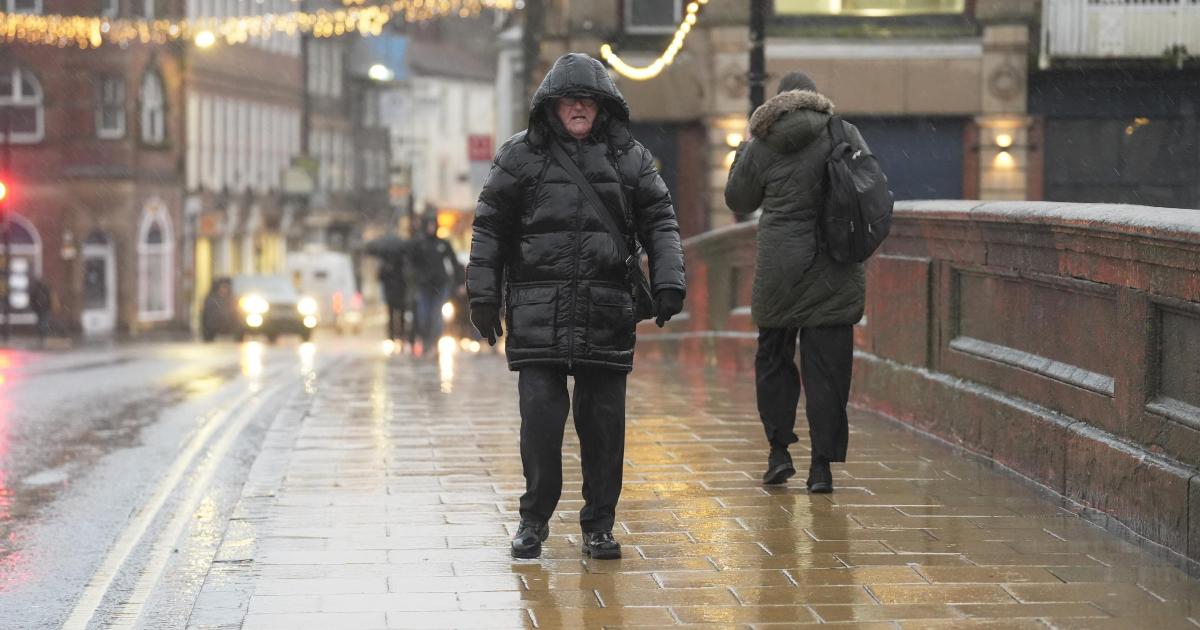
As reported by The Press earlier today, the Met Office has issued a yellow weather warning for strong winds from 5pm tomorrow (Saturday, April 4) through to Sunday, April 5.
It warns that Storm Dave will bring a spell of very strong winds – of 50-60mph in the York area – which may could impact the electricity network across the region.
RECOMMENDED READING:
Advertisement
A Northern Powergrid spokesman said: “Northern Powergrid is ready and prepared in the event of any disruption to power supplies as a result of Storm Dave.
“We are getting in touch with our customers on how to be prepared and what to do if they experience a power cut.
“Our teams are on standby to be deployed to any affected areas and are prepared to help restore power as quickly as possible.”
“If you spot any fallen trees on our power lines or poles or damaged cables due to the strong winds, stay well clear and call 105 immediately.”
Advertisement
People are being encouraged to report power cuts at northernpowergrid.com or by calling 105; they are also advised to ensure their phones are charged, turn off electrical appliances at the socket, keep a light switched on to know when power is restored, keep a torch handy, and check on elderly relatives.
Customer support vehicles and welfare partners are also prepared to provide on-the-ground assistance where needed.
Tech giant Oracle announced this week that up to 30,000 employees would lose their jobs, and official documents have put a finer point on just who is being let go in the sweeping lay-offs.
Oracle sent lay-off notices via email at 6 a.m. local time Tuesday to employees in Canada, India, Mexico, and the U.S, citing “broader organizational change” as the reason, according to Business Insider. The company made the cuts to free up $8 billion to $10 billion to fund AI projects, according to The Next Web.
Some 491 employees who work remotely, or at two Oracle locations in Seattle, Washington, will be laid off in June, according to a WARN Notice filed with the state’s Employment Security Department late last month.
Companies are obligated to file WARN Notices if they have at least 100 full-time employees and plan to lay off at least 50 people at a single location, according to the Department of Labor.
Advertisement
Among the 491 Washington employees who were laid off were 270 software developers; 46 software development managers, directors and vice presidents; 40 program managers and 30 product managers.
Tech giant Oracle announced this week that up to 30,000 employees would lose their jobs, and official documents have put a finer point on just who is being let go in the sweeping lay-offs (Getty Images)
Tech firm Oracle, led by billionaire Larry Ellison, is reportedly diverting freed-up cash from its recent layoffs to AI projects (Getty Images)
Oracle, which provides database management and cloud computing solutions, also plans to let 539 employees go at its Kansas City, Missouri, campus from May 26 to June 1, according to a WARN notice filed with the state’s Office of Workforce Development March 31. Positions include:
85 software developers
43 systems analysts
39 program managers
35 sales representatives
24 consulting positions
18 production services developers
16 technical analysts in support
13 project managers.
The company laid off around 12,000 employees in India, including positions in engineering and cloud infrastructure, global news network NDTV reported Thursday.
Oracle employees expressed their shock across social media following the lay-offs.
“It’s hard to put into words how heavy this feels,” Oracle customer success manager Eugenia Zanolli Andrade wrote Tuesday on her LinkedIn page. “Work is way more than just your source of income, it’s also a space where we grow, contribute, and build a sense of purpose.”
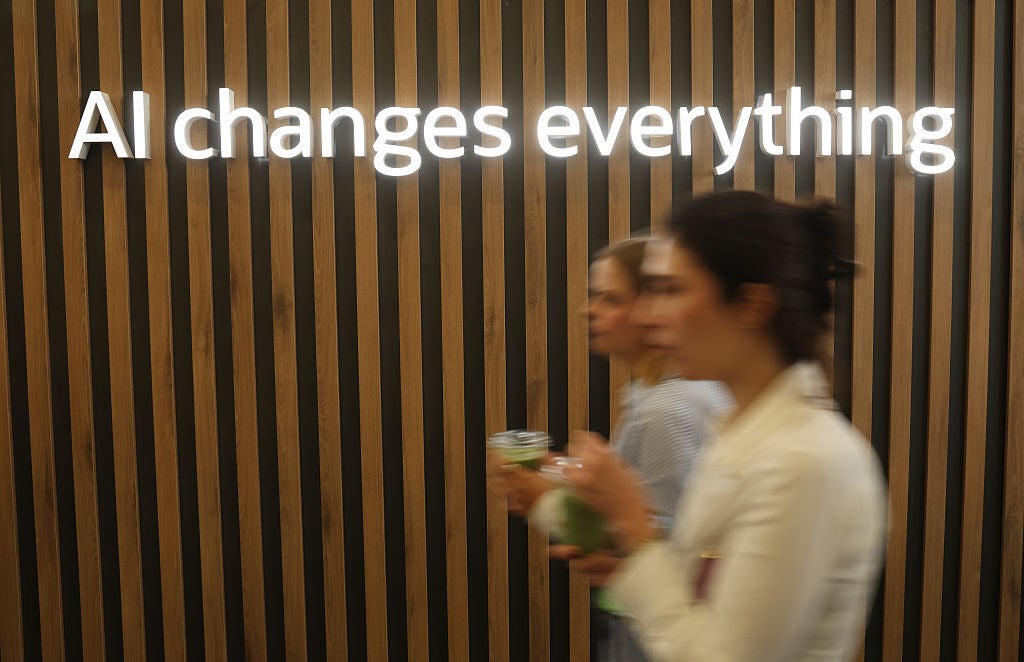
Oracle’s sweeping cuts are another red flag to white-collar workers over the shift to AI at major companies. The reported $8billion and $10 billion savings will fund AI-related projects such as building data centers, according to The Next Web, citing data from investment bank TD Cowen.
Advertisement
Oracle declined to comment to The Independent.
The Oracle lay-offs follow similar decisions by other tech firms in recent months. Amazon announced 16,000 lay-offs in January, largely in white-collar positions, according to CNBC. Block, a fintech company headed by former Twitter boss Jack Dorsey, let around 4,000 employees go in February.
‘It’s hard to put into words how heavy this feels,’ an Oracle employee said in a LinkedIn post after Tuesday’s layoffs (Sean Gallup/Getty Images)
AI’s impacts on white-collar jobs goes beyond the tech industry – Goldman Sachs recently estimated that 6-7 percent of U.S. workers could lose their jobs amid wider AI rollouts.
In October, Ford CEO Jim Farley said he expects AI to replace “literally half” of all white-collar positions, Yahoo Finance reported.
AI firm Anthropic said in a March 2026 report that computer programmers are most susceptible to AI-related job cuts. Customer service representatives, data entry, medical record specialists, market research specialists and marketing specialists are also easily replaced by AI, Anthropic stated.
Advertisement
H.P. Newquist, a consultant and analyst at AI tracking firm The Relayer Group, said the recent Oracle layoffs were related to AI in a more indirect way.
“The Oracle layoffs are only related to AI in that the money saved by slashing the workforce will be applied to building AI infrastructure,” Newquist said in an email to The Independent. “The layoffs have little or nothing to do with the applied use of AI to replace employees.”
Beyond AI, the Oracle layoffs should give prospective job-hunters food for thought, said Jessica Kriegel, chief strategy officer at business consultancy Culture Partners.
“The reason people should take note of the Oracle layoffs is because this represents a behavioral shift for the company. They’ve historically done incremental, surgical layoffs, not sweeping ones,” Kriegel told The Independent in an email.
Advertisement
“The move to large-scale cuts signals a change in how leadership is thinking about the future of work.”
She added: “This is the part people are getting wrong: AI isn’t directly replacing jobs at scale yet. But AI spending is forcing companies to make tradeoffs, and labor is where those tradeoffs are showing up.”
IN THE dim and distant past, on a day out to a town or city, you would park your car in a designated car park. On the way in, you would pass a little hut or kiosk, wherein sat a man who would hand over a ticket stamped with your arrival time.
Later, after a hopefully pleasant day out, you would return to your car and drive out, passing the little hut or kiosk, where you would hand back your ticket and pay the fee. This was usually in cash, because in those days we weren’t talking three-figure sums.
Now, even the idea of visiting somewhere that could potentially involve the use of official car parks fills me with dread. This is all down to automatic car parking machines. These things scare the life out of me. On the occasions when I have been forced to use them – when there has been no alternative within a three-mile radius – I have generally had to enlist the help of others. On occasion, I have simply given up and driven off.
Advertisement
The last time I attempted to use one, in the North Yorkshire town of Northallerton, I couldn’t get the machine to accept my money, and, along with two other drivers, became even more flustered when a passer-by said the car park would start charging after ten minutes, having captured our vehicles on camera at the entrance. We sped out of there faster than F1 Ferraris.
I was reminded of this while reading about a woman fined for spending 11 minutes in a car park in Stratford-upon-Avon, after, she alleges, finding the car park machine broken. Her initial £100 fine rocketed to £270 after she refused to pay.
A similar thing happened to me in a small car park in Grasmere in the Lake District. Not too long ago only large car parks in popular towns like Ambleside and Keswick had car parking machines. On our last visit to the Lakes, in early 2020, they seemed to be everywhere, even on tiny roadside patches of soil, which this was.
The machine took my money but I couldn’t get it to register my number plate – it was stuck on the previous one. As suggested by another motorist I took pictures of the meter. We left immediately and I contacted the company in question, who noted what had happened. I didn’t get a fine, but it affected our day out – we ended up driving back to our hotel and walking nearby.
Advertisement
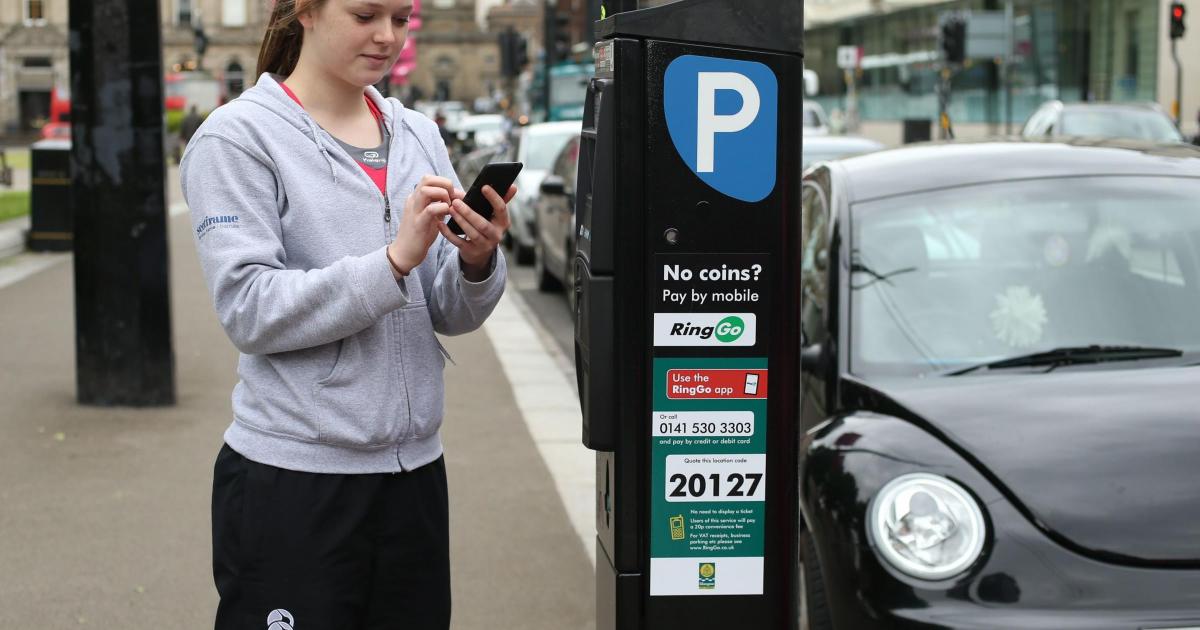
Things are getting worse not better. Now many car parks have removed pay-and-display machines and are changing to remote app-only payments to reduce maintenance costs. I don’t want dozens of parking apps for different companies cluttering up my phone, and chances are I would struggle to use them anyway. I recently came across a man in York standing beside his car fretting as his phone was stuck on the pay screen, the little white circle whirling endlessly around. Not everywhere has great internet reception.
Also, I am loathe to tap my bank details into a car park machine, or indeed pass them to a car parking firm I know nothing about.
This sort of thing unnerves me so much that we now tend to go most places by bus or train. Of course this has its advantages environmentally, but it definitely restricts where we go and how often.
It’s yet another example of a world that doesn’t care about people who are not comfortable with modern technology. Some older people don’t even have mobile phones and others may not own a smartphone. Having to download an app to pay for parking, when short-stay amounts can be as little as £1, seems to me ludicrous.
Advertisement
I still have a bag of coins in my car – a throwback from the man-in-hut days – for use in parking meters. In my experience few people like parking apps. I live in hope that, one day, we technophobes will rise up, and the tide will turn.
It’s also believed a nun that was trapped and left to die in a building haunts the town
One of Cambridgeshire’s market towns is believed to be haunted by ghostly monks. As a town with lots of history, it’s one that also comes with spirits and ghosts. Ramsey is considered a “highly haunted town”. Paranormal investigators have investigated several parts of the town.
Advertisement
They claim to have identified ghostly monks and orbs. One very haunted place with some of these spirits is Ramsey Abbey. The abbey was founded in 985 and was home to at least 80 monks. The abbey was dissolved during Henry VIII’s reign. Today, there is not much left to see, except the 15th century abbey gatehouse, the Abbey School, and a parish church with a bell tower.
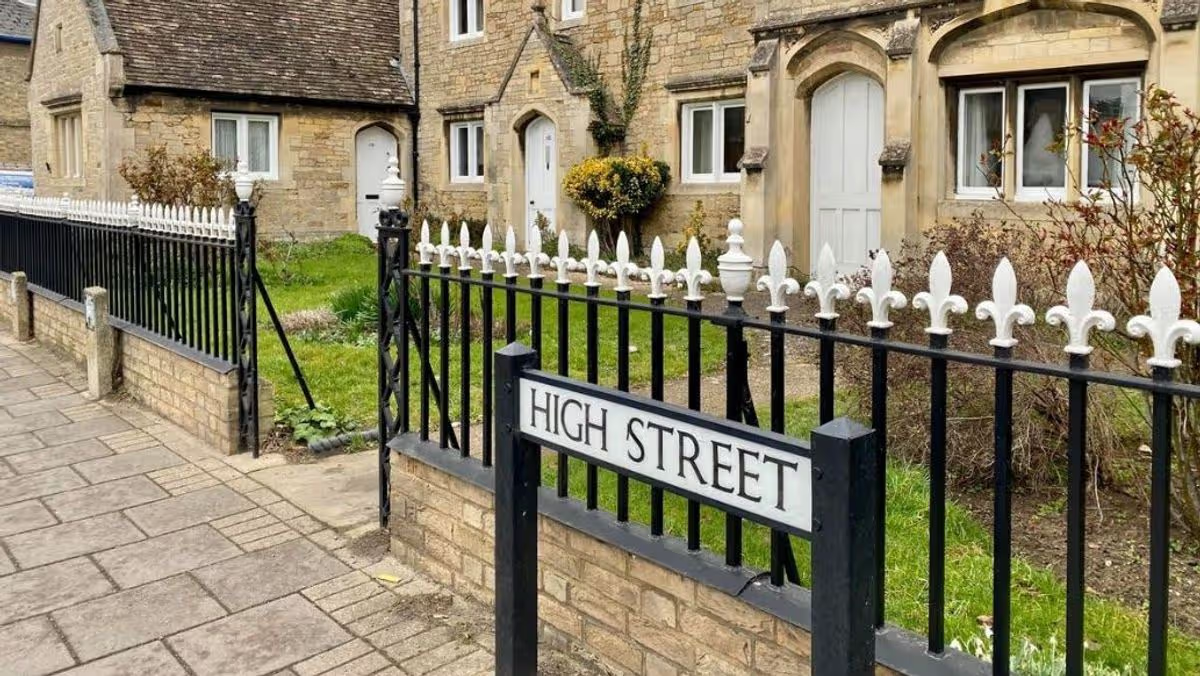
Another place believed to be haunted is Ramsey’s high street. In 1665, the plague hit Ramsey due to a contaminated coat from London. Those who died from the awful disease are thought to haunt the high street late at night.
The Ale House Kitchen, formerly the George Hotel, is said to be haunted by its former landlady, who was called Mary. Mary reportedly died in a fire after she blew out candles. Ramsey Rural Museum is also said to be haunted. In 2013, a paranormal database reported ghostly activity, where unexplained noises were heard and dark shadows were captured on pictures.
Advertisement
Keeping with ghostly religious figures, Bodsey House is said to be haunted by a nun. It’s reported a nun went to the house in the 14th century to visit her dying brother. However, she was caught and punished by being bricked up in the chimney breast and left to die.
The four crew of Nasa’s Artemis II mission have shared a “spectacular moment” as their craft left Earth’s orbit and started its final push towards the far side of the Moon.
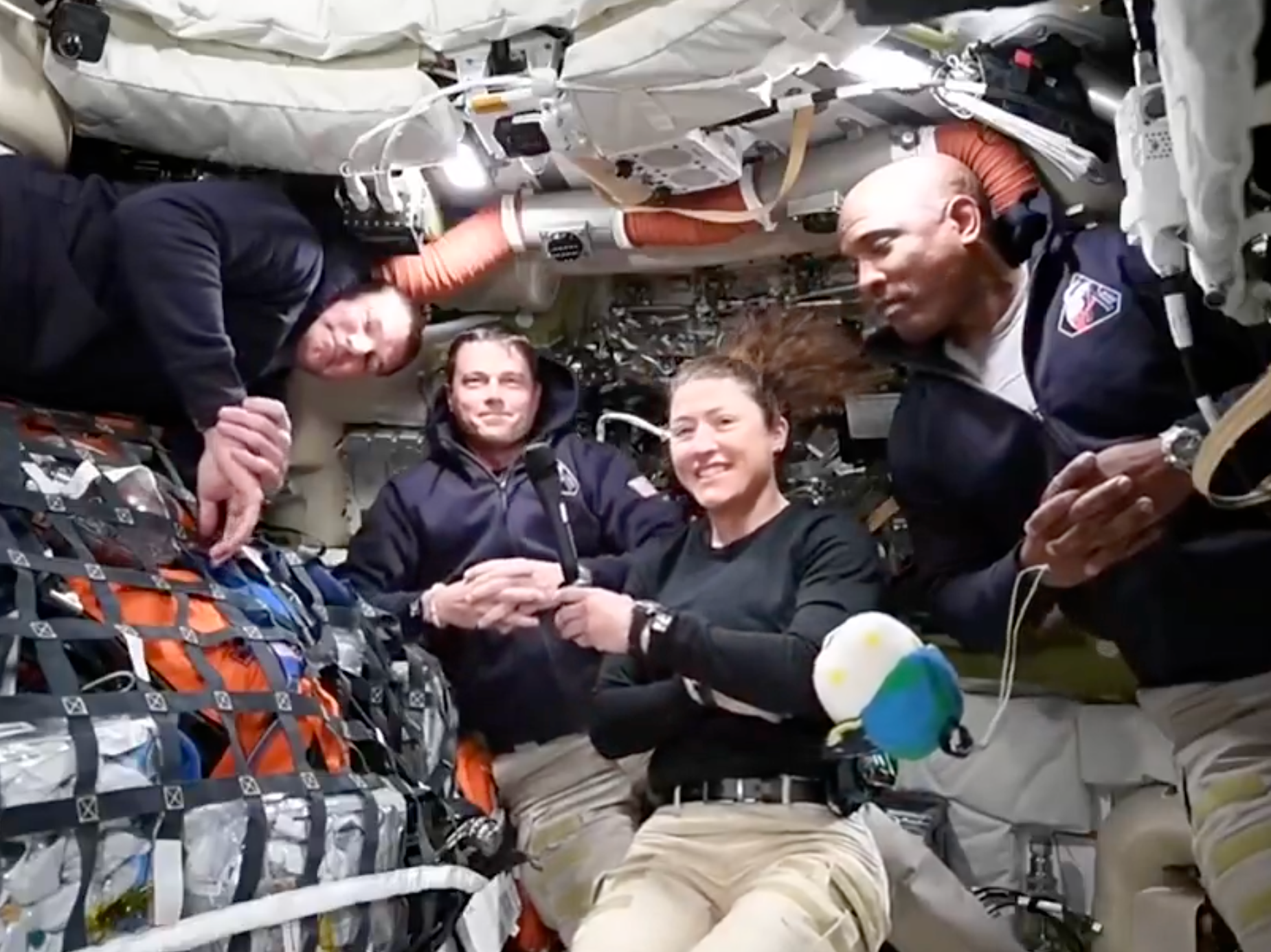
During the first public video conference with the crew, Commander Reid Wiseman said they saw a “spectacular view” as the spacecraft moved away from Earth.
“You can see the entire globe from pole to pole… It was the most spectacular moment and it paused all four of us in our tracks,” he said.
In what is the first crewed mission to the Moon since Apollo 17 in 1972, the four astronauts on the Artemis II mission spent the first 25 hours of the flight circling the Earth after the launch from Cape Canaveral in Florida on Wednesday evening.
Advertisement
The spacecraft is now heading around the far side of the moon and back again.
Nasa’s Artemis II moon rocket lifts off from the Kennedy Space Centre (Chris O’Meara/AP) (AP)
Canadian astronaut Jeremy Hansen said the crew were glued to the windows to see the “phenomenal” view.
He said: “Humanity has once again shown what we are capable of, and it’s your hopes for the future that carry us now on this journey around the moon.”
Hansen told Nasa‘s mission control that the crew “firmly felt the power” of those who had worked hard on the Artemis II mission
“Humanity has once again shown what we are capable of,” he said. “It’s your hopes for the future that carry us now on this journey around the Moon.”
Advertisement
After spending about a day in Earth’s orbit, Orion‘s engines, navigation and life-support systems were checked and given the final approval. The engine burn began pushing the spacecraft thousands of kilometres per hour.
The five minute and 55 second engine burn went “flawlessly”, Nasa’s Dr Lori Glaze said afterwards.
Orion is now set to head around 4,000 miles beyond the moon with a lunar flyby on Monday the next major milestone which will send the crew some 252,000 miles (406,000 kilometres) into space before returning to Earth.
The four astronauts on the Artemis II mission spent the first 25 hours of the flight circling the Earth after the launch from Cape Canaveral in Florida on Wednesday evening (NASA)
The current record for the furthest spaceflight is about 248,000 miles, held by members of the Apollo 13 lunar mission in 1970, which was hit by technical problems.
However, if something does go seriously wrong the astronauts can still turn back using a U-turn which will get them home within 36 hours.
Advertisement
The astronauts will get to see a total solar eclipse on the sixth day of the mission as the spacecraft cruises beyond the Moon.
While the astronauts will not touch down on the Moon, the Artemis II mission paves the way for a future lunar landing and also lays the foundation to send a crew to Mars.
The mission previously had to be postponed by two months because of hydrogen fuel leaks and clogged helium lines.
Nasa is seeking to return a crew to the lunar surface by 2028, before China does in about 2030.
‘They have to know that they can’t get away with everything’
17:44, 03 Apr 2026Updated 17:45, 03 Apr 2026
Advertisement
‘Mouthy’ kids running riot in the centre of Rochdale need to face tougher action, people in the town say. Teenagers have been reported to have ‘terrorised’ business – harassing staff and ‘causing criminal damage’.
The order allows officers to ban people from an area. People living in the town told the Manchester Evening News large groups of youths gathering and causing trouble was common.
Get MEN Premium now for just £1 HERE – or get involved in our WhatsApp group by clicking HERE. And don’t miss out on our brilliant selection of newsletters HERE.
Advertisement
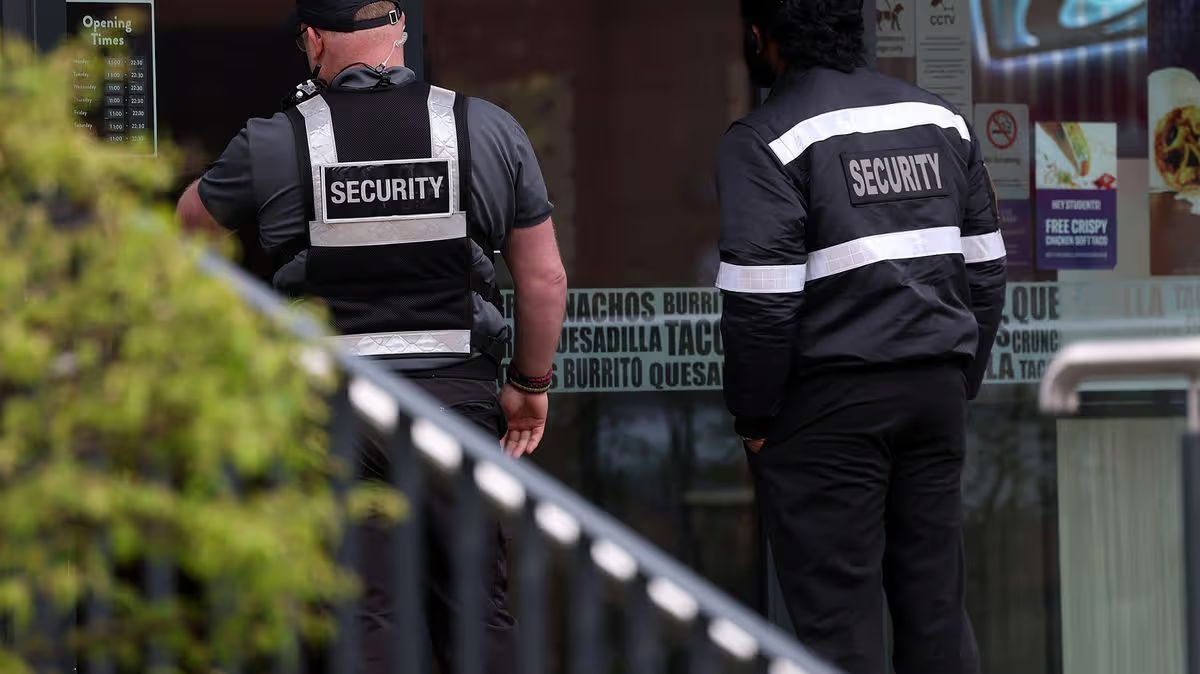
Some stores have beefed up security, with guards stationed at the doors of businesses. Jeanette Scott, 83, said: “I saw about 50 to 60 of them the other day. They were just running around, being very mouthy to the PCSOs.
“I think the police have done the right thing with the order. They’re doing what they have to do. They have to know that they can’t get away with everything.”
An 18-year-old, who asked not to be named, said there was ‘absolutely a problem with anti-social behaviour’ in Rochdale. He said troublemakers need to face tougher action.
“I went to school with a lot of these people and I know what they’re like,” he said. “There’s always something happening, especially near the bus stop. You see them running around, getting into fights. At least once a week there is some kind of incident. Something has to be done.
Advertisement
“There needs to be some kind of consequence – like if you act up then you’re banned from public transport or can’t come into town. Something like that.”
There are two main corridors of shops in the town centre. Yorkshire Street has charity shops, nail salons and clothing shops, while newly-built Rochdale Riverside – a few feet away from a tram stop and bus station – has teenage favourites including Nandos, Taco Bell, JD, H&M and a cinema.
People in the town say Riverside is an issue. “You barely see any kids on Yorkshire Street,” one business owner said. “Most of the groups hang around on that [Riverside] side, near the cinema and bowling alley.
Advertisement
“The other day I finished work and there was loads of them. But they are all out of school and that’s what they going to do.” Speaking about the dispersal order, another person said: “I think that’s more of a deterrent so they don’t come into town.”
On Yorkshire Street, Anna Bradley said she was ‘shocked’ to hear of the order, instead highlighting the good she’s seen in Rochdale’s youth.
“Anti-social behaviour is not something I see around here. But I don’t muck around with young people and am back home by 5pm once the shops are closed. There are little groups here and there, but nothing bad. What are they supposed to do?
“When I was young, this place was busier than Manchester. I was in work by 16 – we had a cinema, a dance hall, all kinds of shops and even a nightclub for teenagers.
Advertisement
“Stuff like that is missing. At that age, you’re treated like a child, but you don’t feel like one. There’s nothing around to help them make that next step in life.
“To make them feel a little bit like an adult. I’m really disappointed in that order. There’s some good kids in Rochdale and sometimes they get tarred with a bad brush.”
Anwar Ali said dozens of youths gathering is a familiar site, adding: “I’m expecting to see them today. I see them all the time, loads of kids in big groups near the tram stop.
Advertisement
“They’re usually in school uniform or during the holidays there are loads. They’ve never done anything really bad, but I’ve seen a fights break out from little groups and stuff like that.”
GMP earlier said: “Officers in Rochdale have put a 48-hour dispersal order in place to enhance their ability to tackle anti-social behaviour. Rochdale town centre has seen several recent reports of ASB, and officers are proactively working to tackle issues in the area.
“Officers have implemented a 48-hour dispersal order across Rochdale Town Centre following recent incidents of anti-social behaviour. This includes incidents yesterday where groups of young people were reported to be harassing staff and causing criminal damage at a business and in the centre.
Advertisement
“The aim of the notice is to minimise behaviour contributing to, or likely to contribute to anti-social behaviour or crime or disorder in the area.”
Inspector Meena Yasin, from GMP’s Rochdale district, said: “We have implemented this order to provide further powers for officers in the area to robustly deal with anti-social behaviour, and to protect people and businesses.
“We will not tolerate anti-social behaviour and where this is reported, we will look to take the strongest action – whether through proactive action or preventative problem-solving work.
“These powers are in place for the next 48-hours, and officers will be patrolling the town centre to ensure everyone has a safe and enjoyable Bank Holiday weekend.”




















































You must be logged in to post a comment Login