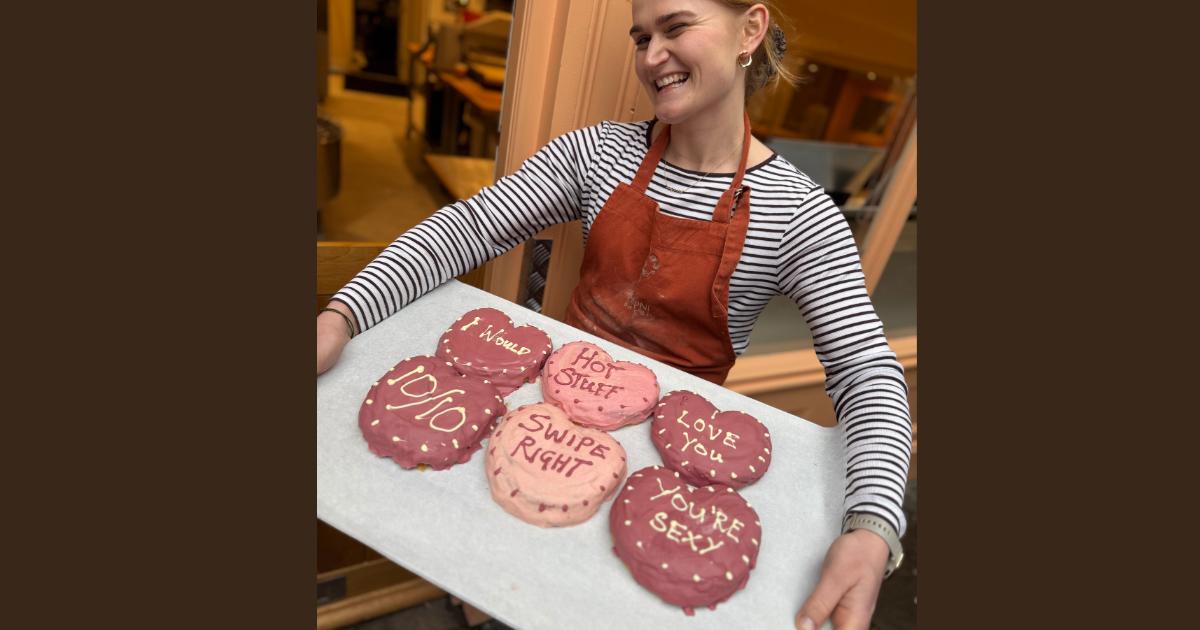
Heppni Bakeri, in Swinegate, is taking orders for personalised pink palmiers in the run-up to February 14.
Known for their distinctive heart shape, palmiers are made with puff pastry and sugar – and in the case of Heppni Bakeri delicious Edinburgh butter and pink icing.
Recommended reading:
Speaking about this, business owner India Luck said: “With so much doom and gloom in the world, we wanted to add a little extra magic to Valentine’s Day.
Advertisement
“We are now taking order for our special Valentine’s palmiers.
“These can be customised and will the make the perfect Valentine’s Day gift!”
The palmiers are made three days in advance and can be decorated with personalised icing (Image: Supplied)
According to India, the palmiers take three days to make – a process which involves making the dough, laminating it with butter to build up their characteristic layers and proving overnight.
She explained: “We bake the pastry on day three.
Advertisement
“It’s a long process and one that takes a lot of care and hard work.
“Sadly, we aren’t making vegan or gluten-free options with the palmiers, but we have lots of alternative options in store.”
The North Yorkshire Moors Railway (NYMR) is aiming to raise at least £800,000 to fund urgent repairs to Bridge 42, which crosses the River Murk Esk.
The temporary propping will allow the bridge to remain in use for the 2026 season.
Phil Sash, director of civils at NYMR, said: “Propping Bridge 42 is a carefully considered solution that keeps the bridge fully operational for the upcoming season.
Advertisement
“It also gives us the time needed to develop a detailed repair programme, which will be implemented over the winter months to secure the long-term safety and performance of this important structure.
“That said, propping does come with challenges due to the bridge’s location and access.
“The final cost of the project with propping and full repair works will be confirmed once we have received all final surveys and quotations – we are currently awaiting responses from five contractors.”
Temporary supports will be installed to ensure trains can safely cross the bridge throughout the 2026 season.
Advertisement
A full repair programme will then be carried out during the winter of 2026/27 to restore the bridge’s long-term structural integrity.
The work will allow NYMR to continue operating without interruption while protecting the heritage railway for future generations.
Laura Strangeway, CEO at NYMR, said: “Our heritage railway is at the heart of the local community, and it’s important that we continue to provide a safe and enjoyable experience for all our visitors.
“The proactive measures for Bridge 42 reflect our commitment to both operational safety and the long-term preservation of this historic line.”
Advertisement
The NYMR has launched a major appeal to help cover the costs of propping and repairing the bridge.
Supporters can contribute by visiting nymr.co.uk/bridge42.
He will tour a section of the 83-mile Sports Boulevard which connects cycling paths, horse trails, green parks and cultural landmarks – a project supporting the core quality-of-life initiative of Saudi Arabia’s Vision 2030, which aims to transform the kingdom into a diversified and sustainable economy.
US skier Lindsey Vonn says she has “no regrets” despite confirming she needs “multiple surgeries” after suffering a leg fracture in a crash at the Winter Olympics.
The 41-year-old was competing in the women’s downhill skiing final on Sunday in Cortina, northern Italy, when she crashed on the piste after clipping a slalom gate while midair.
The crash, occurring just 13 seconds into the run, resulted in Vonn, who was airlifted to hospital, sustaining a “complex tibia fracture” and undergoing initial surgery.
Image: Lindsey Vonn crashes 13 seconds into her run. Pic: AP
She had already ruptured her ACL in a crash at a World Cup race in Switzerland on 30 January but was determined to compete at her fifth and final Games.
Advertisement
In an Instagram post on Monday, Vonn said: “Yesterday my Olympic dream did not finish the way I dreamt it would.
“It wasn’t a story book ending or a fairy tale, it was just life.
“Unfortunately, I sustained a complex tibia fracture that is currently stable but will require multiple surgeries to fix properly.
“While yesterday did not end the way I had hoped, and despite the intense physical pain it caused, I have no regrets.”
Advertisement
Instagram
This content is provided by Instagram, which may be using cookies and other technologies.
To show you this content, we need your permission to use cookies.
You can use the buttons below to amend your preferences to enable Instagram cookies or to allow those cookies just once.
You can change your settings at any time via the Privacy Options.
Unfortunately we have been unable to verify if you have consented to Instagram cookies.
To view this content you can use the button below to allow Instagram cookies for this session only.
Despite coming into the Winter Olympics with injury, Vonn was still considered a medal hopeful and completed two impressive training runs earlier in the week.
The 2010 downhill champion had returned to elite ski racing last season after nearly six years in retirement, having had a partial knee replacement on her right leg.
Advertisement
She said her past injuries “had nothing to do with my crash whatsoever”.
Taking risks ‘the beauty of life’
In her social media message, Vonn acknowledged the dangers of ski racing but insisted having the chance to compete “was an incredible feeling that I will never forget”.
“Knowing I stood there having a chance to win was a victory in and of itself,” she said. “I also knew that racing was a risk. It always was and always will be an incredibly dangerous sport.
Advertisement
“And similar to ski racing, we take risks in life.
“We dream. We love. We jump. And sometimes we fall. Sometimes our hearts are broken. Sometimes we don’t achieve the dreams we know we could have. But that is also the beauty of life; we can try.
Passengers on a homeward-bound flight to Northern Ireland experienced a more nerve-racking flight than usual when a bird strike occurred shortly after take-off yesterday.
Advertisement
One passenger captured the event on video which featured a loud bang from the bird striking the plane. The incident occurred on the Airbus A320 Neo aircraft – EasyJet 3052/U23052 – after it departed Amsterdam Airport Schiphol on Sunday evening, destined for Belfast.
But, after a bird impacted with the aircraft, it diverted back to Schiphol Airport as it completed a loop over the ocean before heading inland to it’s departure location.
The passenger not knowing fully what was going to happen after the bird hit the plane labelled the encounter as a “scary” experience.
They added: “I am just glad we made it safely back on the ground.”
An update at the time from EasyJet read: “We’re sorry that your flight has been returned to Amsterdam. This is because the plane needs to be inspected by our engineers following a bird strike.”
“This can take between 30 minutes to two hours and we’ll keep you updated as soon as we know more. The safety of you and our crew is our highest priority and we thank you for your patience.”
Bird strikes are a common occurrence and a regular hazard for air travel with thousands of incidents reported from around the world annually.
Advertisement
Belfast Live has approached EasyJet for an updated comment.
Eddie Vedder is at the heart of Matter of Time, which arrives on Netflix this Monday, February 9, but the new documentary does not focus on the singer’s storied exploits with his band Pearl Jam.
Instead, the film tells the story of Vedder’s solo concerts in Seattle in October 2023, organized to raise money for clinical research into Epidermolysis Bullosa.
Epidermolysis Bullosa is a rare, life-threatening genetic skin disorder that mostly affects children. The condition causes fragile, blistering skin, and those who have it are sometimes called “butterfly children” as their skin is considered as fragile and easy-to-break as a butterfly’s wing.
People born with EB lack critical proteins that bind the skin’s two layers together. Without these proteins, the skin tears apart easily, leading to severe pain, disfigurement, and internal and external wounds.
Advertisement
It is estimated that 500,000 people worldwide have EB. Those who have the most severe forms of EB can have a shortened life expectancy that ranges from early infancy to 30 years of age.
Eddie Vedder performing during the ‘Matter Of Time’ premiere at New York’s Tribeca Festival in 2025 (Mike Coppola/Getty Images for Tribeca Festival)
Epidermolysis Bullosa activist Lily Meyer, her brother Eli Meyer, who was born with EB, and Eddie Vedder at the ‘Matter Of Time’ premiere (Mike Coppola/Getty Images for Tribeca Festival)
Vedder and his wife Jill became aware of the condition when a close friend of their family had a child born with it. In 2010, the couple co-founded the EB Research Partnership with a group of affected families. The charity has since become the largest organization funding research into EB, and they’ve set a goal of finding a cure for the disorder for 2030.
Advertisement
Matter of Time, named for the belief that a cure is on the way, combines footage of Vedder’s concerts with real-life stories of the patients, families and researchers who have been affected by EB. It also features a score by indie rock band Broken Social Scene.
In a statement, Eddie Vedder said: “We are so grateful to the music community, and the entire team who made these concerts and this film possible. This is a story of hope, resilience, and the power of community.”
Michael Hund, the CEO of EB Research Partnership, added: “This film celebrates our community of courageous patients and families, and highlights the real scientific progress that is happening right now.
Enjoy unlimited access to 100 million ad-free songs and podcasts with Amazon Music
ADVERTISEMENT. If you sign up to this service we will earn commission. This revenue helps to fund journalism across The Independent.
“We are showing the world how rare diseases like EB can be cured, and we hope to take our model to thousands of other rare diseases. Our goal is to raise the visibility of this urgent cause and to inspire others to join us in our mission to cure EB by 2030.”
The film was directed by Canadian documentary maker Matt Finlin, who said: “The concert wasn’t just about music; it was about amplifying the voices of a small but mighty community that refuses to let this disease define them. Through the Vedders’ dedication and the efforts of everyone involved, this documentary demonstrates to the world how, even against all odds, real change is within reach.”
“I cannot fix potholes myself, but I can at least make sure signs are clean, clear and readable,” he said.
A local councillor has said that he has been forced to take it upon himself to go out and clean road signs which have been “badly neglected” by the Department for Infrastructure.
Advertisement
Alliance Councillor Aaron Skinner has been out and about in Carrickfergus and Greenisland over the weekend, cleaning a number of road signs.
Cllr Kinner said that while he can’t fix the potholes in the roads, he can at least do his bit to make the roads a bit safer.
“With road conditions continuing to deteriorate, I cannot fix potholes myself, but I can at least make sure signs are clean, clear and readable for drivers and pedestrians,” he said.
“Local DfI staff on the ground are working as hard as they can, but are being let down by a Department that is failing to provide the resources needed to keep roads safe and properly maintained.
Advertisement
“While cleaning signs will not fix the wider problems, it is about doing something useful rather than standing back and accepting things as they are.”
A DFI spokesperson said: “The Department’s resource budget, which is used to deliver day-to-day maintenance activities, has been under significant pressure for over a decade.
“In response, the Department has had to reduce its routine road maintenance activities to a limited service, which prioritises public safety, with priority given to mandatory and warning signs.”
The expression is: “handed to you on a silver plate”. But a recent breakthrough came to me on a painted ceramic one. Following the clues on that plate led me to solve a small historical puzzle: who once owned a Renaissance manuscript now held in Paris.
Known as a maiolica, the plate features three different imprese: that is, emblems used during the Renaissance as personal badges. Under a coat of arms is a music scroll bearing pauses and rests; on a balustrade in the foreground, the Latin motto Nec spe nec metu (neither by hope nor by fear), and, repeated twice, the most unassuming of all: a Latin numeral, XXVII.
I had seen that number years earlier, inside an embellishment on the first page of a manuscript at Paris’ Bibliothèque nationale de France, not far from where the plate was being shown, on a temporary loan from the V&A to the Al Thani Collection Foundation. The manuscript was a partial copy of a lost one, and I had been trying to figure out where it came from.
The coat of arms and the different imprese were all Isabella d’Este’s (1474–1539), Marchioness of Mantua, daughter of Duke Ercole I d’Este of Ferrara and Eleanor of Aragon. The answer was suddenly obvious: the Parisian manuscript was originally in her personal library.
Advertisement
Portrait d’Isabelle d’Este by Leonardo da Vinci (1499). Louvre
Despite marrying at just 16, Isabella was an extremely well-educated woman. This likely helped her to play her part in ruling Mantua, especially when her husband Francesco Gonzaga was away fighting in the Italian wars and then taken prisoner. She also had considerable personal financial resources, and was free to spend her money as she wished, enabling her to become the most significant female collector of the Italian Renaissance.
A patron of the arts, Isabella was portrayed in medals, paintings and drawings by several artists, including Leonardo da Vinci. To house her antiquities and artworks, she adapted some rooms within her apartments. One of them was known as her studiolo, a room dedicated to private reading and writing. Many leading artists were commissioned paintings to adorn it, as well as her new apartment in Mantua, where she moved after her husband’s death in 1519.
Isabella’s considerable library was also housed there. A partial inventory drawn up after her death reveals that it was more akin to the libraries of Renaissance elite men than courtly women. It consisted mostly of contemporary books and secular works, instead of inherited volumes and religious texts, and it contained an unusually high proportion of handwritten books.
Advertisement
During her lifetime, Isabella used at least eight different imprese. These could be marks of possession, as seen with the Parisian manuscript and the V&A plate, as well as the other 23 surviving pieces of its dinner service. However, they were also intended to convey coded messages.
A Renaissance impresa contained some sort of personal statement, concerning its bearer’s situation, philosophy, aspirations, personal qualities. Unlike coats of arms, which were inherited, it expressed nothing related to family lines or social standing, could be used by anyone who decided to design one and altered or discarded at will.
Since its true meaning required interpretation, an impresa was often ambiguous. Isabella’s pauses and rests on a musical scroll could signify silence, a traditionally feminine virtue, but also, being symmetrical, a visual representation of the principle of balance – not unlike her Latin motto. Whatever its meaning, it was one of those Isabella chose to adorn the gowns she wore for special occasions, namely, her brother Alfonso’s wedding to Lucrezia Borgia in 1502.
One of the many paintings commissioned for Isabella’s studiolo, Parnassus by Andrea Mantegna (1496–1497). Louvre
The marchioness did not appreciate overly complicated explanations of her imprese. In 1506, when the author Mario Equicola wrote a booklet on her Latin motto, she stated in a letter to the noblewoman who was protecting him at the time that “we did not have it created with as many mysteries as he has attributed to it”.
Isabella’s Latin motto was, unusually, reused by others, including one of her sons and a Spanish king. Not so the enigmatic XXVII. Its presence on the first page of the Parisian manuscript is therefore proof of Isabella’s ownership.
Advertisement
Other evidence was already known. The Parisian manuscript is a partial copy of the lost Raccolta Aragonese, an anthology of rare early Italian poetry, gifted by the statesman Lorenzo de’ Medici to Federico d’Aragona, son of the king of Naples, around 1477. The last sovereign of his dynasty, Federico went into exile in France with his books.
After his death, most of them passed to his widow, who settled in Ferrara under the protection of Isabella’s family. Her letters reveal that in January 1512 she managed to borrow the collection:
“The book of the first vernacular poets that Your Majesty was so good as to lend me I will hold in all due respect and reverence, and it will not fall into the hands of anyone else. As soon as I have finished with it, I will send it back to Your Majesty, whom I thank for her great humanity toward me.”
Isabella was not lying. She wanted the book because of the rarity of its contents, and she liked to be the sole or near-sole owner of texts. We could already hypothesise that she had commissioned a copy, and we now know this to be true. Thanks to her initiative, these rare poems enjoyed wider circulation; but this is a result neither she nor her correspondent could have anticipated.
Advertisement
Looking for something good? Cut through the noise with a carefully curated selection of the latest releases, live events and exhibitions, straight to your inbox every fortnight, on Fridays. Sign up here.
Axel said getting the site ready to welcome customers has been a rollercoaster of emotions for him and Nicola, and said they cannot wait to open.
Advertisement
He said: “We are both excited, but we are beyond that now. It is about dotting the I’s and crossing the T’s, making sure we have not rushed anything.
“There is a massive anticipation in the town for our product to come out, so we are making sure we give ourselves that due diligence.”
And it’s the relationship between the childhood friends turned business partners which Axel says makes the experience even better.
The best thing I have done is get close to my best mate. When I am having a rubbish time, I feel like I am burdening Nicola, but when she is having a rubbish time, I know she feels the same like she’s burdening me.
Advertisement
“But that is because we are working in tandem, we do need each other.
“I am with my missus and she is with her partner and we are both on the phone to each other every day.
“It is nice to have a strong enough relationship in that we are friends and not business partners. That is the rewarding factor.”
Axel, who works offshore but is also a model, admitted the move and refurbishment of the building has been stressful at times.
Advertisement
Nicola Patterson and Axel Tucker outside Meet & Marrow on Duke Street, Darlington (Image: Stuart Boulton)
“If it was not for modelling, I feel I would have been screwed on my half because I would not have been able to uphold my end on this venture,” he said.
“Two weeks ago, before the last thing was on the wall, I was feeling a bit of pressure. Once that was done, the feeling went and I was quite emotional.
“When everyone left, I stayed at the café for more than two hours, and I just stood and cried.”
And Axel spoke of just how excited the pair are to open their doors and serve the first customer next Monday.
Advertisement
He said: “There is an element of nerves, but at the same time there is more excitement.
“People have been coming up to us both saying how much they are looking forward to coming down.
“My partner had seen the pictures and thought it looked nice, but she came in and it took her breath away. That is what it has been like for everyone.
The changes, introduced by the government for members of the Local Government Pension Scheme (LGPS), target one of the most persistent drivers of pension inequality: time taken out of paid work for caring responsibilities, particularly maternity leave.
For millions of women working across local government – from school kitchens and libraries to housing services and street cleaning – the reforms represent a meaningful shift towards a fairer pension system.
What is the gender pension gap?
Women make up around three-quarters of the LGPS’s nearly seven million members, yet still retire with lower pensions on average than men.
Advertisement
One of the main reasons is maternity leave. Periods of unpaid additional maternity leave have historically not counted towards pension savings, permanently reducing retirement income for women who take time out to care for children.
As Pensions Minister Torsten Bell put it: “For too long, women have been penalised in retirement simply for having children.”
Maternity, adoption and shared parental leave made pensionable
At the heart of the pension scheme reforms is a change that directly tackles this structural problem. Unpaid additional maternity leave, shared parental leave and adoption leave will now be automatically pensionable.
This means women will no longer see their pension pots shrink simply because they stepped away from work to care for a new baby or child.
Advertisement
Torsten Bell said the change marks a fundamental shift in how the pension system treats families: “These reforms mean that for millions of women working in local government, taking time out to care for a new baby will no longer cost them their pension security.”
“This is about a pension system that works for modern families and properly values the vital contribution of working women across our public services.”
Frontline workers see real financial gains
These reforms are designed to benefit everyday workers, not just higher earners. Women serving school lunches, cleaning public buildings, managing libraries and maintaining local services are among those set to benefit most.
Local Government and Homelessness Minister Alison McGovern described the changes as a long-overdue correction: “It is shocking that this gender imbalance in our pension system has persisted for so long, and I am proud that these reforms will help correct this historic inequality.
Advertisement
“These crucial changes will give hard-working cleaners, librarians, school cooks and other public servants the security in retirement they deserve.”
Changes to survivor pensions
The pension scheme reforms to tackle the gender pension gap also address inequalities in survivor benefits.
Due to flaws in previous regulations, some surviving partners – particularly those in opposite-sex marriages and partnerships – could receive lower pension payments than others, while some same-sex couples received more generous entitlements.
Under the new rules, all discrimination based on sex or relationship type will be removed, with backdated payments and higher future pensions ensuring equal treatment for all survivors.
Advertisement
Another key reform removes the age cap that required an LGPS member to have died before age 75 for their survivor to receive a lump sum payment, a rule that could unfairly deny families vital financial support.
Keeping more women enrolled in pensions
Recognising that women are more likely to opt out of workplace pensions due to affordability pressures or career breaks, the government is also enhancing data collection to better understand why members leave the scheme.
The aim is to keep more people, particularly women, saving for retirement and benefiting from long-term pension growth.
Trade unions have welcomed the reforms while urging further action across the wider workforce.
Advertisement
Recommended reading:
TUC General Secretary Paul Nowak says: “Everyone deserves a decent quality of life in retirement, but the gender pension gap means that too many women are pushed into hardship.
“That’s why these measures are an important step forward — they will make a meaningful difference for millions of women working in local government.
“It’s now vital we see more action to close the gender pensions pay gap across the whole workforce.”
Nationalist parties say the decision is “discrimination” and “anti- GAA.”
22:50, 09 Feb 2026Updated 22:52, 09 Feb 2026
Plans to end concerts at Boucher Road Playing Fields for two new GAA pitches and a soccer pitch have been shelved.
Now discussions on the future of the park will return to the Belfast City Council table after a significant backlash by promoters, the music community and local politicians.
Last Friday the majority of elected representatives at a Belfast City Committee meeting decided to return the Boucher Road Playing Fields to their “original purpose” as a dedicated sports facility, meaning large-scale music concerts and festivals at the site would end in a few years time.
Advertisement
However, at the February meeting of the full Belfast Council on Monday, February 9, on a tight vote the chamber passed a joint DUP and Alliance proposal, and then a Green Party proposal. Both proposed defer a decision on Boucher Road Playing Fields, pending further discussions, which might include looking at the possibility of dual-use at the park to keep big music gigs there.
Sinn Féin said the decision was “discrimination,” while the SDLP said it was “anti- GAA.”
Advertisement
The council stated after the meeting: “At the full meeting of council on Monday February 9, elected members agreed to refer any decision regarding the council’s pitches programme back to its Strategic Policy and Resources Committee for further discussion.
“This includes a decision on the future use of Boucher Road Playing Fields, with agreement by elected members to bring back a specific report on this particular location.”
On Friday a decision was made behind closed doors at City Hall on Friday, in a restricted session away from the public and press, to provide two full-size GAA pitches and one intermediate soccer pitch at the Playing Fields, as part of the council’s Pitch Strategy. The decision sailed through with votes from Sinn Féin, the SDLP and the DUP, but with opposition from Alliance.
The balance of power changed on Monday after the DUP changed their position on the proposal, and a joint Alliance/DUP proposal got through, backed by 30 votes in favour to 28 votes against. A Green Party proposal to defer all decisions back to committee passed on a similar score, and technically is the chosen amendment.
Advertisement
If Friday’s decision had been ratified at the full council, Belfast would have lost a major outdoor concert venue with a capacity of 40,000. Known for hosting massive concerts and festivals like Belfast Vital, the Fields have hosted A listers such as Bruce Springsteen, Ed Sheeran, Liam Gallagher, The Killers, Sam Fender, and Eminem.
This has not come without controversy, and locals have been airing their grievances for years about the disruption created by the big live events. The Fields have hosted large gigs since 2010, and while a huge source of income to the city economy, are an ongoing source of upset to neighbours.
Every summer South Belfast councillors warn of disruption and logistical challenges for residents during the summer season of big concerts. In 2024 the council set up a “Social Value Fund” to be allocated to those local communities beside Boucher Road Playing Fields who felt adverse effects from large concerts.
In June 2022 Boucher Fields were confirmed to remain a venue for music gigs and other events, when its entertainment licence was renewed, despite complaints and objections from local residents. Two months later Belfast council announced extra residential security to protect residents around the Playing Fields gigs after people were left “traumatised” in their homes after an Ed Sheeran concert.
Advertisement
After the announcements on Friday by Sinn Féin that the GAA pitches and a soccer pitch were approved, and gigs would end at Boucher, critics argued that closing the venue without an alternative site lined up would “kill” the city’s large-scale music scene. They added the lack of a transition plan would leave a significant gap in the city’s cultural and arts infrastructure.
The Alliance/DUP proposal states the council “agrees to defer any final decision regarding the future of the Boucher Road site,” and requests a report including an assessment of how the site can be “reconfigured to support enhanced sports provision alongside a major events venue with a capacity of up to 40,000.”
The proposal asks for an evaluation of “potential alternative sites across the city suitable for development as a major events space” as well as “a comprehensive analysis of the economic impact of Boucher Road operating as an events venue, including benefits to local businesses, tourism, and employment.”
The proposal also urges the council to work with promoters and partners such as Eventsec, MCD, and Shine, to “look at options of creating a hybrid site which provides sporting facilities and large scale events with a capacity of 40,000.”
Advertisement
DUP Councillor Sarah Bunting said at the meeting: “It does feel some of these decisions have been pushed through in a whirlwind of activity, and it might be time just to take a slight pause, even though the usual slow process of getting things through this council can be extremely frustrating at times.
“We fully support the return of Boucher Playing Fields to pitches, that 100 percent remains our objective, we have worked persistently to move this forward and our position hasn’t changed.”
She added: “What I cannot support is the political theatre, which we witnessed on Friday with both the Pitches Strategy and leisure transformation. Before these issues even reached full council, before ratification and before final scrutiny in this chamber, Sinn Féin’s well-oiled publicity machine was already in motion.
“Press releases were issued, credits were named and narratives were written, but importantly process was ignored. And then predictably came the photo opportunities.”
Advertisement
She added: “Over the past few days we have engaged directly with promoters. They have indicated a willingness to work constructively with the council, and crucially to potentially cover the costs of additional works required to ensure this site can function both as pitches and as an events space.”
Green Party Councillor Áine Groogan said: “We have really put the cart before the horse here. The Pitches Strategy has not been agreed, it is due to come back next month, and I don’t understand why we are agreeing outcomes of a strategy that is not itself agreed.
“Decision in terms of priorities for funding and phasing should all flow from the strategy.”
Alliance Councillor Micky Murray said: “No one is arguing Boucher Road should remain an events space forever. I am not opposed to turning it to playing fields in the long term, to close it without first securing a replacement is simply poor planning.
Advertisement
“We all know that music tourism is a major economic driver that contributes over £135 million to the local economy. What we get at Boucher is over £10 million to the local economy, £2.5 million in hotel stays and £1 million in other hospitality.”
Sinn Féin Councillor Ciaran Beattie said: “There is one way to describe this, and it is discrimination. It is because of what it is. We are talking about 26 sites across Belfast, and the only two sites that people have issues with are GAA pitches.
“If you look at the usage across the city, in terms of the deficit, there are 45,158 hours of a deficit for GAA in the city. That is nearly double what it is for soccer.”
He said the hybrid approach “just wouldn’t work” at Boucher, and said Sinn Féin would be demanding an equality impact assessment on any decision to block the Boucher pitches plan.
Advertisement
SDLP Councillor Carl Whyte said a deferral was “an anti-GAA move in the chamber.”