

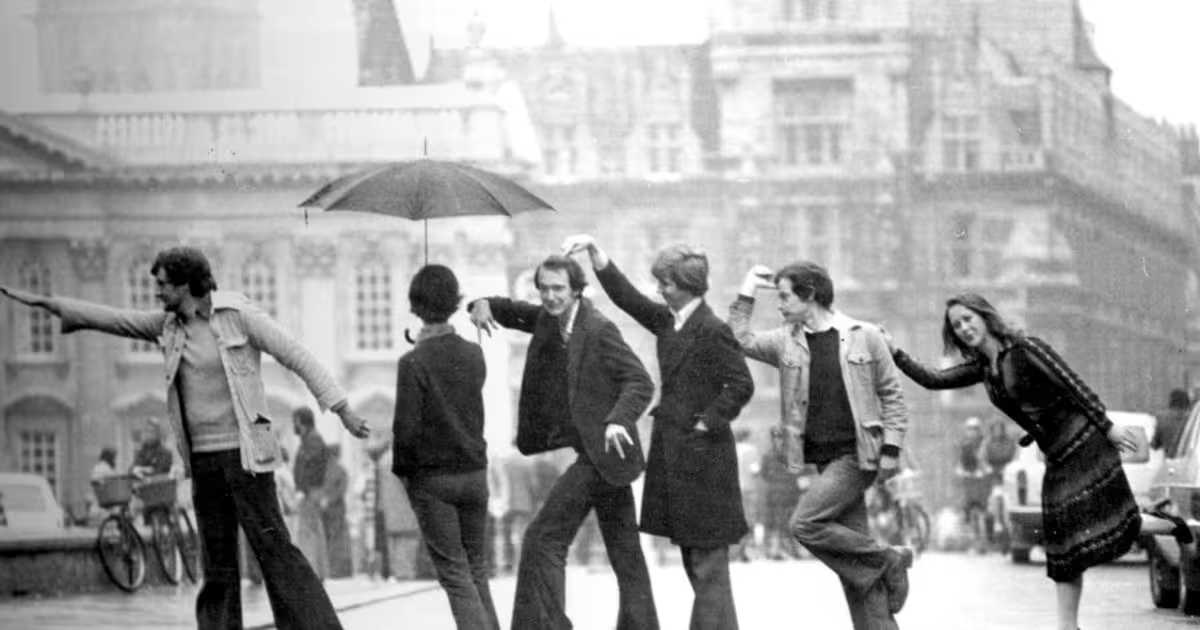
The Footlights has turned out star names including Stephen Fry, John Cleese, Douglas Adams, David Baddiel and many more
For more than 50 years the Cambridge Footlights has been a conveyor belt of comic genius. A student sketch comedy troupe at the University of Cambridge which dates back to 1883, its alumni reads like a who’s who of British comedy – John Cleese, Eric Idle, Steve Punt, Hugh Dennis, all of the Goodies, Richard Osman, Jan Ravens, Nick Mohammed, Alexander Armstrong, Ben Miller, Phil Wang, Mirian Margolyes, David Baddiel and Douglas Adams are just a few of the big-name former Footlighters who have kept us entertained.
Now a new book has offered a fascinating and entertaining deep dive into the Footlights, with more than 70 former Footlighters recalling their experiences and giving insights into why the troupe has been such a prolific comedy production line.
The Cambridge Footlights: A Very British Comedy Institution was written by Robert Sellers, the author of more than 25 books on subjects such as cinema, theatre, television, music and popular culture, and was released this month by Bloomsbury.
“You could call it a factory for churning out comedians since the 50s,” said Robert. “So I thought it was an interesting institution to examine. I’m a huge Monty Python fan so I knew that most of the Pythons went to Cambridge. I’m also a big Goodies fan and all of them went to Cambridge.
“I’ve been aware of it for a while but what interested me before I decided to pursue it properly…was it still churning out these people?
“The high point was the 60s, 70s and early 80s – but it’s still remarkably consistent. Just look at The Inbetweeners, Richard Ayoade, David Mitchell and people like that. It’s still part of television, theatre and comedy. It’s still relevant.”
As he researched the subject and spoke to former Footlighters, it became apparent to Robert that the secret to the success of the Footlights conveyor belt of talent was the experience it gave those involved.
The opportunity to write and perform, not only in Cambridge but in the West End, theatres around the country and at the Edinburgh Fringe Festival, was both unique and invaluable.
“I wanted the book to be as much as possible an oral history,” said Robert. “I didn’t want it to be a staid, academic-type book. I wanted it to follow people through the years, their personal experiences. So I’ve interviewed over 70 people who are ex-Footlighters. It’s very much a personal history of their time there.
“A lot of people said it’s the experience that it gives you. A lot of people said it’s better than a drama school. In a drama school you’re performing to your own classmates for most of the time. With the Footlights, because of the revue and the tour they go on, and when they go up to the Edinburgh Festival, they’re performing in front of the public from a very early age.
“There’s a thing called smokers which they put on every few weeks for the college. Anyone from the college and the university can come and watch, and you have to write your own material. Someone told me that when they arrived, they were quite surprised that they had to write their own material. They thought they were given material and they’d just have to go on stage and be funny. But no, you had to write it and perform it, and a lot of people found that a real challenge. That helps enormously, that you’re writing material every three weeks.
“Someone told me that when he left the Footlights and was performing stand-up on this quite big venue, a fellow comedian said to them, ‘This is your first time here – this must be a big moment for you, performing in front of an audience’. But he had spent three years going to the Edinburgh Fringe and performing in front of 1,000 people and going on tour to theatres around the country.
“It’s a real ladder of opportunity – also for producers and directors. Some people might not necessarily want to be a performer, but a writer or a producer or a director.
“So they’ve left university having directed a professional production. It’s a huge advantage over your contemporaries and your competitors.”
The Footlights is still a thriving institution – and still supplementary to whatever academic course its members have chosen for their studies. “It was almost a release valve for their studies,” said Robert of the former Footlighters he interviewed.
“Once a week they could just be silly and do silly jokes. It was a wonderful release from the pressures of academia. It started as a hobby because people enjoyed doing drama and theatre but they had no ambition to be a professional performer.
“John Cleese had no ambition to be a comedian even though he was in the Footlights. He wanted to be a lawyer or a barrister. Graham Chapman wanted to be a doctor.
“It started to change in the 70s when people went to Cambridge purely to be a comedian and join the Footlights after seeing so many people come through in the 50s and 60s – Peter Cook, and people like that. So in the 80s sometimes people were taking the Footlights more seriously than their academic work.”
But while students from colleges throughout the university took advantage of the opportunity to indulge themselves in drama, women were excluded from being full members of The Footlights until 1964. “An interesting element of the book is the role of women in the Footlights,” explained Robert.
“I interviewed Graeme Garden and he wanted to introduce women during the year he was president. But one of the high principals who was on the board and had quite a lot of significance, said he would resign if women were made members.
“So the following year when Tim Brooke-Taylor was vice-president and Eric Idle was president, they said ‘this time we’re doing it – if the guy wants to resign we’ll call his bluff – but women have to be members this time’.
“Women could perform in the Footlights but couldn’t be members. They could do smokers and occasionally, like Miriam Margolyes, be in the revue show – but were treated abominably. Someone told me she (Margolyes) wasn’t even allowed to go to the after-show party, even though she’d been in the show. She went back home and cried all night.
“When Germaine Greer did a smoker, they just thought there was no way they could say ‘no’ to her. She was very powerful and that changed everything. She was the first female member.”
Not everyone who joined the Footlights went on to pursue a career in the entertainment industry, of course. One of the alumni Robert interviewed for his book was Peter Firth, who was 97 at the time, and was president of the Footlights in 1953. He went on to become a priest.
“He was a lovely guy and his memory was crystal clear,” said Robert. “He was president of his year and he put the revue on. It was such a success that a West End producer said, ‘Can you put it on in the West End please?’ But he knew he wanted to be a priest so he didn’t do it.
“But the following year the revue was again a success and the same producer came back and this time they said yes, and that became the first Footlights revue in the West End.
“It became a bit of an institution in the 60s and 70s that the Cambridge revue would not only do a tour round the UK and Edinburgh, but also go into the West End. It became a big deal although it doesn’t happen any more. One revue even went to Broadway.”
What became clear to Robert is that members of the Footlights fully acknowledged the privileged position that attending the University of Cambridge put them in.
“There were lots and lots of societies – each house had its own little comedy group,” he said. “I don’t think there’s any other institution in the country where you get that much practice. These guys left Cambridge pretty much a honed comedian.”
And for a time coming from The Footlights actually worked against any would-be comic looking to make their mark. The rise of alternative comedy in the 1980s meant that talent emerging from the Footlights was viewed as ‘the Establishment’ and therefore actively sneered at.
“For quite a long period of time, coming from The Footlights was actually a negative,” said Robert. “In the 1980s because of the rise of alternative comedy, if you came from The Footlights, you were almost cancelled – certainly looked down on. If you were Cambridge you were seen as rich and coming from a well-off family – you were dismissed as a rich tw*ts.
“Matthew Holness talks about it a lot – how hostile the environment was when he went to Edinburgh. David Baddiel told me that when he left the Footlights in the mid-80s he phoned up the Comedy Store in London to ask if he could do a gig or perform in some way.
“They said, ‘That’s fine, interesting’ and asked if he had any experience. David said he was vice-president of the Footlights and they hung up on him! For many years he never mentioned he was a Footlighter.
“Nick Hancock is from the Midlands and people assumed he was never anywhere near the Cambridge Footlights – and he never revealed he was a Footlighter.
“There was a lot of hostility, I think because of the revue called The Cellar Tapes. It was Emma Thompson, Hugh Laurie and Stephen Fry. They won the first ever Perrier Award and I think there was a lot of resentment.
“Stephen, Hugh and Emma were all from very privileged backgrounds. You’ve got the Young Ones sketch where they’re on University Challenge (Fry, Laurie and Thompson all appear as obnoxious toffs in the opposing Footlights College team). That sums up how the Footlights was seen at that time. They were ‘posh tw*ts’.
“But I spoke to a lot of people who were in it over the last few years and it’s different now. It’s very diverse. A lot of effort has gone into making it so, which is covered in the book as well.”





































You must be logged in to post a comment Login